2001 BMW M ROADSTER COUPE steering
[x] Cancel search: steeringPage 65 of 171
65n
IndexDataTechnologyRepairsCar careControlsOverview
The conceptDSC helps maintain vehicle stability,
even in critical driving situations.
The system optimizes vehicle stability
during acceleration and when starting
from a full stop, as well as optimizing
traction. In addition, it recognizes
unstable vehicle conditions, such as
understeering or oversteering, and, as
far as is possible within the laws of
physics, helps keep the vehicle on a
steady course by reducing the engine
speed and brake applications to the
individual wheels.
The DSC is operational every time you
start the engine.
Indicator lamp
The indicator lamp in the instru-
ment cluster goes out shortly
after you switch on the ignition.
Refer to page 22.
The indicator lamp flashes:
DSC is active and controls the drive
and braking forces.
If the indicator lamp fails to go out after
the engine has been started, or if it
comes on during normal driving and
stays on: the DSC has been switched
off via the button or there is a malfunc-
tion. You can continue to drive the
vehicle normally, but without DSC.
In the event of a malfunction, please
consult your BMW center.
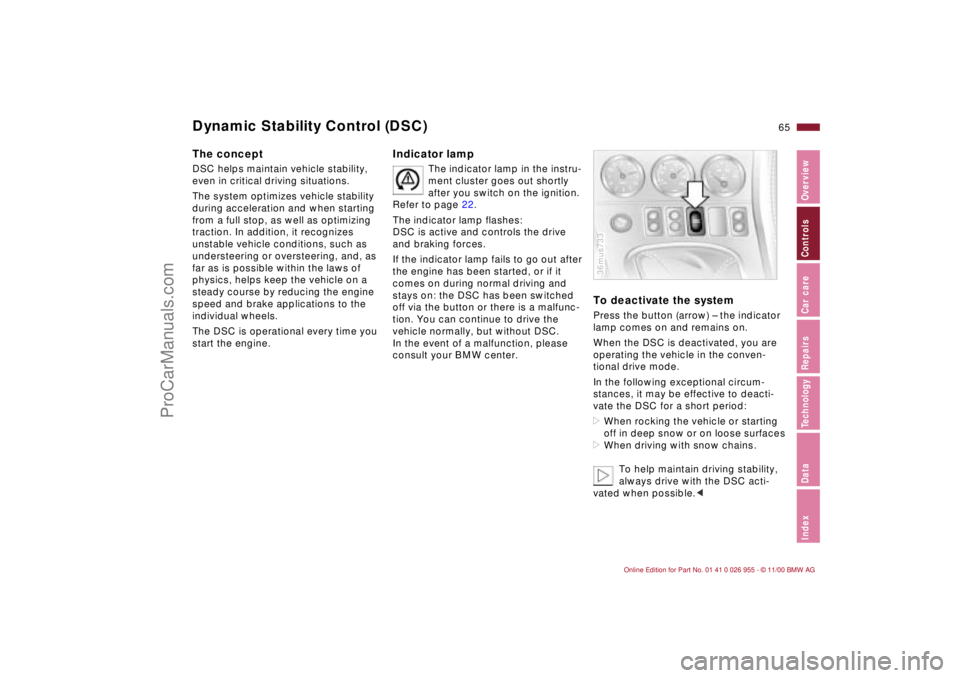
To deactivate the systemPress the button (arrow) – the indicator
lamp comes on and remains on.
When the DSC is deactivated, you are
operating the vehicle in the conven-
tional drive mode.
In the following exceptional circum-
stances, it may be effective to deacti-
vate the DSC for a short period:
>When rocking the vehicle or starting
off in deep snow or on loose surfaces
>When driving with snow chains.
To help maintain driving stability,
always drive with the DSC acti-
vated when possible.< 36mus733
Dynamic Stability Control (DSC)
ProCarManuals.com
Page 68 of 171
68n
Tire Pressure Warning (RDW)Activating/deactivating the
systemThe system is automatically active in
ignition key position 2 and is therefore
always on during driving.
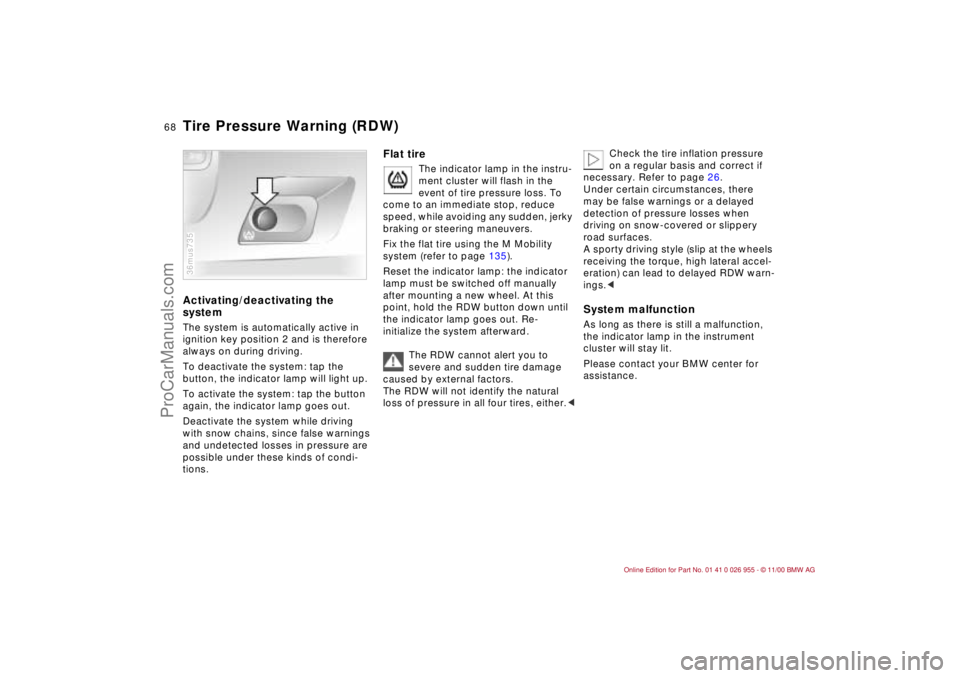
To deactivate the system: tap the
button, the indicator lamp will light up.
To activate the system: tap the button
again, the indicator lamp goes out.
Deactivate the system while driving
with snow chains, since false warnings
and undetected losses in pressure are
possible under these kinds of condi-
tions. 36mus735
Flat tire
The indicator lamp in the instru-
ment cluster will flash in the
event of tire pressure loss. To
come to an immediate stop, reduce
speed, while avoiding any sudden, jerky
braking or steering maneuvers.
Fix the flat tire using the M Mobility
system (refer to page 135).
Reset the indicator lamp: the indicator
lamp must be switched off manually
after mounting a new wheel. At this
point, hold the RDW button down until
the indicator lamp goes out. Re-
initialize the system afterward.
The RDW cannot alert you to
severe and sudden tire damage
caused by external factors.
The RDW will not identify the natural
loss of pressure in all four tires, either.<
Check the tire inflation pressure
on a regular basis and correct if
necessary. Refer to page 26.
Under certain circumstances, there
may be false warnings or a delayed
detection of pressure losses when
driving on snow-covered or slippery
road surfaces.
A sporty driving style (slip at the wheels
receiving the torque, high lateral accel-
eration) can lead to delayed RDW warn-
ings.<
System malfunctionAs long as there is still a malfunction,
the indicator lamp in the instrument
cluster will stay lit.
Please contact your BMW center for
assistance.
ProCarManuals.com
Page 83 of 171
83n
IndexDataTechnologyRepairsCar careControlsOverview
Roof-mounted luggage rackA special luggage system is available
for your coupe as an optional acces-
sory. Please comply with the precau-
tions included with the installation
instructions.
Because roof racks raise the center of
gravity of the vehicle when loaded, they
exercise a major effect on its handling
and steering response.
You should therefore always remember
not to exceed the approved roof load
capacity, the approved gross vehicle
weight or the axle loads when loading
the rack. You will find the specifications
for this under "Technical Data" on
page 158.
Make sure that the load is not too large
in size, and distribute it evenly. Always
load the heaviest pieces first (on the
bottom). Be sure that adequate clear-
ance is maintained for raising the
sunroof, and that objects do not project
into the opening path of the luggage
compartment lid.
Lash the roof luggage down correctly
and securely to prevent it from shifting
or being lost during driving – this would
endanger following traffic.Drive smoothly and avoid sudden
acceleration or braking. Do not corner
at high speeds.
The roof load increases the aerody-
namic resistance. Increased fuel
consumption results from this.
ProCarManuals.com
Page 85 of 171
Overview
Controls and features
Operation, care
and maintenance
Owner service procedures
Technical data
Index Advanced technology
85n
IndexDataTechnologyRepairsCar careControlsOverview
Special operating instructions:
Break-in procedure86
Driving notes87
Catalytic converter88
Antilock Brake System (ABS)89
Disc brakes91
Brake system92
Winter operation93
Power steering94
Cellular phone95
Radio reception95
Hardtop – roadster96
Wheels and tires:
Notes on tire inflation
pressure98
Tire condition98
Tire replacement99
Tire rotation100
Wheel and tire
combinations101
Special features of winter
tires102
Snow chains102
Approved wheel and tire
specifications103Under the hood:
Hood104
Engine compartment106
Fluids for the washer
systems108
Washer nozzles108
Engine oil109
Coolant111
Brake fluid112
Vehicle Identification
Number113
Care and maintenance:
The BMW Maintenance
System114
Caring for your vehicle115
Airbags122
Storing your vehicle123
Laws and regulations:
Technical modifications124
California Proposition
65 Warning124
OBD connector125
Car care
ProCarManuals.com
Page 87 of 171
87n
IndexDataTechnologyRepairsCar careControlsOverview
Driving notes
Brakes:
Do not drive with your foot resting
on the brake pedal. Even light but
consistent pedal pressure can lead to
high temperatures, brake wear and
possibly even brake failure.
Aquaplaning:
When driving on wet or slushy roads,
reduce vehicle speed. If you do not, a
wedge of water may form between the
tires and the road surface. This
phenomenon is referred to as aqua-
planing or hydroplaning. It is character-
ized by a partial or complete loss of
contact between the tires and the road
surface. The ultimate results are loss of
steering and braking control.
Driving through water:
When there is water on the roads, do
not drive in it if it is deeper than 1 ft
(30 cm). If the water is at that depth,
drive only at walking speed, otherwise
the vehicle can sustain damage to the
engine, the electrical systems and the
transmission.
Roll-up cover (coupe):
Never use the roll-up cover to store
heavy or bulky objects. If you do so,
such objects could injure vehicle occu-
pants during braking and evasive
maneuvers or in a crash.
Clothes hook (coupe):
Hang items of clothing on the hooks in
such a manner that they do not obstruct
the driver's vision. Do not hang heavy
objects on the hooks. If you do so, they
could cause personal injury during
braking and evasive maneuvers or in
a crash, for example.<
ProCarManuals.com
Page 89 of 171
89n
IndexDataTechnologyRepairsCar careControlsOverview
Antilock Brake System (ABS)The conceptABS increases active safety by
preventing the wheels from locking
when braking. The reason: locked
wheels are dangerous. When the front
wheels slide, the driver loses steering
control over the vehicle. Traction loss at
the rear wheels can cause the rear end
to break into an uncontrolled skid.
The system can achieve the shortest
braking distances possible under most
conditions (on straight-aways, in curves
and on various road surfaces.).
ABS is designed to meet two essential
requirements during every brake appli-
cation:
>To help provide vehicle stability.
>Assured ability to steer and maneuver
on the various road surfaces (asphalt,
concrete, dirt, wet conditions, snow
and ice).
Braking with ABSThe system is operative once the
vehicle exceeds a speed of approx.
6 mph (10 km/h). It is inactive once
again below approx. 4 mph (6 km/h).
Therefore, the wheels could theoreti-
cally tend to lock in the final phase of a
braking action, but this is insignificant in
actual practice.
If you are in a situation which requires
full braking, you will exploit the full
benefits of the ABS system if you apply
maximum brake pressure ("panic stop").
Since the vehicle maintains steering
responsiveness, you can avoid possible
obstacles with a minimum of steering
effort, despite the full brake application.The ABS closed-loop control circuit
cycles in fractions of a second. The
pulsation at the brake pedal, together
with sounds generated by the hydraulic
control system, indicate to you that the
vehicle is approaching its maximum
braking range. It is a reminder to you
that you must adapt the vehicle's road
speed to existing road conditions.
On road surfaces that have a loose
surface layer on a firm base with good
traction (on gravel, deep sand or snow,
for example), braking distances may be
longer than with locked wheels. This
also applies for driving with snow
chains. However, ABS continues to
provide enhanced vehicle stability and
steering response under these condi-
tions.
ProCarManuals.com
Page 90 of 171
90n
Antilock Brake System (ABS)Information for your safetyNot even ABS can suspend the laws
of physics. ABS alone cannot prevent
accidents if the brakes are applied
without an adequate, safe distance
between vehicles or if the speed limit
has been exceeded. Nor can it prevent
the hazards of aquaplaning. Responsi-
bility for these types of situations
remains in the hands (and at the feet) of
the driver. You should never allow the
added safety of ABS to lull you into a
false sense of security, or mislead you
into taking increased risks that could
affect your own safety and that of
others.
Do not make any modifications to
the ABS system.
Service procedures on ABS are to be
performed by authorized technicians
only.< Antilock Brake System (ABS)/
Cornering Brake Control (CBC)CBC is an advanced engineering
feature of the ABS. When braking while
cornering at high speed or braking
during high lateral acceleration, or
when braking during a lane change,
vehicle stability is improved and
steering response is enhanced.
In the event of a malfunction
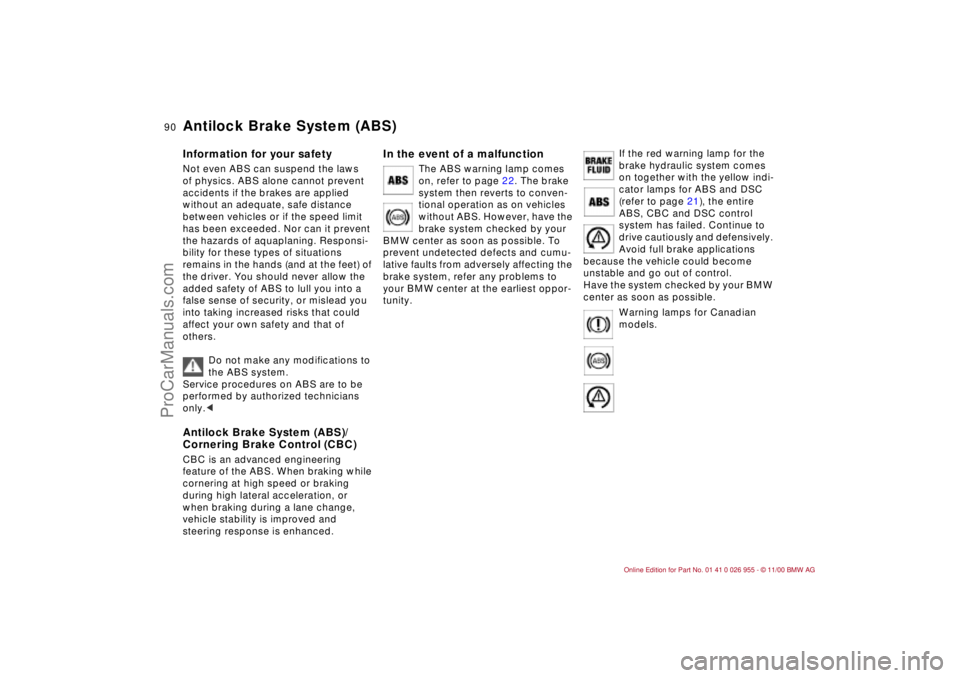
The ABS warning lamp comes
on, refer to page 22. The brake
system then reverts to conven-
tional operation as on vehicles
without ABS. However, have the
brake system checked by your
BMW center as soon as possible. To
prevent undetected defects and cumu-
lative faults from adversely affecting the
brake system, refer any problems to
your BMW center at the earliest oppor-
tunity.
If the red warning lamp for the
brake hydraulic system comes
on together with the yellow indi-
cator lamps for ABS and DSC
(refer to page 21), the entire
ABS, CBC and DSC control
system has failed. Continue to
drive cautiously and defensively.
Avoid full brake applications
because the vehicle could become
unstable and go out of control.
Have the system checked by your BMW
center as soon as possible.
Warning lamps for Canadian
models.
ProCarManuals.com
Page 91 of 171
91n
IndexDataTechnologyRepairsCar careControlsOverview
Disc brakesDisc brakes furnish optimum decelera-
tion and braking control and greater
fade resistance under heavy use.
When the vehicle is driven only occa-
sionally, during extended periods when
the vehicle is not used at all, or in oper-
ating conditions where brake applica-
tions are less frequent, there is an
increased tendency for corrosion of the
discs and accumulation of contamina-
tion on the brake pads. This occurs
because the minimal pressure which
must be exerted by the pads to clean
the discs by brake applications is not
reached.
If the brake discs are corroded, they will
tend to respond to braking with a
pulsating effect which even extended
application will fail to cure.
For your own safety: use only
brake pads that BMW has
approved for your specific vehicle
model. BMW cannot evaluate non-
approved brake pads to determine if
they are suited for use, and therefore
cannot ensure the operating safety of
the vehicle in the event of their use.<
Driving notesWhile driving in wet conditions and in
heavy rain, it is advisable to apply light
pressure to the brake pedal every few
miles – watch traffic conditions to
ensure that this maneuver does not
endanger other road users. The heat
generated in this braking process helps
dry the brake pads and discs.
Maximum braking force is obtained
while the wheels continue to rotate,
peaking when the wheels remain on the
verge of locking without actually doing
so. ABS maintains this state automati-
cally. If the ABS fails, you should revert
to the staggered braking technique
described on page 94.
Extended or steep mountain descents
should be driven in the gear in which
only minimal periodic brake application
is required. This avoids excessive strain
on the brakes and possible impairment
of the braking effect.
You can increase the engine's braking
effect by selecting progressively lower
gears, downshifting into first gear, if
necessary. Should engine braking prove inade-
quate, you should still avoid extended,
continuous braking. Instead, decelerate
the vehicle with increased pressure on
the brake pedal (watch for following
traffic!), release the pedal and then
repeat the brake application (staggered
braking). This staggered braking tech-
nique allows the brakes to cool in the
intervals between active braking
phases, preventing overheating and
ensuring that full braking capacity
remains available at all times.
Do not drive the vehicle with the
clutch depressed, with the shift
lever in neutral or with the engine shut
off. The engine provides no braking
control when the transmission is in
neutral and there is no power assist for
braking and steering when the engine is
shut off.
Never allow floor mats, carpets or any
other objects to protrude into the area
around the accelerator, clutch and
brake pedals and obstruct their move-
ment.<
ProCarManuals.com