2001 BMW 330Ci CONVERTIBLE dsc
[x] Cancel search: dscPage 10 of 215

Contents
Overview
Controls and features
Cockpit16
Instrument cluster18
Indicator and warning lamps20
Multifunction steering wheel
(MFL)24
Hazard warning flashers25
Warning triangle25
First-aid kit25
Refueling26
Fuel specifications27
Tire inflation pressure27
Opening and closing:
Keys32
Electronic vehicle
immobilizer33
Central locking system34
Opening and closing Ð from the
outside34
Opening and closing Ð from the
inside38
Luggage compartment lid39
Luggage compartment40
Alarm system42
Electric power windows44
The manual convertible top45
The fully automatic convertible
top48
Wind deflector50
Adjusting:
Seats52
Seat and mirror memory56
Steering wheel57
Mirrors57
Car Memory, Key Memory59
Passenger safety systems:
Safety belts60
Airbags61
Transporting children safely64
Rollover protection system67
Driving:
Steering/Ignition lock69
Starting the engine69
Switching off the engine70
Parking brake71
Manual transmission72
Automatic transmission with
Steptronic73
Turn signal indicator/Headlamp
flasher76
Washer/Wiper system76
Rear window defroster78
Cruise control79
Everything under control:
Odometer81
Tachometer81
Energy Control81
Fuel temperature gauge82
Coolant temperature gauge82
Service Interval Display82
Check Control83
Computer83
Technology for driving comfort
and safety:
Park Distance Control (PDC)87
Automatic Stability Control plus
Traction (ASC+T)88
Dynamic Stability Control
(DSC)89
Tire Pressure Control (RDC)91
Contents
Page 12 of 215

Contents
Repairs
Advanced technology
Technical data
Replacement procedures:
Onboard tool kit166
Windshield wiper blades166
Lamps and bulbs166
Changing a wheel173
Battery176
Fuses179
Microfilter/Activated-charcoal
filter180
In case of electrical
malfunction:
Fuel filler door180
Convertible top181
Assistance, giving and
receiving:
Jump-starting183
Towing the vehicle184Adaptive Transmission Control
(ATC)188
Airbags189
Automatic Stability Control plus
Traction (ASC+T)/Dynamic
Stability Control (DSC)189
Radio reception190
Safety belt tensioner190
Interior rearview mirror with
automatic dimming
feature191
Rain sensor191
Tire Pressure Control (RDC)192
Self-diagnostics192
Rollover protection system193
Xenon lamps193Engine data196
Dimensions197
Weights198
Capacities199
Electrical system200
Drive belts200
Page 19 of 215

19n
IndexDataTechnologyRepairsCar careControlsOverview
Instrument cluster
1 Fuel gauge with indicator lamp
for fuel reserve82
2 Turn signal indicator23
3 Speedometer
4 Indicator lamp for:
>
Battery charge current20
>
High beams23
>
Engine oil pressure/Engine oil
level20, 22
5 Tachometer and
Energy control81
6 Engine coolant temperature gauge
with "Coolant temperature too high"
indicator82
7 Indicator and warning lamps (clock-
wise) for:
>
Parking brake/Brake hydraulic
system/Cornering Brake Control
(CBC)/DBC20
>
Antilock Brake System (ABS)22
>
Brake pads22
>
Tire Pressure Control
(RDC)
*
20, 22
>
Rollover protection system67
>
Airbags21
>
Adjust and lock backrest/Please
fasten safety belts21
>
Cruise control23
8 Set button for the clock849 Program display for automatic
transmission
*
75
Indicator lamp for automatic
transmission
*
21, 75
10 Indicator lamp for Automatic
Stability Control plus Traction
(ASC+T)/Dynamic Stability Control
(DSC)
*
and ADB22
11 Indicator for:
>
Odometer81
>
Trip odometer81
>
Clock84
>
Service Interval82
Indicator for computer,
operation using the turn signal lever,
refer to page 83:
>
Clock
>
Outside temperature
>
Average fuel consumption
>
Range
>
Average speed
12 Indicator for Check Control83
13 Trip odometer, reset to zero8114 Indicator and warning lamps (clock-
wise) for:
>
Front fog lamps23
>
Add washer fluid22
>
Coolant level23
>
Electronic Throttle Control
(EML)
*
23
>
Service engine soon22
You can display the outside
temperature and distance driven
in different units of measurement.
<
Page 21 of 215

21n
IndexDataTechnologyRepairsCar careControlsOverview
Indicator and warning lampsRed and yellow: continue driving
cautiously
The brake warning lamp and the
yellow indicator lamps for ABS
and ASC+T/DSC both light up:
The entire ABS, CBC, ASC+T/
DSC
and
ADB/DBC system has
failed. Continue driving
cautiously and defensively.
Avoid hard brake applications.
Please have the system checked by
your BMW center as soon as possible.
For additional information, refer to
pages 88, 123.
CBC, ABS, ASC+T/DSC
indi-
cator and warning lamps for
Canadian models.
Red: an important reminder
Parking brake
Comes on when the parking
brake is applied Ð an acoustic
signal also sounds when starting off.
For additional information, refer to
page 71. Parking brake warning lamp for
Canadian models.
Adjust and lock backrest/Please
fasten safety belts l
A warning signal will sound at
the same time. Flashes, if the backrest
is not locked. Lights up until the safety
belt is fastened.
For additional information on safety
belts, refer to page 60.
Airbags l
Please have the system
inspected by your BMW center.
For additional information, refer to
pages 61, 189.
Orange: consult the nearest BMW
center
Automatic transmission
Because of a malfunction, the
automatic transmission shifts
only in the emergency program. Please
consult the nearest BMW center.
For additional information, refer to
page 75.
Page 22 of 215

22n
Indicator and warning lampsYellow: check as soon as possible
Antilock Brake System (ABS) l
ABS has been deactivated in
response to system malfunction.
Conventional braking efficiency is avail-
able without limitations. Please have
the system inspected by your BMW
center.
For additional information, refer to
page 123.
ABS warning lamp for Canadian
models.
Engine oil level
Lights up while driving:
The oil level is at the absolute
minimum; therefore, add engine oil as
soon as possible. Do not drive more
than 30 miles (50 km) until you do.
For additional information, refer to
page 145.
Engine oil level
Comes on after the engine has
been shut off: add oil at the
earliest opportunity (when you stop to
refuel).
For additional information, refer to
page 145.
Brake pads l
Have the brake pads checked.
For additional information, refer
to page 126.
Tire Pressure Control (RDC) l
Check tire inflation pressure:
refer to pages 27, 91.
Automatic Stability Control
plus Traction (ASC+T)/Dynamic
Stability Control (DSC l
Indicator lamp flashes:
The system is active and governs drive
force and braking force.
The indicator lamp remains on:
ASC+T has been switched off via the
button or it is defective, or the DSC has
been switched off, ADB is operational.
Please consult the nearest BMW center
in the event of a fault.
For additional information, refer to
page 88.
Automatic Stability Control plus
Traction (ASC+T)/Dynamic
Stability Control (DSC) and
brake warning lamp l
The indicator lamps remain on:
DSC
and ADB/DBC are
switched off via the button or are defec-
tive.
Please consult the nearest BMW
center.
For additional information, refer to
page 88.
DSC and ADB/DBC indicator
and warning lamps for Canadian
models.
Add washer fluid.
The washer fluid is too low. Top
up the fluid at the earliest
opportunity.
For additional information, refer to
page 144.
Service Engine Soon l
If the indicator lamp comes on
either continuously or intermit-
tently, this indicates a fault in the emis-
sions-related electronic systems.
Although the vehicle remains opera-
tional, you should have the systems
inspected by your BMW center at the
earliest possible opportunity.
For additional information, refer to
page 162.
Service Engine Soon warning
lamp for Canadian models.
Page 31 of 215

Overview
Controls and features
Operation, care
and maintenance
Owner service procedures
Technical data
Index Advanced technology
31n
IndexDataTechnologyRepairsCar careControlsOverview
Driving:
Steering/Ignition lock69
Starting the engine69
Switching off the engine70
Parking brake71
Manual transmission72
Automatic transmission with
Steptronic73
Turn signal indicator/Headlamp
flasher76
Washer/Wiper system76
Rear window defroster78
Cruise control79
Everything under control:
Odometer81
Tachometer81
Energy Control81
Fuel gauge82
Coolant temperature gauge82
Service Interval Display82
Check Control83
Computer83
Technology for driving comfort
and safety:
Park Distance Control (PDC)87
Automatic Stability Control plus
traction (ASC+T)88
Dynamic Stability Control
(DSC)89
Tire Pressure Control (RDC)91Lamps:
Side lamps/Low beams93
Instrument panel lighting93
High beams/Parking lamps94
Fog lamps94
Interior lamps94
Controlling the climate
for pleasant driving:
Air conditioner96
Automatic climate control102
Seat heating107
Interior convenience:
Glove compartment107
BMW Universal Transmitter108
Storage facilities110
Cellular phone111
Ashtray, front111
Cigarette lighter112
Ashtray rear112
Loading and transporting:
Ski bag113
Cargo loading114
Roof-mounted luggage rack for
hardtop116
Page 88 of 215
88n
ASC+TThe conceptThese systems enhance driving stability
and traction, especially when you are
just starting off, accelerating or in
curves.
ASC+T recognizes the danger present
in traction loss and will increase driving
stability and traction by reducing the
engine's output, and if necessary, by
applying the brakes to the rear wheels.
ASC+T is available as soon as the
engine starts up.
Indicator lamp
The indicator lamp in the instru-
ment cluster goes out shortly
after you switch on the ignition.
Refer to pages 21 and 22.
Indicator lamp flashes:
ASC+T controls the drive and braking
forces.
If the indicator lamp fails to go out after
the engine is started, or if it comes on
during normal driving and stays on:
There is a system malfunction or the
system was deactivated with the
button. Consequently, interventions to
increase driving stability (as described
in the preceding column) are not avail-
able. You can still drive the vehicle
normally without ASC+T.
Please consult your BMW center in the
event of a malfunction. Refer to
pages 21 and 22.
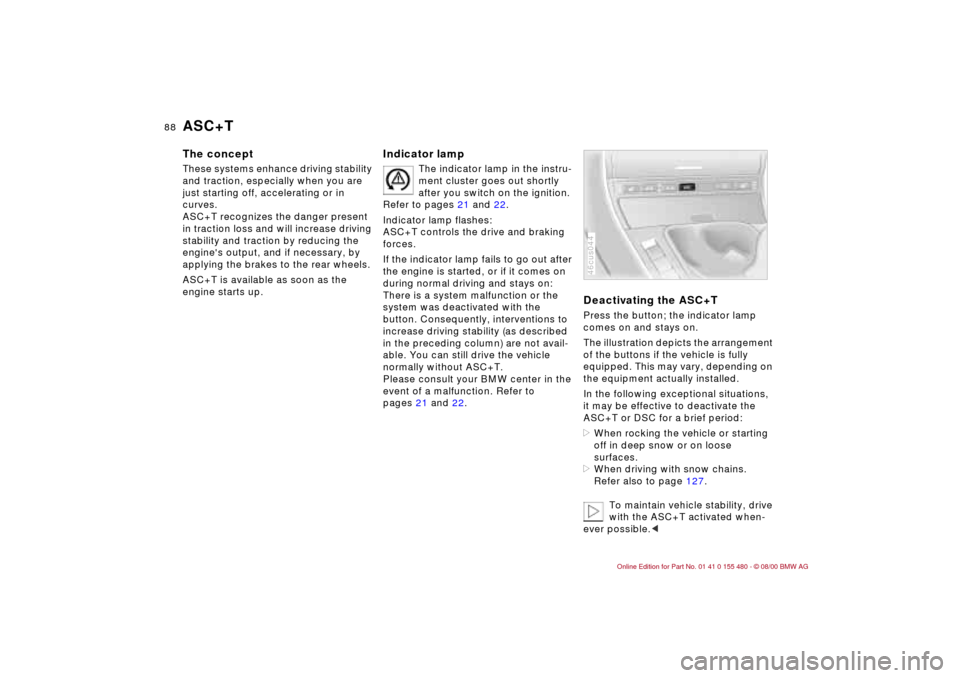
Deactivating the ASC+T Press the button; the indicator lamp
comes on and stays on.
The illustration depicts the arrangement
of the buttons if the vehicle is fully
equipped. This may vary, depending on
the equipment actually installed.
In the following exceptional situations,
it may be effective to deactivate the
ASC+T or DSC for a brief period:
>When rocking the vehicle or starting
off in deep snow or on loose
surfaces.
>When driving with snow chains.
Refer also to page 127.
To maintain vehicle stability, drive
with the ASC+T activated when-
ever possible.<46cus044
Page 89 of 215

89n
IndexDataTechnologyRepairsCar careControlsOverview
ASC+T DSC*Reactivating ASC+TPress the button again; the indicator
lamp goes out.
The laws of physics cannot be
repealed, even with ASC+T. It will
always be the driver's responsibility to
drive in a manner that matches road
conditions. This is why you should not
use the additional safety margin the
system provides as an excuse to take
risks.<
For additional details concerning
ASC+T, please refer to the chapter
"Advanced Technology" on page 189.
The conceptDSC maintains vehicle stability, even in
critical driving situations.
The system optimizes vehicle stability
during acceleration and when starting
from a full stop, as well as optimizing
traction. In addition, it recognizes
unstable vehicle conditions, such as
understeering or oversteering, and, as
far as is possible within the laws of
physics, helps keeping the car on a
steady course by reducing the RPMs
and brake applications to the individual
wheels.
The DSC is operational every time you
start the engine. DSC includes the
functions of ADB and CBC, refer to
page 123.
The ADB (Automatic Differential
Braking) copies the function of conven-
tional differential and transverse lock
through brake intervention, and
increases traction whenever conditions
merit, e. g. when driving on snow-
covered roads.
If the DSC is switched off the ADB will
still be in ready mode.
Indicator lamp
The indicator lamp in the instru-
ment cluster goes out shortly
after you switch on the ignition.
Refer to page 21, 22.
Indicator lamp flashes:
DSC controls the drive and braking
forces.
The indicator lamp stays lit:
DSC has been switched off via the
button; ADB is operational.
ADB control intervention is not indi-
cated.
The indicator and the brake
warning lamps will remain on
the continuously:
The DSC, ADB and DBC have
been switched off via the button
or are defective.
The vehicle will remain completely
operational, however, without DSC. In
the event of a fault, please see your
BMW center. Refer to page 21, 22.
Indicator and warning lamps for
Canadian models.