2001 BMW 330Ci CONVERTIBLE dsc
[x] Cancel search: dscPage 90 of 215

90n
DSC*Switch DSC off/activate ADBPress the DSC button briefly; the indi-
cator lamp comes on and stays on.
DSC has been switched; ADB is opera-
tional.
In the following exceptional circum-
stances, it may be effective to deacti-
vate the ADB for a short period:
>When rocking the vehicle or starting
off in deep snow or on loose
surfaces.
>When driving on snow-covered
grades, in deep snow, or on a snow-
covered surface that has been
packed down from being driven on
>When driving with snow chains.
Refer also to page 128.
The gain in traction is achieved by a
reduction in stabilizing intervention.46cus045
Switch DSC and ADB off>Hold the DSC switch down for at
least 3 seconds. The indicator lamp
and the yellow brake warning lamps
will remain on continuously.
In this case, no interventions to
increase stability and traction for engine
and brakes are carried out.
To maintain vehicle stability,
always drive with DSC switched
on as often as possible.<
Switch DSC and ADB on againPress the button again; the indicator
lamp or the indicator lamps will go out.
The laws of physics cannot be
repealed, even with DSC. It will
always be the driver's responsibility to
drive in a manner that matches road
conditions. We therefore urge you to
avoid using the additional safety margin
of the system as an excuse for taking
risks.
The DSC will not carry out any stabi-
lizing intervention when the ADB is in
ready mode.
Do not make any modifications to the
DSC system. Allow only authorized
technicians to perform service proce-
dures on the DSC.<
For additional details concerning DSC,
please refer to the chapter "Advanced
technology" on page 189.
Page 123 of 215
123n
IndexDataTechnologyRepairsCar careControlsOverview
Antilock Brake System (ABS)Antilock Brake System (ABS)/
Cornering Brake Control (CBC) CBC is an advanced engineering
design of the ABS. When braking while
cornering at high speed or braking
during high lateral acceleration, or
when braking during a lane change,
vehicle stability is improved and
steering response is enhanced.
In the event of a malfunction
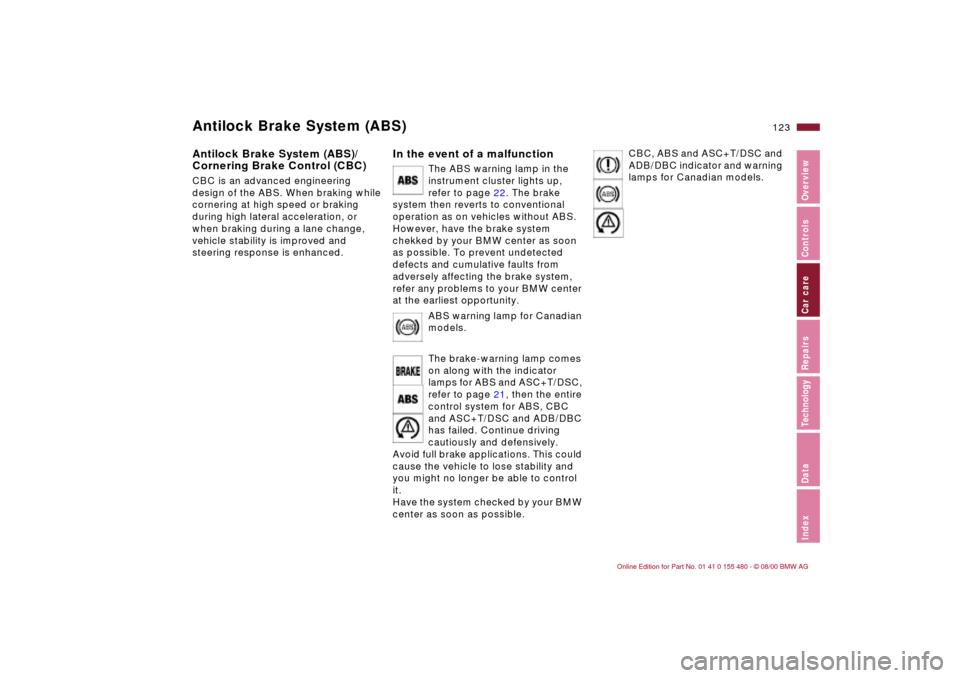
The ABS warning lamp in the
instrument cluster lights up,
refer to page 22. The brake
system then reverts to conventional
operation as on vehicles without ABS.
However, have the brake system
chekked by your BMW center as soon
as possible. To prevent undetected
defects and cumulative faults from
adversely affecting the brake system,
refer any problems to your BMW center
at the earliest opportunity.
ABS warning lamp for Canadian
models.
The brake-warning lamp comes
on along with the indicator
lamps for ABS and ASC+T/DSC,
refer to page 21, then the entire
control system for ABS, CBC
and ASC+T/DSC and ADB/DBC
has failed. Continue driving
cautiously and defensively.
Avoid full brake applications. This could
cause the vehicle to lose stability and
you might no longer be able to control
it.
Have the system checked by your BMW
center as soon as possible.
CBC, ABS and ASC+T/DSC and
ADB/DBC indicator and warning
lamps for Canadian models.
Page 124 of 215

124n
Antilock Brake System (ABS)Dynamic Brake Control (DBC)*DBC is included in the DSC, refer to
information beginning on page 89.
If you step on the brake rapidly, this
system automatically produces
maximum braking force boost and thus
helps to achieve the shortest possible
braking distance during "panic stops."
All of the benefits of the ABS system
are exploited under these circum-
stances.
Do not reduce the pressure on the
brake pedal for the duration of the
brake application. When the brake
pedal is released, the DBC is deacti-
vated.
In the event of a malfunction,
the brake warning lamp lights up
yellow. Normal braking effi-
ciency and ABS are still fully available.
Have the system checked and repaired
at your BMW center as soon as
possible.
Please observe the section "Infor-
mation for your safety" concerning
the ABS system, which also applies to
the DSC system.<
Page 127 of 215

127n
IndexDataTechnologyRepairsCar careControlsOverview
Winter operationThe onset of winter is often accompa-
nied by rapid changes in weather.
Adaptations in driving style should be
accompanied by preparations on the
vehicle itself to ensure that your
progress through the winter remains
safe and trouble-free.CoolantBe sure that the coolant mixture
contains the year-round ratio of 50:50
water and extended-duty antifreeze/
corrosion protection. This mixture
provides protection against freezing
down to approx. Ð34 7 (Ð37 6).
Replace the coolant every four years.LocksBMW door lock deicer can be used to
free them if frozen. This deicer also
contains lubricant.
After using the deicer, we recommend
you treat the door lock with BMW lock
cylinder lubricant.
Rubber seals and components To prevent the weather-stripping from
freezing, apply a spray-on rubber treat-
ment or silicone spray to the door, hood
and luggage compartment lid seals.
A full range of car care products is
available from your BMW center.
BMW snow chains can be mounted on
both summer and winter tires. Mount
them in pairs on the rear wheels only
and comply with the manufacturer's
safety precautions. Do not exceed a
maximum speed of 30 mph (50 km/h).
In this rare situation, it may be effective
to deactivate the ASC+T/DSC for a
brief period of time. Refer to page 88.
Starting offWhen starting up from a full stop in
deep snow or when "rocking" the
vehicle to free it, it may be effective to
deactivate the ASC+T/DSC system for
a brief period of time. Refer to page 88.Driving on low-traction road
surfacesUse smooth, gentle pressure to control
the accelerator pedal. Avoid excessive
engine speeds and shift to the next
higher gear at an early point. On down-
hill grades or slopes, shift down to the
next lower gear at an early point. Main-
tain an adequate distance between
yourself and the vehicle ahead.
Page 135 of 215

135n
IndexDataTechnologyRepairsCar careControlsOverview
Wheel and tire combinations The right choice Use only BMW-approved tires, begin-
ning on page 137.
Due to the high speeds this vehicle can
reach, the use of specific brands,
specifications and sizes is mandatory.
Consult any BMW center for details.
Comply with local/national regulations.
The correct wheel/tire combina-
tion has an effect on the different
systems such as ABS, ATC, ASC+T/
DSC
and ADB/DBC whose functioning
would be otherwise impaired if the
incorrect wheel/tire combinations were
used.
For this reason, use only tires of the
same manufacture and tread configura-
tion. In the event of a flat tire, for
example, remount the approved wheel/
tire combination as soon as possible.<
Codes on the tires and wheels The tire codes will aid you in selecting
the correct tire.
The codes on radial tires:
The speed rating indicates the approved
maximum speed for the tire.
Summer tires:
S = up to112 mph (180 km/h)
T = up to 118 mph (190 km/h)
H = up to 130 mph (210 km/h)
V = up to 150 mph (240 km/h)
W = up to 167 mph (270 km/h)
Y = up to 187 mph (300 km/h)
ZR = over 150 mph (240 km/h) Example:
Nominal width
in mm
Aspect ratio in X
Radial tire ID code
Rim diameter in inches
Load rating
(not on ZR tires)
Speed rating
(before R on ZR tires)
225/50 R
1692W
Winter tires and all-season tires:
Q M+S = up to 100 mph (160 km/h)
T M+S = up to 118 mph (190 km/h)
H M+S = up to 130 mph (210 km/h)
Codes stamped on light-alloy wheels:
Protect tire valve from dirt by using
screw-on valve stem caps. Dirt in the
valves frequently leads to slow leaks. Example:
Rim width
in inches
Code letter for
flange type
Symbol for full-drop
center rim
Rim diameter in inches
Hump on the 2 rim shoulders
7 x 16 H 2
J
Page 187 of 215

Overview
Controls and features
Operation, care
and maintenance
Owner service procedures
Technical data
Index Advanced technology
187n
IndexDataTechnologyRepairsCar careControlsOverview
Adaptive Transmission Control
(ATC)188
Airbags189
Automatic Stability Control plus
Traction (ASC+T)/Dynamic
Stability Control (DSC)189
Radio reception190
Safety belt tensioner190
Interior rearview mirror
with automatic dimming
feature191
Rain sensor191
Tire Pressure Control (RDC)192
Self-diagnostics192
Rollover protection system193
Xenon lamps193
Technol-
Page 189 of 215

189n
IndexDataTechnologyRepairsCar careControlsOverview
Deceleration sensors continuously
monitor the acceleration forces acting
upon the vehicle. If, as the result of a
frontal collision, a deceleration is
reached at which the protection of the
safety belts alone is no longer
adequate, the gas generators of the
driver and passenger-front airbags are
ignited. However, the passenger-side
airbag is only triggered if an additional
sensor has recognized that the
passenger seat is occupied.
In the event of a side collision, the side
airbags in the front and/or rear
* are
triggered if necessary.
390de012
The airbags located under the marked
covers inflate and unfold in a matter of
a few milliseconds. In this process, they
tear through the designed separation
points of the upholstered covers or
press them out.
Because the inflation process must be
virtually instantaneous, it is accompa-
nied by a certain amount of ignition and
inflation noise, which will be drowned
out by the noise from the accident
itself. The gas required to inflate the
airbags is not dangerous, and the
associated smoke then dissipates.
The entire process is completed within
fractions of a second.Highly sensitive sensors monitor the
number of revolutions of the wheels.
When equipped with DSC, they also
monitor steering angle, lateral accelera-
tion, brake pressure and the movement
of the vehicle around its vertical axis.
If differences in the wheel speeds
occur, ASC+T counteracts the danger
of wheelspin by reducing engine
torque; if necessary, ASC+T will also
respond by applying the brakes to the
rear wheels.
In addition, DSC permanently monitors
the vehicle's current operating condi-
tion and compares it with an ideal
condition that is calculated from the
sensor's signals. If deviations from this
occur (understeering or oversteering,
for instance), DSC can stabilize the
vehicle in fractions of a second by
reducing engine output and with the
assistance of braking intervention at
individual wheels. Dangerous skids are
thus prevented before they can even
start, and all of this is possible, of
course, only within physically possible
limits. You may need some time to
become accustomed to the system's
intervention. However, it provides
optimum drive force and vehicle
stability. The braking intervention may
be accompanied by sounds specific to
the system.
Airbags ASC+T/DSC
*
Page 205 of 215

Everything from A to Z
205n
IndexDataTechnologyRepairsCar careControlsOverview
upholstery155
vinyl upholstery154
wool velour155
Cargo
loading114
securing114
Caring for the vehicle's
finish153
Cassette operation, refer
also to the Radio Owner's
Manual
Catalytic converter121
CBC (Cornering Brake
Control)21,123
CD operation, refer also to
the Radio Owner's Manual
Cellular phone111,129
refer to also the separate
Owner's Manual
Center (high-mount) brake
lamp171
Center armrest110
Central locking system34
button38
Changing a tire173
Changing a wheel173
Check Control83
Child restraints64
Child restraint
systems61,64
Child seat security65
Child's seat61,64
Cigarette lighter112 Cleaning headlamps78
Cleaning windshield77
Clock84
Cockpit16
Code, refer to the radio
Owner's Manual
Coin box, cup holder111
Combination switch76
Compression196
Computer83
refer also to the separate
Owner's Manual
Configure settings59
Consumption85
Contents10
Convertible top45
cleaning and care157
closing following an
electrical malfunction181
compartment panel41
convenience operation34
electrical fault181
emergency closure181
Coolant127,147,199
antifreeze127
Cooling system199
Copyright4
Cornering Brake Control
(CBC)21,123
Cruise control79
Cruising range85
Curb weight198
Current check indicator20
D
Data
dimensions197
engine196
technical196
weights198
Daytime-driving lamp
switch93
DBC (Dynamic Brake
Control)124
Deep water121
Defrost setting100,105
Defrostable rear
window98,106
Defrosting the
windows100,105
Digital clock84
Dimensions197
Dipstick145
Disc brakes125
Displacement196
Display lighting93
Displays18
Disposal
batteries178
engine oil147
Distance warning87
Diversity Antenna190
Door key32
Door locks, care127 Doors
emergency operation34
remote control35
unlocking and locking34
DOT Quality Grades133
Draft-free
ventilation99,106
Drive belts200
Driving hints121
Driving in winter127
Driving lamps93
DSC (Dynamic Stability
Control)22,88,189
Dynamic Brake Control
(DBC)124
Dynamic Stability Control
(DSC)22,88,189
E
Electric power windows44
Electrical accessories,
failure179
Electrical system200
Electronic vehicle
immobilizer33
Elements of operation16
Emergency closure181
Emergency operation
convertible top181
doors34
fuel filler door180
Energy Control81