Page 187 of 211
187n
IndexDataTechnologyRepairsCar careControlsOverview
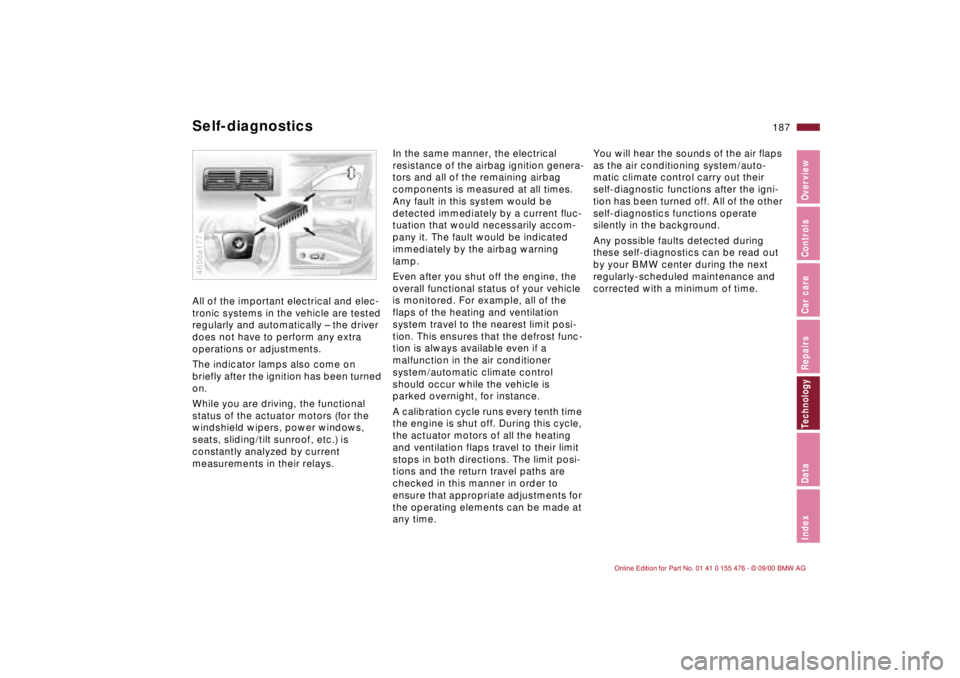
Self-diagnostics All of the important electrical and elec-
tronic systems in the vehicle are tested
regularly and automatically Ð the driver
does not have to perform any extra
operations or adjustments.
The indicator lamps also come on
briefly after the ignition has been turned
on.
While you are driving, the functional
status of the actuator motors (for the
windshield wipers, power windows,
seats, sliding/tilt sunroof, etc.) is
constantly analyzed by current
measurements in their relays.460de177
In the same manner, the electrical
resistance of the airbag ignition genera-
tors and all of the remaining airbag
components is measured at all times.
Any fault in this system would be
detected immediately by a current fluc-
tuation that would necessarily accom-
pany it. The fault would be indicated
immediately by the airbag warning
lamp.
Even after you shut off the engine, the
overall functional status of your vehicle
is monitored. For example, all of the
flaps of the heating and ventilation
system travel to the nearest limit posi-
tion. This ensures that the defrost func-
tion is always available even if a
malfunction in the air conditioner
system/automatic climate control
should occur while the vehicle is
parked overnight, for instance.
A calibration cycle runs every tenth time
the engine is shut off. During this cycle,
the actuator motors of all the heating
and ventilation flaps travel to their limit
stops in both directions. The limit posi-
tions and the return travel paths are
checked in this manner in order to
ensure that appropriate adjustments for
the operating elements can be made at
any time.You will hear the sounds of the air flaps
as the air conditioning system/auto-
matic climate control carry out their
self-diagnostic functions after the igni-
tion has been turned off. All of the other
self-diagnostics functions operate
silently in the background.
Any possible faults detected during
these self-diagnostics can be read out
by your BMW center during the next
regularly-scheduled maintenance and
corrected with a minimum of time.
Page 188 of 211
188n
Xenon lamps
*
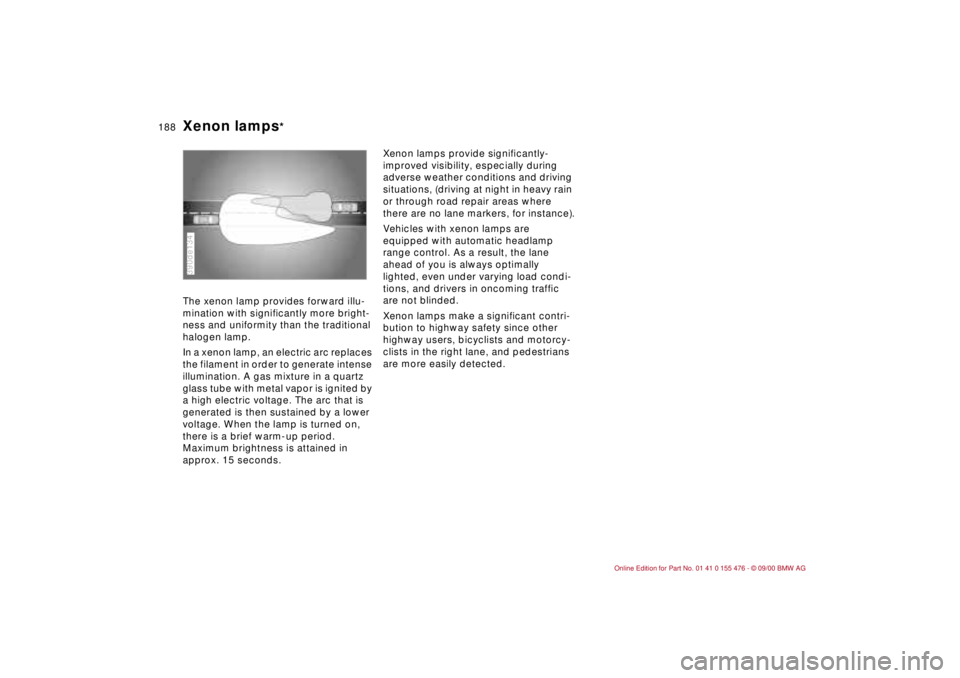
The xenon lamp provides forward illu-
mination with significantly more bright-
ness and uniformity than the traditional
halogen lamp.
In a xenon lamp, an electric arc replaces
the filament in order to generate intense
illumination. A gas mixture in a quartz
glass tube with metal vapor is ignited by
a high electric voltage. The arc that is
generated is then sustained by a lower
voltage. When the lamp is turned on,
there is a brief warm-up period.
Maximum brightness is attained in
approx. 15 seconds.390de134
Xenon lamps provide significantly-
improved visibility, especially during
adverse weather conditions and driving
situations, (driving at night in heavy rain
or through road repair areas where
there are no lane markers, for instance).
Vehicles with xenon lamps are
equipped with automatic headlamp
range control. As a result, the lane
ahead of you is always optimally
lighted, even under varying load condi-
tions, and drivers in oncoming traffic
are not blinded.
Xenon lamps make a significant contri-
bution to highway safety since other
highway users, bicyclists and motorcy-
clists in the right lane, and pedestrians
are more easily detected.
Page 189 of 211
189n
IndexDataTechnologyRepairsCar careControlsOverview
Page 191 of 211
Overview
Controls and features
Operation, care
and maintenance
Technical data
Index Advanced technology
191n
IndexDataTechnologyRepairsCar careControlsOverview
Engine data192
Dimensions193
Weights194
Capacities195
Electrical system196
V-belts196
Data
Owner service procedures
Page 193 of 211
193n
IndexDataTechnologyRepairsCar careControlsOverview
460us303
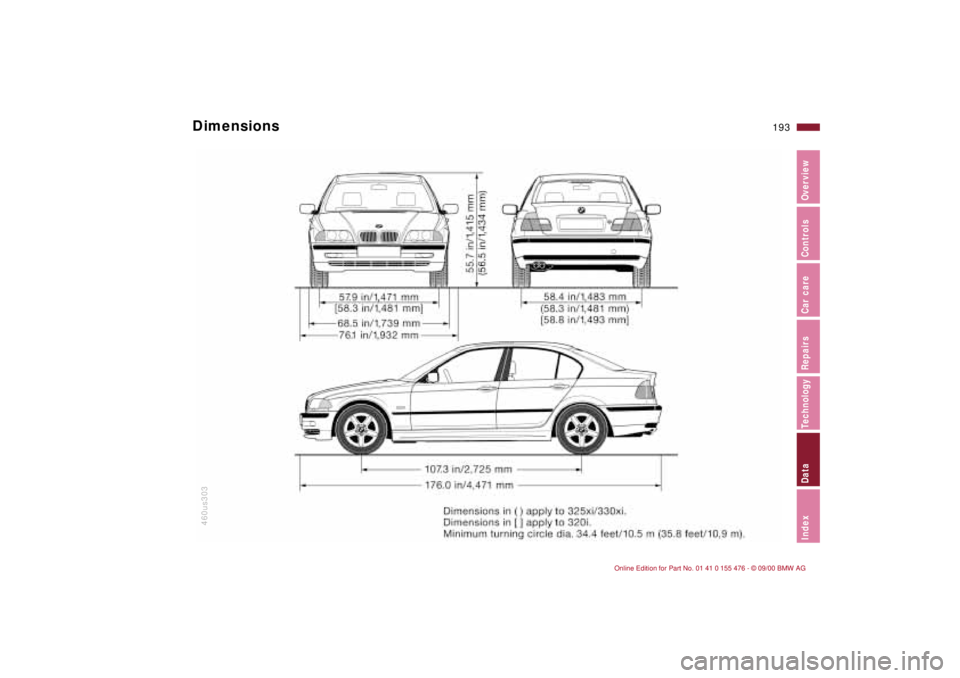
Dimensions
Page 195 of 211
195n
IndexDataTechnologyRepairsCar careControlsOverview
Capacities
Notes
Fuel tank
reserve gal. (liters)
gal. (liters)approx. 16.6 (approx. 63)
approx. 2.1 (approx. 8)Fuel specification: page 28
Windshield washer system/
Headlamp washer systemquarts (liters) approx. 5.6 (approx. 5.3) For details: page 138
Cooling system including heater circuit quarts (liters) approx. 8.9 (approx. 8.4) For details: page 142
Engine oil and filter change quarts (liters) 320i, 325i, 330i:
approx. 6.9 (approx. 6.5)
325xi, 330xi:
approx. 7.9 (approx. 7,5)BMW High Performance
Synthetic Oil
For details: page 140
Manual and automatic transmission, transfer
box and differentialÐ Lifetime fluid, no fluid change
required
Page 197 of 211
197n
IndexDataTechnologyRepairsCar careControlsOverview
Page 199 of 211
Overview
Controls and features
Operation, care
and maintenance
Owner service procedures
Technical data
Index Advanced technology
199n
IndexDataTechnologyRepairsCar careControlsOverview
Everything from A to Z200
Owner service procedures206
Index