2000 YAMAHA YZF600 light
[x] Cancel search: lightPage 59 of 109
PERIODIC MAINTENANCE AND MINOR REPAIR
6-9
6Installation
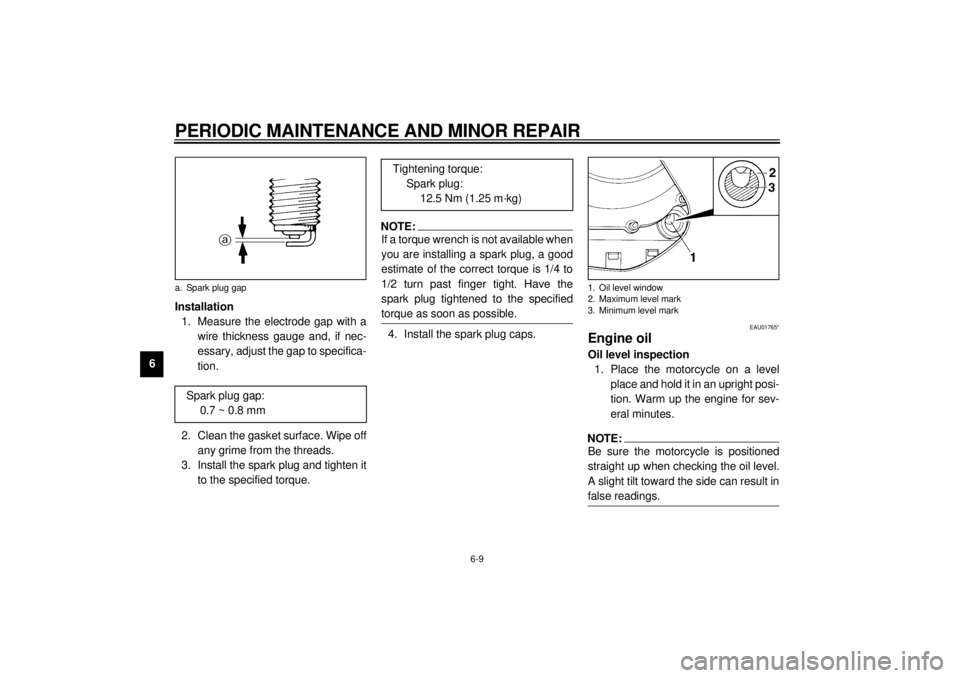
1. Measure the electrode gap with a
wire thickness gauge and, if nec-
essary, adjust the gap to specifica-
tion.
2. Clean the gasket surface. Wipe off
any grime from the threads.
3. Install the spark plug and tighten it
to the specified torque.
NOTE:@ If a torque wrench is not available when
you are installing a spark plug, a good
estimate of the correct torque is 1/4 to
1/2 turn past finger tight. Have the
spark plug tightened to the specified
torque as soon as possible. @4. Install the spark plug caps.
EAU01765*
Engine oilOil level inspection
1. Place the motorcycle on a level
place and hold it in an upright posi-
tion. Warm up the engine for sev-
eral minutes.NOTE:@ Be sure the motorcycle is positioned
straight up when checking the oil level.
A slight tilt toward the side can result in
false readings. @
a. Spark plug gap
Spark plug gap:
0.7 ~ 0.8 mm
Tightening torque:
Spark plug:
12.5 Nm (1.25 m·kg)
1. Oil level window
2. Maximum level mark
3. Minimum level mark
E_4tv_Periodic.fm Page 9 Wednesday, September 1, 1999 11:12 AM
Page 61 of 109
PERIODIC MAINTENANCE AND MINOR REPAIR
6-11
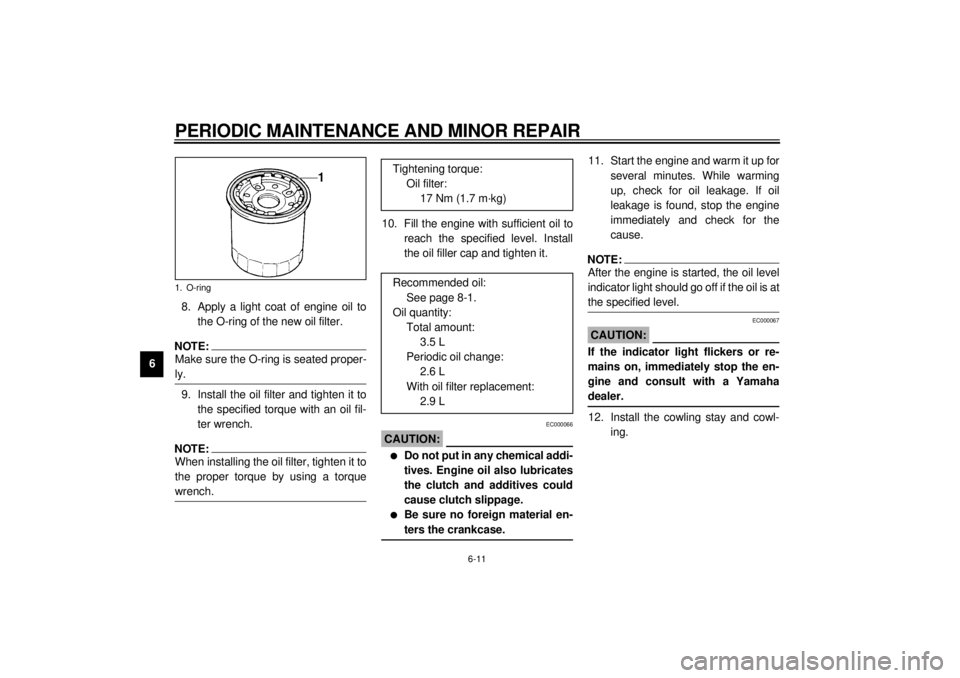
68. Apply a light coat of engine oil to
the O-ring of the new oil filter.
NOTE:@ Make sure the O-ring is seated proper-
ly. @9. Install the oil filter and tighten it to
the specified torque with an oil fil-
ter wrench.NOTE:When installing the oil filter, tighten it to
the proper torque by using a torque
wrench.
10. Fill the engine with sufficient oil to
reach the specified level. Install
the oil filler cap and tighten it.
EC000066
CAUTION:@ l
Do not put in any chemical addi-
tives. Engine oil also lubricates
the clutch and additives could
cause clutch slippage.
l
Be sure no foreign material en-
ters the crankcase.
@
11. Start the engine and warm it up for
several minutes. While warming
up, check for oil leakage. If oil
leakage is found, stop the engine
immediately and check for the
cause.NOTE:@ After the engine is started, the oil level
indicator light should go off if the oil is at
the specified level. @
EC000067
CAUTION:@ If the indicator light flickers or re-
mains on, immediately stop the en-
gine and consult with a Yamaha
dealer. @12. Install the cowling stay and cowl-
ing.
1. O-ring
Tightening torque:
Oil filter:
17 Nm (1.7 m·kg)
Recommended oil:
See page 8-1.
Oil quantity:
Total amount:
3.5 L
Periodic oil change:
2.6 L
With oil filter replacement:
2.9 L
E_4tv_Periodic.fm Page 11 Wednesday, September 1, 1999 11:12 AM
Page 72 of 109
PERIODIC MAINTENANCE AND MINOR REPAIR
6-22
6
EAU00684
WARNING
@ This motorcycle is fitted with super
high-speed running tires. The fol-
lowing points must be observed in
order for you to make fully effective
use of these tires.l
Never fail to use the specified
tires in tire replacement. Other
tires may have a danger of
bursting at super high-speeds.
l
New tires have a relatively low
grip on the road surface until
they have been slightly worn.
Therefore, approximately 100 km
should be traveled at normal
speed before any high-speed
riding is done.
l
Before any high-speed runs, the
tires should be warmed-up suf-
ficiently.
l
Always inflate to the correct tire
pressure according to the oper-
ating conditions.
@
EAU00687
WheelsTo ensure maximum performance,
long service, and safe operation, note
the following:l
Always inspect the wheels before
a ride. Check for cracks, bends, or
warpage of the wheels. If any ab-
normal condition exists in a wheel,
consult a Yamaha dealer. Do not
attempt even small repairs to the
wheel. If a wheel is deformed or
cracked, it must be replaced.
l
Tires and wheels should be bal-
anced whenever either one is
changed or replaced. Failure to
have a wheel balanced can result
in poor performance, adverse han-
dling characteristics, and short-
ened tire life.
l
Ride at moderate speeds after
changing a tire since the tire sur-
face must first be broken in for it to
develop its optimal characteristics.
E_4tv_Periodic.fm Page 22 Wednesday, September 1, 1999 11:12 AM
Page 74 of 109
PERIODIC MAINTENANCE AND MINOR REPAIR
6-24
6
EW000109
WARNING
@ A soft or spongy feeling in the brake
pedal can indicate the presence of
air in the brake system. This air
must be removed by bleeding the
brake system before the motorcycle
is operated. Air in the system will
cause greatly diminished braking
capability and can result in loss of
control and an accident. Have a
Yamaha dealer inspect and bleed
the system if necessary. @
EAU00713
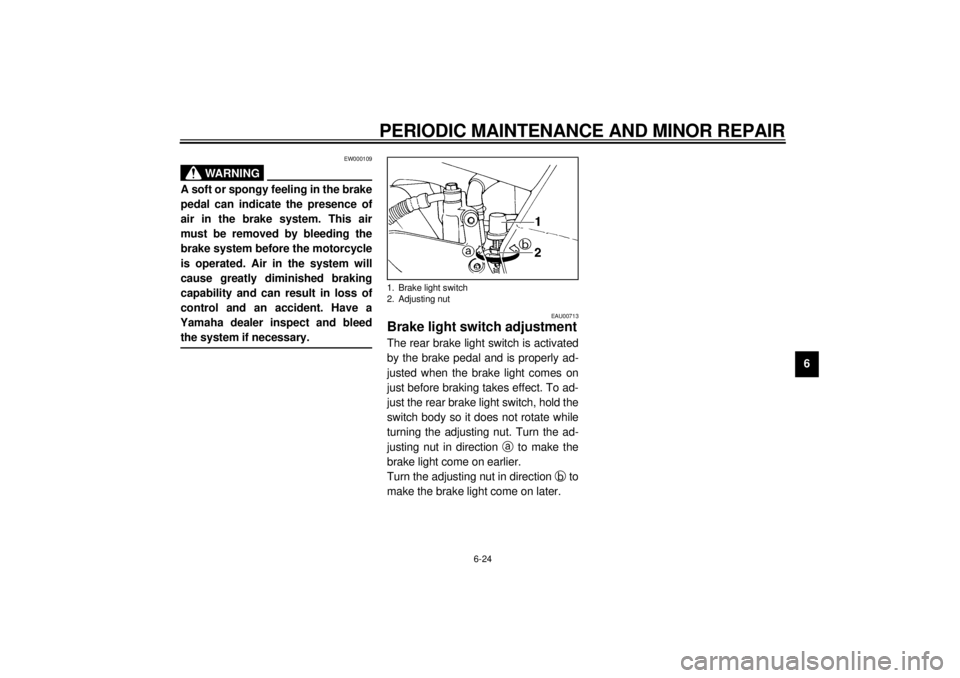
Brake light switch adjustmentThe rear brake light switch is activated
by the brake pedal and is properly ad-
justed when the brake light comes on
just before braking takes effect. To ad-
just the rear brake light switch, hold the
switch body so it does not rotate while
turning the adjusting nut. Turn the ad-
justing nut in direction a
to make the
brake light come on earlier.
Turn the adjusting nut in direction b
to
make the brake light come on later.1. Brake light switch
2. Adjusting nut
E_4tv_Periodic.fm Page 24 Wednesday, September 1, 1999 11:12 AM
Page 83 of 109
PERIODIC MAINTENANCE AND MINOR REPAIR
6-33
6
EAU00819
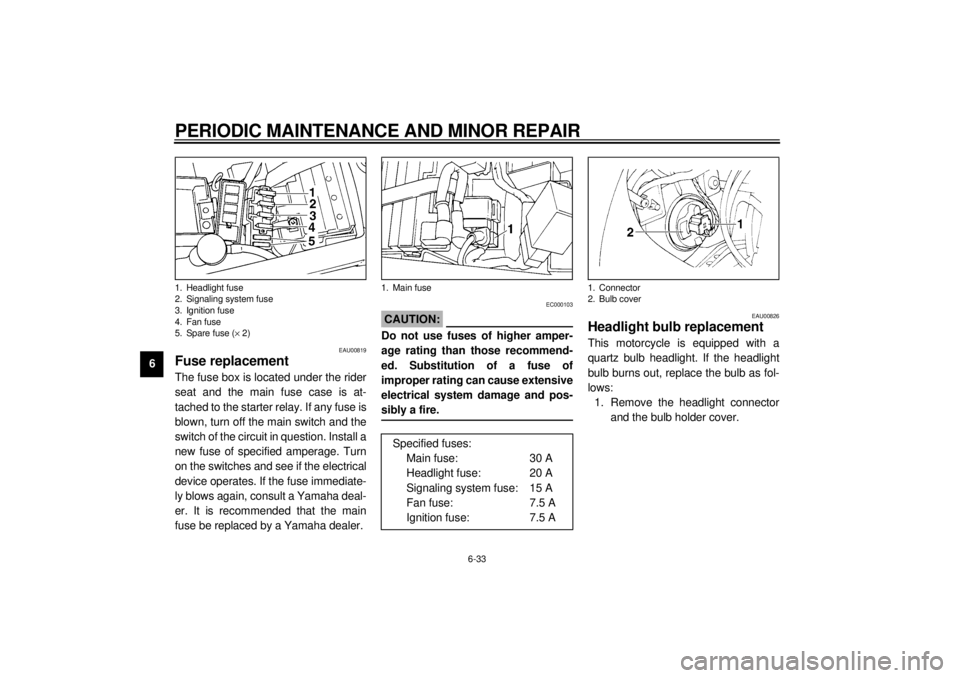
Fuse replacementThe fuse box is located under the rider
seat and the main fuse case is at-
tached to the starter relay. If any fuse is
blown, turn off the main switch and the
switch of the circuit in question. Install a
new fuse of specified amperage. Turn
on the switches and see if the electrical
device operates. If the fuse immediate-
ly blows again, consult a Yamaha deal-
er. It is recommended that the main
fuse be replaced by a Yamaha dealer.
EC000103
CAUTION:@ Do not use fuses of higher amper-
age rating than those recommend-
ed. Substitution of a fuse of
improper rating can cause extensive
electrical system damage and pos-
sibly a fire. @
EAU00826
Headlight bulb replacementThis motorcycle is equipped with a
quartz bulb headlight. If the headlight
bulb burns out, replace the bulb as fol-
lows:
1. Remove the headlight connector
and the bulb holder cover.
1. Headlight fuse
2. Signaling system fuse
3. Ignition fuse
4. Fan fuse
5. Spare fuse (´ 2)
1. Main fuse
Specified fuses:
Main fuse: 30 A
Headlight fuse: 20 A
Signaling system fuse: 15 A
Fan fuse: 7.5 A
Ignition fuse: 7.5 A
1. Connector
2. Bulb cover
E_4tv_Periodic.fm Page 33 Wednesday, September 1, 1999 11:12 AM
Page 84 of 109
PERIODIC MAINTENANCE AND MINOR REPAIR
6-34
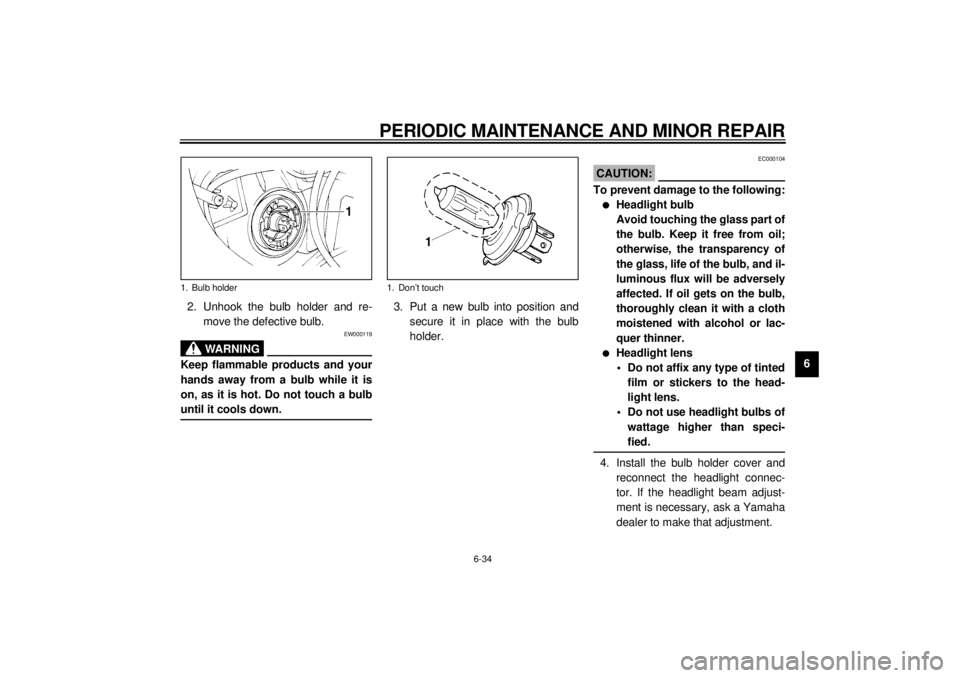
6 2. Unhook the bulb holder and re-
move the defective bulb.
EW000119
WARNING
@ Keep flammable products and your
hands away from a bulb while it is
on, as it is hot. Do not touch a bulb
until it cools down. @
3. Put a new bulb into position and
secure it in place with the bulb
holder.
EC000104
CAUTION:@ To prevent damage to the following:l
Headlight bulb
Avoid touching the glass part of
the bulb. Keep it free from oil;
otherwise, the transparency of
the glass, life of the bulb, and il-
luminous flux will be adversely
affected. If oil gets on the bulb,
thoroughly clean it with a cloth
moistened with alcohol or lac-
quer thinner.
l
Headlight lens
• Do not affix any type of tinted
film or stickers to the head-
light lens.
• Do not use headlight bulbs of
wattage higher than speci-
fied.
@4. Install the bulb holder cover and
reconnect the headlight connec-
tor. If the headlight beam adjust-
ment is necessary, ask a Yamaha
dealer to make that adjustment.
1. Bulb holder
1. Don’t touch
E_4tv_Periodic.fm Page 34 Wednesday, September 1, 1999 11:12 AM
Page 85 of 109
PERIODIC MAINTENANCE AND MINOR REPAIR
6-35
6
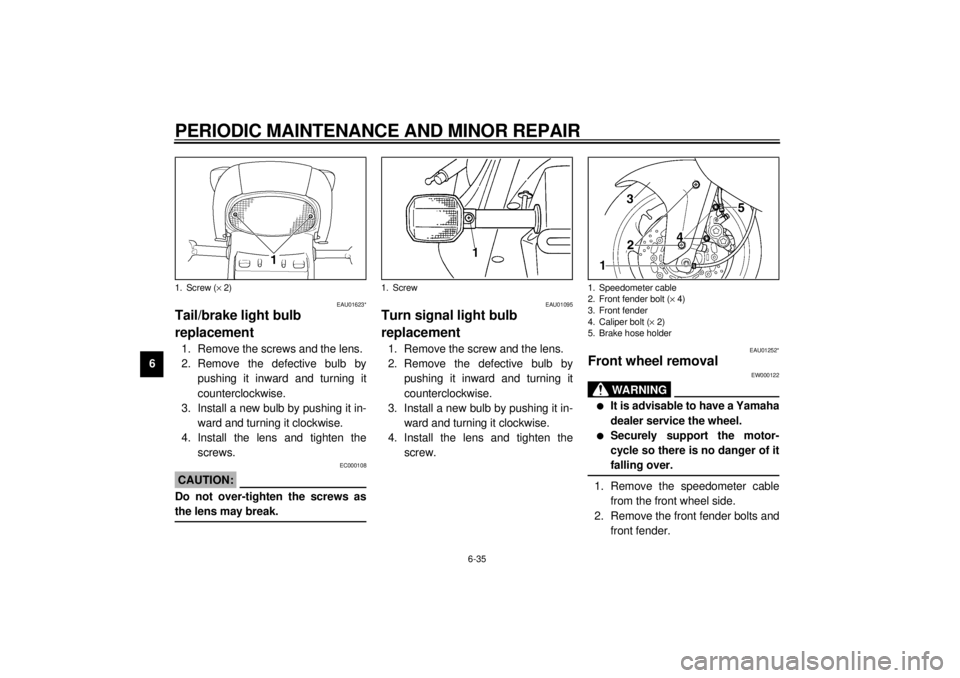
EAU01623*
Tail/brake light bulb
replacement1. Remove the screws and the lens.
2. Remove the defective bulb by
pushing it inward and turning it
counterclockwise.
3. Install a new bulb by pushing it in-
ward and turning it clockwise.
4. Install the lens and tighten the
screws.
EC000108
CAUTION:@ Do not over-tighten the screws as
the lens may break. @
EAU01095
Turn signal light bulb
replacement1. Remove the screw and the lens.
2. Remove the defective bulb by
pushing it inward and turning it
counterclockwise.
3. Install a new bulb by pushing it in-
ward and turning it clockwise.
4. Install the lens and tighten the
screw.
EAU01252*
Front wheel removal
EW000122
WA R N I N G
@ l
It is advisable to have a Yamaha
dealer service the wheel.
l
Securely support the motor-
cycle so there is no danger of it
falling over.
@1. Remove the speedometer cable
from the front wheel side.
2. Remove the front fender bolts and
front fender.
1. Screw (´ 2)
1. Screw
1. Speedometer cable
2. Front fender bolt (´ 4)
3. Front fender
4. Caliper bolt (´ 2)
5. Brake hose holder
E_4tv_Periodic.fm Page 35 Wednesday, September 1, 1999 11:12 AM
Page 94 of 109
MOTORCYCLE CARE AND STORAGE
7-2
7
ECA00010
CAUTION:@ l
Avoid using strong acidic wheel
cleaners, especially on spoked
wheels. If you do use such
products for hard-to-remove
dirt, do not leave it on any long-
er than instructed, then thor-
oughly rinse it off with water,
immediately dry the area and
apply a corrosion protection
spray.
l
Improper cleaning can damage
windshields, cowlings, panels
and other plastic parts. Use
only a soft, clean cloth or
sponge with mild detergent and
water to clean plastic.
l
Do not use any harsh chemical
products on plastic parts. Be
sure to avoid using cloths or
sponges which have been in
contact with strong or abrasive
cleaning products, solvent or
thinner, fuel (gasoline), rust re-
movers or inhibitors, brake flu-
id, antifreeze or electrolyte.
l
Do not use high-pressure wash-
ers or steam-jet cleaners since
they cause water seepage and
deterioration in the following ar-
eas: seals (of wheel bearings,
swingarm bearings, forks and
brakes), electric components
(couplers, connectors, instru-
ments, switches and lights),
breather hoses and vents.
l
For motorcycles equipped with
a windshield: Do not use strong
cleaners or hard sponges as
they will cause dulling or
scratching. Some cleaning
compounds for plastic may
leave scratches on the wind-
shield. Test the product on a
small hidden part of the wind-
shield to make sure they do not
leave any marks. If the wind-
shield is scratched, use a quali-
ty plastic polishing compound
after washing.
@After riding in the rain, near the sea oron salt-sprayed roadsSince sea salt or salt sprayed on the
roads in the winter are extremely corro-
sive in combination with water, carry
out the following steps after each ride
in the rain, near the sea or on salt-
sprayed roads. (Salt sprayed in the
winter may remain on the roads well
into spring.)
E_4tv_Cleaning.fm Page 2 Wednesday, September 1, 1999 11:13 AM