Page 59 of 104
6-14
PERIODIC MAINTENANCE AND MINOR REPAIR
1
2
3
4
5
6
7
8
9
EW000071
w
8 8
Support the fuel tank carefully
during this procedure.
8 8
Do not tilt the fuel tank too
much or pull it too hard
because the fuel hose connec-
tions may become loose caus-
ing fuel leakage.
1
2
2
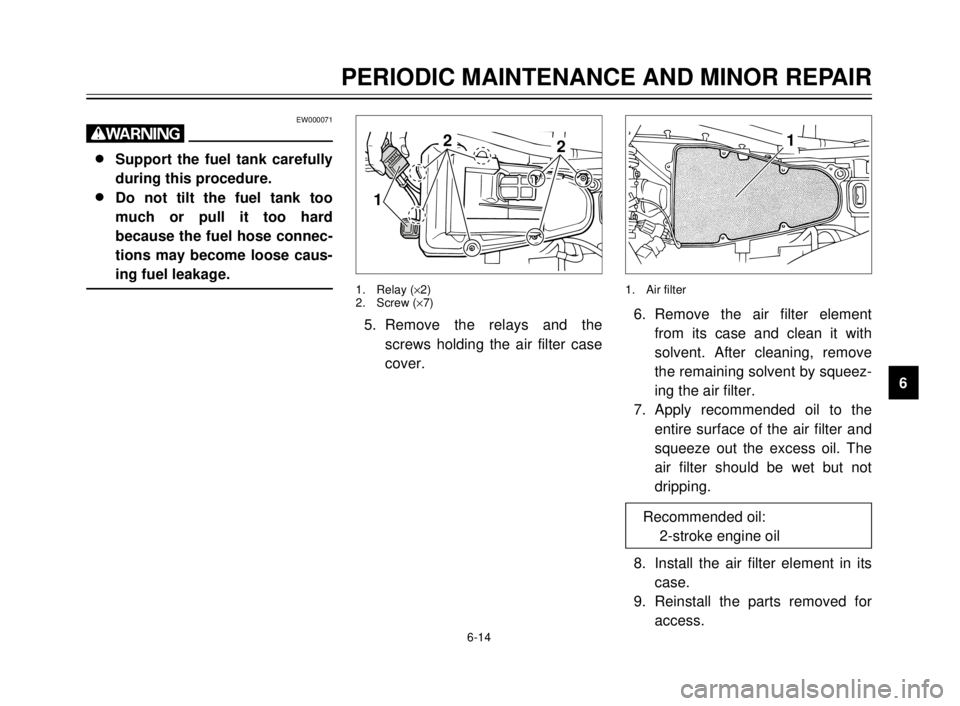
1. Relay (´2)
2. Screw (´7)
5. Remove the relays and the
screws holding the air filter case
cover.
1
1. Air filter
6. Remove the air filter element
from its case and clean it with
solvent. After cleaning, remove
the remaining solvent by squeez-
ing the air filter.
7. Apply recommended oil to the
entire surface of the air filter and
squeeze out the excess oil. The
air filter should be wet but not
dripping.
8. Install the air filter element in its
case.
9. Reinstall the parts removed for
access. Recommended oil:
2-stroke engine oil
5AE-9-E3 (ENG) 4/11/0 11:06 AM Page 57
Page 60 of 104
6-15
PERIODIC MAINTENANCE AND MINOR REPAIR
1
2
3
4
5
6
7
8
9
EC000082
cC
8
8
Make sure the air filter is prop-
erly seated in the air filter
case.
8 8
The engine should never be
run without the air filter
installed. Excessive piston
and/or cylinder wear may
result.
EW000131
w
Make sure that the fuel hoses and
vacuum hose are properly con-
nected, in place and not pinched. If
a hose is damaged, be sure to
replace it.
EAU00629Carburetor adjustment
The carburetor is a vital part of the
engine and requires very sophisticat-
ed adjustment. Most adjustments
should be left to a Yamaha dealer
who has the professional knowledge
and experience to do so. However,
the following may be serviced by the
owner as part of routine mainte-
nance.
EC000094
cC
The carburetor was set at the
Yamaha factory after many tests. If
the settings are changed, poor
engine performance and damage
may result.
ba
1
EAU00632Idle speed adjustment
1. Start the engine and warm it up
for a few minutes at approxi-
mately 1,000 to 2,000 r/min.
Occasionally rev the engine to
4,000 to 5,000 r/min. The engine
is warm when it quickly responds
to the throttle.
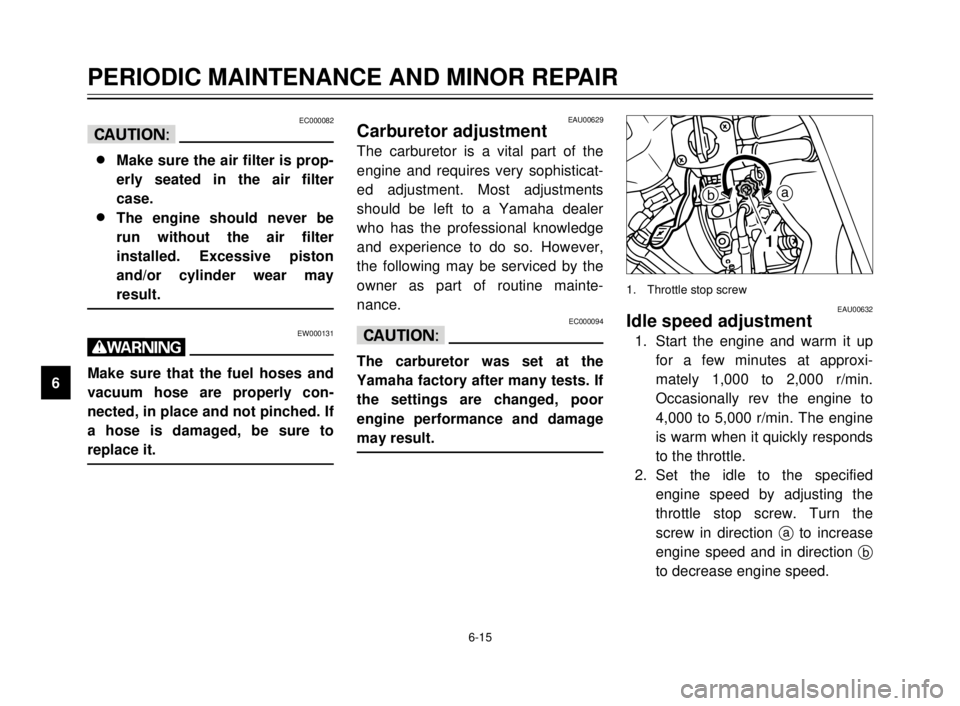
2. Set the idle to the specified
engine speed by adjusting the
throttle stop screw. Turn the
screw in direction ato increase
engine speed and in direction b
to decrease engine speed.
1. Throttle stop screw
5AE-9-E3 (ENG) 4/11/0 11:06 AM Page 58
Page 61 of 104
6-16
PERIODIC MAINTENANCE AND MINOR REPAIR
1
2
3
4
5
6
7
8
9
NOTE:
If the specified idle speed cannot be
obtained by performing the above
adjustment, consult a Yamaha deal-
er.
Standard idle speed:
1,300 ~ 1,500 r/min
1,400 ~ 1,500 r/min
(A, CH only)
EAU00634
Throttle cable free play
adjustment
NOTE:
Before checking the throttle cable
free play, the engine idling speed
should be adjusted.
Adjust the throttle cable by turning
the adjusting nut so that specified
free play at the throttle grip is
obtained.
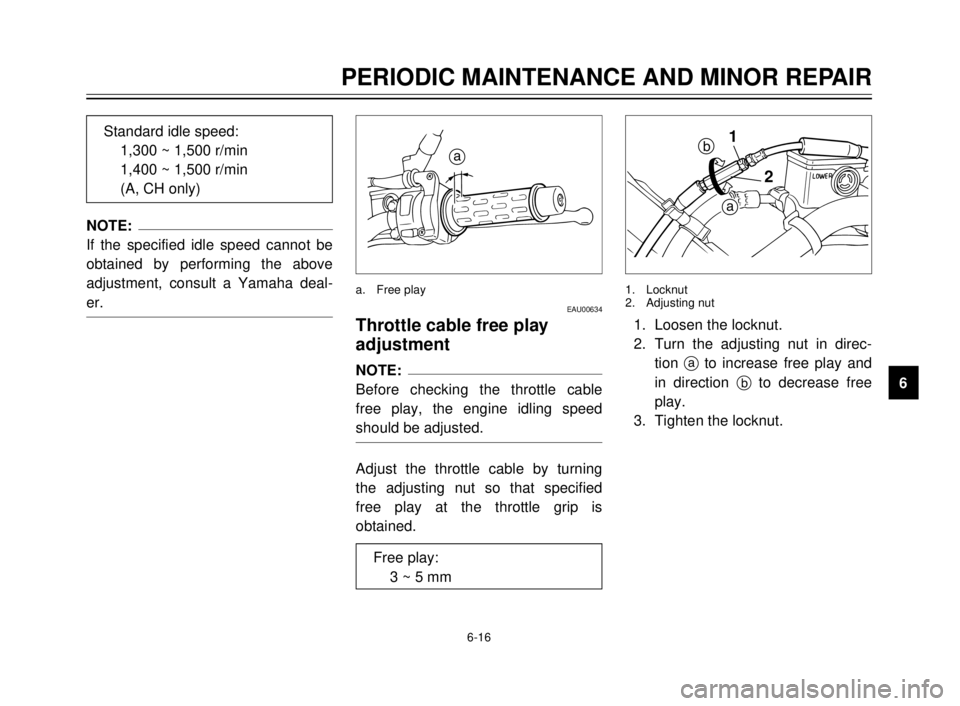
a. Free play
a
Free play:
3 ~ 5 mm
2 1
b
a
1. Loosen the locknut.
2. Turn the adjusting nut in direc-
tion ato increase free play and
in direction bto decrease free
play.
3. Tighten the locknut.
1. Locknut
2. Adjusting nut
5AE-9-E3 (ENG) 4/11/0 11:06 AM Page 59
Page 62 of 104

6-17
PERIODIC MAINTENANCE AND MINOR REPAIR
1
2
3
4
5
6
7
8
9
EAU00647Tires
To ensure maximum performance,
long service, and safe operation, note
the following:
Tire air pressure
Always check and adjust the tire
pressure before operating the motor-
cycle.
EW000082
w
Tire inflation pressure should be
checked and adjusted when the
temperature of the tire equals the
ambient air temperature. Tire infla-
tion pressure must be adjusted
according to total weight of cargo,
rider, passenger, and accessories
(fairing, saddlebags, etc. if
approved for this model), and vehi-
cle speed.
* Load is the total weight of cargo, rider, passenger
and accessories. Maximum load*180 kg
179 kg (CH, A)
Cold tire pressure Front Rear
175 kPa 200 kPa
Up to 90 kg load* (1.75 kg/cm
2, (2.00 kg/cm2,1.75 bar) 2.00 bar)
90 kg load ~175 kPa 225 kPa
Maximum load*(1.75 kg/cm
2, (2.25 kg/cm2,
1.75 bar) 2.25 bar)
EW000083
w
Proper loading of your motorcycle
is important for several character-
istics of your motorcycle, such as
handling, braking, performance
and safety. Do not carry loosely
packed items that can shift.
Securely pack your heaviest items
close to the center of the motorcy-
cle, and distribute the weight even-
ly from side to side. Properly
adjust the suspension for your
load, and check the condition and
pressure of your tires. NEVER
OVERLOAD YOUR MOTORCYCLE.
Make sure the total weight of the
cargo, rider, passenger, and
accessories (fairing, saddlebags,
etc. if approved for this model)
does not exceed the maximum
load of the motorcycle. Operation
of an overloaded motorcycle could
cause tire damage, an accident, or
even injury.
5AE-9-E3 (ENG) 4/11/0 11:06 AM Page 60
Page 63 of 104
6-18
PERIODIC MAINTENANCE AND MINOR REPAIR
1
2
3
4
5
6
7
8
9 Tire inspection
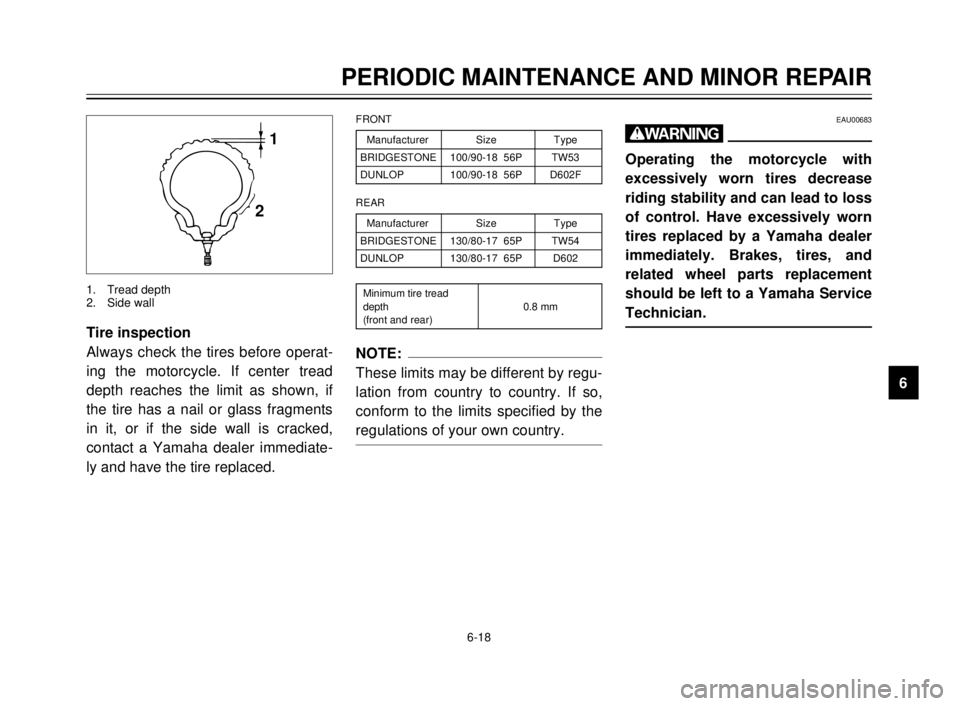
Always check the tires before operat-
ing the motorcycle. If center tread
depth reaches the limit as shown, if
the tire has a nail or glass fragments
in it, or if the side wall is cracked,
contact a Yamaha dealer immediate-
ly and have the tire replaced.
1
2
1. Tread depth
2. Side wall
NOTE:
These limits may be different by regu-
lation from country to country. If so,
conform to the limits specified by the
regulations of your own country.
Manufacturer Size Type
BRIDGESTONE 100/90-18 56P TW53
DUNLOP 100/90-18 56P D602F
FRONT
Manufacturer Size Type
BRIDGESTONE 130/80-17 65P TW54
DUNLOP 130/80-17 65P D602
REAR
Minimum tire tread
depth 0.8 mm
(front and rear)
EAU00683
w
Operating the motorcycle with
excessively worn tires decrease
riding stability and can lead to loss
of control. Have excessively worn
tires replaced by a Yamaha dealer
immediately. Brakes, tires, and
related wheel parts replacement
should be left to a Yamaha Service
Technician.
5AE-9-E3 (ENG) 4/11/0 11:06 AM Page 61
Page 64 of 104
6-19
PERIODIC MAINTENANCE AND MINOR REPAIR
1
2
3
4
5
6
7
8
9
EAU00687Wheels
To ensure maximum performance,
long service, and safe operation, note
the following:
8Always inspect the wheels
before a ride. Check for cracks,
bends, or warpage of the wheels.
If any abnormal condition exists
in a wheel, consult a Yamaha
dealer. Do not attempt even
small repairs to the wheel. If a
wheel is deformed or cracked, it
must be replaced.
8Tires and wheels should be bal-
anced whenever either one is
changed or replaced. Failure to
have a wheel balanced can
result in poor performance,
adverse handling characteristics,
and shortened tire life.
8Ride at moderate speeds after
changing a tire since the tire sur-
face must first be broken in for it
to develop its optimal character-
istics.
a
b12 3
EAU00694
Clutch lever free play
adjustment
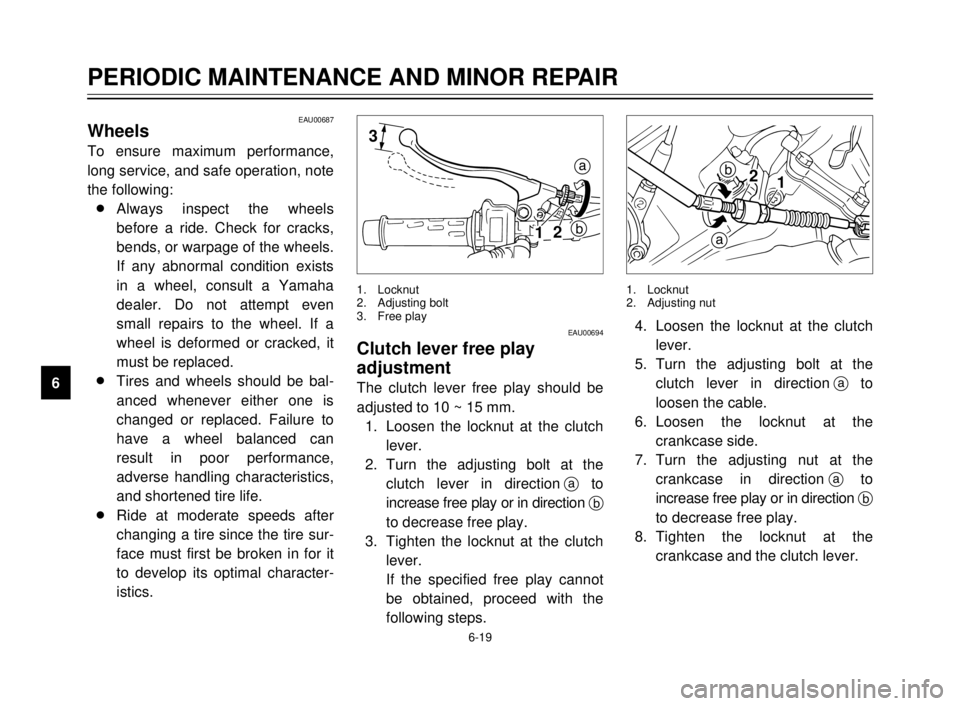
The clutch lever free play should be
adjusted to 10 ~ 15 mm.
1. Loosen the locknut at the clutch
lever.
2. Turn the adjusting bolt at the
clutch lever in directionato
increase free play or in direction b
to decrease free play.
3. Tighten the locknut at the clutch
lever.
If the specified free play cannot
be obtained, proceed with the
following steps.
1. Locknut
2. Adjusting bolt
3. Free play
b
a
12
4. Loosen the locknut at the clutch
lever.
5. Turn the adjusting bolt at the
clutch lever in directionato
loosen the cable.
6. Loosen the locknut at the
crankcase side.
7. Turn the adjusting nut at the
crankcase in directionato
increase free play or in direction b
to decrease free play.
8. Tighten the locknut at the
crankcase and the clutch lever.
1. Locknut
2. Adjusting nut
5AE-9-E3 (ENG) 4/11/0 11:06 AM Page 62
Page 65 of 104
6-20
PERIODIC MAINTENANCE AND MINOR REPAIR
1
2
3
4
5
6
7
8
9
1
2
b
a3
EAU00696
Front brake lever free play
adjustment
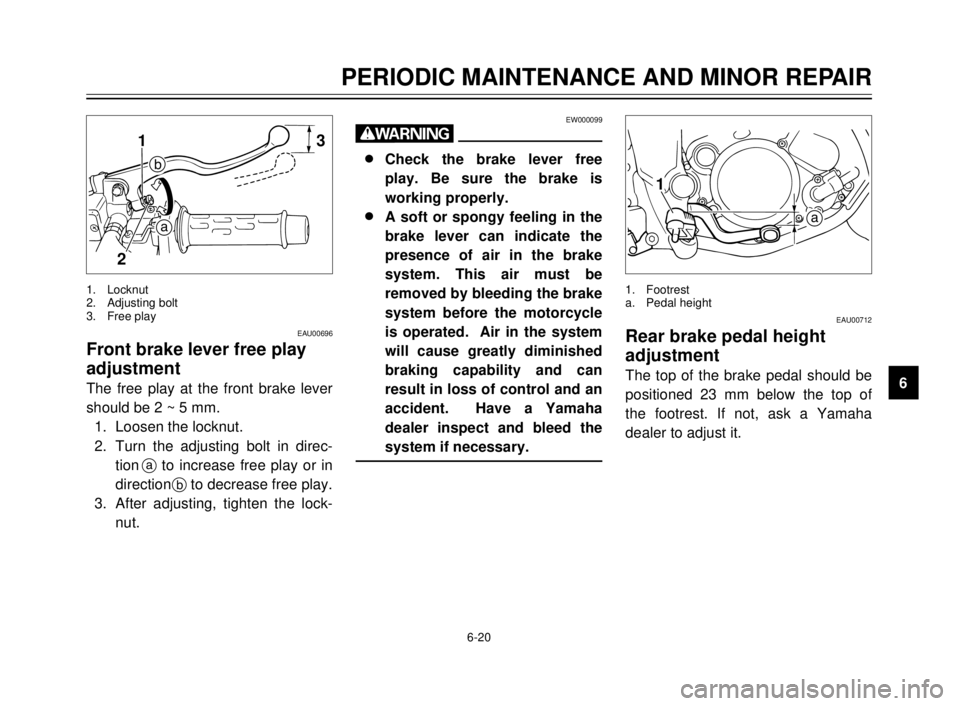
The free play at the front brake lever
should be 2 ~ 5 mm.
1. Loosen the locknut.
2. Turn the adjusting bolt in direc-
tionato increase free play or in
directionbto decrease free play.
3. After adjusting, tighten the lock-
nut.
1. Locknut
2. Adjusting bolt
3. Free play
EW000099
w
8 8
Check the brake lever free
play. Be sure the brake is
working properly.
8 8
A soft or spongy feeling in the
brake lever can indicate the
presence of air in the brake
system. This air must be
removed by bleeding the brake
system before the motorcycle
is operated. Air in the system
will cause greatly diminished
braking capability and can
result in loss of control and an
accident. Have a Yamaha
dealer inspect and bleed the
system if necessary.
a
1
EAU00712
Rear brake pedal height
adjustment
The top of the brake pedal should be
positioned 23 mm below the top of
the footrest. If not, ask a Yamaha
dealer to adjust it.
1. Footrest
a. Pedal height
5AE-9-E3 (ENG) 4/11/0 11:06 AM Page 63
Page 66 of 104
6-21
PERIODIC MAINTENANCE AND MINOR REPAIR
1
2
3
4
5
6
7
8
9
EW000109
w
A soft or spongy feeling in the
brake pedal can indicate the pres-
ence of air in the brake system.
This air must be removed by
bleeding the brake system before
the motorcycle is operated. Air in
the system will cause greatly
diminished braking capability and
can result in loss of control and an
accident. Have a Yamaha dealer
inspect and bleed the system if
necessary.
EAU00713
Brake light switch
adjustment
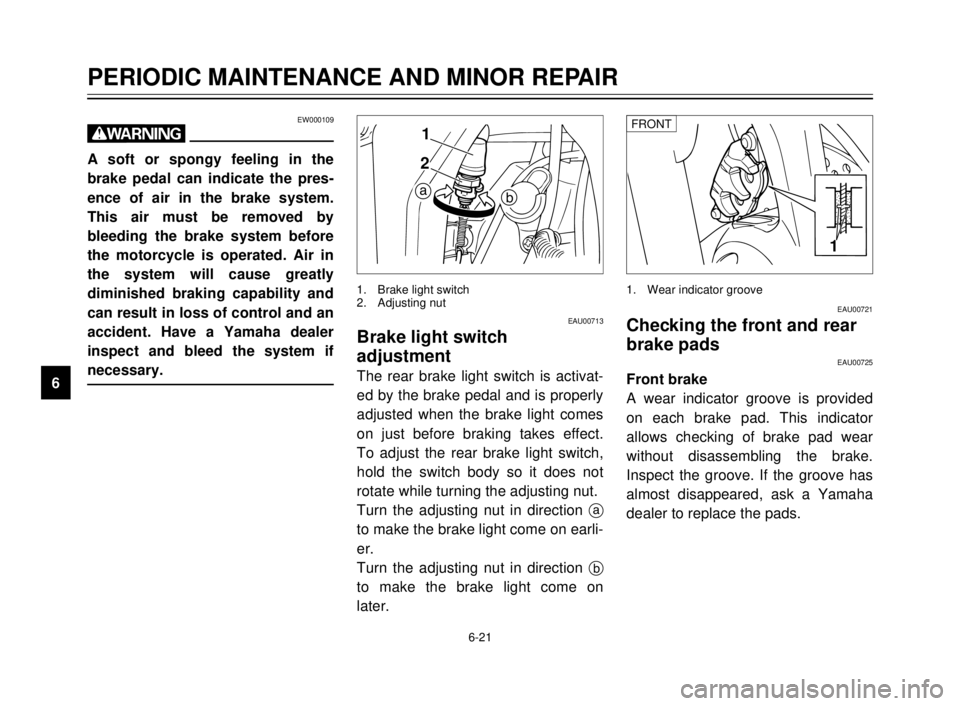
The rear brake light switch is activat-
ed by the brake pedal and is properly
adjusted when the brake light comes
on just before braking takes effect.
To adjust the rear brake light switch,
hold the switch body so it does not
rotate while turning the adjusting nut.
Turn the adjusting nut in direction a
to make the brake light come on earli-
er.
Turn the adjusting nut in direction b
to make the brake light come on
later.
ba
1
2
1. Brake light switch
2. Adjusting nut
EAU00721
Checking the front and rear
brake pads
EAU00725
Front brake
A wear indicator groove is provided
on each brake pad. This indicator
allows checking of brake pad wear
without disassembling the brake.
Inspect the groove. If the groove has
almost disappeared, ask a Yamaha
dealer to replace the pads.
1
1. Wear indicator grooveFRONT
5AE-9-E3 (ENG) 4/11/0 11:06 AM Page 64