Page 29 of 78

OPERATION AND IMPORTANT RIDING POINTS
5-5
5
EAU00424
Tips for reducing fuel
consumptionYour motorcycle’s fuel consumption
depends to a large extent on your
riding style. The following tips can help
reduce fuel consumption:l
Warm up the engine before riding.
l
Turn off the starter (choke) as
soon as possible.
l
Shift up swiftly and avoid high en-
gine speeds during acceleration.
l
Do not double-clutch or rev the en-
gine while shifting down and avoid
high engine speeds with no load
on the engine.
l
Turn off the engine instead of let-
ting it idle for an extended length
of time, i.e. in traffic jams, at traffic
lights or railroad crossings.
EAU00436
Engine break-inThere is never a more important period
in the life of your motorcycle than the
period between zero and 1,000 km. For
this reason we ask that you carefully
read the following material. Because
the engine is brand new, you must not
put an excessive load on it for the first
1,000 km. The various parts in the en-
gine wear and polish themselves to the
correct operating clearances. During
this period, prolonged full throttle oper-
ation, or any condition which might re-
sult in excessive heating of the engine,
must be avoided.
E_3mw.book Page 5 Monday, February 5, 2001 9:54 AM
Page 30 of 78

OPERATION AND IMPORTANT RIDING POINTS
5-6
5
EAU00438
0 ~ 150 km
Avoid operation above 1/3 throttle.
Stop the engine and let it cool for 5 to
10 minutes after every hour of opera-
tion. Vary the speed of the motorcycle
from time to time. Do not operate it at
one set throttle position.
150 ~ 500 km
Avoid prolonged operation above
1/2 throttle.
500 ~ 1,000 km
Avoid cruising speeds in excess of
3/4 throttle.
EC000050
CAUTION:@ After 1,000 km of operation, be sure
to replace the engine oil. @
1,000 km and beyond
Avoid prolonged full-throttle operation.
Vary speed occasionally.
EC000049
CAUTION:@ If any engine trouble should occur
during the break-in period, consult a
Yamaha dealer immediately. @
EAU00457
ParkingWhen parking the motorcycle, stop the
engine and remove the ignition key.
Turn the fuel cock to “OFF” whenever
stopping the engine.
EW000058
WARNING
@ The exhaust system is hot. Park the
motorcycle in a place where pedes-
trians or children are not likely to
touch the motorcycle. Do not park
the motorcycle on a slope or soft
ground; the motorcycle may over-
turn. @
E_3mw.book Page 6 Monday, February 5, 2001 9:54 AM
Page 32 of 78
PERIODIC MAINTENANCE AND MINOR REPAIR
6-2
6
EAU03686
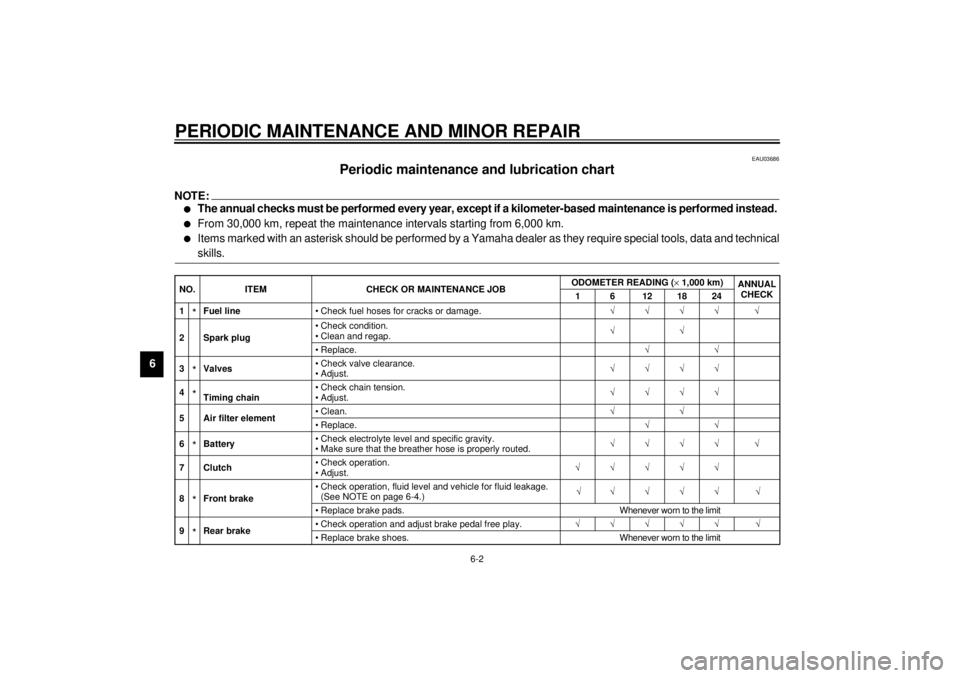
Periodic maintenance and lubrication chart
NOTE:_ l
The annual checks must be performed every year, except if a kilometer-based maintenance is performed instead.
l
From 30,000 km, repeat the maintenance intervals starting from 6,000 km.
l
Items marked with an asterisk should be performed by a Yamaha dealer as they require special tools, data and technical
skills.
_CP-03ENO. ITEM CHECK OR MAINTENANCE JOBODOMETER READING (´1,000 km)
ANNUAL
CHECK
1 6 12 18 24
1
*Fuel line• Check fuel hoses for cracks or damage.ÖÖÖÖ Ö
2 Spark plug• Check condition.
• Clean and regap.ÖÖ
•Replace.ÖÖ
3*Valves• Check valve clearance.
• Adjust.ÖÖÖÖ
4*Timing chain• Check chain tension.
• Adjust.ÖÖÖÖ
5 Air filter element• Clean.ÖÖ
•Replace.ÖÖ
6*Battery• Check electrolyte level and specific gravity.
• Make sure that the breather hose is properly routed.ÖÖÖÖ Ö
7Clutch• Check operation.
• Adjust.ÖÖÖÖÖ
8*Front brake• Check operation, fluid level and vehicle for fluid leakage.
(See NOTE on page 6-4.)ÖÖÖÖÖ Ö
• Replace brake pads. Whenever worn to the limit
9*Rear brake• Check operation and adjust brake pedal free play.ÖÖÖÖÖ Ö
• Replace brake shoes. Whenever worn to the limit
E_3mw.book Page 2 Monday, February 5, 2001 9:54 AM
Page 43 of 78

PERIODIC MAINTENANCE AND MINOR REPAIR
6-13
6
EAU00637
Valve clearance adjustmentThe correct valve clearance changes
with use, resulting in improper fuel/air
supply or engine noise. To prevent this,
the valve clearance must be adjusted
regularly. This adjustment however,
should be left to a professional
Yamaha service technician.
EAU00647
TiresTo ensure maximum performance,
long service, and safe operation, note
the following:
Tire air pressure
Always check and adjust the tire pres-
sure before operating the motorcycle.
EW000082
WARNING
@ Tire inflation pressure should be
checked and adjusted when the
temperature of the tire equals the
ambient air temperature. Tire infla-
tion pressure must be adjusted ac-
cording to total weight of cargo,
rider, passenger, and accessories
(fairing, saddlebags, etc. if approved
for this model), and vehicle speed. @
CE-32EMaximum load* 160 kg
Cold tire pressure Front Rear
Up to 90 kg*175 kPa
(1.75 kg/cm
2,
1.75 bar)200 kPa
(2.00 kg/cm
2,
2.00 bar)
90 kg load ~
Maximum load*175 kPa
(1.75 kg/cm
2,
1.75 bar)225 kPa
(2.25 kg/cm
2,
2.25 bar)
* Load is the total weight of cargo, rider, passenger
and accessories.
E_3mw.book Page 13 Monday, February 5, 2001 9:54 AM
Page 63 of 78

PERIODIC MAINTENANCE AND MINOR REPAIR
6-33
6
EAU01723*
Rear wheel installation1. Install the rear wheel and the axle.
2. Install the axle nut and let the
motorcycle down.
3. Insert the brake rod into the brake
cam lever and install the brake
pedal free play adjusting nut.
4. Install the brake torque rod bolt
and tighten to the specified tight-
ening torque. Then install a new
cotter pin.
5. Adjust the drive chain free play.
(See page 6-22.)
6. Tighten the axle nut to the speci-
fied tightening torque.7. Adjust the rear brake pedal height
and free play. (See page 6-17.)
EW000103
WARNING
@ Check the operation of the brake
light after adjusting the rear brake. @
EAU01008
TroubleshootingAlthough Yamaha motorcycles receive
a rigid inspection before shipment from
the factory, trouble may occur during
operation.
Any problem in the fuel, compression,
or ignition systems can cause poor
starting and loss of power. The trouble-
shooting chart describes a quick, easy
procedure for making checks.
If your motorcycle requires any repair,
bring it to a Yamaha dealer. The skilled
technicians at a Yamaha dealership
have the tools, experience, and know-
how to properly service your motor-
cycle. Use only genuine Yamaha parts
on your motorcycle. Imitation parts may
look like Yamaha parts, but they are of-
ten inferior. Consequently, they have a
shorter service life and can lead to ex-
pensive repair bills. Specified torque:
Brake torque rod bolt:
25 Nm (2.5 m·kg)
Specified torque:
Axle nut:
65 Nm (6.5 m·kg)
E_3mw.book Page 33 Monday, February 5, 2001 9:54 AM
Page 64 of 78
PERIODIC MAINTENANCE AND MINOR REPAIR
6-34
6
EAU03009
Troubleshooting chart
EW000125
WARNING
@ Never check the fuel system while smoking or in the vicinity of an open flame. @
Check if there is fuel in
the fuel tank.1. Fuel
Enough fuel.
No fuel.
Go to compression check.
Supply fuel.
Engine doesn’t start, go to compression check.
Use the electric starter.2. Compression
There is compression.
No compression.
Go to ignition check.
Ask a Yamaha dealer to
inspect.
Remove spark plug and
check electrodes.3. Ignition
Wet.
Dry.
Wipe clean with dry cloth and correct
spark gap or replace spark plug.
Ask a Yamaha dealer to inspect.
Engine doesn’t start, ask a Yamaha
dealer to inspect.Engine doesn’t start, go to battery
check.Open throttle half-way and start
the engine.
Use the electric starter.4. Battery
Engine turns over
quickly.
Engine turns over
slowly.
Battery good.Check fluid, recharge,
check connections.
E_3mw.book Page 34 Monday, February 5, 2001 9:54 AM
Page 66 of 78

MOTORCYCLE CARE AND STORAGE
7-2
7
ECA00010
CAUTION:@ l
Avoid using strong acidic wheel
cleaners, especially on spoked
wheels. If you do use such
products for hard-to-remove
dirt, do not leave it on any long-
er than instructed, then thor-
oughly rinse it off with water,
immediately dry the area and
apply a corrosion protection
spray.
l
Improper cleaning can damage
windshields, cowlings, panels
and other plastic parts. Use
only a soft, clean cloth or
sponge with mild detergent and
water to clean plastic.
l
Do not use any harsh chemical
products on plastic parts. Be
sure to avoid using cloths or
sponges which have been in
contact with strong or abrasive
cleaning products, solvent or
thinner, fuel (gasoline), rust re-
movers or inhibitors, brake flu-
id, antifreeze or electrolyte.
l
Do not use high-pressure wash-
ers or steam-jet cleaners since
they cause water seepage and
deterioration in the following ar-
eas: seals (of wheel bearings,
swingarm bearings, forks and
brakes), electric components
(couplers, connectors, instru-
ments, switches and lights),
breather hoses and vents.
l
For motorcycles equipped with
a windshield: Do not use strong
cleaners or hard sponges as
they will cause dulling or
scratching. Some cleaning
compounds for plastic may
leave scratches on the wind-
shield. Test the product on a
small hidden part of the wind-
shield to make sure they do not
leave any marks. If the wind-
shield is scratched, use a quali-
ty plastic polishing compound
after washing.
@
E_3mw.book Page 2 Monday, February 5, 2001 9:54 AM
Page 68 of 78
MOTORCYCLE CARE AND STORAGE
7-4
7
ECA00013
CAUTION:@ l
Apply spray oil and wax spar-
ingly and wipe off any excess.
l
Never apply oil or wax on rub-
ber and plastic parts, but treat
them with a suitable care prod-
uct.
l
Avoid using abrasive polishing
compounds as they wear away
the paint.
@NOTE:@ Consult a Yamaha dealer for advice on
what products to use. @
StorageShort-term
Always store your motorcycle in a cool,
dry place and, if necessary, protect it
against dust with a porous cover.
ECA00014
CAUTION:@ l
Storing the motorcycle in a
poorly ventilated room or cover-
ing it with a tarp while it is still
wet will allow water and humidi-
ty to seep in and cause rust.
l
To prevent corrosion, avoid
damp cellars, stables (because
of the presence of ammonia)
and areas where strong chemi-
cals are stored.
@
Long-term
Before storing your motorcycle for
several months:
1. Follow all the instructions in the
“Care” section of this chapter.
2. Drain the carburetor float chamber
by loosening the drain bolt; this will
prevent fuel deposits from building
up. Pour the drained fuel into the
fuel tank.
3. Only for motorcycles equipped
with a fuel cock which has an
“OFF” position: Turn the fuel cock
to “OFF”.
4. Fill up the fuel tank and add fuel
stabilizer (if available) to prevent
the fuel tank from rusting and the
fuel from deteriorating.
5. Perform the following steps to pro-
tect the cylinder, piston rings, etc.
from corrosion.
E_3mw.book Page 4 Monday, February 5, 2001 9:54 AM
