Page 442 of 698

ENGINE GENERAL INFORMATION AND DIAGNOSIS 6-73
6) Repeat above steps 5) 4 times.
7) Increase vehicle speed to about 50 mph (80 km/h) in 3rd gear or 2 range.
8) Release accelerator pedal and with engine brake applied, keep vehicle coasting (fuel cut condition) for
10sec. or more.
9) Stop vehicle (don’t turn ignition switch OFF) and run engine at idle for 2 min.
After this step 9), if “Oxygen Sensor Monitoring TEST COMPLETED” is displayed in “READINESS TESTS”
mode and DTC is not displayed in “DTC” mode, confirmation test is completed.
If “TEST NOT COMPLTD” is still being displayed, proceed to next step 10).
10) Drive vehicle under usual driving condition for 10 min. (or vehicle is at a stop and run engine at idle for 10
min. or longer)
11) Stop vehicle (don’t turn ignition switch OFF). Confirm test results according to “Test Result Confirmation
Flow Table” in “DTC CONFIRMATION PROCEDURE” of DTC P0420.
INSPECTION
�Usual driving : Driving at 30 – 40 mph, 50 – 60 km/h including short stop according to traffic signal. (under driving condition other than high-load, high-engine
speed, rapid accelerating and decelerating)
Step Action Yes No
1Was “ENGINE DIAG. FLOW TABLE” per-
formed?Go to Step 2. Go to “ENGINE DIAG.
FLOW TABLE”.
2 Check Exhaust System for leakage, loose con-
nection and damage.
Is it good condition?Go to Step 3. Repair or replace.
3 Check HO2S-2 and Its Circuit.
Was HO2S-2 output voltage indicated on scan
tool in step 3) of DTC confirmation test less
than 1.275 V?Go to Step 4.“BRN”, “YEL” or “ORN”
circuit short to power sup-
ply circuit or HO2S-2 mal-
function.
4 Check Short Term Fuel Trim.
Did short term fuel trim very within – 20 – + 20%
range in step 3) of DTC confirmation test?Check “BRN”, “YEL” or
“ORN” wire for open and
short, and connection for
poor connection. If wire
and connection are OK,
replace HO2S-2.Check fuel system. Go to
DTC P0171/P0172 Diag.
Flow Table.
Page 443 of 698
6-74 ENGINE GENERAL INFORMATION AND DIAGNOSIS
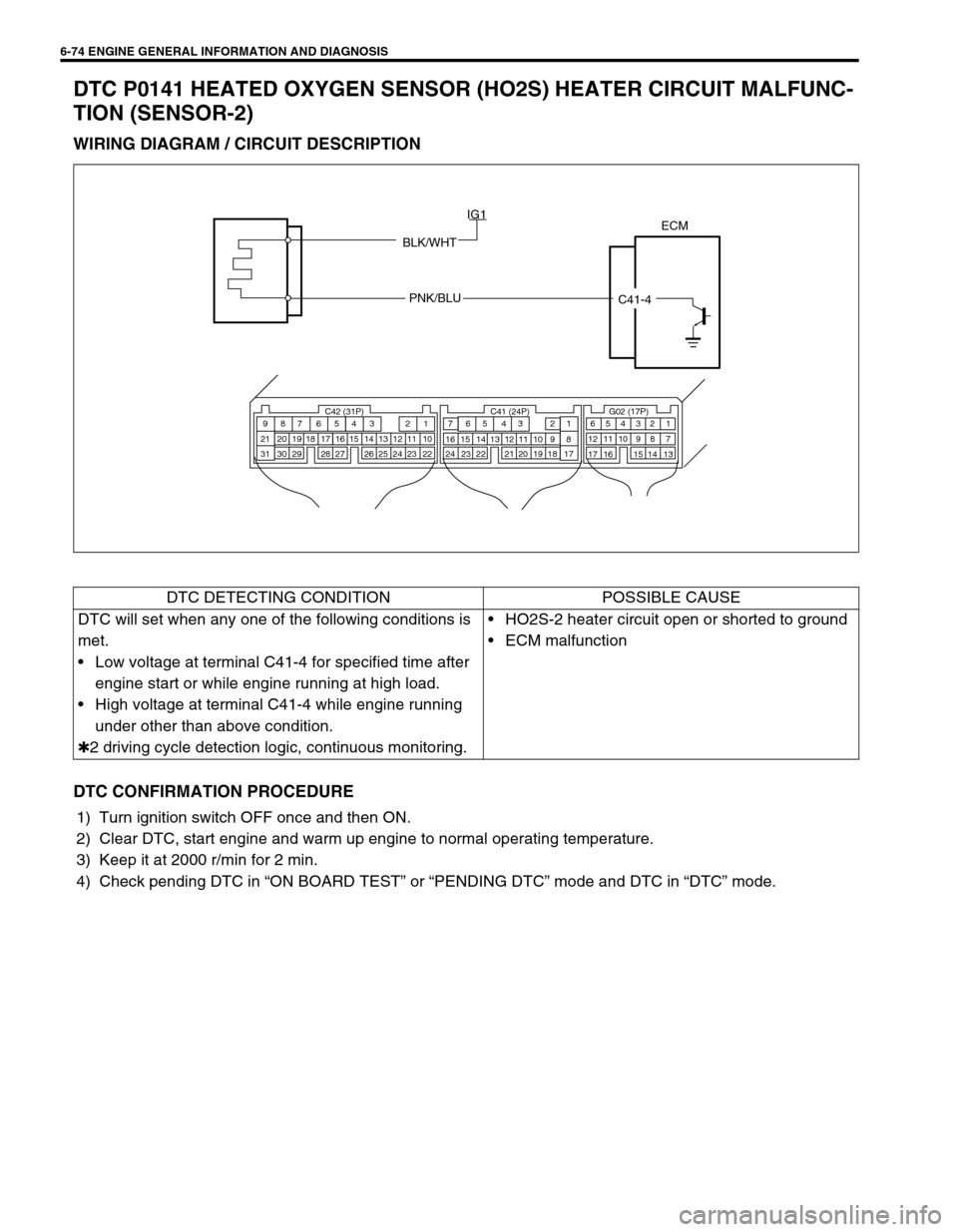
DTC P0141 HEATED OXYGEN SENSOR (HO2S) HEATER CIRCUIT MALFUNC-
TION (SENSOR-2)
WIRING DIAGRAM / CIRCUIT DESCRIPTION
DTC CONFIRMATION PROCEDURE
1) Turn ignition switch OFF once and then ON.
2) Clear DTC, start engine and warm up engine to normal operating temperature.
3) Keep it at 2000 r/min for 2 min.
4) Check pending DTC in “ON BOARD TEST” or “PENDING DTC” mode and DTC in “DTC” mode.
ECM
BLK/WHT
PNK/BLU
C41-4 IG1
C42 (31P) C41 (24P) G02 (17P)1 2 3 4 5 6 7 8 9
10 11 12 13 14 15 16 17 18 19 20 21
22 23 24 25 26 28 27 29 30 315 6
1 2 3 4 5 6 7
11 12
9 10 11 13 12 14 15 16
16 171 2
7 8
13 14 3 4
9 10
15 17 188
19 20 21 22 23 24
DTC DETECTING CONDITION POSSIBLE CAUSE
DTC will set when any one of the following conditions is
met.
Low voltage at terminal C41-4 for specified time after
engine start or while engine running at high load.
High voltage at terminal C41-4 while engine running
under other than above condition.
✱2 driving cycle detection logic, continuous monitoring.HO2S-2 heater circuit open or shorted to ground
ECM malfunction
Page 445 of 698
![SUZUKI SWIFT 2000 1.G RG413 Service Workshop Manual 6-76 ENGINE GENERAL INFORMATION AND DIAGNOSIS
DTC P0171 FUEL SYSTEM TOO LEAN
DTC P0172 FUEL SYSTEM TOO RICH
WIRING DIAGRAM / CIRCUIT DESCRIPTION
1. Injector [a] : Signal to decrease amount of fuel inj](/manual-img/20/7606/w960_7606-444.png "SUZUKI SWIFT 2000 1.G RG413 Service Workshop Manual 6-76 ENGINE GENERAL INFORMATION AND DIAGNOSIS
DTC P0171 FUEL SYSTEM TOO LEAN
DTC P0172 FUEL SYSTEM TOO RICH
WIRING DIAGRAM / CIRCUIT DESCRIPTION
1. Injector [a] : Signal to decrease amount of fuel inj")
6-76 ENGINE GENERAL INFORMATION AND DIAGNOSIS
DTC P0171 FUEL SYSTEM TOO LEAN
DTC P0172 FUEL SYSTEM TOO RICH
WIRING DIAGRAM / CIRCUIT DESCRIPTION
1. Injector [a] : Signal to decrease amount of fuel injection [f] : A/F mixture becomes leaner
2. HO2S-1 [b] : Signal to increase amount of fuel injection [g] : Oxygen concentration decreases
3. WU-TWC (Warm up-three way catalytic convec-
tor)[c] : High voltage [h] : Oxygen concentration increases
4. Sensed information [d] : Low voltage
5. ECM [e] : A/F mixture becomes richer
[a]
[b]
[f] [e] [g][d]
[h][c]
1
2 5
1
2
2
3
54
+BECM
C42-9
C42-21
C42-8 C42-31
C42-1
BLU/YEL
BLU/WHT
BLU/RED
BLK/ORN
C42-3
BLK/ORN BLU/ORN
WHT
ORNC42-10C42-13
E111
DTC DETECTING CONDITION POSSIBLE CAUSE
When one of the following conditions occurs while
engine running under closed loop condition.
Air/fuel ratio too lean
(Total fuel trim (short and long terms added) is more
than 30%)
Air/fuel ratio too rich
(Total fuel trim is less than – 30%)
✱2 driving cycle detection logic, continuous monitoring.Vacuum leaks (air drawn in).
Exhaust gas leakage.
Heated oxygen sensor-1 circuit malfunction.
Fuel pressure out of specification.
Fuel injector malfunction (clogged or leakage).
MAP sensor poor performance.
ECT sensor poor performance.
IAT sensor poor performance.
TP sensor poor performance.
EVAP control system malfunction.
PCV valve malfunction.
Page 520 of 698
ENGINE MECHANICAL (M13 ENGINE) 6A1-19
EXHAUST MANIFOLD
REMOVAL
1) Disconnect negative cable at battery.
2) Disconnect heated oxygen sensor coupler (1) (if equipped)
and detach it from its stay.
3) Remove front bumper with front grille and heat insulator
panel by referring to Section 9.
4) Remove exhaust manifold cover (2).
1. Exhaust manifold 6. Exhaust manifold stiffener 11. Exhaust manifold mounting bolt
2. Exhaust manifold gasket 7. Gasket Tightening torque
3. Heated oxygen sensor (if equipped) 8. Exhaust manifold mounting nut Do not reuse.
4. Exhaust manifold cover 9. Exhaust manifold stiffener bolt
5. Engine hook 10. Exhaust pipe bolt
WARNING:
To avoid danger of being burned, do not service exhaust
system while it is still hot. Service should be performed
after system cools down.
Page 522 of 698
ENGINE MECHANICAL (M13 ENGINE) 6A1-21
4) Install exhaust manifold cover (1) .
5) Connect heated oxygen sensor coupler (2) and fit coupler to
bracket securely (if equipped).
6) Install heat insulator panel and front bumper with front grille
by referring to Section 9.
7) Connect negative cable at battery.
8) Check exhaust system for exhaust gas leakage.
OIL PAN AND OIL PUMP STRAINER
REMOVAL
1) Disconnect negative cable at battery.
2) Disconnect heated oxygen sensor coupler and detach it from
its stay.
3) Remove oil level gauge.
[A] : Sealant application amount 3. O-ring 8. Oil pan nut
“a” : 3 mm (0.12 in.) 4. Gasket 9. Oil pan bolt
“b” : 2 mm (0.08 in.) 5. Drain plug Tightening torque
1. Oil pan
: Apply sealant 99000-31150 to mating surface.6. Strainer bolt Do not reuse.
2. Strainer 7. Bracket bolt
Page 526 of 698

ENGINE MECHANICAL (M13 ENGINE) 6A1-25
TIMING CHAIN COVER
REMOVAL
1) Disconnect negative cable at battery.
2) Disconnect the following electric lead wires, and remove
these connector bracket.
CMP sensor
Heated oxygen No.1 and No.2 sensors
Engine oil pressure switch
[A] : Sealant application
amount
3. Oil seal
: Apply engine oil to oil seal lip.8. Oil pan mounting bolt
“a” : 3 mm (0.12 in.) 4. Timing chain cover
: Apply sealant 99000-31140 to the mating surface
of cylinder and cylinder head.
: Apply sealant 99000-31150 to the mating surface
of timing chain cover referring to the figure of Step
1) in INSTALLATION.9. Oil pan mounting nut
“b” : 2 mm (0.08 in.) 5. Pin 10. Cylinder head cover
: Apply sealant 99000-31150 to the sealing
point for timing chain cover mating surface
and cylinder head gasket sealing point.
Refer to “CYLINDER HEAD COVER
INSTALLATION”.
1. Crankshaft pulley bolt 6. Cylinder head gasket Tightening torque
2. Crankshaft pulley 7. Timing chain cover mounting bolts Do not reuse.
Page 546 of 698
ENGINE MECHANICAL (M13 ENGINE) 6A1-45
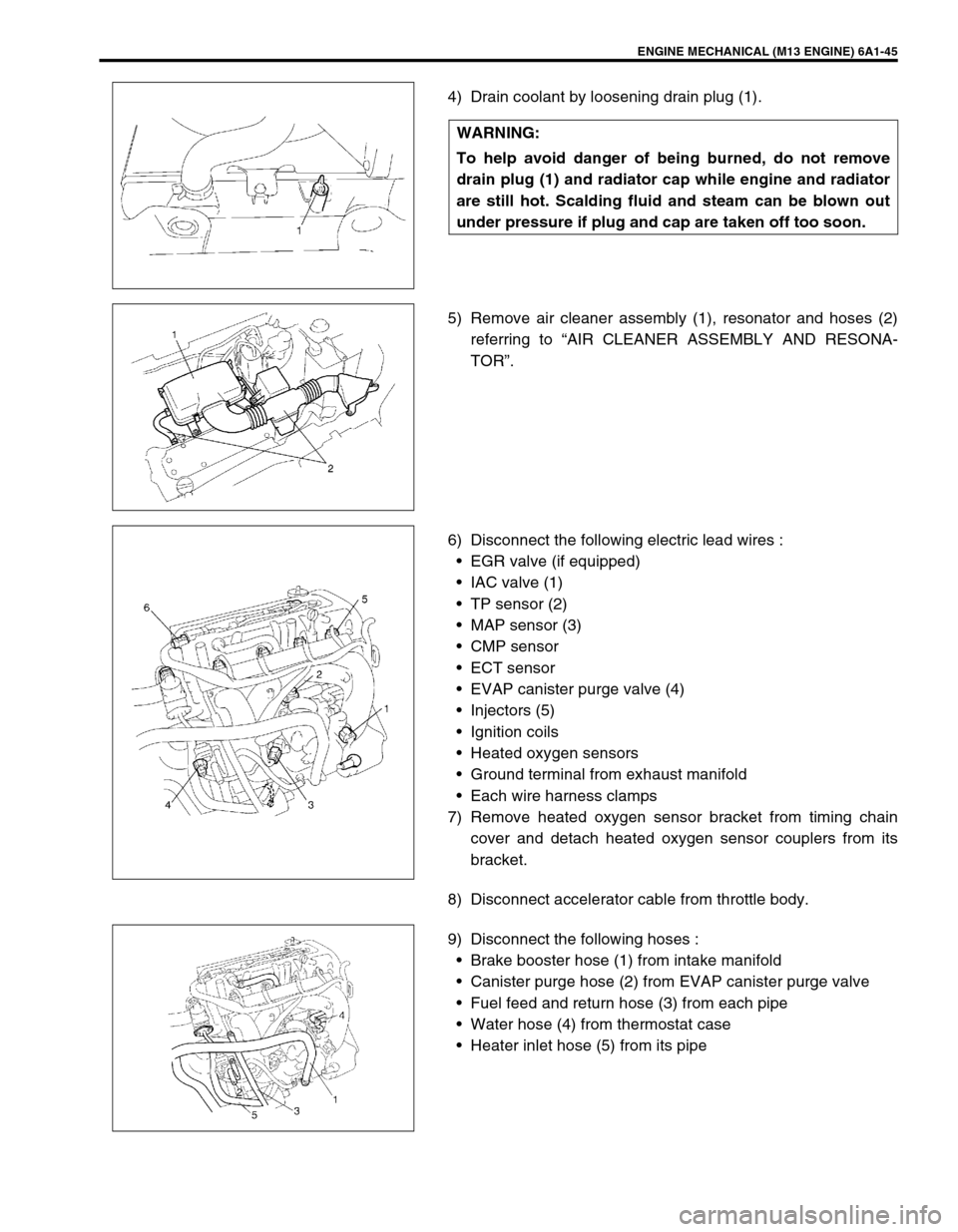
4) Drain coolant by loosening drain plug (1).
5) Remove air cleaner assembly (1), resonator and hoses (2)
referring to “AIR CLEANER ASSEMBLY AND RESONA-
TOR”.
6) Disconnect the following electric lead wires :
EGR valve (if equipped)
IAC valve (1)
TP sensor (2)
MAP sensor (3)
CMP sensor
ECT sensor
EVAP canister purge valve (4)
Injectors (5)
Ignition coils
Heated oxygen sensors
Ground terminal from exhaust manifold
Each wire harness clamps
7) Remove heated oxygen sensor bracket from timing chain
cover and detach heated oxygen sensor couplers from its
bracket.
8) Disconnect accelerator cable from throttle body.
9) Disconnect the following hoses :
Brake booster hose (1) from intake manifold
Canister purge hose (2) from EVAP canister purge valve
Fuel feed and return hose (3) from each pipe
Water hose (4) from thermostat case
Heater inlet hose (5) from its pipe WARNING:
To help avoid danger of being burned, do not remove
drain plug (1) and radiator cap while engine and radiator
are still hot. Scalding fluid and steam can be blown out
under pressure if plug and cap are taken off too soon.
Page 570 of 698
ENGINE MECHANICAL (M13 ENGINE) 6A1-69
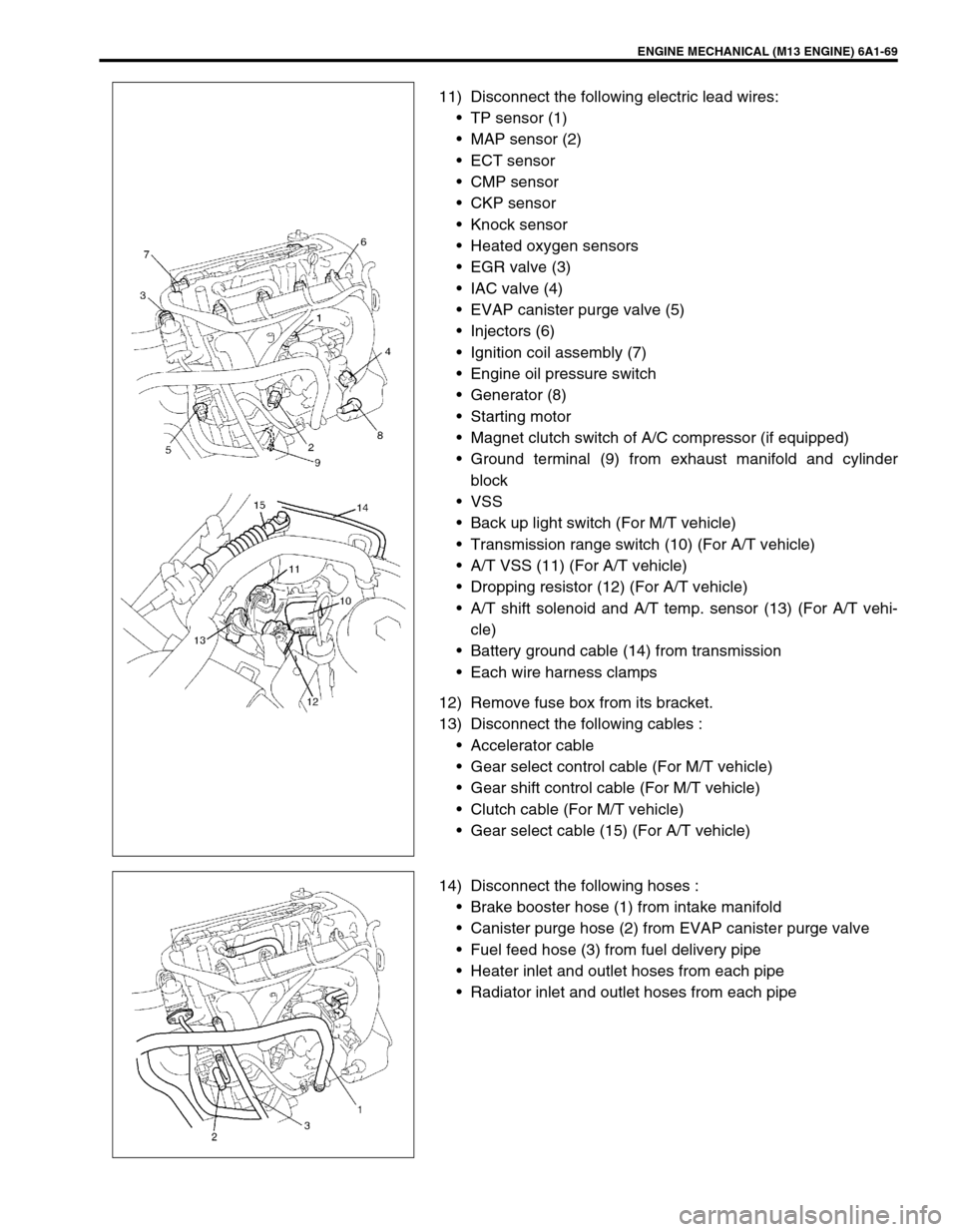
11) Disconnect the following electric lead wires:
TP sensor (1)
MAP sensor (2)
ECT sensor
CMP sensor
CKP sensor
Knock sensor
Heated oxygen sensors
EGR valve (3)
IAC valve (4)
EVAP canister purge valve (5)
Injectors (6)
Ignition coil assembly (7)
Engine oil pressure switch
Generator (8)
Starting motor
Magnet clutch switch of A/C compressor (if equipped)
Ground terminal (9) from exhaust manifold and cylinder
block
VSS
Back up light switch (For M/T vehicle)
Transmission range switch (10) (For A/T vehicle)
A/T VSS (11) (For A/T vehicle)
Dropping resistor (12) (For A/T vehicle)
A/T shift solenoid and A/T temp. sensor (13) (For A/T vehi-
cle)
Battery ground cable (14) from transmission
Each wire harness clamps
12) Remove fuse box from its bracket.
13) Disconnect the following cables :
Accelerator cable
Gear select control cable (For M/T vehicle)
Gear shift control cable (For M/T vehicle)
Clutch cable (For M/T vehicle)
Gear select cable (15) (For A/T vehicle)
14) Disconnect the following hoses :
Brake booster hose (1) from intake manifold
Canister purge hose (2) from EVAP canister purge valve
Fuel feed hose (3) from fuel delivery pipe
Heater inlet and outlet hoses from each pipe
Radiator inlet and outlet hoses from each pipe

