2000 SAAB 9-3 coolant
[x] Cancel search: coolantPage 167 of 236

167 Car care
IB944
Hood release handle ....... 168
Engine .............................. 168
Engine bay ....................... 169
Engine oil ......................... 172
Transmission fluid .......... 173
Coolant ............................. 174
Brake- clutch fluid and
brake pads ..................... 176
Power steering ................ 177
Battery .............................. 177
Drive belt .......................... 179
Wipers and washers ....... 179
Wiper blades .................... 179
Changing bulbs ............... 181
Fuses ................................ 187
Wheels.............................. 192
Safety belts ...................... 199 Upholstery and trim ......... 200
Textile carpeting .............. 200
Engine bay ........................ 201
Washing ............................ 201
Waxing and polishing ...... 202
Touching up the paint ..... 202
Anti-corrosion treatment . 203
Recovery and/or recycling
of automotive materials. 205
Air conditioning (A/C
system) ........................... 207 Car care
ProCarManuals.com
Page 169 of 236
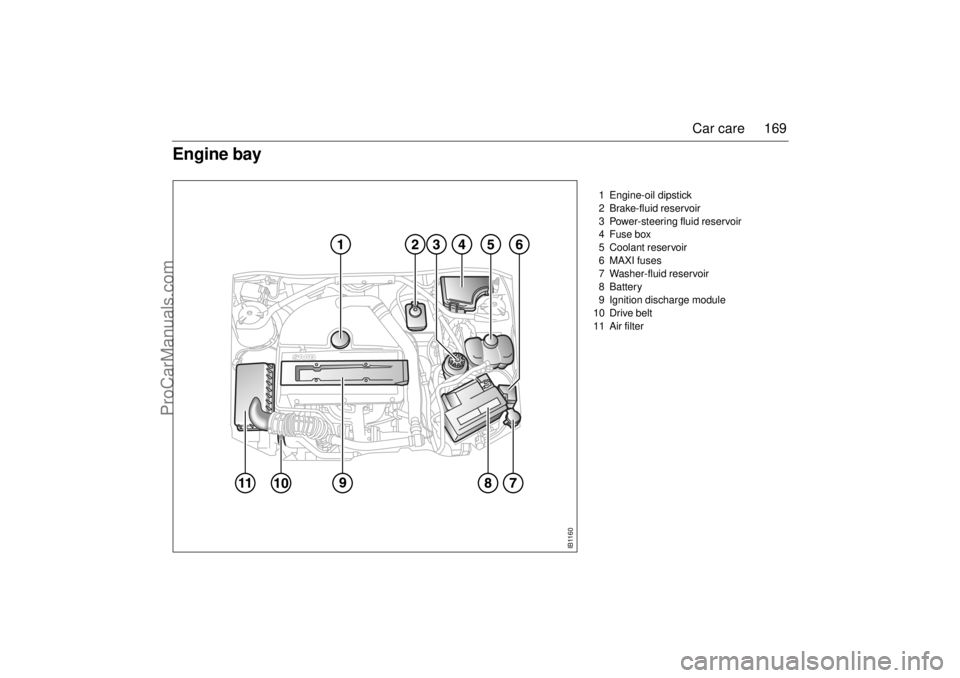
169 Car care
1 Engine-oil dipstick
2 Brake-fluid reservoir
3 Power-steering fluid reservoir
4 Fuse box
5 Coolant reservoir
6 MAXI fuses
7 Washer-fluid reservoir
8Battery
9 Ignition discharge module
10 Drive belt
11 Air filter
Engine bay
IB1160
ProCarManuals.com
Page 170 of 236

170 Car careEngine familiesSaab cars imported into the United States
and Canada meet all applicable emission
control standards. The engine family and
appropriate tune-up specifications are iden-
tified on a label affixed to the left front inner
fender.
These engine families meet applicable EPA
Federal Standards, California State Stan-
dards and Canadian Federal Standards and
are equipped with the following systems:
• Sequential multiport fuel injection system.
Three way catalytic converter.
Crankcase emissions control system.
Evaporative emission system.
Emission control
systemsThe systems for controlling emissions to the
atmosphere require regular checking and
adjustment at the intervals specified in the
service program.
In addition to meeting the exhaust emission
regulations and thereby helping to keep the
environment clean, a correctly tuned engine
will also give maximum fuel economy.
Saab Trionic engine management
systemThe Saab Trionic engine management
system is a unique Saab development that
combines sequential multiport fuel injection,
electronic distributorless ignition and turbo-
charger boost pressure control into one sys-
tem.
The Trionic engine control module (ECM)
monitors many different engine parameters
such as:
Intake manifold pressure.
Intake air temperature.
Crankshaft position.
Engine coolant temperature.
Throttle position.
The oxygen content of the exhaust gases.
The ECM receives information regarding
engine knocking from a sophisticated feed-
back function in the ignition discharge unit.
By processing all of this information, the Tri-
onic system can control fuel injector open-
ing duration, ignition timing and turbo-
charger boost pressure to provide excellent
engine performance while maintaining low
emissions and fuel consumption.
ProCarManuals.com
Page 174 of 236

174 Car care
(80°C). This can be achieved by driving
the car for about 30 min on the open
road.
2 With the engine idling, move the selector
lever to D and wait for at least
15 seconds. Next, move the selector
lever to R and wait for 15 seconds again.
Finally, move the selector lever to P. Let
the engine idle.
3 Wipe the dipstick clean with a lint-free
cloth and put it back.
4 With the fluid at normal temperature, the
level should be between the MAX and
MIN marks on the dipstick. Top up, as
necessary, with Texaco Texamatic
Dexron III automatic-transmission fluid,
adding it through the dipstick pipe. The
distance between the MIN and MAX
marks on the dipstick corresponds to a
volume of approximately 0.4 qts
(0.4 litre).
If the outside temperature is below 50°F
(10°C), the fluid will not reach the specified
temperature of 175°F (80°C). In this case,
the correct fluid level may be 0.8 in (20 mm)
below the MAX mark.
CoolantThe expansion tank is transparent, to facili-
tate checking. The level must be a little
under the mark ”KALT – COLD” on the tank
when the engine is cold. If the SID message
"FILL COOLANT FLUID" is displayed, the
level in the expansion tank should be
checked. Top up as necessary with equal
parts of clean water and coolant. Use only
coolant approved by Saab.
If the expansion tank is empty when coolant
is added, run the engine to normal temper-
ature and top up again, as necessary. Coolant The cooling system is filled at the factory
with coolant containing a 50% concentra-
tion of a combined antifreeze and corrosion
inhibitor. A weaker mixture will result in
reduced anticorrosion protection. For pro-
tection against freezing in very cold
weather, a stronger concentration will be
needed.
A 60% concentration of antifreeze will pro-
vide protection at temperatures down to
-58 F (-50°C).
The corrosion-inhibiting properties of the
coolant deteriorate over time, but coolant
approved by Saab can be used for
year-round protection. Change the coolant
as specified in the service program (page
215) and use only coolant approved by
Saab – other makes may need changing
more frequently and may damage the sys-
tem.
NOTEIf there is a burnt smell or the fluid is black,
change the fluid as soon as possible.
Coolant expansion tank
ProCarManuals.com
Page 175 of 236

175 Car care
Changing the coolant(Usually carried out as part of the Saab
original service by an authorized Saab
dealer)
1 If the engine is hot, loosen the expan-
sion-tank filler cap a little to release the
pressure. Leave the cap in place.
2 Fit a suitable piece of hose onto the
nipple of the drain cock. Let the hose dis-
charge into a receptacle under the radi-
ator and open the drain cock, which is
located on the inside of the radiator
facing the engine bay.
3 Remove the filler cap on the expansion
tank.
4 In a couple of minutes the system will be
empty. Close the drain cock. 5 Mix antifreeze and water in a suitable
container. Use only Saab-approved
coolant.
6 Add the coolant slowly to the expansion
tank. This will take about two minutes,
as the air needs time to escape.
7 Screw the expansion-tank cap on and
run the engine to normal temperature.
Top up with coolant until the level is just
under the "KALT – COLD" mark on the
tank.
8 Check the coolant again after a few days
and top up as necessary.
NOTEAlways mix the antifreeze with the
appropriate volume of water before
adding it to the cooling system.
If pure antifreeze is added, the engine
could still freeze and be damaged. This is
because the antifreeze will not mix
properly with the coolant before the
thermostat has opened to allow full
circulation.
WARNING
Proceed with caution if the radiator is
boiling when you open the hood.
Never remove the expansion-tank
filler cap when the radiator is boiling.
Loosen the cap carefully, and let the
engine cool before removing the cap.
The cooling system is pressurized –
hot coolant and vapor can escape
when the filler cap is released.
IB893
Radiator drain cock
ProCarManuals.com
Page 215 of 236

215 Maintenance and owner assistance
Saab Original Service Program M2000 USA, Canada, (9-3 Models)* These are the minimum required Emission Control System maintenance steps. Saab urges that all recommended maintenance procedures be performed
according to this program.
(a.) Engine oil and filter should be changed at least once a year. Intermediate oil and filter changes (halfway between indicated intervals) suggested for
cars primarily used for driving in dense city traffic or for repeated short trip operation without sufficient warm up.
** Service intervals:
Refer to the Warranties & Service Record Book for service intervals beyond 100,000 miles (160,000 km).Service Intervals **
Miles = U.S. Cars
Kilometers = Canadian Cars
1,000
(1,600 km)
10,000
(16,000 km)
20,000
(32,000 km)
30,000
(48,000 km)
40,000
(64,000 km)
50,000
(80,000 km)
60,000
(96,000 km)
70,000
(112,000 km)
80,000
(128,000 km)
90,000
(144,000 km)
100,000
(160,000 km)
Service #
1234567891011
Engine and engine compartment
E Engine oil and filter (a.)!!!!!!!!!!!
R Engine coolant freezing point and level""" "" "" "
R Engine coolant flush and replace (max. 3-year intervals)!!!
R Engine cooling system, hoses and cap""""""""""
R Drive belt; condition""""" ! """"
E Spark plugs!
*
!*
!*
E Crankcase ventilation and vacuum lines""
Application/type of service (col. 1) Service Procedure
E = emission service"= Check - top up, adjust or replace if necessary
R = regular maintenance!= Replace
#= Lubricate
ProCarManuals.com
Page 223 of 236

223 Technical data
Engine Engine oilType _____________________________ 4 cyl, 2 overhead
camshafts,
16 valves and 2 bal-
ancer shafts
Cylinder bores ______________________ 3.54" (90 mm)
Stroke:
2.0 Turbo _________________________ 3.071" (78 mm)
Viggen __________________________ 3.543” (90 mm)
Swept volume:
2.0 Turbo _________________________ 121 cu.in.
(1,985 dm
3)
Viggen __________________________ 140 cu.in.
(2.290 dm3)
Idling speed _______________________ 900 rpm
Antifreeze _________________________ Saab-approved
antifreeze
Coolant volume, cooling system ________ 8.7 qts. (8.5 l)
Oil grade: We recommend the use of oils that are available from your
Saab dealer, for the regular oil changes.
These oils fulfill the most stringent requirements set by API and
ACEA classifications.
Oil for gasoline engines is classified by the API standards
(American Petroleum Institute) into the grade classes SH (since
1993) and SJ (since 1996). The SJ class fulfils more stringent
requirements and has a lower phosphorous level.
These grade classes are most often combined with the corre-
sponding classes for diesel engines. The class designations for
diesel engines begin with the letter “C“ (Commercial). For ex-
ample a grade combination suitable for both types of engine
could be API SH/CD or SJ/CF.
Under ACEA nomenclature, oils are divided into Class A for
gasoline engines and Class B for diesel-engined passenger
cars. There is a further class for heavy diesel engines. Each
class is divided into three grades: 1, 2 and 3, where grades 2
and 3 normally encompass semi and fully-synthetic oils.
In the same way as in the API system, gasoline and diesel
engine specifications are combined for products that can be
used in both types of engine. For example, a grade designation
could be ACEA A2/B2 or ACEA A3/B3.
To afford Saab engines the best protection, with regard to lubri-
cation, the ability to dissolve residues and the neutralization of
combustion products, we recommend the following oil grades:
API SH/CD/CF or SJ/CD/CF.
ACEA A2/B2 or A3/B3.
These oils contain the additives required for the engine to
function well. We advise against the use of further addi-
tives.
ProCarManuals.com
Page 231 of 236

231 Technical data
Several of the systems in your Saab
car may be adjusted to better fit your
individual needsSome functions are governed by legal
requirements and cannot therefore be
reprogrammed.
Consult an authorized Saab dealer for fur-
ther information.
Car alarm/central locking system:
The level of the siren when locking/
unlocking, HIGH or LOW.
The number of blinks when locking/
unlocking, 1 to 7.
Automatic locking of the trunk when the
car is driven, 1 to 8 mph (2-14 km/h), YES
or NO.
Preclude the unlocking of the trunk while
the car is driven, YES or NO.
Automatic locking of the trunk after
1 second-4 minutes if it has not been
opened, YES or NO.
Automatic locking of the trunk when it is
closed, YES or NO.Automatic climate control (ACC):
Indoor temperature can be
increased/decreased relative to the
selected temperature.
Delayed start of fan after starting the car,
to reduce risk of fogging windshield.
Temperature at which the defroster mode
is automatically selected.
Response time for the fan speed when
the selected temperature is changed.
Temperature at which the air distribution
switches from defrost mode to
defrost/floor mode.
Last manual selection will be selected the
next time the car is started.Saab Information Display (SID):
Outdoor temperature display can be
adjusted.
Days remaining to next service can be
activated/counted or not.
Delete “Test Brake Light“ message on
SID at start-up.
Miscellaneous:
Select the on-time for heated rear seat.
Coolant temperature gauge adjustment
can be increased/decreased.
Fuel level gauge adjustment can be
increased/decreased.
Additional sweep of the wipers after wind-
shield washer function (ON or OFF).
Follow me home on-time can vary from 20
to 50 seconds.
Night panel illumination deactivation
speed for the speedometer can be
adjusted.
ProCarManuals.com