Page 41 of 318

1-29
NOTICE:
If you damage the covering for the driver's or the
right front passenger's air bag, the bag may not
work properly. You may have to replace the air
bag module in the steering wheel or both the air
bag module and the instrument panel for the
right front passenger's air bag. Do not open or
break the air bag coverings.
If your vehicle ever gets into a lot of water -- such as
water up to the carpeting or higher
-- or if water enters
your vehicle and soaks the carpet, the air bag controller
can be soaked and ruined. If this ever happens, and then
you start your vehicle, the damage could make the air
bags inflate, even if there's no crash. You would have to
replace the air bags as well as the sensors and related
parts. If your vehicle is ever in a flood, or if it's exposed
to water that soaks the carpet, you can avoid needless
repair costs by turning off the vehicle immediately and
disconnecting the battery cables. Don't let anyone start
the vehicle under any circumstances. See your dealer
for service.
Servicing Your Air Bag-Equipped Vehicle
Air bags affect how your vehicle should be serviced.
There are parts of the air bag system in several places
around your vehicle. You don't want the system to
inflate while someone is working on your vehicle.
Your dealer and the service manual have information
about servicing your vehicle and the air bag system.
To purchase a service manual, see ªService and Owner
Publicationsº in the Index.
CAUTION:
For up to 10 minutes after the ignition key is
turned off and the battery is disconnected, an air
bag can still inflate during improper service. You
can be injured if you are close to an air bag when
it inflates. Avoid wires wrapped with yellow tape
or yellow connectors. They are probably part
of the air bag system. Be sure to follow proper
service procedures, and make sure the person
performing work for you is qualified to do so.
The air bag system does not need regular maintenance.
Page 66 of 318

2-
2-1
Section 2 Features and Controls
Here you can learn about the many standard and optional features on your vehicle, and information on starting,
shifting and braking. Also explained are the instrument panel and the warning systems that tell you if everything is
working properly
-- and what to do if you have a problem.
2
-2 Keys
2
-4 Door Locks
2
-9 Keyless Entry System If Equipped)
2
-12 Trunk
2
-14 Theft
2
-15 Passlock�
2-16 New Vehicle ªBreak-Inº
2
-16 Ignition Switch
2
-17 Starting Your Engine
2
-20 Engine Coolant Heater (If Equipped)
2
-22 Automatic Transaxle Operation
2
-25 Manual Transaxle Operation
2
-27 Parking Brake
2
-28 Shifting Into PARK (P)
(Automatic Transaxle Only)
2
-30 Shifting Out of PARK (P)
(Automatic Transaxle Only)
2
-30 Parking Your Vehicle
(Manual Transaxle Models Only)2
-30 Parking Over Things That Burn
2
-31 Engine Exhaust
2
-32 Running Your Engine While You're Parked
(Automatic Transaxle)
2
-33 Windows
2
-34 Tilt Wheel
2
-34 Turn Signal/Multifunction Lever
2
-41 Exterior Lamps
2
-44 Interior Lamps
2
-46 Mirrors
2
-48 Storage Compartments
2
-48 Ashtray and Lighter (If Equipped)
2
-49 Sun Visors
2
-49 Sunroof (If Equipped)
2
-50 The Instrument Panel-Your
Information System
2
-54 Warning Lights, Gages and Indicators
Page 87 of 318
2-22
Automatic Transaxle Operation
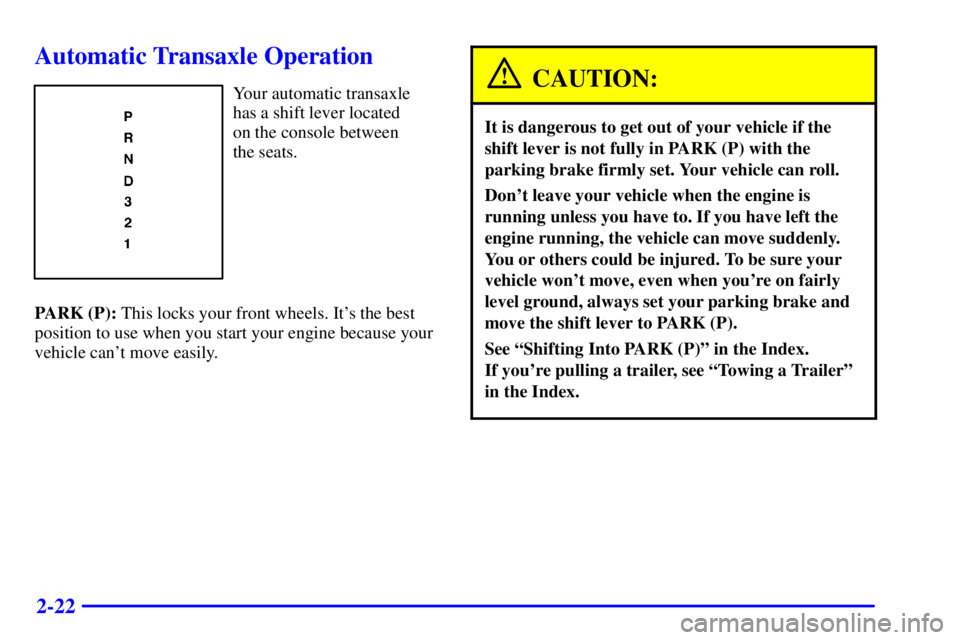
Your automatic transaxle
has a shift lever located
on the console between
the seats.
PARK (P): This locks your front wheels. It's the best
position to use when you start your engine because your
vehicle can't move easily.CAUTION:
It is dangerous to get out of your vehicle if the
shift lever is not fully in PARK (P) with the
parking brake firmly set. Your vehicle can roll.
Don't leave your vehicle when the engine is
running unless you have to. If you have left the
engine running, the vehicle can move suddenly.
You or others could be injured. To be sure your
vehicle won't move, even when you're on fairly
level ground, always set your parking brake and
move the shift lever to PARK (P).
See ªShifting Into PARK (P)º in the Index.
If you're pulling a trailer, see ªTowing a Trailerº
in the Index.
Page 88 of 318

2-23
Ensure the shift lever is fully in PARK (P) before
starting the engine. Your vehicle has an automatic
transaxle shift lock control. You have to apply your
regular brake before you can shift from PARK (P) when
the ignition key is in ON. If you cannot shift out of
PARK (P), ease pressure on the shift lever and push the
shift lever all the way into PARK (P) and as you
maintain brake application. Then move the shift lever
into the gear you wish. (Press the shift lever button
before moving the shift lever.) See ªShifting Out of
PARK (P)º later in this section.
REVERSE (R): Use this gear to back up.
NOTICE:
Shifting to REVERSE (R) while your vehicle is
moving forward could damage your transaxle.
Shift to REVERSE (R) only after your vehicle
is stopped.
To rock your vehicle back and forth to get out of snow,
ice or sand without damaging your transaxle, see ªStuck
In Sand, Mud, Ice or Snowº in the Index.NEUTRAL (N): In this position, your engine
doesn't connect with the wheels. To restart when you're
already moving, use NEUTRAL (N) only. Also, use
NEUTRAL (N) when your vehicle is being towed.
CAUTION:
Shifting out of PARK (P) or NEUTRAL (N) while
your engine is ªracingº (running at high speed) is
dangerous. Unless your foot is firmly on the
brake pedal, your vehicle could move very
rapidly. You could lose control and hit people or
objects. Don't shift out of PARK (P) or
NEUTRAL (N) while your engine is racing.
NOTICE:
Damage to your transaxle caused by shifting out
of PARK (P) or NEUTRAL (N) with the engine
racing isn't covered by your warranty.
Page 90 of 318
2-25
FIRST (1): This position gives you even more power
(but lower fuel economy) than SECOND (2). You can
use it on very steep hills, or in deep snow or mud.
If the selector lever is put in FIRST (1), the transaxle
won't shift into first gear until the vehicle is going
slowly enough.
NOTICE:
If your front wheels can't rotate, don't try to
drive. This might happen if you were stuck in
very deep sand or mud or were up against a solid
object. You can damage your transaxle.
Also, if you stop when going uphill, don't hold
your vehicle there with only the accelerator
pedal. This could overheat and damage the
transaxle. Use your brakes or shift into PARK (P)
to hold your vehicle in position on a hill.
Manual Transaxle Operation
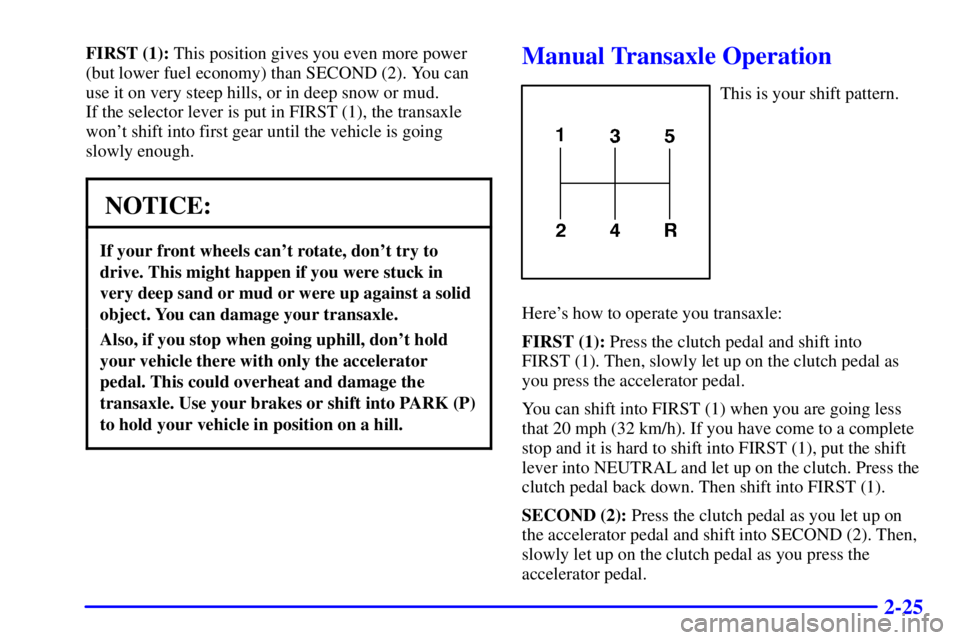
This is your shift pattern.
Here's how to operate you transaxle:
FIRST (1): Press the clutch pedal and shift into
FIRST (1). Then, slowly let up on the clutch pedal as
you press the accelerator pedal.
You can shift into FIRST (1) when you are going less
that 20 mph (32 km/h). If you have come to a complete
stop and it is hard to shift into FIRST (1), put the shift
lever into NEUTRAL and let up on the clutch. Press the
clutch pedal back down. Then shift into FIRST (1).
SECOND (2): Press the clutch pedal as you let up on
the accelerator pedal and shift into SECOND (2). Then,
slowly let up on the clutch pedal as you press the
accelerator pedal.
Page 98 of 318

2-33
Windows
Manual Windows
On a vehicle with manual windows, use the window
crank to open and close each window.
Power Windows (If Equipped)
The power window switches are located on the armrest
of the driver's door. In addition, each passenger door has
a switch for its own window.Auto
-Down Switch
The driver's window switch has an auto
-down feature.
This switch is black. Push the top of the switch partway,
and the driver's window will open a small amount. If the
switch is pushed all the way, the window will go all the
way down.
To stop the window while it is lowering, push the
switch forward. To raise the window, push and hold
the switch forward.
Lock
-Out Switch
On four
-door models, the driver's power window
controls also include a lock
-out switch. When the
lock
-out switch is moved to the left (with the red
showing), the driver and passengers will be able to use
their window switches. Move the lock
-out switch to the
right to stop the passengers from using their window
switches. The driver can still control all the windows
with the lock on.
Horn
You can sound the horn by pressing the horn symbol on
your steering wheel.
Page 99 of 318
2-34
Tilt Wheel
A tilt steering wheel allows you to adjust the steering
wheel before you drive.
You can also raise it to the highest level to give your
legs more room when you exit and enter the vehicle.
To tilt the wheel, hold the steering wheel and pull the
lever toward you.
Move the steering wheel to a comfortable level, then
release the lever to lock the wheel in place.
Turn Signal/Multifunction Lever
The lever on the left side of the steering column
includes your:
�Turn Signal and Lane Change Indicator
�Headlamp High/Low Beam Changer
�Park Lamps and Headlamps Control Switch
Page 103 of 318
2-38 Cruise Control (If Equipped)
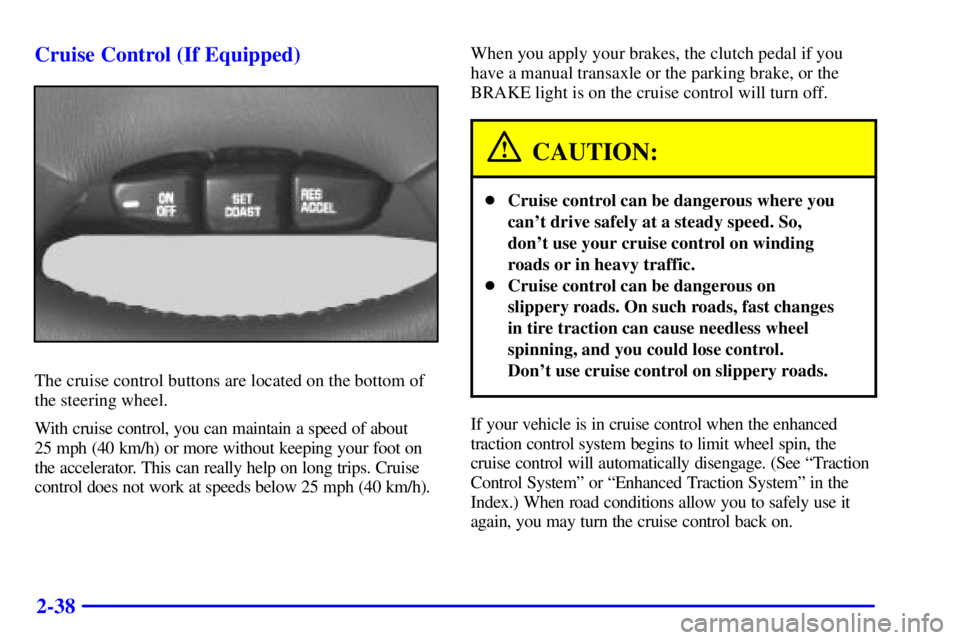
The cruise control buttons are located on the bottom of
the steering wheel.
With cruise control, you can maintain a speed of about
25 mph (40 km/h) or more without keeping your foot on
the accelerator. This can really help on long trips. Cruise
control does not work at speeds below 25 mph (40 km/h).When you apply your brakes, the clutch pedal if you
have a manual transaxle or the parking brake, or the
BRAKE light is on the cruise control will turn off.
CAUTION:
�Cruise control can be dangerous where you
can't drive safely at a steady speed. So,
don't use your cruise control on winding
roads or in heavy traffic.
�Cruise control can be dangerous on
slippery roads. On such roads, fast changes
in tire traction can cause needless wheel
spinning, and you could lose control.
Don't use cruise control on slippery roads.
If your vehicle is in cruise control when the enhanced
traction control system begins to limit wheel spin, the
cruise control will automatically disengage. (See ªTraction
Control Systemº or ªEnhanced Traction Systemº in the
Index.) When road conditions allow you to safely use it
again, you may turn the cruise control back on.