Page 5 of 402
Table of Contents (cont'd)
Defensive Driving
Drunken Driving
Control of a Vehicle
Braking
SteeringDriving Tips for Various Road Conditions
Recreational Vehicle Towing
Loading Your Vehicle
Towing a Trailer Heating and Air Conditioning
Setting the Radio Clock
Radio/Cassette Player/CD PlayerRadio Theft-Deterrent Feature
Steering Wheel Controls (If Equipped)
Hazard Warning Flashers
Jump Starting
Towing Your VehicleEngine Overheating
Changing a Flat Tire
If You're Stuck
Problems on the Road
iii
Comfort Controls and Audio Systems
Your Driving and the Road
Section
3
Section
4
Section
5
Page 35 of 402
1-23
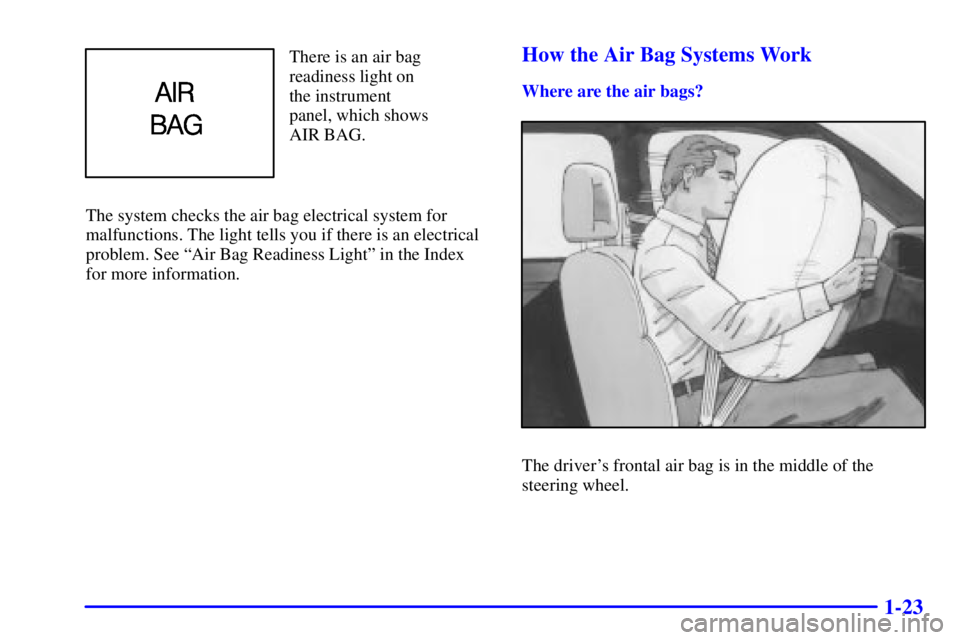
There is an air bag
readiness light on
the instrument
panel, which shows
AIR BAG.
The system checks the air bag electrical system for
malfunctions. The light tells you if there is an electrical
problem. See ªAir Bag Readiness Lightº in the Index
for more information.How the Air Bag Systems Work
Where are the air bags?
The driver's frontal air bag is in the middle of the
steering wheel.
Page 37 of 402
1-25
CAUTION:
If something is between an occupant and an
air bag, the bag might not inflate properly or
it might force the object into that person.
The path of an inflating air bag must be kept
clear. Don't put anything between an occupant
and an air bag, and don't attach or put anything
on the steering wheel hub or on or near any other
air bag covering and don't let seat covers block
the inflation path of a side impact air bag.
When should an air bag inflate?
The driver's and right front passenger's frontal air bags
are designed to inflate in moderate to severe frontal or
near
-frontal crashes. The frontal air bags are designed
to inflate only if the impact speed is above the system's
designed ªthreshold level.º If your vehicle goes straight
into a wall that doesn't move or deform, the threshold
level is about 11 to 16 mph (18 to 26 km/h). The
threshold level can vary, however, with specific vehicle design, so that it can be somewhat above or below this
range. If your vehicle strikes something that will move
or deform, such as a parked car, the threshold level
will be higher. The driver's and right front passenger's
frontal air bags are not designed to inflate in rollovers,
side impacts, or rear impacts, because inflation would
not help the occupant.
The side impact air bags are designed to inflate in
moderate to severe side crashes. A side impact air bag
will inflate if the crash severity is above the system's
designed ªthreshold level.º The threshold level can vary
with specific vehicle design. Side impact air bags are not
designed to inflate in frontal or near
-frontal impacts,
rollovers or rear impacts, because inflation would not
help the occupant. A side impact air bag will only
deploy on the side of the vehicle that is struck.
In any particular crash, no one can say whether an air
bag should have inflated simply because of the damage
to a vehicle or because of what the repair costs were.
For frontal air bags, inflation is determined by the angle
of the impact and how quickly the vehicle slows down
in frontal and near
-frontal impacts. For side impact
air bags, inflation is determined by the location and
severity of the impact.
Page 38 of 402

1-26
What makes an air bag inflate?
In an impact of sufficient severity, the air bag sensing
system detects that the vehicle is in a crash. For both
frontal and side impact air bags, the sensing system
triggers a release of gas from the inflator, which inflates
the air bag. The inflator, air bag and related hardware
are all part of the air bag modules inside the steering
wheel, instrument panel and the side of the front
seatbacks closest to the door.
How does an air bag restrain?
In moderate to severe frontal or near frontal collisions,
even belted occupants can contact the steering wheel
or the instrument panel. In moderate to severe side
collisions, even belted occupants can contact the inside
of the vehicle. The air bag supplements the protection
provided by safety belts. Air bags distribute the force of
the impact more evenly over the occupant's upper body,
stopping the occupant more gradually. But the frontal air
bags would not help you in many types of collisions,
including rollovers, rear impacts, and side impacts,
primarily because an occupant's motion is not toward
the air bag. Side impact air bags would not help you in
many types of collisions, including frontal or near frontal collisions, rollovers, and rear impacts, primarily
because an occupant's motion is not toward those air
bags. Air bags should never be regarded as anything
more than a supplement to safety belts, and then only in
moderate to severe frontal or near
-frontal collisions for
the driver's and right front passenger's frontal air bags,
and only in moderate to severe side collisions for the
driver's and right front passenger's side impact air bags.
What will you see after an air bag inflates?
After an air bag inflates, it quickly deflates, so quickly
that some people may not even realize the air bag
inflated. Some components of the air bag module
-- the
steering wheel hub for the driver's air bag, the
instrument panel for the right front passenger's bag, the
side of the seatback closest to the door for the driver and
right front passenger's side impact air bags
-- will be
hot for a short time. The parts of the bag that come into
contact with you may be warm, but not too hot to touch.
There will be some smoke and dust coming from the
vents in the deflated air bags. Air bag inflation doesn't
prevent the driver from seeing or being able to steer the
vehicle, nor does it stop people from leaving the vehicle.
Page 40 of 402
1-28
NOTICE:
If you damage the covering for the driver's or
the right front passenger's air bag, or the air
bag covering on the driver's and right front
passenger's seatback, the bag may not work
properly. You may have to replace the air bag
module in the steering wheel, both the air bag
module and the instrument panel for the right
front passenger's air bag, or both the air bag
module and seatback for the driver's and right
front passenger's side impact air bag. Do not
open or break the air bag coverings.
Servicing Your Air Bag-Equipped Vehicle
Air bags affect how your vehicle should be serviced.
There are parts of the air bag systems in several places
around your vehicle. Your dealer and the service manual
have information about servicing your vehicle and the
air bag systems. To purchase a service manual, see
ªService and Owner Publicationsº in the Index.
CAUTION:
For up to 10 seconds after the ignition key is
turned off and the battery is disconnected, an
air bag can still inflate during improper service.
You can be injured if you are close to an air bag
when it inflates. Avoid yellow connectors. They
are probably part of the air bag systems. Be sure
to follow proper service procedures, and make
sure the person performing work for you is
qualified to do so.
The air bag systems do not need regular maintenance.
Page 84 of 402

2-20
Ignition Positions
With the key in the ignition, you can turn the switch to
four different positions.
LOCK (A): This is the only position from which you
can remove the key. This position locks your ignition
and transaxle. It's a theft
-deterrent feature.
NOTICE:
If your key seems stuck in LOCK and you can't
turn it, be sure you are using the correct key;
if so, is it all the way in? If it is, then turn the
steering wheel left and right while you turn the
key hard. But turn the key only with your hand.
Using a tool to force it could break the key or the
ignition switch. If none of this works, then your
vehicle needs service.
ACCESSORY (B): In this position you can operate
your electrical power accessories such as power
windows, power sunroof (option), audio system and
windshield wipers.
RUN (C): This is the position the switch returns to after
you start your engine and release the switch. Even when
the engine is not running, you can use RUN to operate
your electrical power accessories and to display some
instrument panel cluster warning lights. This is the
position for driving your vehicle.
Page 97 of 402
2-33
Windows
Power Windows
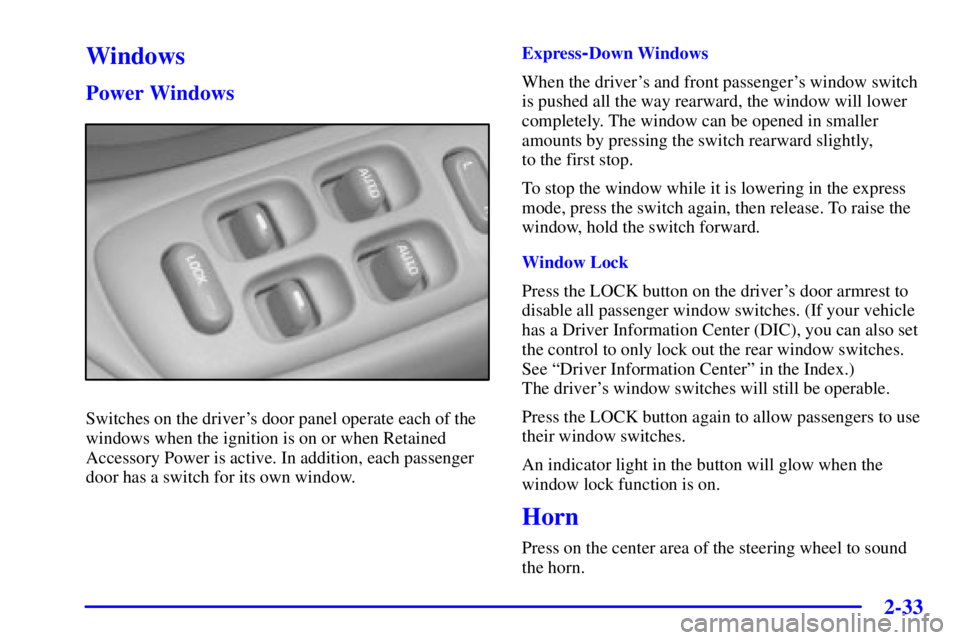
Switches on the driver's door panel operate each of the
windows when the ignition is on or when Retained
Accessory Power is active. In addition, each passenger
door has a switch for its own window.Express
-Down Windows
When the driver's and front passenger's window switch
is pushed all the way rearward, the window will lower
completely. The window can be opened in smaller
amounts by pressing the switch rearward slightly,
to the first stop.
To stop the window while it is lowering in the express
mode, press the switch again, then release. To raise the
window, hold the switch forward.
Window Lock
Press the LOCK button on the driver's door armrest to
disable all passenger window switches. (If your vehicle
has a Driver Information Center (DIC), you can also set
the control to only lock out the rear window switches.
See ªDriver Information Centerº in the Index.)
The driver's window switches will still be operable.
Press the LOCK button again to allow passengers to use
their window switches.
An indicator light in the button will glow when the
window lock function is on.
Horn
Press on the center area of the steering wheel to sound
the horn.
Page 98 of 402
2-34
Tilt Wheel
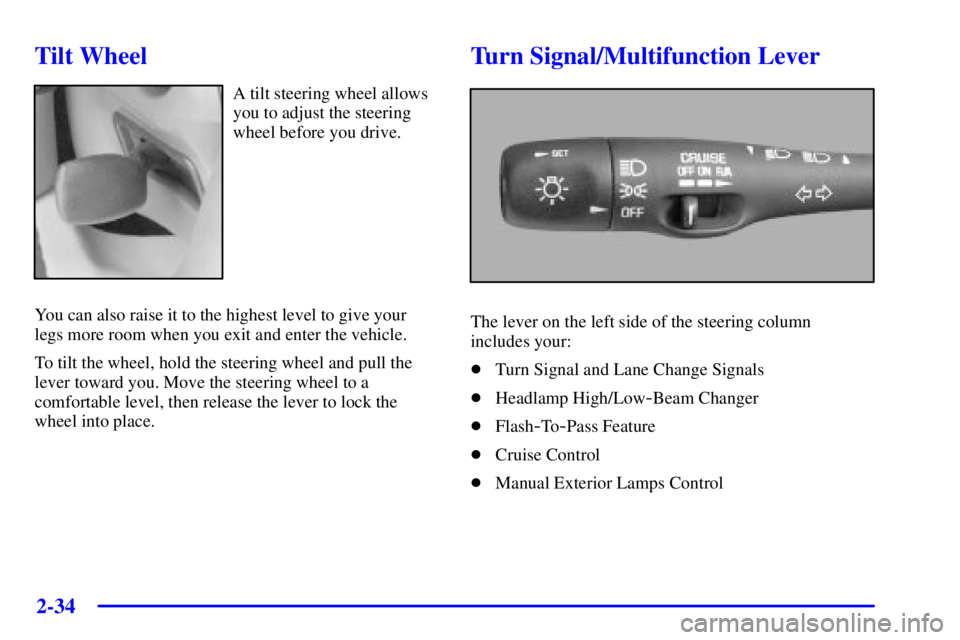
A tilt steering wheel allows
you to adjust the steering
wheel before you drive.
You can also raise it to the highest level to give your
legs more room when you exit and enter the vehicle.
To tilt the wheel, hold the steering wheel and pull the
lever toward you. Move the steering wheel to a
comfortable level, then release the lever to lock the
wheel into place.
Turn Signal/Multifunction Lever
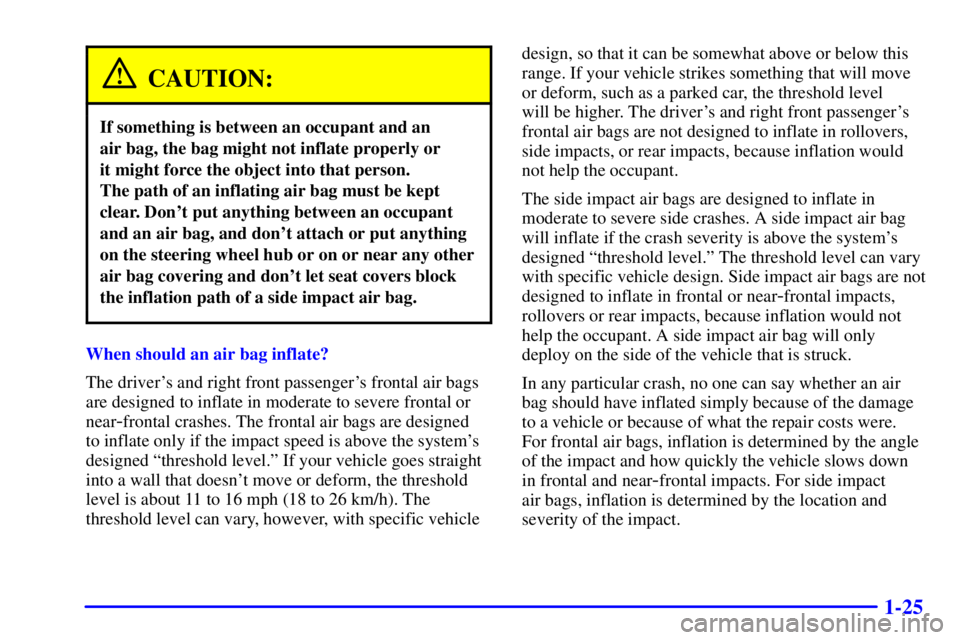
The lever on the left side of the steering column
includes your:
�Turn Signal and Lane Change Signals
�Headlamp High/Low
-Beam Changer
�Flash
-To-Pass Feature
�Cruise Control
�Manual Exterior Lamps Control