Page 111 of 402
2-47
If your vehicle's battery remains in a heavy discharge
condition for a long period of time, the blower fan, rear
defogger, heated seats and heated mirrors will be
disabled and the DIC will display BATTERY SAVER
ACTIVE. This can happen either under long periods of
idling or low speed driving with high electrical loading,
or in the event of a charging system fault.
Monitor the battery voltage when in the BATTERY
SAVER ACTIVE mode.
�If the voltmeter remains in the red area (below
11 volts) when driving then have the charging
system serviced immediately.
�If the voltage increases above 12 volts then the battery
needs to be recharged. Try driving on the highway
with as few electrical accessories on as possible.
Mirrors
Inside Day/Night Manual Rearview Mirror
When you are sitting in a comfortable driving position,
adjust the mirror so you can see clearly behind your
vehicle. Grip the mirror in the center to move it up or
down and side to side. The day/night adjustment allows
you to adjust the mirror to avoid glare from the lamps
behind you. Push the tab away from you for daytime
use; pull it toward you for night use.
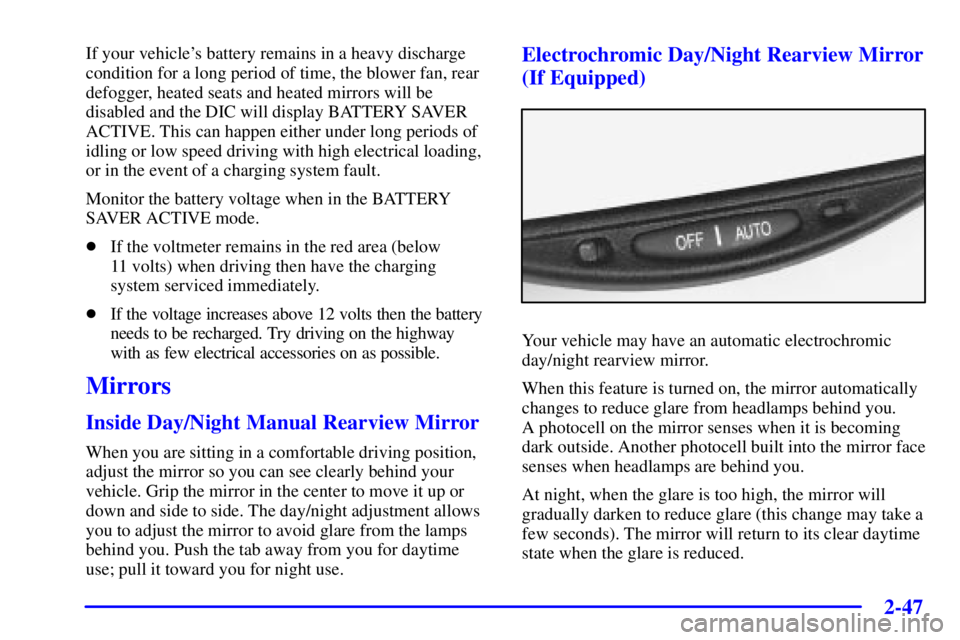
Electrochromic Day/Night Rearview Mirror
(If Equipped)
Your vehicle may have an automatic electrochromic
day/night rearview mirror.
When this feature is turned on, the mirror automatically
changes to reduce glare from headlamps behind you.
A photocell on the mirror senses when it is becoming
dark outside. Another photocell built into the mirror face
senses when headlamps are behind you.
At night, when the glare is too high, the mirror will
gradually darken to reduce glare (this change may take a
few seconds). The mirror will return to its clear daytime
state when the glare is reduced.
Page 113 of 402

2-49
To adjust a mirror, move the arrow control in the
direction you want that mirror to go. Leave the L/R
switch in the center position to disable mirror movement
by the arrow control. Adjust each outside mirror so that
your vehicle is barely visible in the mirror.
If your vehicle is equipped with the memory seat and
mirrors feature, these mirror positions, along with the
driver's seat position can be stored in memory.
See ªMemory Seat and Mirrorsº in the Index.
Parallel Park Assist Mirror (If Equipped)
If you have the memory seat and mirrors feature,
the passenger's outside rearview mirror also includes a
tilt
-down feature that operates when the shift lever is in
REVERSE (R). When the vehicle is shifted out of
REVERSE (R), the passenger's mirror will return to its
original position after a five
-second delay. This delay
prevents movement of the mirror if multiple gear
transitions (REVERSE (R) to DRIVE (D) to
REVERSE (R)) occur during a parallel parking
maneuver. This feature can be programmed on or off
through the DIC personalization programming menu.
See ªDIC Personalization Programmingº in the Index
for programming instructions. Vehicles are delivered
with this feature off.
Convex Outside Mirror
Your passenger's side mirror is convex. A convex
mirror's surface is curved so you can see more from the
driver's seat.
CAUTION:
A convex mirror can make things (like other
vehicles) look farther away than they really are.
If you cut too sharply into the right lane, you
could hit a vehicle on your right. Check your
inside mirror or glance over your shoulder before
changing lanes.
Heated Outside Mirror
When you operate the rear window defogger, a defogger
also warms the heated driver's and passenger's outside
mirrors to help clear them of ice and snow.
Page 220 of 402

4-16
Driving at Night
Night driving is more dangerous than day driving.
One reason is that some drivers are likely to be
impaired
-- by alcohol or drugs, with night vision
problems, or by fatigue.Here are some tips on night driving.
�Drive defensively.
�Don't drink and drive.
�Adjust your inside rearview mirror to reduce the
glare from headlamps behind you.
�Since you can't see as well, you may need to slow
down and keep more space between you and
other vehicles.
�Slow down, especially on higher speed roads. Your
headlamps can light up only so much road ahead.
�In remote areas, watch for animals.
�If you're tired, pull off the road in a safe place and rest.
No one can see as well at night as in the daytime. But as
we get older these differences increase. A 50
-year-old
driver may require at least twice as much light to see the
same thing at night as a 20
-year-old.
What you do in the daytime can also affect your night
vision. For example, if you spend the day in bright
sunshine you are wise to wear sunglasses. Your eyes
will have less trouble adjusting to night. But if you're
driving, don't wear sunglasses at night. They may cut
down on glare from headlamps, but they also make a lot
of things invisible.
Page 227 of 402
4-23
Here are some things you can check before a trip:
�Windshield Washer Fluid: Is the reservoir full?
Are all windows clean inside and outside?
�Wiper Blades: Are they in good shape?
�Fuel, Engine Oil, Other Fluids: Have you checked
all levels?
�Lamps: Are they all working? Are the lenses clean?
�Tires: They are vitally important to a safe,
trouble
-free trip. Is the tread good enough for
long
-distance driving? Are the tires all inflated to the
recommended pressure?
�Weather Forecasts: What's the weather outlook
along your route? Should you delay your trip a short
time to avoid a major storm system?
�Maps: Do you have up
-to-date maps?
Highway Hypnosis
Is there actually such a condition as ªhighway hypnosisº?
Or is it just plain falling asleep at the wheel? Call it
highway hypnosis, lack of awareness, or whatever.
There is something about an easy stretch of road with
the same scenery, along with the hum of the tires on the
road, the drone of the engine, and the rush of the wind
against the vehicle that can make you sleepy. Don't let it
happen to you! If it does, your vehicle can leave the
road in less than a second, and you could crash and
be injured.
What can you do about highway hypnosis?
First, be aware that it can happen.
Then here are some tips:
�Make sure your vehicle is well ventilated, with a
comfortably cool interior.
�Keep your eyes moving. Scan the road ahead and to
the sides. Check your rearview mirrors and your
instruments frequently.
�If you get sleepy, pull off the road into a rest, service
or parking area and take a nap, get some exercise, or
both. For safety, treat drowsiness on the highway as
an emergency.