Page 2 of 402
Free lockout assistance
Free dead-battery assistance
Free out-of-fuel assistance
Free flat-tire change
Emergency towing
1-800-762-3743
(For vehicles purchased in Canada,
call
1-800-268-6800)
that provides in an emergency:
1-800-762-3743
(For vehicles purchased in Canada,
call
1-800-268-6800)
Bumper-to-Bumper
3-years/36,000 miles (60 000 km)
Limited Warranty
Courtesy
Transportation
Every
2000 Bonneville
under warranty is
backed with the
following
services:
Page 5 of 402
Table of Contents (cont'd)
Defensive Driving
Drunken Driving
Control of a Vehicle
Braking
SteeringDriving Tips for Various Road Conditions
Recreational Vehicle Towing
Loading Your Vehicle
Towing a Trailer Heating and Air Conditioning
Setting the Radio Clock
Radio/Cassette Player/CD PlayerRadio Theft-Deterrent Feature
Steering Wheel Controls (If Equipped)
Hazard Warning Flashers
Jump Starting
Towing Your VehicleEngine Overheating
Changing a Flat Tire
If You're Stuck
Problems on the Road
iii
Comfort Controls and Audio Systems
Your Driving and the Road
Section
3
Section
4
Section
5
Page 116 of 402
2-52
Air Inflator System (Option)
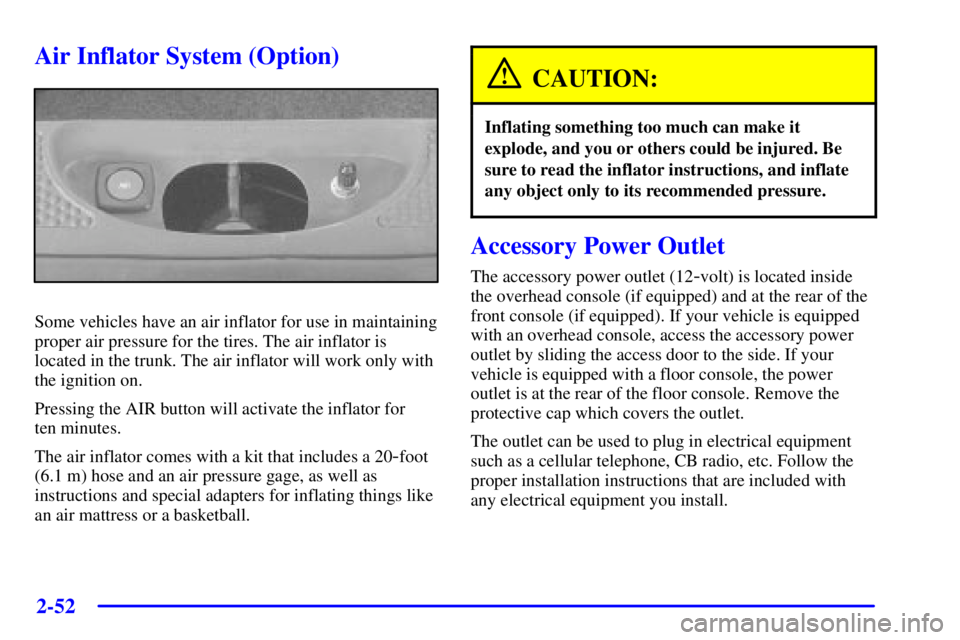
Some vehicles have an air inflator for use in maintaining
proper air pressure for the tires. The air inflator is
located in the trunk. The air inflator will work only with
the ignition on.
Pressing the AIR button will activate the inflator for
ten minutes.
The air inflator comes with a kit that includes a 20
-foot
(6.1 m) hose and an air pressure gage, as well as
instructions and special adapters for inflating things like
an air mattress or a basketball.
CAUTION:
Inflating something too much can make it
explode, and you or others could be injured. Be
sure to read the inflator instructions, and inflate
any object only to its recommended pressure.
Accessory Power Outlet
The accessory power outlet (12-volt) is located inside
the overhead console (if equipped) and at the rear of the
front console (if equipped). If your vehicle is equipped
with an overhead console, access the accessory power
outlet by sliding the access door to the side. If your
vehicle is equipped with a floor console, the power
outlet is at the rear of the floor console. Remove the
protective cap which covers the outlet.
The outlet can be used to plug in electrical equipment
such as a cellular telephone, CB radio, etc. Follow the
proper installation instructions that are included with
any electrical equipment you install.
Page 150 of 402

2-86
Battery Volts: On vehicles with a supercharged engine,
press the SELECT button until the display shows
BATTERY VOLTS. If the voltage is normal the display
will show BATTERY ## VOLTS. If the voltage drops
below 10.5 volts for 30 seconds, the battery volts
display will show BATTERY LOW. If the voltage is
above 16.2 volts for 30 seconds, the battery volts
display will show BATTERY HIGH. If the display
shows the high or low message, you need to have your
battery checked.
GM Oil Life System�: Press the SELECT button
until OIL LIFE appears in the display. The OIL LIFE
NORMAL display will show an estimate of the oil's
remaining useful life. When the oil life index is less than
10%, an ENGINE OIL CHANGE SOON message will be
displayed and the oil life display will show OIL LIFE
CHANGE. When the oil life index is less than 5%, an
ENGINE OIL CHANGE NOW message will be displayed
and the oil life display will show OIL LIFE CHANGE
NOW. When you have the oil changed according to the
maintenance schedule, you will have to reset the Oil Life
System. To reset the Oil Life System, see ªOil Life
Systemº in the Index. Also, see ªEngine Oil, When to
Changeº and ªMaintenance Scheduleº in the Index.Tire Pressure Status: Press the SELECT button until
TIRE PRESSURE appears in the display. TIRE
PRESSURE NORMAL is displayed when the Check Tire
Pressure System believes your vehicle's tire pressures are
normal. If a potential problem is detected, the display will
show CHECK TIRE PRESSURE and the tire pressure
status will show TIRE PRESSURE LOW. If you see the
CHECK TIRE PRESSURE message, you should stop as
soon as you can and check all your tires for damage.
(If a tire is flat, see ªIf a Tire Goes Flatº in the Index.)
Also check the tire pressure in all four tires as soon as
you can. See ªInflation
- Tire Pressureº and ªCheck
Tire Pressure Systemºin the Index.
Page 160 of 402

2-96
EXP (Export ID) Warning Message
83 SERVICE AIR BAG. . . . . . . . . . . . . . . . . . . . . . .
102 CHECK CHARGE SYSTEM. . . . . . . . . . . . . . .
140 DRIVER DOOR AJAR. . . . . . . . . . . . . . . . . . .
141 FRONT PASSENGER DOOR AJAR. . . . . . . .
142 LEFT REAR DOOR AJAR. . . . . . . . . . . . . . . .
143 RIGHT REAR DOOR AJAR. . . . . . . . . . . . . . .
144 CHECK TIRE PRESSURE. . . . . . . . . . . . . . . .
147 PARK BRAKE SET *. . . . . . . . . . . . . . . . . . . .
The EXP codes are used to make translation from
English to other languages easier.
Pressing any of the DIC control buttons will remove the
above messages or warnings from the DIC display,
unless noted by an asterisk (*).SERVICE STABILITY SYSTEM - 54 : If you ever
see the SERVICE STABILITY SYSTEM message,
it means there may be a problem with your stability
enhancement system. If you see this message, try to
reset the system (stop; turn off the engine; then start the
engine again). If the SERVICE STABILITY SYSTEM
message still comes on, it means there is a problem. You
should see your dealer for service. Reduce your speed
and drive accordingly.
Tire Pressure Status
- 144 : If you see the CHECK
TIRE PRESSURE message, you should stop as soon as
you can and check all your tires for damage. (If a tire is
flat, see ªIf a Tire Goes Flatº in the Index.) Also check
the tire pressure in all four tires as soon as you can.
See ªInflation
- Tire Pressureº and ªCheck Tire
Pressure Systemº in the Index.
Page 227 of 402

4-23
Here are some things you can check before a trip:
�Windshield Washer Fluid: Is the reservoir full?
Are all windows clean inside and outside?
�Wiper Blades: Are they in good shape?
�Fuel, Engine Oil, Other Fluids: Have you checked
all levels?
�Lamps: Are they all working? Are the lenses clean?
�Tires: They are vitally important to a safe,
trouble
-free trip. Is the tread good enough for
long
-distance driving? Are the tires all inflated to the
recommended pressure?
�Weather Forecasts: What's the weather outlook
along your route? Should you delay your trip a short
time to avoid a major storm system?
�Maps: Do you have up
-to-date maps?
Highway Hypnosis
Is there actually such a condition as ªhighway hypnosisº?
Or is it just plain falling asleep at the wheel? Call it
highway hypnosis, lack of awareness, or whatever.
There is something about an easy stretch of road with
the same scenery, along with the hum of the tires on the
road, the drone of the engine, and the rush of the wind
against the vehicle that can make you sleepy. Don't let it
happen to you! If it does, your vehicle can leave the
road in less than a second, and you could crash and
be injured.
What can you do about highway hypnosis?
First, be aware that it can happen.
Then here are some tips:
�Make sure your vehicle is well ventilated, with a
comfortably cool interior.
�Keep your eyes moving. Scan the road ahead and to
the sides. Check your rearview mirrors and your
instruments frequently.
�If you get sleepy, pull off the road into a rest, service
or parking area and take a nap, get some exercise, or
both. For safety, treat drowsiness on the highway as
an emergency.
Page 228 of 402
4-24
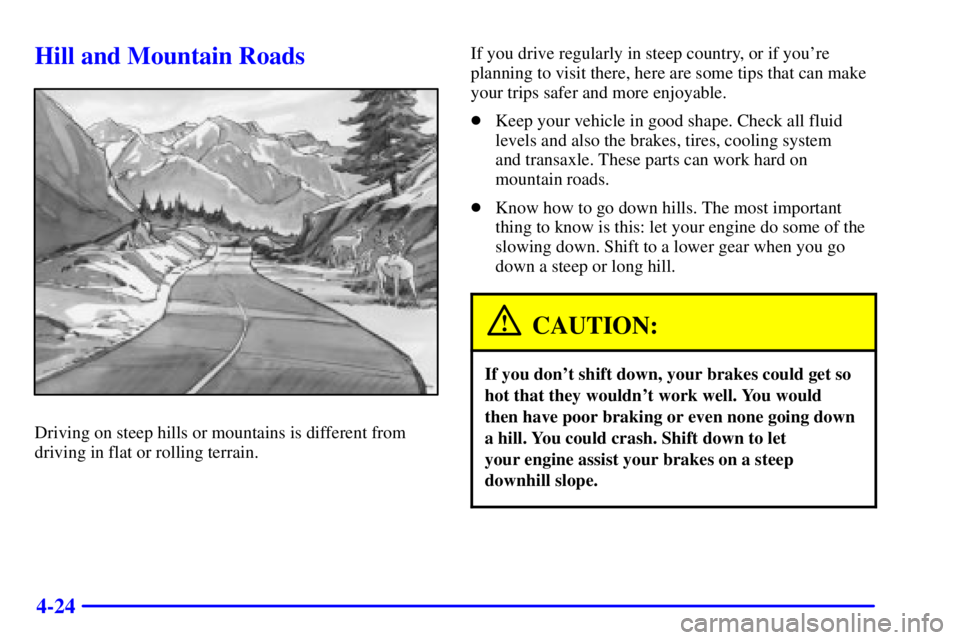
Hill and Mountain Roads
Driving on steep hills or mountains is different from
driving in flat or rolling terrain.If you drive regularly in steep country, or if you're
planning to visit there, here are some tips that can make
your trips safer and more enjoyable.
�Keep your vehicle in good shape. Check all fluid
levels and also the brakes, tires, cooling system
and transaxle. These parts can work hard on
mountain roads.
�Know how to go down hills. The most important
thing to know is this: let your engine do some of the
slowing down. Shift to a lower gear when you go
down a steep or long hill.
CAUTION:
If you don't shift down, your brakes could get so
hot that they wouldn't work well. You would
then have poor braking or even none going down
a hill. You could crash. Shift down to let
your engine assist your brakes on a steep
downhill slope.
Page 234 of 402
4-30
Then, shut the engine off and close the window almost
all the way to preserve the heat. Start the engine again
and repeat this only when you feel really uncomfortable
from the cold. But do it as little as possible. Preserve the
fuel as long as you can. To help keep warm, you can get
out of the vehicle and do some fairly vigorous exercises
every half hour or so until help comes.
Recreational Vehicle Towing
Your vehicle was not designed to be towed with all four
wheels on the ground. If your vehicle must be towed,
see ªTowing Your Vehicleº in the Index.
NOTICE:
Towing your vehicle with all four wheels on the
ground will damage drivetrain components.
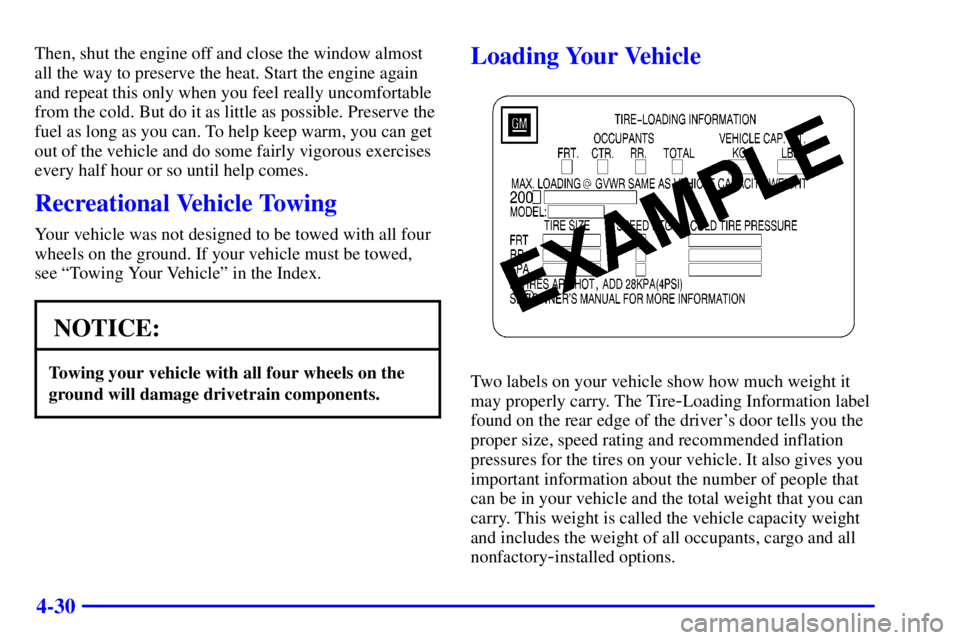
Loading Your Vehicle
Two labels on your vehicle show how much weight it
may properly carry. The Tire
-Loading Information label
found on the rear edge of the driver's door tells you the
proper size, speed rating and recommended inflation
pressures for the tires on your vehicle. It also gives you
important information about the number of people that
can be in your vehicle and the total weight that you can
carry. This weight is called the vehicle capacity weight
and includes the weight of all occupants, cargo and all
nonfactory
-installed options.