2000 NISSAN PATHFINDER stop start
[x] Cancel search: stop startPage 194 of 265
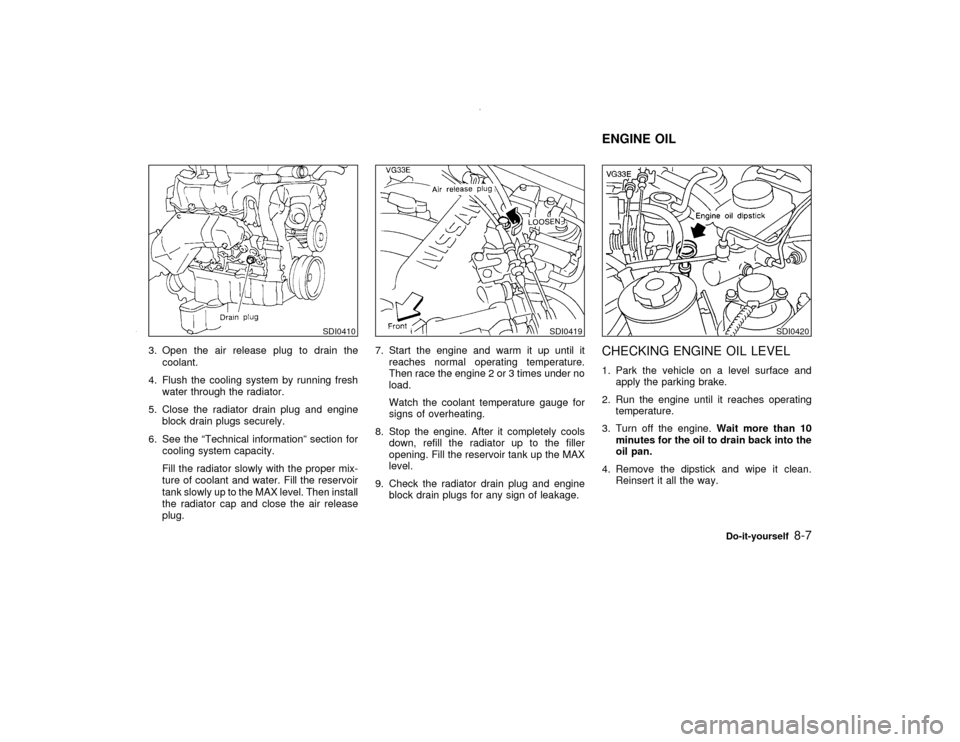
3. Open the air release plug to drain the
coolant.
4. Flush the cooling system by running fresh
water through the radiator.
5. Close the radiator drain plug and engine
block drain plugs securely.
6. See the ªTechnical informationº section for
cooling system capacity.
Fill the radiator slowly with the proper mix-
ture of coolant and water. Fill the reservoir
tank slowly up to the MAX level. Then install
the radiator cap and close the air release
plug.7. Start the engine and warm it up until it
reaches normal operating temperature.
Then race the engine 2 or 3 times under no
load.
Watch the coolant temperature gauge for
signs of overheating.
8. Stop the engine. After it completely cools
down, refill the radiator up to the filler
opening. Fill the reservoir tank up the MAX
level.
9. Check the radiator drain plug and engine
block drain plugs for any sign of leakage.
CHECKING ENGINE OIL LEVEL1. Park the vehicle on a level surface and
apply the parking brake.
2. Run the engine until it reaches operating
temperature.
3. Turn off the engine.Wait more than 10
minutes for the oil to drain back into the
oil pan.
4. Remove the dipstick and wipe it clean.
Reinsert it all the way.
SDI0410
SDI0419
SDI0420
ENGINE OIL
Do-it-yourself
8-7
Z
00.1.17/R50-D/V5
X
Page 204 of 265

The filter element should not be cleaned and
reused as it is given a special treatment. We
recommended it be replaced according to the
maintenance intervals. See ªPeriodic mainte-
nanceº in the ª9. Maintenanceº section for
maintenance intervals. When replacing the
filter, wipe the inside of the air cleaner housing
and the cover with a damp cloth.
WARNING
IOperating the engine with the air
cleaner removed can cause you orothers to be burned. The air cleaner
not only cleans the air, it stops flame
if the engine backfires. If it is not
there, and the engine backfires, you
could be burned. Do not drive with
the air cleaner removed and be care-
ful working on the engine with the air
cleaner removed.
INever pour fuel into the throttle body
or attempt to start the engine with the
air cleaner removed. Doing so could
result in serious injury.
SDI0393
AIR CLEANER
Do-it-yourself
8-17
Z
00.1.17/R50-D/V5
X
Page 207 of 265

Self-adjusting brakesYour vehicle is equipped with self-adjusting
brakes.
The front disc-type brakes self-adjust every
time the brake pedal is applied. The rear
drum-type brakes self-adjust every time the
parking brake is applied. If the brake pedal
goes down farther than normal, it may be due
to a lack of adjustment of the rear drum
brakes. Apply the parking brake several times.
WARNING
See your NISSAN dealer and have it
checked if the brake pedal height does
not return to normal.Brake pad wear indicatorsThe disc brake pads on your vehicle have
audible wear indicators. When a brake pad
requires replacement, it will make a high
pitched scraping or screeching sound when
the vehicle is in motion whether or not the
brake pedal is depressed. Have the brakes
checked as soon as possible if the wear indi-
cator sound is heard.
Under some driving or climate conditions, oc-casional brake squeak, squeal or other noise
may be heard. Occasional brake noise during
light to moderate stops is normal and does not
affect the function or performance of the brake
system.
The rear drum brakes (if so equipped) do not
have audible wear indicators. Should you ever
hear an unusually loud noise from the rear
drum brakes, have them inspected as soon as
possible by your NISSAN dealer.
Proper brake inspection intervals should
be followed.For additional information, see
ªPeriodic maintenanceº in the ª9. Mainte-
nanceº section for maintenance intervals.
BRAKE BOOSTERCheck the brake booster function with the
following steps:
1. With the engine off, press and release the
brake pedal several times. When brake
pedal movement (distance of travel) re-
mains the same from one pedal application
to the next, continue on to the next step.
2. While depressing the brake pedal, start the
engine. The pedal height should drop a
little.
3. With the brake pedal depressed, stop the
engine. Keeping the pedal depressed forabout 30 seconds, the pedal height should
not change.
4. Run the engine for one minute without
depressing the brake pedal, then turn it off.
Depress the brake pedal several times. The
pedal travel distance will decrease gradu-
ally with each depression as the vacuum is
released from the booster.
If the brakes do not operate properly, have the
brake checked by your NISSAN dealer.
8-20
Do-it-yourself
Z
00.1.17/R50-D/V5
X
Page 251 of 265

the vehicle's behavior, you should practice
turning, stopping and backing up in an area
which is free from traffic. Steering stability and
braking performance will be somewhat differ-
ent than under normal driving conditions.
IAlways secure items in the trailer to prevent
load shift while driving.
IAvoid abrupt starts, acceleration or stops.
IAvoid sharp turns or lane changes.
IAlways drive your vehicle at a moderate
speed.
IAlways block the wheels on both vehicle
and trailer when parking. Parking on a
slope is not recommended; however, if you
must do so, and if your vehicle is equipped
with automatic transmission, first block the
wheels and apply the parking brake, and
then move the transmission selector lever
into the P position. If you move the selector
lever to the P position before blocking the
wheels and applying the parking brake,
transmission damage could occur.
IWhen going down a hill, shift into a lower
gear and use the engine braking effect.
When ascending a long grade, downshift
the transmission to a lower gear and reduce
speed to reduce chances of engine over-
loading and/or overheating.However, for long steep grades, do not stay in
1st or 2nd gear when driving above 35 MPH
(56 km/h).
IIf the engine coolant rises to an extremely
high temperature when the air conditioning
system is on, turn off the air conditioner.
Coolant heat can be additionally vented by
opening the windows, switching the fan
control to high and setting the temperature
control to the HOT position.
ITrailer towing requires more fuel than nor-
mal circumstances.
IAvoid towing a trailer for the first 500 miles
(800 km).
IHave your vehicle serviced more often than
at intervals specified in the recommended
Maintenance Schedule.
When towing a trailer, change oil in the
transmission more frequently. See the
Maintenance Schedule.Your NISSAN is covered by the following
emission warranties.
For US:
1) Emission Defects Warranty
2) Emissions Performance Warranty
For CANADA:
Emission Control System Warranty
Details of these warranties may be found with
other vehicle warranties in your Warranty In-
formation and Maintenance Log Booklet which
comes with your NISSAN. If you did not re-
ceive a Warranty Information and Mainte-
nance Log Booklet or it becomes lost, you may
obtain a replacement by writing.
INissan North America, Inc. Consumer Af-
fairs Department P.O. Box 191 Gardena.
CA 90248-0191
INissan Canada Inc. 5290 Orbitor Drive
Mississauga, Ontario, L4W 4Z5
EMISSION CONTROL SYSTEM
WARRANTY
10-18
Technical and consumer information
Z
00.1.17/R50-D/V5
X
Page 258 of 265

Power steering fluid................................... 8-12
Window washer fluid ................................. 8-13
Fog light switch ............................................... 2-20
Four wheel drive (4WD).................................. 5-20
Front fog light switch ...................................... 2-20
Front manual seat adjustment .......................... 1-2
Fuel
Capacities and recommended fuel/
lubricants ................................................... 10-2
Filler cap .................................................... 3-12
Filler lid ...................................................... 3-12
Filler lid and cap ........................................ 3-12
Filler lid opener lever................................. 3-12
Fuel economy ............................................ 5-20
Fuel octane rating ..................................... 10-4
Fuel recommendation................................ 10-4
Gauge .......................................................... 2-5
Fuses .............................................................. 8-21
Fusible links .................................................... 8-21
G
Garage door opener, Integrated HomeLink
Universal Transceiver ..................................... 2-36
Gas cap .......................................................... 3-12
Gauge ............................................................... 2-3
Engine coolant temperature gauge ............. 2-4
Fuel gauge .................................................. 2-5
Odometer..................................................... 2-3
Speedometer ............................................... 2-3
Tachometer ................................................. 2-4
General maintenance ....................................... 9-2Glass hatch and outside mirror defogger
switch .............................................................. 2-17
Glass hatch lock ............................................. 3-11
Glass hatch opener ........................................ 3-11
Glasses case .................................................. 2-24
Glove box........................................................ 2-26
Glove box lock ................................................ 2-26
H
Hazard warning flasher switch........................ 2-21
Head restraints ................................................. 1-9
Headlamps, (Bulb replacement) ..................... 8-25
Headlights
(Bulb replacement) .................................... 8-25
Headlight switch ........................................ 2-17
Heated seats................................................... 2-22
Heater
Engine coolant heater ............................... 5-29
Heater and air conditioner (automatic) (if so
equipped)..................................................... 4-9
Heater and air conditioner controls ............. 4-3
Heater operation.......................................... 4-3
HomeLink
Universal Transceiver .................. 2-36
Hood, release ................................................... 3-9
Hook, Luggage hook ...................................... 2-28
Horn ................................................................ 2-21
How to stop alarm, Theft warning .................. 2-15
I
Ignition switch ................................................... 5-6Automatic transmission models .................. 5-6
Key positions ....................................................
Manual transmission models....................... 5-7
Immobilizer system ......................................... 2-15
Indicator lights and chimes (See warning/
indicator lights and chimes) ............................ 2-12
Inside mirror .................................................... 3-14
Inspection/maintenance (I/M) test................. 10-19
Instrument panel ............................................... 2-2
Integrated HomeLink
Universal
Transceiver ..................................................... 2-36
Interior lights ................................................... 2-34
J
Jump starting .................................................... 6-9
K
Keyless entry, (See multi-remote control
system) ............................................................. 3-5
Keys .................................................................. 3-2
L
Label, Air conditioner specification label ...... 10-13
Label, Emission control information label ..... 10-12
Label, F.M.V.S.S. certification label.............. 10-12
Labels
Air bag warning labels............................... 1-20
Air conditioner specification label ........ 4-3, 4-9
Z
00.1.17/R50-D/V5
X
11-3