2000 NISSAN PATHFINDER check engine light
[x] Cancel search: check engine lightPage 197 of 265
CAUTION
Be careful not to burn yourself, as the
engine oil may be hot.
4. Wipe the engine oil filter mounting surface
with a clean rag.
Be sure to remove any old rubber gasket
remaining on the mounting surface of the
engine.
5. Coat the rubber gasket on the new filter
with engine oil.
6. Screw in the oil filter until a slight resistance
is felt, then tighten an additional 2/3 turn.
7. Start the engine and check for leakage
around the oil filter. Correct as required.
8. Turn the engine off and wait several min-
utes. Check the oil level. Add engine oil if
necessary.
WARNING
IWhen engine is running, keep hands,
jewelry, and clothing away from any
moving parts such as fan and drive
belt.
IAutomatic transmission fluid is poi-
sonous and should be stored care-
fully in marked containers out of the
reach of children.
TEMPERATURE CONDITIONS
FOR CHECKINGThe fluid level should be checked using the
HOT range (L & H marks) on the dipstick at
fluid temperatures between 122 and 176ÉF (50
and 80ÉC) after the vehicle has been driven
approximately 5 minutes in urban areas after
the engine is warmed up. The level can be
checked at fluid temperatures between 86 and
122ÉF (30 and 50ÉC) using the COLD range on
the dipstick for reference, after the engine is
warmed up but before driving. However, the
fluid level must be rechecked using the HOT
range.
1. Park the vehicle on a level surface and set
the parking brake.
2. Start the engine and then move the selector
lever through each gear range, ending in P.
3. Check the fluid level with the engine idling.
If the vehicle has been driven for a long
time at high speeds, or in city traffic in hot
weather, or if it is being used to pull a
trailer, the fluid level cannot be read accu-
rately. You should wait until the fluid has
cooled down (about 30 minutes).
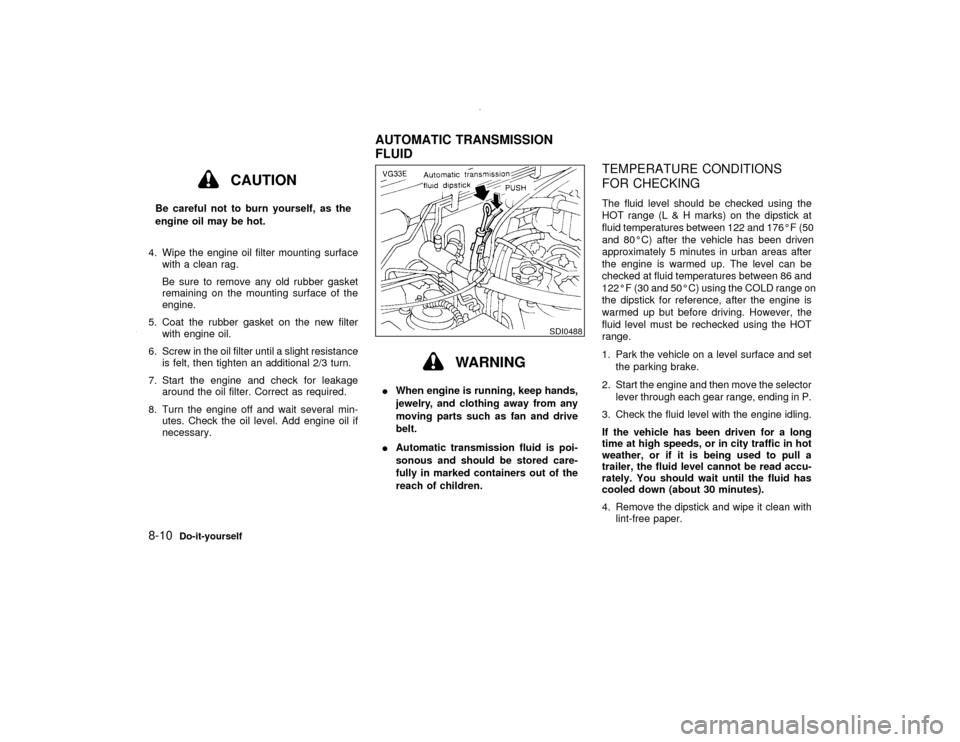
4. Remove the dipstick and wipe it clean with
lint-free paper.
SDI0488
AUTOMATIC TRANSMISSION
FLUID
8-10
Do-it-yourself
Z
00.1.17/R50-D/V5
X
Page 207 of 265

Self-adjusting brakesYour vehicle is equipped with self-adjusting
brakes.
The front disc-type brakes self-adjust every
time the brake pedal is applied. The rear
drum-type brakes self-adjust every time the
parking brake is applied. If the brake pedal
goes down farther than normal, it may be due
to a lack of adjustment of the rear drum
brakes. Apply the parking brake several times.
WARNING
See your NISSAN dealer and have it
checked if the brake pedal height does
not return to normal.Brake pad wear indicatorsThe disc brake pads on your vehicle have
audible wear indicators. When a brake pad
requires replacement, it will make a high
pitched scraping or screeching sound when
the vehicle is in motion whether or not the
brake pedal is depressed. Have the brakes
checked as soon as possible if the wear indi-
cator sound is heard.
Under some driving or climate conditions, oc-casional brake squeak, squeal or other noise
may be heard. Occasional brake noise during
light to moderate stops is normal and does not
affect the function or performance of the brake
system.
The rear drum brakes (if so equipped) do not
have audible wear indicators. Should you ever
hear an unusually loud noise from the rear
drum brakes, have them inspected as soon as
possible by your NISSAN dealer.
Proper brake inspection intervals should
be followed.For additional information, see
ªPeriodic maintenanceº in the ª9. Mainte-
nanceº section for maintenance intervals.
BRAKE BOOSTERCheck the brake booster function with the
following steps:
1. With the engine off, press and release the
brake pedal several times. When brake
pedal movement (distance of travel) re-
mains the same from one pedal application
to the next, continue on to the next step.
2. While depressing the brake pedal, start the
engine. The pedal height should drop a
little.
3. With the brake pedal depressed, stop the
engine. Keeping the pedal depressed forabout 30 seconds, the pedal height should
not change.
4. Run the engine for one minute without
depressing the brake pedal, then turn it off.
Depress the brake pedal several times. The
pedal travel distance will decrease gradu-
ally with each depression as the vacuum is
released from the booster.
If the brakes do not operate properly, have the
brake checked by your NISSAN dealer.
8-20
Do-it-yourself
Z
00.1.17/R50-D/V5
X
Page 208 of 265
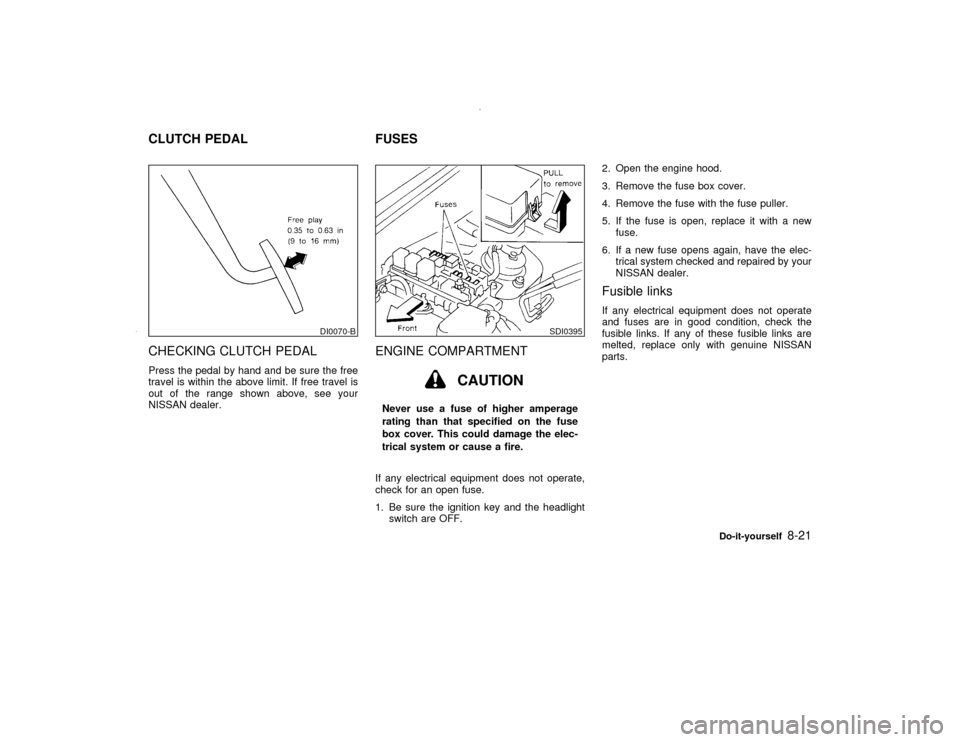
CHECKING CLUTCH PEDALPress the pedal by hand and be sure the free
travel is within the above limit. If free travel is
out of the range shown above, see your
NISSAN dealer.
ENGINE COMPARTMENT
CAUTION
Never use a fuse of higher amperage
rating than that specified on the fuse
box cover. This could damage the elec-
trical system or cause a fire.
If any electrical equipment does not operate,
check for an open fuse.
1. Be sure the ignition key and the headlight
switch are OFF.2. Open the engine hood.
3. Remove the fuse box cover.
4. Remove the fuse with the fuse puller.
5. If the fuse is open, replace it with a new
fuse.
6. If a new fuse opens again, have the elec-
trical system checked and repaired by your
NISSAN dealer.
Fusible linksIf any electrical equipment does not operate
and fuses are in good condition, check the
fusible links. If any of these fusible links are
melted, replace only with genuine NISSAN
parts.
DI0070-B
SDI0395
CLUTCH PEDAL FUSES
Do-it-yourself
8-21
Z
00.1.17/R50-D/V5
X
Page 224 of 265

Wheel nuts*:
When checking the tires, make sure no nuts
are missing, and check for any loose nuts.
Tighten if necessary.
Tire rotation*:
Tires should be rotated every 7,500 miles
(12,000 km). However, the timing for tire rota-
tion may vary according to your driving habits
and road surface conditions.
Wheel alignment and balance:
If the vehicle should pull to either side while
driving on a straight and level road, or if you
detect uneven or abnormal tire wear, there
may be a need for wheel alignment.
If the steering wheel or seat vibrates at normal
highway speeds, wheel balancing may be
needed.
Windshield wiper blades*:
Check for cracks or wear if they do not wipe
properly.
Doors and engine hood:
Check that all doors and the engine hood,
operate properly. Also ensure that all latches
lock securely. Lubricate hinges, latches, rollers
and links if necessary. Make sure that the
secondary latch keeps the hood from openingwhen the primary latch is released.
When driving in areas using road salt or other
corrosive materials, check lubrication fre-
quently.
Inside the vehicleLights*:
Make sure that the headlights, stop lights, tail
lights, turn signal lights, and other lights are all
operating properly and installed securely. Also
check headlight aim.INTERIOR MAINTENANCEThe maintenance items listed here should be
checked on a regular basis, such as when
performing periodic maintenance, cleaning the
vehicle, etc.
Warning lights and chimes:
Make sure that all warning lights and chimes
are operating properly.
Windshield wiper and washer*:
Check that the wipers and washer operate
properly and that the wipers do not streak.Windshield defroster:
Check that the air comes out of the defroster
outlets properly and in sufficient quantity when
operating the heater or air conditioner.
Steering wheel:
Check for changes in the steering conditions,
such as excessive freeplay, hard steering or
strange noises.
Seats:
Check seat position controls such as seat
adjusters, seatback recliner, etc. to ensure
they operate smoothly and that all latches lock
securely in every position. Check that the head
restraints move up and down smoothly and
that the locks (if so equipped) hold securely in
all latched positions.
Seat belts:
Check that all parts of the seat belt system
(e.g. buckles, anchors, adjusters and retrac-
tors) operate properly and smoothly, and are
installed securely. Check the belt webbing for
cuts, fraying, wear or damage.
Accelerator pedal:
Check the pedal for smooth operation and
make sure the pedal does not catch or require
Maintenance
9-3
Z
00.1.17/R50-D/V5
X
Page 238 of 265

eastern Nevada, southern Idaho, western
South Dakota, western Nebraska, and that
part of Texas which is directly south of New
Mexico.
Using unleaded gasoline with an octane
rating lower than stated above can cause
persistent, heavy spark knock. (Spark
knock is a metallic rapping noise.) If se-
vere, this can lead to engine damage. If you
detect a persistent heavy spark knock even
when using gasoline of the stated octane
rating, or if you hear steady spark knock
while holding a steady speed on level
roads, have your dealer correct the condi-
tion. Failure to correct the condition is
misuse of the vehicle, for which NISSAN is
not responsible.
Incorrect ignition timing will result in knocking,
after-run or overheating. This in turn may
cause excessive fuel consumption or damage
to the engine. If any of the above symptoms
are encountered, have your vehicle checked at
a NISSAN dealer or other competent service
facility.
However, now and then you may notice
light spark knock for a short time while
accelerating or driving up hills. This is no
cause for concern, because you get the
greatest fuel benefit when there is lightspark knock for a short time.
Technical and consumer information
10-5
Z
00.1.17/R50-D/V5
X
Page 256 of 265

11 Index
A
ABS (Anti-lock brake system) ......................... 5-26
Air bag system (See supplemental restraint
system) ........................................................... 1-16
Air bag system, Side (See supplemental side air
bag system) .................................................... 1-18
Air bag warning labels .................................... 1-20
Air bag warning light.............................. 1-21, 2-11
Air cleaner housing filter ................................. 8-17
Air conditioner
Air conditioner operation ...................... 4-3, 4-9
Air conditioner service ................ 4-3, 4-9, 4-11
Air conditioner specification
label .......................................... 4-3, 4-9, 10-13
Air conditioner system refrigerant and
lubrication recommendations ............... 4-3, 4-9
Heater and air conditioner (automatic) (if so
equipped)..................................................... 4-9
Heater and air conditioner controls ............. 4-3
Servicing air conditioner .............................. 4-3
Air conditioning system refrigerant and lubricant
recommendations ........................................... 10-8
Air flow charts ............................................ 4-6, 4-9
Alcohol, drugs and driving ................................ 5-4
AM-FM radio with cassette player .................. 4-12
AM-FM radio with cassette player and compact
disc player....................................................... 4-12
AM-FM radio with compact disc player .......... 4-12Anchor point locations
Top tether strap ......................................... 1-41
Antenna
Manual ....................................................... 4-25
Power ........................................................ 4-25
Anti-lock Brake System (ABS) ........................ 5-26
Anti-lock brake warning light............................. 2-9
Appearance care
Exterior appearance care ............................ 7-2
Interior appearance care ............................. 7-3
Armrest ............................................................. 1-9
Ashtray (See cigarette lighter ashtray) ........... 2-23
ATP warning light ........................................... 2-10
Audio system .................................................. 4-12
Automatic
Automatic transmission fluid (ATF) ........... 8-10
Driving with automatic transmission.......... 5-10
Sunroof ...................................................... 2-33
Transmission park warning light ............... 2-10
Transmission selector lever lock release .. 5-13
Avoiding collision and rollover .......................... 5-4
B
Battery............................................................. 8-14
Battery saver system................................. 2-18
Battery replacement, (See multi-remote control
system) ............................................................. 3-8Before starting the engine ................................ 5-9
Belts (See drive belts) .................................... 8-15
Brake
Anti-lock brake system (ABS) ................... 5-26
Brake and clutch fluid................................ 8-12
Brake booster ............................................ 8-20
Brake fluid ................................................. 8-12
Brake pedal ............................................... 8-19
Brake pedal check..................................... 8-19
Parking brake check ........................ 5-16, 8-19
Parking brake operation ............................ 5-16
System....................................................... 5-26
Warning light ............................................. 2-10
Break-in schedule ........................................... 5-19
Bulb check/instrument panel ............................ 2-9
Bulb replacement ............................................ 8-24
C
Capacities and recommended fuel/
lubricants......................................................... 10-2
Car phone ....................................................... 4-26
Cargo (See vehicle loading information) ........ 2-30
Cargo net ........................................................ 2-30
Cassette player (See audio system) .............. 4-16
Cassette tape operation ................................. 4-12
Catalytic converter, Three way catalyst............ 5-3
CB radio or car phone .................................... 4-26
Z
00.1.17/R50-D/V5
X
Page 257 of 265

Child restraints ................................................ 1-31
Installation on front passenger seat .......... 1-42
Installation on rear seat outboard
positions .................................................... 1-35
Installation on rear seat center position .... 1-33
Precautions on child restraints .................. 1-31
Top tether strap anchor point locations .... 1-41
With top tether strap.................................. 1-40
Child safety ..................................................... 1-24
Child safety rear door lock................................ 3-4
Chimes ............................................................ 2-13
Cigarette lighter (accessory) and ashtray....... 2-23
Circuit breaker, Fusible link ............................ 8-21
Cleaning exterior and interior .................... 7-2, 7-3
Clutch
Clutch pedal .............................................. 8-21
Fluid ........................................................... 8-12
Clutch housing drain (
only) .................. 8-34
Cold weather driving ....................................... 5-28
Compact Disc (CD) player (See audio
system) ........................................................... 4-23
Compact disc (CD) player operation .............. 4-12
Compass display .............................................. 2-7
Console box .................................................... 2-27
Controls
Audio controls............................................ 4-12
Audio controls (rear).................................. 4-12
Audio controls (steering wheel)................. 4-12
Heater and air conditioner controls ............. 4-3
Heater and air conditioner controls
(automatic)................................................... 4-9
Coolant
Capacities and recommended fuel/
lubricants ................................................... 10-2Changing engine coolant ............................ 8-6
Checking engine coolant level .................... 8-5
Corrosion protection ......................................... 7-4
Cruise control.................................................. 5-17
Cup holders .................................................... 2-25
D
Daytime running light system ......................... 2-19
Defogger switch, Glass hatch and outside mirror
defogger switch............................................... 2-17
Dimensions and weights ............................... 10-10
Door open warning light ................................. 2-11
Drive belts ....................................................... 8-15
Driving
Cold weather driving ................................. 5-28
Driving with automatic transmission.......... 5-10
Driving with manual transmission ............. 5-14
On-pavement and offroad driving ............... 5-3
Precautions when starting and driving ........ 5-2
Safety precautions....................................... 5-4
E
Economy, Fuel ................................................ 5-20
Emission control information label ................ 10-12
Emission control system warranty ................ 10-18
Engine
Before starting the engine ........................... 5-9
Block heater .............................................. 5-29
Capacities and recommended fuel/
lubricants ................................................... 10-2Changing engine coolant ............................ 8-6
Changing engine oil .................................... 8-8
Changing engine oil filter ............................ 8-9
Checking engine coolant level .................... 8-5
Checking engine oil level ............................ 8-7
Coolant temperature gauge ........................ 2-4
Engine compartment check locations ......... 8-4
Engine cooling system ................................ 8-5
Engine oil..................................................... 8-7
Engine oil and oil filter recommendation... 10-6
Engine oil viscosity .................................... 10-6
Engine serial number .............................. 10-12
Engine specifications................................. 10-9
If your engine overheats ........................... 6-11
Starting the engine ...................................... 5-9
Exhaust gas (Carbon monoxide) ...................... 5-2
F
F.M.V.S.S. certification label......................... 10-12
Filter, Air cleaner housing filter ....................... 8-17
Flashers (See hazard warning flasher
switch) ............................................................. 2-21
Flat tire .............................................................. 6-2
Floor mat cleaning ............................................ 7-4
Fluid
Automatic transmission fluid (ATF) ........... 8-10
Brake and clutch fluid................................ 8-12
Brake fluid ................................................. 8-12
Capacities and recommended fuel/
lubricants ................................................... 10-2
Engine coolant............................................. 8-5
Engine oil..................................................... 8-7
Z
00.1.17/R50-D/V5
X
11-2
Page 259 of 265

Engine serial number .............................. 10-12
Vehicle identification number (VIN)......... 10-11
Light
Air bag warning light ................................. 1-21
Bulb replacement ...................................... 8-24
Fog light switch ......................................... 2-20
Headlamps (Bulb replacement)................. 8-25
Headlight switch ........................................ 2-17
Headlights (Bulb replacement) .................. 8-25
Interior lights .............................................. 2-34
Map lights .................................................. 2-34
Personal lights ........................................... 2-35
Replacement ............................................. 8-24
Spot lights.................................................. 2-34
Vanity mirror light ...................................... 2-36
Warning/indicator lights and
chimes ................................................ 2-9, 2-12
Loading information (See vehicle loading
information) ................................................... 10-13
Lock
Door locks ................................................... 3-2
Glass hatch lock ........................................ 3-11
Glove box lock........................................... 2-26
Power door lock .......................................... 3-2
Rear door lock ............................................. 3-9
Rear door opener ........................................ 3-9
Luggage hooks ............................................... 2-28
Luggage rack .................................................. 2-31
M
Maintenance
Battery ....................................................... 8-14Explanation of maintenance items ............ 9-10
General maintenance .................................. 9-2
Inside the vehicle ........................................ 9-2
Maintenance precautions ............................ 8-2
Outside the vehicle...................................... 9-2
Periodic maintenance schedules ................ 9-5
Seat belt maintenance .............................. 1-31
Under the hood and vehicle ........................ 9-4
Manual front seat adjustment ........................... 1-2
Map lights ....................................................... 2-34
Meters and gauges ........................................... 2-3
Mirror
Inside mirror .............................................. 3-14
Outside mirror............................................ 3-15
Outside mirror control................................ 3-15
Outside mirrors .......................................... 3-15
Multi-remote control system.............................. 3-5
N
Net, Cargo net ................................................ 2-30
New vehicle break-in ...................................... 5-19
Nissan vehicle Immobilizer System ................ 2-14
Nissan vehicle immobilizer system engine
start ................................................................... 5-8
O
Odometer .......................................................... 2-3
Oil
Capacities and recommended fuel/
lubricants ................................................... 10-2Changing engine oil .................................... 8-8
Changing engine oil filter ............................ 8-9
Checking engine oil level ............................ 8-7
Engine oil..................................................... 8-7
Engine oil viscosity .................................... 10-6
Outside mirror ................................................. 3-15
Outside mirror control ..................................... 3-15
Outside mirrors ............................................... 3-15
Outside temperature display ............................. 2-6
Overdrive switch ............................................. 5-13
Overheat, If your vehicle overheats................ 6-11
P
Parking
Brake check............................................... 8-19
Parking brake check.................................. 5-16
Parking brake operation ............................ 5-16
Parking on hills .......................................... 5-16
Parking/parking on hills .................................. 5-24
Periodic maintenance schedules ...................... 9-5
Personal lights ................................................ 2-35
Power
Power door lock .......................................... 3-2
Power outlet .............................................. 2-23
Power steering fluid................................... 8-12
Power steering system .............................. 5-25
Power windows ......................................... 2-32
Pre-tensioner seat belt system ....................... 1-19
Precautions
Braking precautions................................... 5-26
Cruise control operations .......................... 5-19
Cruise control precautions ........................ 5-17
Z
00.1.17/R50-D/V5
X
11-4