2000 NISSAN PATHFINDER brake light
[x] Cancel search: brake lightPage 188 of 265

8 Do-it-yourselfMaintenance precautions .......................................... 8-2
Engine compartment check locations ....................... 8-4
Engine cooling system .............................................. 8-5
Checking engine coolant level .................................. 8-5
Changing engine coolant .......................................... 8-6
Engine oil .................................................................. 8-7
Checking engine oil level .......................................... 8-7
Changing engine oil .................................................. 8-8
Changing engine oil filter .......................................... 8-9
Automatic transmission fluid ................................... 8-10
Temperature conditions for checking ...................... 8-10
Power steering fluid ................................................ 8-12
Brake and clutch fluid ............................................. 8-12
Brake fluid ............................................................... 8-12
Clutch fluid .............................................................. 8-13
Window washer fluid ............................................... 8-13
Window washer fluid reservoir ................................ 8-13
Battery ..................................................................... 8-14
Jump starting........................................................... 8-15
Drive belts ............................................................... 8-15
Spark plugs ............................................................. 8-16
Replacing spark plugs ............................................. 8-16Air cleaner ............................................................... 8-17
Windshield wiper blades ......................................... 8-18
Cleaning .................................................................. 8-18
Replacement ........................................................... 8-18
Parking brake and brake pedal ............................... 8-19
Checking parking brake .......................................... 8-19
Checking brake pedal ............................................. 8-19
Brake booster .......................................................... 8-20
Clutch pedal ............................................................ 8-21
Checking clutch pedal ............................................. 8-21
Fuses....................................................................... 8-21
Engine compartment ............................................... 8-21
Passenger compartment ......................................... 8-22
Multi-remote controller battery replacement ........... 8-22
Lights ....................................................................... 8-24
Headlights ............................................................... 8-25
Wheels and tires ..................................................... 8-28
Tire pressure ........................................................... 8-28
Types of tires .......................................................... 8-29
Tire chains............................................................... 8-30
Changing wheels and tires...................................... 8-30
Clutch housing drain ................................... 8-34
Z
00.1.17/R50-D/V5
X
Page 197 of 265
CAUTION
Be careful not to burn yourself, as the
engine oil may be hot.
4. Wipe the engine oil filter mounting surface
with a clean rag.
Be sure to remove any old rubber gasket
remaining on the mounting surface of the
engine.
5. Coat the rubber gasket on the new filter
with engine oil.
6. Screw in the oil filter until a slight resistance
is felt, then tighten an additional 2/3 turn.
7. Start the engine and check for leakage
around the oil filter. Correct as required.
8. Turn the engine off and wait several min-
utes. Check the oil level. Add engine oil if
necessary.
WARNING
IWhen engine is running, keep hands,
jewelry, and clothing away from any
moving parts such as fan and drive
belt.
IAutomatic transmission fluid is poi-
sonous and should be stored care-
fully in marked containers out of the
reach of children.
TEMPERATURE CONDITIONS
FOR CHECKINGThe fluid level should be checked using the
HOT range (L & H marks) on the dipstick at
fluid temperatures between 122 and 176ÉF (50
and 80ÉC) after the vehicle has been driven
approximately 5 minutes in urban areas after
the engine is warmed up. The level can be
checked at fluid temperatures between 86 and
122ÉF (30 and 50ÉC) using the COLD range on
the dipstick for reference, after the engine is
warmed up but before driving. However, the
fluid level must be rechecked using the HOT
range.
1. Park the vehicle on a level surface and set
the parking brake.
2. Start the engine and then move the selector
lever through each gear range, ending in P.
3. Check the fluid level with the engine idling.
If the vehicle has been driven for a long
time at high speeds, or in city traffic in hot
weather, or if it is being used to pull a
trailer, the fluid level cannot be read accu-
rately. You should wait until the fluid has
cooled down (about 30 minutes).
4. Remove the dipstick and wipe it clean with
lint-free paper.
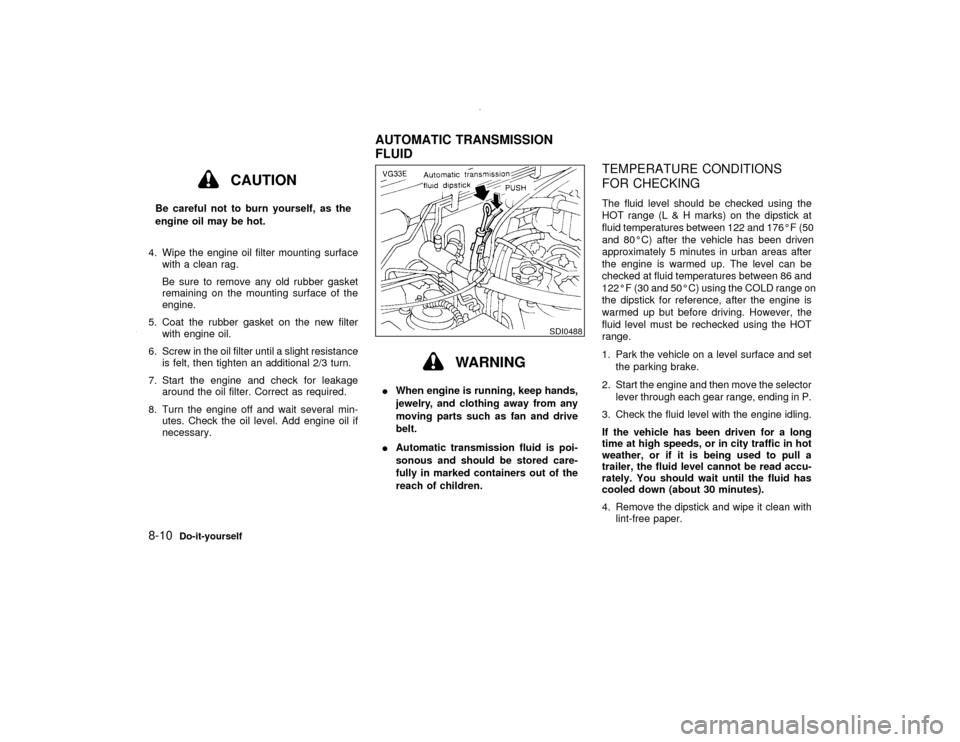
SDI0488
AUTOMATIC TRANSMISSION
FLUID
8-10
Do-it-yourself
Z
00.1.17/R50-D/V5
X
Page 199 of 265
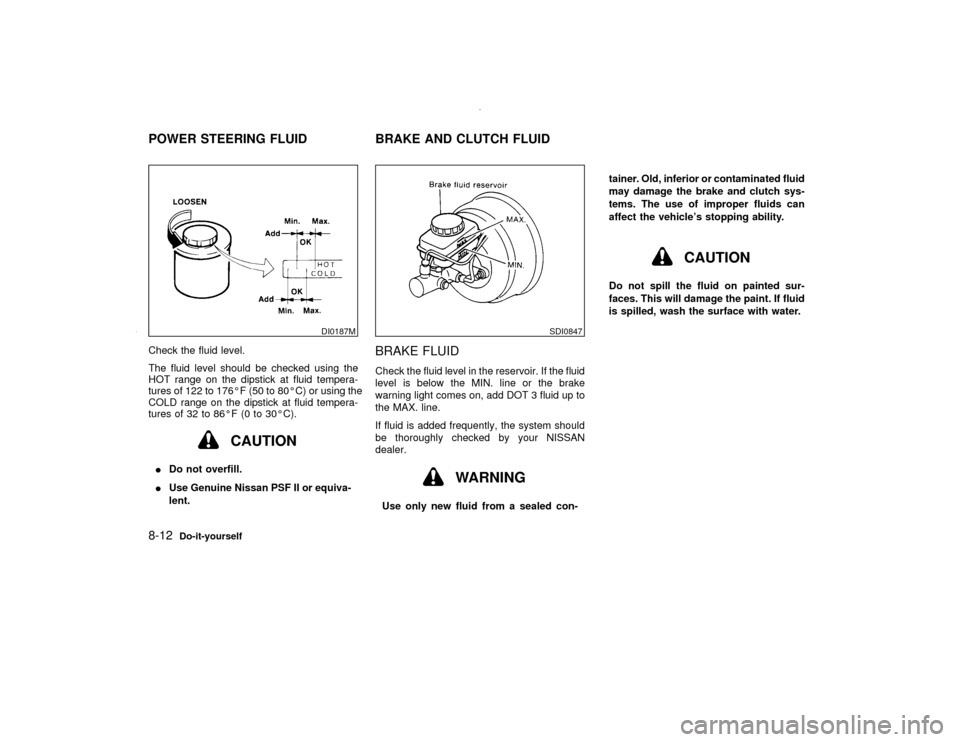
Check the fluid level.
The fluid level should be checked using the
HOT range on the dipstick at fluid tempera-
tures of 122 to 176ÉF (50 to 80ÉC) or using the
COLD range on the dipstick at fluid tempera-
tures of 32 to 86ÉF (0 to 30ÉC).
CAUTION
IDo not overfill.
IUse Genuine Nissan PSF II or equiva-
lent.
BRAKE FLUIDCheck the fluid level in the reservoir. If the fluid
level is below the MIN. line or the brake
warning light comes on, add DOT 3 fluid up to
the MAX. line.
If fluid is added frequently, the system should
be thoroughly checked by your NISSAN
dealer.
WARNING
Use only new fluid from a sealed con-tainer. Old, inferior or contaminated fluid
may damage the brake and clutch sys-
tems. The use of improper fluids can
affect the vehicle's stopping ability.
CAUTION
Do not spill the fluid on painted sur-
faces. This will damage the paint. If fluid
is spilled, wash the surface with water.
DI0187M
SDI0847
POWER STEERING FLUID BRAKE AND CLUTCH FLUID8-12
Do-it-yourself
Z
00.1.17/R50-D/V5
X
Page 200 of 265
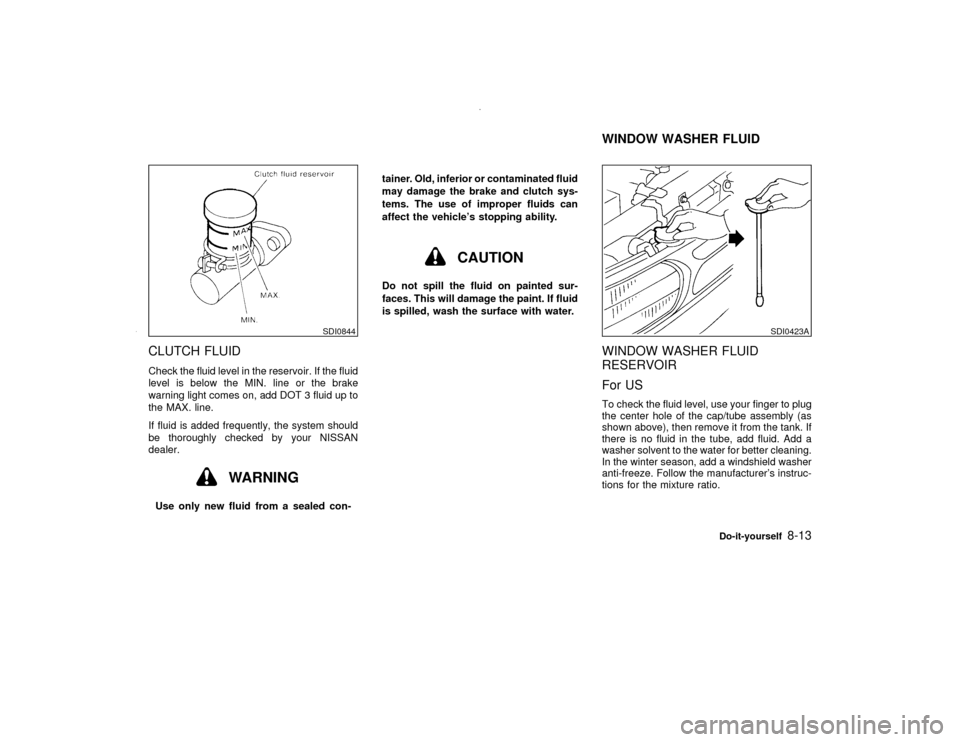
CLUTCH FLUIDCheck the fluid level in the reservoir. If the fluid
level is below the MIN. line or the brake
warning light comes on, add DOT 3 fluid up to
the MAX. line.
If fluid is added frequently, the system should
be thoroughly checked by your NISSAN
dealer.
WARNING
Use only new fluid from a sealed con-tainer. Old, inferior or contaminated fluid
may damage the brake and clutch sys-
tems. The use of improper fluids can
affect the vehicle's stopping ability.
CAUTION
Do not spill the fluid on painted sur-
faces. This will damage the paint. If fluid
is spilled, wash the surface with water.
WINDOW WASHER FLUID
RESERVOIR
For USTo check the fluid level, use your finger to plug
the center hole of the cap/tube assembly (as
shown above), then remove it from the tank. If
there is no fluid in the tube, add fluid. Add a
washer solvent to the water for better cleaning.
In the winter season, add a windshield washer
anti-freeze. Follow the manufacturer's instruc-
tions for the mixture ratio.
SDI0844
SDI0423A
WINDOW WASHER FLUID
Do-it-yourself
8-13
Z
00.1.17/R50-D/V5
X
Page 207 of 265
Self-adjusting brakesYour vehicle is equipped with self-adjusting
brakes.
The front disc-type brakes self-adjust every
time the brake pedal is applied. The rear
drum-type brakes self-adjust every time the
parking brake is applied. If the brake pedal
goes down farther than normal, it may be due
to a lack of adjustment of the rear drum
brakes. Apply the parking brake several times.
WARNING
See your NISSAN dealer and have it
checked if the brake pedal height does
not return to normal.Brake pad wear indicatorsThe disc brake pads on your vehicle have
audible wear indicators. When a brake pad
requires replacement, it will make a high
pitched scraping or screeching sound when
the vehicle is in motion whether or not the
brake pedal is depressed. Have the brakes
checked as soon as possible if the wear indi-
cator sound is heard.
Under some driving or climate conditions, oc-casional brake squeak, squeal or other noise
may be heard. Occasional brake noise during
light to moderate stops is normal and does not
affect the function or performance of the brake
system.
The rear drum brakes (if so equipped) do not
have audible wear indicators. Should you ever
hear an unusually loud noise from the rear
drum brakes, have them inspected as soon as
possible by your NISSAN dealer.
Proper brake inspection intervals should
be followed.For additional information, see
ªPeriodic maintenanceº in the ª9. Mainte-
nanceº section for maintenance intervals.
BRAKE BOOSTERCheck the brake booster function with the
following steps:
1. With the engine off, press and release the
brake pedal several times. When brake
pedal movement (distance of travel) re-
mains the same from one pedal application
to the next, continue on to the next step.
2. While depressing the brake pedal, start the
engine. The pedal height should drop a
little.
3. With the brake pedal depressed, stop the
engine. Keeping the pedal depressed forabout 30 seconds, the pedal height should
not change.
4. Run the engine for one minute without
depressing the brake pedal, then turn it off.
Depress the brake pedal several times. The
pedal travel distance will decrease gradu-
ally with each depression as the vacuum is
released from the booster.
If the brakes do not operate properly, have the
brake checked by your NISSAN dealer.
8-20
Do-it-yourself
Z
00.1.17/R50-D/V5
X
Page 219 of 265
headlight aim and bumper height.
Some of these effects may lead to
accidents and could result in serious
personal injury.
IIf the wheels are changed for any
reason, always replace with wheels
which have the same offset dimen-
sion. Wheels of a different offset
could cause early tire wear, possibly
degraded vehicle handling character-
istics and/or interference with the
brake discs. Such interference can
lead to decreased braking efficiency
and/or early brake pad wear.
IDo not install a deformed wheel or
tire even if it has been repaired. Such
wheels or tires could have structural
damage and could fail without warn-
ing.
IThe use of retread tire is not rec-
ommended.
Four wheel drive models
CAUTION
Always use tires of the same size, brand,
construction (bias, bias-belted or ra-
dial), and tread pattern on all four
wheels. Failure to do so may result in a
circumference difference between tires
on the front and rear axles which will
cause excessive tire wear and may dam-
age the transmission, transfer case and
differential gears.
If excessive tire wear is found, it is recom-
mended that all four tires be replaced with tires
of the same size, brand, construction and
tread pattern. The tire pressure and wheel
alignment should also be checked and cor-
rected as necessary. Contact your NISSAN
dealer.Wheel balanceUnbalanced wheels may affect vehicle han-
dling and tire life. Even with regular use,
wheels can get out of balance. Therefore, they
should be balanced as required.
Wheel balance service should be performedwith the wheels off the vehicle. Spin balancing
the rear wheels on the vehicle could lead to
transmission damage.
Care of wheelsIWash the wheels when washing the vehicle
to maintain their appearance.
IClean the inner side of the wheels when the
wheel is changed or the underside of the
vehicle is washed.
IDo not use abrasive cleaners when wash-
ing the wheels.
IInspect wheel rims regularly for dents or
corrosion. This may cause loss of pressure
or damage the tire bead.
INISSAN recommends that the road wheels
be waxed to protect against road salt in
areas where it is used during winter.Small size spare tire (if so equipped)U.S. only. Canadian vehicles are equipped
with a full size spare tire.
Observe the following precautions if the small
size spare tire must be used, otherwise your
vehicle could be damaged or involved in an
accident.
8-32
Do-it-yourself
Z
00.1.17/R50-D/V5
X
Page 250 of 265
TOWING SAFETY
Trailer hitchCheck the towing capacity of your receiver
type frame mounted hitch. Choose a proper
hitch for your vehicle and trailer. A genuine
NISSAN trailer hitch is available from your
NISSAN dealer (Canada only). Make sure the
trailer hitch is securely attached to the vehicle,
to help avoid personal injury or property dam-
age due to sway caused by crosswinds, rough
road surfaces or passing trucks.
CAUTION
ISpecial hitches which include frame
reinforcements are required for tow-
ing above 2,000 lb (907 kg). Suitable
Genuine NISSAN hitches for pickup
truck and sport utility vehicles are
available at an authorized NISSAN
dealer.
IDo not use axle-mounted hitches.
IDo not modify the vehicle exhaust
system, brake system, etc. to install a
trailer hitch.IAfter the hitch is removed, seal the
bolt holes to prevent exhaust fumes,
water or dust from entering the pas-
senger compartment.
IRegularly check all hitch mounting
bolts are securely mounted.
ITo reduce the possibility of additional
damage if your vehicle is struck from
the rear, where practical, remove the
hitch and/or receiver when not in use.
INever connect a trailer brake system
directly to the vehicle brake system.
Tire pressuresIWhen towing a trailer, inflate the vehicle
tires to the recommended cold tire pressure
indicated on the tire placard (affixed to the
glove box lid).
ITrailer tire condition, size, load rating and
proper inflation pressure should be in ac-
cordance with the trailer and tire manufac-
turers' specifications.Safety chainsAlways use a suitable chain between yourvehicle and the trailer. The chain should be
crossed and should be attached to the hitch,
not to the vehicle bumper or axle. Be sure to
leave enough slack in the chain to permit
turning corners.
Trailer lightsTrailer lights should comply with Federal
and/or local regulations.
When wiring vehicle for towing connection,
connect stop and tail light pickup into the
vehicle electrical circuit at point between
the sensor and stop light switch or light
switch.Trailer brakesIf your trailer is equipped with a braking sys-
tem, make sure it conforms to Federal and/or
local regulations and that it is properly in-
stalled.
WARNING
Never connect a trailer brake system
directly to the vehicle brake system.Trailer towing tipsIn order to gain skill and an understanding ofTechnical and consumer information
10-17
Z
00.1.17/R50-D/V5
X
Page 256 of 265
11 Index
A
ABS (Anti-lock brake system) ......................... 5-26
Air bag system (See supplemental restraint
system) ........................................................... 1-16
Air bag system, Side (See supplemental side air
bag system) .................................................... 1-18
Air bag warning labels .................................... 1-20
Air bag warning light.............................. 1-21, 2-11
Air cleaner housing filter ................................. 8-17
Air conditioner
Air conditioner operation ...................... 4-3, 4-9
Air conditioner service ................ 4-3, 4-9, 4-11
Air conditioner specification
label .......................................... 4-3, 4-9, 10-13
Air conditioner system refrigerant and
lubrication recommendations ............... 4-3, 4-9
Heater and air conditioner (automatic) (if so
equipped)..................................................... 4-9
Heater and air conditioner controls ............. 4-3
Servicing air conditioner .............................. 4-3
Air conditioning system refrigerant and lubricant
recommendations ........................................... 10-8
Air flow charts ............................................ 4-6, 4-9
Alcohol, drugs and driving ................................ 5-4
AM-FM radio with cassette player .................. 4-12
AM-FM radio with cassette player and compact
disc player....................................................... 4-12
AM-FM radio with compact disc player .......... 4-12Anchor point locations
Top tether strap ......................................... 1-41
Antenna
Manual ....................................................... 4-25
Power ........................................................ 4-25
Anti-lock Brake System (ABS) ........................ 5-26
Anti-lock brake warning light............................. 2-9
Appearance care
Exterior appearance care ............................ 7-2
Interior appearance care ............................. 7-3
Armrest ............................................................. 1-9
Ashtray (See cigarette lighter ashtray) ........... 2-23
ATP warning light ........................................... 2-10
Audio system .................................................. 4-12
Automatic
Automatic transmission fluid (ATF) ........... 8-10
Driving with automatic transmission.......... 5-10
Sunroof ...................................................... 2-33
Transmission park warning light ............... 2-10
Transmission selector lever lock release .. 5-13
Avoiding collision and rollover .......................... 5-4
B
Battery............................................................. 8-14
Battery saver system................................. 2-18
Battery replacement, (See multi-remote control
system) ............................................................. 3-8Before starting the engine ................................ 5-9
Belts (See drive belts) .................................... 8-15
Brake
Anti-lock brake system (ABS) ................... 5-26
Brake and clutch fluid................................ 8-12
Brake booster ............................................ 8-20
Brake fluid ................................................. 8-12
Brake pedal ............................................... 8-19
Brake pedal check..................................... 8-19
Parking brake check ........................ 5-16, 8-19
Parking brake operation ............................ 5-16
System....................................................... 5-26
Warning light ............................................. 2-10
Break-in schedule ........................................... 5-19
Bulb check/instrument panel ............................ 2-9
Bulb replacement ............................................ 8-24
C
Capacities and recommended fuel/
lubricants......................................................... 10-2
Car phone ....................................................... 4-26
Cargo (See vehicle loading information) ........ 2-30
Cargo net ........................................................ 2-30
Cassette player (See audio system) .............. 4-16
Cassette tape operation ................................. 4-12
Catalytic converter, Three way catalyst............ 5-3
CB radio or car phone .................................... 4-26
Z
00.1.17/R50-D/V5
X