2000 NISSAN MAXIMA AKI
[x] Cancel search: AKIPage 199 of 239

CAUTION
IThe T-type spare tire should be used
only for emergency. It should be re-
placed by the standard tire at the first
opportunity.
IDrive carefully while the T-type spare
tire is installed.
Avoid sharp turns and abrupt braking
while driving.
IPeriodically check the T-type spare
tire inflation pressure, and always
keep it at 60 psi (420 kPa, 4.2 bar).
IAlways keep the pressure of the full
size spare tire (if so equipped) at the
recommended pressure for standard
tires, as indicated on the tire placard.
For tire placard location, see ªTire
placardº in the ª10. Technical and
consumer informationº.
IDo not drive your vehicle at speeds
faster than 50 MPH (80 km/h).
IDo not use tire chains on a T-typespare tire. Tire chains will not fit prop-
erly on the T-type spare tire and may
cause damage to the vehicle.
IWhen driving on roads covered with
snow or ice, the T-type spare tire
should be used on the rear wheel and
the original tire used on the front
wheels (drive wheels). Use tire chains
only on the front two original tires.
ITire tread of the T-type spare tire will
wear at a faster rate than the original
tire. Replace the T-type spare tire as
soon as the tread wear indicators
appear.
IBecause the T-type spare tire is
smaller than the original tire, ground
clearance is reduced. To avoid dam-
age to the vehicle do not drive over
obstacles. Also do not drive the ve-
hicle through an automatic car wash
since it may get caught.
IDo not use the T-type spare tire on
other vehicles.
IDo not use more than one T-typespare tire at the same time.
IDo not tow a trailer while the T-type
spare tire is installed.8-36
Do-it-yourself
Z
00.1.17/A33-D/V5.0
X
Page 211 of 239

The following are approximate capacities. The actual refill capacities may be a little different. When refilling, follow the procedure
instructed in the ª8. Do-it-yourselfº section to determine the proper refill capacity.
Capacity (Approximate)
Recommended
specifications US
measureImp
measureLiter
Fuel 18-1/2 gal 15-3/8 gal 70 Unleaded gasoline with an octane rating of at least 91 AKI (RON 96)*1
Engine oil*6
Drain and refill
With oil filter change 4-1/4 qt 3-1/2 qt 4.0IAPI Certification Mark*2, *3
IAPI grade SG/SH, Energy ConservingI&IIorAPIgrade SJ, Energy
Conserving*2, *3
IILSAC grade GF-I & GF-II*2, *3 Without oil filter change 3-7/8 qt 3-1/4 qt 3.7
Cooling system
With reservoir 8-1/8 qt 6-3/4 qt 7.7
Genuine NISSAN anti-freeze coolant or equivalent
Reservoir 3/4 qt 5/8 qt 0.7
Manual transmission gear oil Ð Ð Ð API GL-4, Viscosity SAE 75W-90 only
Automatic transmission fluid
Refill to the proper oil level according to the instructions
in the ª8. Do-it-yourselfº section.Nissan Matic ªDº (Continental U.S. and Alaska) or Canada NISSAN Auto-
matic Transmission Fluid*4
Power steering fluidGenuine Nissan PSFII or equivalent*8
Brake and clutch fluidGenuine Nissan Brake Fluid*5 or equivalent DOT 3 (US FMVSS No. 116)
Multi-purpose grease Ð Ð Ð NLGI No. 2 (Lithium soap base)
Air conditioning system refrigerant Ð Ð Ð HFC-134a (R-134a)*7
Air conditioning system lubricants Ð Ð ÐNissan A/C System Oil
Type S or exact equivalent
*1: For additional information, see later in this paragraph for fuel recommendation.
*2: For additional information, see later in this paragraph for engine oil and oil filter recommendation.
*3: For additional information, see later in this paragraph for recommended SAE viscosity number.
*4: Dexron
TMIII/Mercon
TM
or equivalent may also be used. Outside the continental United States and Alaska contact a NISSAN dealer for more information regarding
suitable fluids, including recommended brand(s) of Dexron
TMIII/Mercon
TM
automatic transmission fluid.
*5: Available in mainland US through your NISSAN dealer.
*6: For additional information, see ªEngine oilº in the ª8. Do-it-yourselfº section for changing engine oil.
*7: For additional information, see ªVehicle identificationº in this section for air conditioner specification label.
*8: Genuine Nissan PSFII, Canada Nissan Automatic Transmission fluid, Dexron
TMIII/Mercon
TM
or equivalent ATF may also be used.
CAPACITIES AND
RECOMMENDED
FUEL/LUBRICANTS10-2
Technical and consumer information
Z
00.1.17/A33-D/V5.0
X
Page 212 of 239

FUEL RECOMMENDATIONUnleaded premium gasoline with an octane
rating of at least 91 AKI (Anti-Knock Index)
number (Research octane number 96)
If unleaded premium gasoline is not avail-
able, unleaded regular gasoline with an
octane rating of at least 87 AKI (Research
octane number 91) can be used.
However, for maximum vehicle perfor-
mance, the use of unleaded premium gaso-
line is recommended.
CAUTION
Using a fuel other than that specified
could adversely affect the emission con-
trol devices and systems, and could
also affect the warranty coverage.
Under no circumstances should a
leaded gasoline be used, since this will
damage the three-way catalyst.Reformulated gasolineSome fuel suppliers are now producing refor-
mulated gasolines. These gasolines are spe-
cially designed to reduce vehicle emissions.NISSAN supports efforts towards cleaner air
and suggests that you use reformulated gaso-
line when available.
Gasoline containing oxygenatesSome fuel suppliers sell gasoline containing
oxygenates such as ethanol, MTBE and
methanol with or without advertising their pres-
ence. NISSAN does not recommend the use of
fuels of which the oxygenate content and the
fuel compatibility for your NISSAN cannot be
readily determined. If in doubt, ask your ser-
vice station manager.
If you use oxygenate-blend gasoline, please
take the following precautions as the usage of
such fuels may cause vehicle performance
problems and/or fuel system damage.
IThe fuel should be unleaded and have
an octane rating no lower than that rec-
ommended for unleaded gasoline.
IIf an oxygenate-blend, excepting a
methanol blend, is used, it should con-
tain no more than 10% oxygenate.
(MTBE may, however, be added up to
15%.)
IIf a methanol blend is used, it should
contain no more than 5% methanol (me-
thyl alcohol, wood alcohol). It should
also contain a suitable amount of appro-priate cosolvents and corrosion inhibi-
tors. If not properly formulated with ap-
propriate cosolvents and corrosion
inhibitors, such methanol blends may
cause fuel system damage and/or ve-
hicle performance problems. At this
time, sufficient data is not available to
ensure that all methanol blends are suit-
able for use in NISSAN vehicles.
If any undesirable driveability problems such
as engine stalling and hard hot starting are
experienced after using oxygenate-blend fu-
els, immediately change to a non-oxygenate
fuel or a fuel with a low blend of MTBE.
Take care not to spill gasoline during refu-
eling. Gasoline containing oxygenates can
cause paint damage.
Aftermarket fuel additivesNISSAN does not recommend the use of any
fuel additives (i.e. fuel injector cleaner, octane
booster, intake valve deposit removers, etc.)
which are sold commercially. Many of these
additives intended for gum, varnish or deposit
removal may contain active solvent or similar
ingredients that can be harmful to the fuel
system and engine.Technical and consumer information
10-3
Z
00.1.17/A33-D/V5.0
X
Page 213 of 239

Octane rating tipsIn most parts of North America, you should use
unleaded gasoline with an octane rating of at
least 87 or 91 AKI (Anti-Knock Index) number.
However, you may use unleaded gasoline with
an octane rating as low as 85 AKI number in
these high altitude areas [over 4,000 ft (1,219
m)] such as: Colorado, Montana, New Mexico,
Utah, Wyoming, northeastern Nevada, south-
ern Idaho, western South Dakota, western
Nebraska, and that part of Texas which is
directly south of New Mexico.
Using unleaded gasoline with an octane
rating lower than stated above can cause
persistent, heavy spark knock. (Spark
knock is a metallic rapping noise.) If se-
vere, this can lead to engine damage. If you
detect a persistent heavy spark knock even
when using gasoline of the stated octane
rating, or if you hear steady spark knock
while holding a steady speed on level
roads, have your dealer correct the condi-
tion. Failure to correct the condition is
misuse of the vehicle, for which NISSAN is
not responsible.
Incorrect ignition timing will result in knocking,
after-run or overheating. This in turn may
cause excessive fuel consumption or damage
to the engine. If any of the above symptomsare encountered, have your vehicle checked at
a NISSAN dealer or other competent service
facility.
However, now and then you may notice
light spark knock for a short time while
accelerating or driving up hills. This is no
cause for concern, because you get the
greatest fuel benefit when there is light
spark knock for a short time under heavy
engine load.10-4
Technical and consumer information
Z
00.1.17/A33-D/V5.0
X
Page 219 of 239

When planning to travel in another country,
you should first find out if the fuel available is
suitable for your vehicle's engine.
Using fuel with too low an octane rating may
cause engine damage. All gasoline vehicles
must be operated with unleaded engine gaso-
line. Therefore, avoid taking your vehicle to
areas where appropriate fuel is not available.
When transferring the registration of your
vehicle to another country, state, province
or district,it may be necessary to modify the
vehicle to meet local laws and regulations.
The laws and regulations for motor vehicle
emission control and safety standards vary
according to the country, state, province or
district; therefore, vehicle specifications may
differ.
When any vehicle is to be taken into an-
other country, state, province or district
and registered, its modifications, transpor-
tation, and registration are the responsibil-
ity of the user. NISSAN is not responsible
for any inconvenience that may result.
VEHICLE IDENTIFICATION
NUMBER (VIN) PLATEThe vehicle identification number plate is at-
tached as shown. This number is the identifi-
cation for your vehicle and is used in the
vehicle registration.
VEHICLE IDENTIFICATION
NUMBER (Chassis number)The number is stamped as shown.
STI0038
STI0187
WHEN TRAVELING OR
REGISTERING YOUR VEHICLE IN
ANOTHER COUNTRYVEHICLE IDENTIFICATION10-10
Technical and consumer information
Z
00.1.17/A33-D/V5.0
X
Page 224 of 239

ceeded. If GVWR is exceeded, remove
cargo as necessary. If either the front or
rear GAWR is exceeded, shift the load or
remove cargo as necessary.
LOADING TIPSIThe GVW must not exceed GVWR or
GAWR as specified on the F.M.V.S.S. cer-
tification label.
IDo not load the front and rear axle to the
GAWR. Doing so will exceed the GVWR.
WARNING
IProperly secure all cargo to help pre-
vent it from sliding or shifting. Do not
place cargo higher than the seat-
backs. In a sudden stop or collision,
unsecured cargo could cause per-
sonal injury.
IDo not load your vehicle any heavier
than the GVWR or the maximum front
and rear GAWRs. If you do, parts on
your vehicle can break, or it can
change the way your vehicle handles.
This could result in loss of controland cause personal injury.
IOverloading can shorten the life of
your vehicle. Failures caused by
overloading are not covered by your
warranty.
Your new vehicle was designed to be used
primarily to carry passengers and cargo. Re-
member that towing a trailer will place addi-
tional loads on your vehicle's engine, drive
train, steering, braking and other systems.
Information on trailer towing ability and the
special equipment required should be ob-
tained from your Nissan dealer. He can obtain
aNissan Trailer Towing Guidefor you.
TI1011M
TOWING A TRAILERTechnical and consumer information
10-15
Z
00.1.17/A33-D/V5.0
X
Page 225 of 239

MAXIMUM LOAD LIMITS
Maximum trailer loadsNever allow the total trailer load to exceed
1,000 lb (454 kg). The total trailer load equals
trailer weight plus its cargo weight. Towing
loads greater than 1,000 lb (454 kg) or using
improper towing equipment could adversely
affect vehicle handling, braking and perfor-
mance.
The ability of your vehicle to tow a trailer is not
only related to the maximum trailer loads, but
also the places you plan to tow. Tow weights
appropriate for level highway driving may have
to be reduced on very steep grades or in low
traction situations (for example, on slippery
boat ramps).
WARNING
Vehicle damage and/or personal injury
resulting from improper towing proce-
dures are not covered by NISSAN war-
ranties. A Nissan Trailer Towing Guide
(U.S. only) containing information on
trailer towing ability and the specialequipment required may be obtained
from an authorized NISSAN dealer.
Tongue loadKeep the tongue load between 9 and 11% of
the total trailer load. If the tongue load be-
comes excessive, rearrange cargo to allow for
proper tongue load.
Maximum gross vehicle weight/
maximum gross axle weightThe gross vehicle weight of the towing vehicle
must not exceed. GVWR shown on the
F.M.V.S.S. certification label. The gross ve-
hicle weight equals the combined weight of the
unloaded vehicle, passengers, luggage, hitch,
trailer tongue load and any other optional
equipment. In addition, front or rear gross axle
weight must not exceed GAWR shown on the
F.M.V.S.S. certification label.
TI1012M
10-16
Technical and consumer information
Z
00.1.17/A33-D/V5.0
X
Page 226 of 239
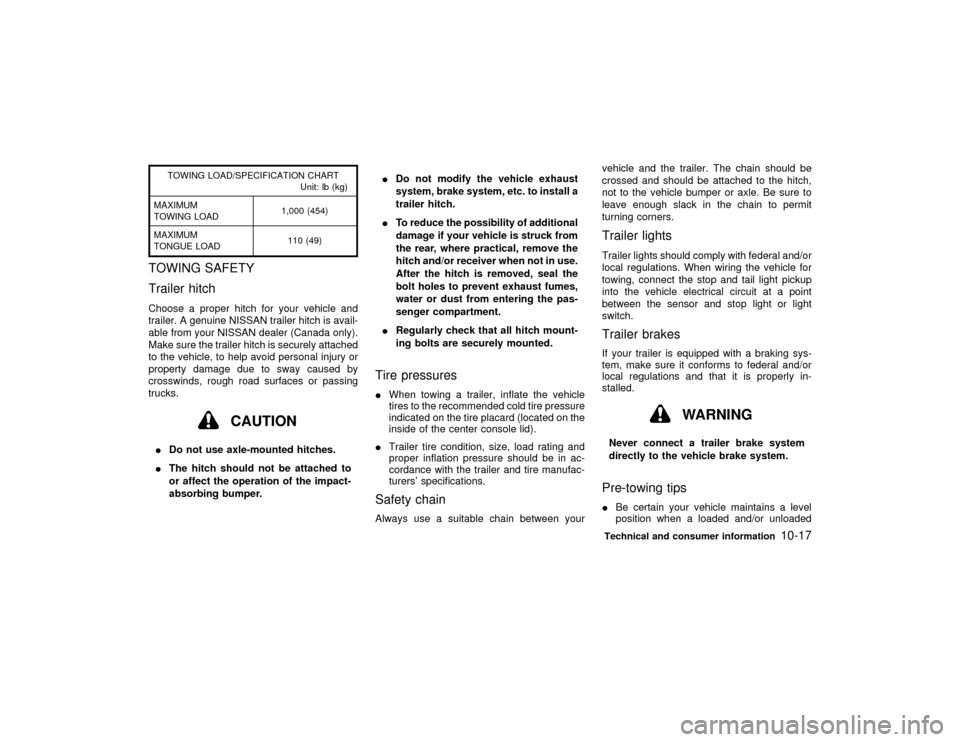
TOWING LOAD/SPECIFICATION CHART
Unit: lb (kg)
MAXIMUM
TOWING LOAD1,000 (454)
MAXIMUM
TONGUE LOAD110 (49)
TOWING SAFETY
Trailer hitchChoose a proper hitch for your vehicle and
trailer. A genuine NISSAN trailer hitch is avail-
able from your NISSAN dealer (Canada only).
Make sure the trailer hitch is securely attached
to the vehicle, to help avoid personal injury or
property damage due to sway caused by
crosswinds, rough road surfaces or passing
trucks.
CAUTION
IDo not use axle-mounted hitches.
IThe hitch should not be attached to
or affect the operation of the impact-
absorbing bumper.IDo not modify the vehicle exhaust
system, brake system, etc. to install a
trailer hitch.
ITo reduce the possibility of additional
damage if your vehicle is struck from
the rear, where practical, remove the
hitch and/or receiver when not in use.
After the hitch is removed, seal the
bolt holes to prevent exhaust fumes,
water or dust from entering the pas-
senger compartment.
IRegularly check that all hitch mount-
ing bolts are securely mounted.
Tire pressuresIWhen towing a trailer, inflate the vehicle
tires to the recommended cold tire pressure
indicated on the tire placard (located on the
inside of the center console lid).
ITrailer tire condition, size, load rating and
proper inflation pressure should be in ac-
cordance with the trailer and tire manufac-
turers' specifications.Safety chainAlways use a suitable chain between yourvehicle and the trailer. The chain should be
crossed and should be attached to the hitch,
not to the vehicle bumper or axle. Be sure to
leave enough slack in the chain to permit
turning corners.
Trailer lightsTrailer lights should comply with federal and/or
local regulations. When wiring the vehicle for
towing, connect the stop and tail light pickup
into the vehicle electrical circuit at a point
between the sensor and stop light or light
switch.Trailer brakesIf your trailer is equipped with a braking sys-
tem, make sure it conforms to federal and/or
local regulations and that it is properly in-
stalled.
WARNING
Never connect a trailer brake system
directly to the vehicle brake system.Pre-towing tipsIBe certain your vehicle maintains a level
position when a loaded and/or unloadedTechnical and consumer information
10-17
Z
00.1.17/A33-D/V5.0
X