2000 NISSAN MAXIMA warning
[x] Cancel search: warningPage 198 of 239

Improper service for a T-type spare tire
may result in serious personal injury. If it
is necessary to repair the T-type spare
tire, contact your NISSAN dealer.Replacing tires and wheelsWhen replacing a tire, use the same size,
speed rating and load carrying capacity as
originally equipped. See ªSpecificationsº in the
ª10. Technical and consumer informationº sec-
tion for recommended types and sizes of tires
and wheels.
WARNING
IThe use of tires other than those
recommended or the mixed use of
tires of different brands, construction
(bias, bias-belted or radial), or tread
patterns can adversely affect the ride,
braking, handling, ground clearance,
body-to-tire clearance, tire chain
clearance, speedometer calibration,
headlight aim and bumper height.
Some of these effects may lead toaccidents and could result in serious
personal injury.
IIf the wheels are changed for any
reason, always replace with wheels
which have the same offset dimen-
sion. Wheels of a different offset
could cause early tire wear, possibly
degraded vehicle handling character-
istics and/or interference with the
brake discs. Such interference can
lead to decreased braking efficiency
and/or early brake pad wear.
IDo not install a deformed wheel or
tire even if it has been repaired. Such
wheels or tires could have structural
damage and could fail without warn-
ing.
IThe use of retread tire is not recom-
mended.
Wheel balanceUnbalanced wheels may affect vehicle han-
dling and tire life. Even with regular use,
wheels can get out of balance. Therefore, they
should be balanced as required.Wheel balance service should be performed
with the wheels off the vehicle. Spin balancing
the front wheels on the vehicle could lead to
transmission damage.
Care of wheelsIWash the wheels when washing the vehicle
to maintain their appearance.
IClean the inner side of the wheels when the
wheel is changed or the underside of the
vehicle is washed.
IDo not use abrasive cleaners when wash-
ing the wheels.
IInspect wheel rims regularly for dents or
corrosion. Such damage may cause loss of
pressure or poor seal at the tire bead.
INISSAN recommends that the road wheels
be waxed to protect against road salt in
areas where it is used during winter.Spare tire (T-type spare tire)US only. Canadian vehicles are equipped with
a full size spare tire.
Observe the following precautions if the T-type
spare tire must be used, otherwise your ve-
hicle could be damaged or involved in an
accident.
Do-it-yourself
8-35
Z
00.1.17/A33-D/V5.0
X
Page 202 of 239

During the normal day-to-day operation of the
vehicle, general maintenance should be per-
formed regularly as prescribed in this section.
If you detect any unusual sounds, vibrations or
smell, be sure to check for the cause or have
your NISSAN dealer do it promptly. In addition,
you should notify your NISSAN dealer if you
think that repairs are required.
When performing any checks or maintenance
work, see ªMaintenance precautionsº in the ª8.
Do-it-yourselfº section.EXPLANATION OF MAINTENANCE
ITEMSAdditional information on the following
items with ª*º is found in the ª8. Do-it-
yourselfº section.Outside the vehicleThe maintenance items listed here should be
performed from time to time, unless otherwise
specified.
Tires*:Check the pressure with a gauge pe-
riodically when at a service station, including
the spare, and adjust to the specified pressure
if necessary. Check carefully for damage, cuts
or excessive wear.
Wheel nuts*:When checking the tires, make
sure no nuts are missing, and check for anyloose nuts. Tighten if necessary.
Tire rotation*:Tires should be rotated every
7,500 miles (12,000 km).
Wheel alignment and balance:If the vehicle
pulls to either side while driving on a straight
and level road, or if you detect uneven or
abnormal tire wear, there may be a need for
wheel alignment.
If the steering wheel or seat vibrates at normal
highway speeds, wheel balancing may be
needed.
Windshield wiper blades*:Check for cracks
or wear if they do not wipe properly.
Doors and engine hood:Check that all doors
and the engine hood operate smoothly as well
as the trunk lid or back hatch. Also make sure
that all latches lock securely. Lubricate if nec-
essary. Make sure that the secondary latch
keeps the hood from opening when the pri-
mary latch is released.
When driving in areas using road salt or other
corrosive materials, check lubrication fre-
quently.
Inside the vehicleThe maintenance items listed here should be
checked on a regular basis, such as whenperforming periodic maintenance, cleaning the
vehicle, etc.
Lights*:Make sure that the headlights, stop
lights, tail lights, turn signal lights, and other
lights are all operating properly and installed
securely. Also check headlight aim.
Warning lights and chimes:Make sure that
all warning lights and chimes are operating
properly.
Windshield wiper and washer*:Check that
the wipers and washer operate properly and
that the wipers do not streak.
Windshield defroster:Check that the air
comes out of the defroster outlets properly and
in good quantity when operating the heater or
air conditioner.
Steering wheel:Check for changes in the
steering conditions, such as excessive free
play, hard steering or strange noises.
Seats:Check seat position controls such as
seat adjusters, seatback recliner, etc. to en-
sure they operate smoothly and that all latches
lock securely in every position. Check that the
head restraints move up and down smoothly
and that the locks (if equipped) hold securely
in all latched positions.
Seat belts:Check that all parts of the seat belt
GENERAL MAINTENANCE
Maintenance
9-3
Z
00.1.17/A33-D/V5.0
X
Page 223 of 239

before placing the license plate bracket on
the fascia.
7. Install the license plate bracket with screws.
8. Install the license plate with bolts that are
no longer than 0.55 in (14 mm).
WARNING
IIt is extremely dangerous to ride in a
cargo area inside of a vehicle. In a
collision, people riding in these areas
are more likely to be seriously injured
or killed
IDo not allow people to ride in any
area of your vehicle that is not
equipped with seats and seat belts.
IBe sure everyone in your vehicle is in
a seat and using a seat belt properly.TERMSIt is important to familiarize yourself with the
following terms before loading your vehicle:
ICurb Weight (actual weight of your vehicle)
- vehicle weight including: standard and
optional equipment, fluids, emergency
tools, and spare tire assembly. This weight
does notinclude passengers and cargo.
IGVW (Gross Vehicle Weight) - curb weight
plus the combined weight of passengers
and cargo.IGVWR (Gross Vehicle Weight Rating) -
maximum total weight (load) limit specified
for the vehicle.
IGAWR (Gross Axle Weight Rating) - maxi-
mum weight (load) limit specified for the
front or rear axle.
DETERMINING VEHICLE LOAD
CAPACITYThe load capacity of this vehicle is determined
by weight, not by available cargo space. For
example, a luggage rack, bike carrier, cartop
carrier or similar equipment does not increase
load carrying capacity of your vehicle.
To determine vehicle load capacity:
Vehicle weight can be determined by using a
commercial-grade scale, found at places such
as a truck stop, gravel quarry, grain elevator,
or a scrap metal recycling facility.
1. Determine the curb weight of your vehicle.
2. Compare the curb weight amount to the
GVWR specified for your vehicle to deter-
mine how much more weight your vehicle
can carry.
3. After loading (cargo and passengers), re-
weigh your vehicle to determine if either
GVWR or GAWR for your vehicle is ex-
VEHICLE LOADING
INFORMATION
10-14
Technical and consumer information
Z
00.1.17/A33-D/V5.0
X
Page 224 of 239

ceeded. If GVWR is exceeded, remove
cargo as necessary. If either the front or
rear GAWR is exceeded, shift the load or
remove cargo as necessary.
LOADING TIPSIThe GVW must not exceed GVWR or
GAWR as specified on the F.M.V.S.S. cer-
tification label.
IDo not load the front and rear axle to the
GAWR. Doing so will exceed the GVWR.
WARNING
IProperly secure all cargo to help pre-
vent it from sliding or shifting. Do not
place cargo higher than the seat-
backs. In a sudden stop or collision,
unsecured cargo could cause per-
sonal injury.
IDo not load your vehicle any heavier
than the GVWR or the maximum front
and rear GAWRs. If you do, parts on
your vehicle can break, or it can
change the way your vehicle handles.
This could result in loss of controland cause personal injury.
IOverloading can shorten the life of
your vehicle. Failures caused by
overloading are not covered by your
warranty.
Your new vehicle was designed to be used
primarily to carry passengers and cargo. Re-
member that towing a trailer will place addi-
tional loads on your vehicle's engine, drive
train, steering, braking and other systems.
Information on trailer towing ability and the
special equipment required should be ob-
tained from your Nissan dealer. He can obtain
aNissan Trailer Towing Guidefor you.
TI1011M
TOWING A TRAILERTechnical and consumer information
10-15
Z
00.1.17/A33-D/V5.0
X
Page 225 of 239

MAXIMUM LOAD LIMITS
Maximum trailer loadsNever allow the total trailer load to exceed
1,000 lb (454 kg). The total trailer load equals
trailer weight plus its cargo weight. Towing
loads greater than 1,000 lb (454 kg) or using
improper towing equipment could adversely
affect vehicle handling, braking and perfor-
mance.
The ability of your vehicle to tow a trailer is not
only related to the maximum trailer loads, but
also the places you plan to tow. Tow weights
appropriate for level highway driving may have
to be reduced on very steep grades or in low
traction situations (for example, on slippery
boat ramps).
WARNING
Vehicle damage and/or personal injury
resulting from improper towing proce-
dures are not covered by NISSAN war-
ranties. A Nissan Trailer Towing Guide
(U.S. only) containing information on
trailer towing ability and the specialequipment required may be obtained
from an authorized NISSAN dealer.
Tongue loadKeep the tongue load between 9 and 11% of
the total trailer load. If the tongue load be-
comes excessive, rearrange cargo to allow for
proper tongue load.
Maximum gross vehicle weight/
maximum gross axle weightThe gross vehicle weight of the towing vehicle
must not exceed. GVWR shown on the
F.M.V.S.S. certification label. The gross ve-
hicle weight equals the combined weight of the
unloaded vehicle, passengers, luggage, hitch,
trailer tongue load and any other optional
equipment. In addition, front or rear gross axle
weight must not exceed GAWR shown on the
F.M.V.S.S. certification label.
TI1012M
10-16
Technical and consumer information
Z
00.1.17/A33-D/V5.0
X
Page 226 of 239
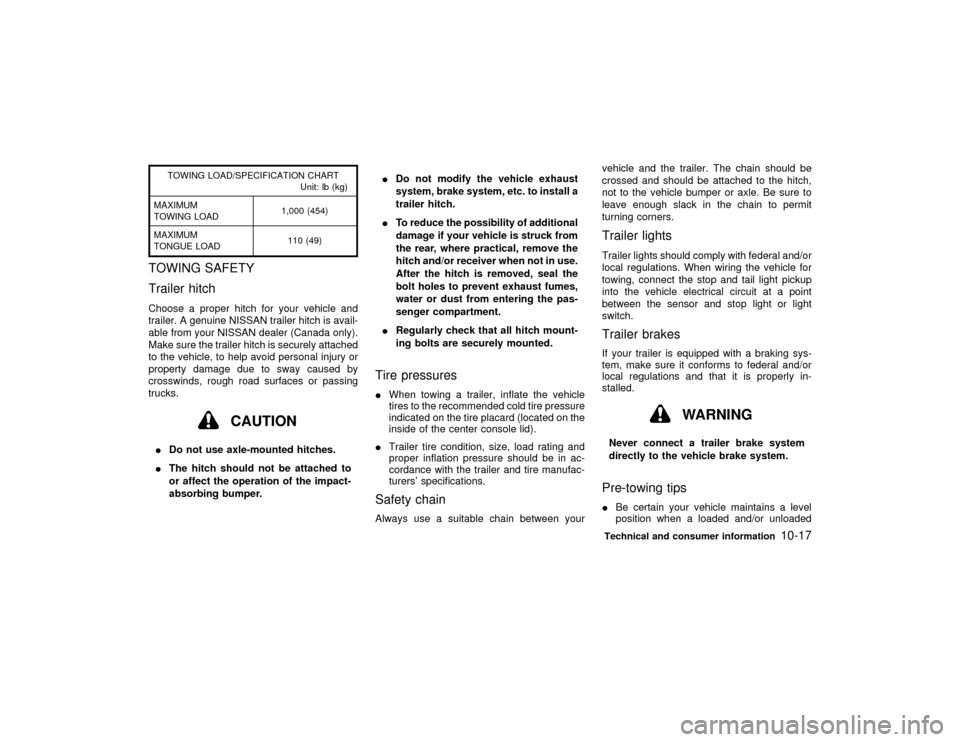
TOWING LOAD/SPECIFICATION CHART
Unit: lb (kg)
MAXIMUM
TOWING LOAD1,000 (454)
MAXIMUM
TONGUE LOAD110 (49)
TOWING SAFETY
Trailer hitchChoose a proper hitch for your vehicle and
trailer. A genuine NISSAN trailer hitch is avail-
able from your NISSAN dealer (Canada only).
Make sure the trailer hitch is securely attached
to the vehicle, to help avoid personal injury or
property damage due to sway caused by
crosswinds, rough road surfaces or passing
trucks.
CAUTION
IDo not use axle-mounted hitches.
IThe hitch should not be attached to
or affect the operation of the impact-
absorbing bumper.IDo not modify the vehicle exhaust
system, brake system, etc. to install a
trailer hitch.
ITo reduce the possibility of additional
damage if your vehicle is struck from
the rear, where practical, remove the
hitch and/or receiver when not in use.
After the hitch is removed, seal the
bolt holes to prevent exhaust fumes,
water or dust from entering the pas-
senger compartment.
IRegularly check that all hitch mount-
ing bolts are securely mounted.
Tire pressuresIWhen towing a trailer, inflate the vehicle
tires to the recommended cold tire pressure
indicated on the tire placard (located on the
inside of the center console lid).
ITrailer tire condition, size, load rating and
proper inflation pressure should be in ac-
cordance with the trailer and tire manufac-
turers' specifications.Safety chainAlways use a suitable chain between yourvehicle and the trailer. The chain should be
crossed and should be attached to the hitch,
not to the vehicle bumper or axle. Be sure to
leave enough slack in the chain to permit
turning corners.
Trailer lightsTrailer lights should comply with federal and/or
local regulations. When wiring the vehicle for
towing, connect the stop and tail light pickup
into the vehicle electrical circuit at a point
between the sensor and stop light or light
switch.Trailer brakesIf your trailer is equipped with a braking sys-
tem, make sure it conforms to federal and/or
local regulations and that it is properly in-
stalled.
WARNING
Never connect a trailer brake system
directly to the vehicle brake system.Pre-towing tipsIBe certain your vehicle maintains a level
position when a loaded and/or unloadedTechnical and consumer information
10-17
Z
00.1.17/A33-D/V5.0
X
Page 228 of 239

IAvoid holding the brake pedal down too
long or too frequently. This could cause the
brakes to overheat, resulting in reduced
braking efficiency.
When towing a trailer, change oil in the
transmission more frequently.
See ªPeriodic maintenance schedulesº in
the ª9. Maintenanceº section.DOT (Department Of Transportation) Quality
Grades: All passenger car tires must conform
to federal safety requirements in addition to
these grades.
Quality grades can be found where applicable
on the tire sidewall between tread shoulder
and maximum section width. For example:
Treadwear 200 Traction AA Temperature A
TreadwearTreadwear grade is a comparative rating
based on tire wear rate when tested under
controlled conditions on specified government
test courses. For example, a tire graded 150
would wear one and a half (1-1/2) times as well
on the government course as a tire graded
100. However, relative tire performance de-
pends on actual driving conditions, and may
vary significantly from the norm due to varia-
tions in driving habits, service practices and
differences in road characteristics and climate.Traction AA, A, B and CThe traction grades, from highest to lowest,
are AA, A, B, and C. Those grades represent
the tire's ability to stop on wet pavement as
measured under controlled conditions on
specified government test surfaces of asphaltand concrete. A tire marked C may have poor
traction performance.
WARNING
The traction grade assigned to your ve-
hicle tires is based on straight-ahead
braking traction tests, and does not in-
clude acceleration, cornering, hydro-
planing, or peak traction characteristics.Temperature A, B and CTemperature grades are A (the highest), B,
and C. They represent a tire's resistance to
heat build-up, and its ability to dissipate heat
when tested under controlled conditions on a
specified indoor laboratory test wheel. Sus-
tained high temperature can cause tire mate-
rial to degenerate, reducing tire life. Excessive
temperatures can lead to sudden tire failure.
Grade C corresponds to a performance level
which all passenger car tires must meet under
the Federal Motor Vehicle Safety Standard No.
109. Grades A and B represent higher levels of
performance on laboratory test wheels than
the minimum required by law.
UNIFORM TIRE QUALITY
GRADING
Technical and consumer information
10-19
Z
00.1.17/A33-D/V5.0
X
Page 229 of 239

WARNING
The temperature grade for this tire is
established for a tire that is properly
inflated and not overloaded. Excessive
speed, underinflation, or excessive
loading, either separately or in combina-
tion, can cause heat buildup and pos-
sible tire failure.Your NISSAN is covered by the following
emission warranties.
For US:
IEmission Defects Warranty
IEmissions Performance Warranty
For Canada:
Emission Control System Warranty
Details of these warranties may be found with
other vehicle warranties in your Warranty In-
formation and Maintenance Log Booklet that
comes with your NISSAN. If you did not re-
ceive a Warranty Information and Mainte-
nance Log Booklet, or it has become lost, you
may obtain a replacement by writing to:
INissan North America, Inc.
Consumer Affairs Department
P.O. Box 191
Gardena. CA. 90248-0191
INissan Canada Inc.
5290 Orbitor Drive
Mississauga, Ontario,
L4W 4Z5
If you believe that your vehicle has a
defect which could cause a crash or
could cause injury or death, you should
immediately inform the National High-
way Traffic Safety Administration(NHTSA)
in addition to notifying
NISSAN.
If
NHTSA
receives similar complaints,
it may open an investigation, and if it
finds that a safety defect exists in a
group of vehicles, it may order a recall
and remedy campaign. However,
NHTSA
cannot become involved in
individual problems between you, your
dealer, or NISSAN.
To contactNHTSA
, you may either call
the Auto Safety Hotline toll-free at
1-800-424-9393 (or 366-0123 in Wash-
ington, D.C. area) or write to:
NHTSA
,
U.S. Department of Transportation,
Washington, D.C. 20590. You can also
obtain other information about motor
vehicle safety from the Hotline.
You may notify NISSAN by contacting
our Consumer Affairs Department, toll-
free, at 1-800-NISSAN-1.
In Hawaii call (808) 836-0888.
EMISSION CONTROL SYSTEM
WARRANTYREPORTING SAFETY DEFECTS
(US only)
10-20
Technical and consumer information
Z
00.1.17/A33-D/V5.0
X