2000 NISSAN ALTIMA fuel cap
[x] Cancel search: fuel capPage 56 of 242
when the passing signal is activated.
Cruise main switch indicator
light (if so equipped)
The light comes on when the cruise control
main switch is pushed. The light goes out
when the main switch is pushed again.
While the cruise main switch indicator light
comes on, the cruise control system is
operational.
Cruise set indicator light
(if so equipped)
The light comes on while the vehicle speed
is controlled by the cruise control system. If
the light blinks while the engine is running, it
may indicate the cruise control system is not
functioning properly. Have the system
checked by your NISSAN dealer.
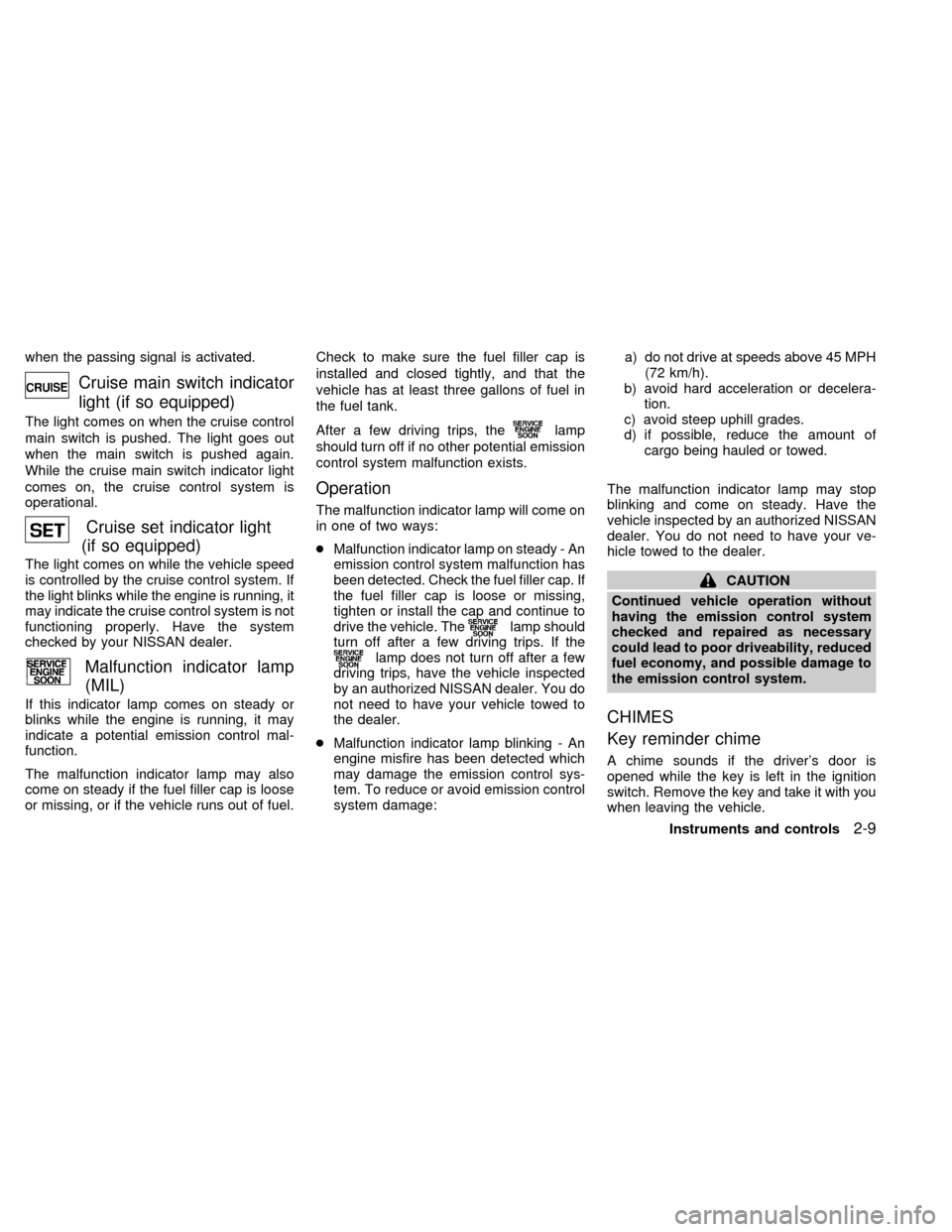
Malfunction indicator lamp
(MIL)
If this indicator lamp comes on steady or
blinks while the engine is running, it may
indicate a potential emission control mal-
function.
The malfunction indicator lamp may also
come on steady if the fuel filler cap is loose
or missing, or if the vehicle runs out of fuel.Check to make sure the fuel filler cap is
installed and closed tightly, and that the
vehicle has at least three gallons of fuel in
the fuel tank.
After a few driving trips, the
lamp
should turn off if no other potential emission
control system malfunction exists.
Operation
The malfunction indicator lamp will come on
in one of two ways:
cMalfunction indicator lamp on steady - An
emission control system malfunction has
been detected. Check the fuel filler cap. If
the fuel filler cap is loose or missing,
tighten or install the cap and continue to
drive the vehicle. The
lamp should
turn off after a few driving trips. If the
lamp does not turn off after a few
driving trips, have the vehicle inspected
by an authorized NISSAN dealer. You do
not need to have your vehicle towed to
the dealer.
cMalfunction indicator lamp blinking - An
engine misfire has been detected which
may damage the emission control sys-
tem. To reduce or avoid emission control
system damage:a) do not drive at speeds above 45 MPH
(72 km/h).
b) avoid hard acceleration or decelera-
tion.
c) avoid steep uphill grades.
d) if possible, reduce the amount of
cargo being hauled or towed.
The malfunction indicator lamp may stop
blinking and come on steady. Have the
vehicle inspected by an authorized NISSAN
dealer. You do not need to have your ve-
hicle towed to the dealer.
CAUTION
Continued vehicle operation without
having the emission control system
checked and repaired as necessary
could lead to poor driveability, reduced
fuel economy, and possible damage to
the emission control system.
CHIMES
Key reminder chime
A chime sounds if the driver's door is
opened while the key is left in the ignition
switch. Remove the key and take it with you
when leaving the vehicle.
Instruments and controls
2-9
ZX
Page 82 of 242

3 Pre-driving checks and adjustments
Keys .......................................................................3-2
Nissan vehicle immobilizer system (NVIS)
keys ........................................................................3-2
Doors ......................................................................3-2
Locking with key .....................................................3-3
Locking with inside lock knob ................................3-3
Locking with power door lock switch .....................3-4
Child safety rear door lock .....................................3-5
Multi-remote control system (if so equipped).........3-5
How to use multi-remote control system ...............3-5
Battery replacement ...............................................3-8
Hood .......................................................................3-9
Trunk lid................................................................3-10Opener operation .................................................3-10
Key operation .......................................................3-10
Fuel filler lid ..........................................................3-11
Opener operation .................................................3-11
Fuel filler cap ........................................................3-11
Steering wheel .....................................................3-13
Tilt operation.........................................................3-13
Sunvisors ..............................................................3-13
Vanity mirrors .......................................................3-13
Mirrors ..................................................................3-14
Inside mirror .........................................................3-14
Outside mirror remote control ..............................3-14
ZX
Page 92 of 242

OPENER OPERATION
The fuel filler lid opener lever is located on
the outside of the driver's seat. To open the
fuel filler lid, push the opener lever down. To
lock, close the fuel filler lid securely.
FUEL FILLER CAP
The fuel filler cap is a screw-on ratcheting
type. Tighten the cap clockwise until ratch-
eting clicks are heard.
WPD0009APD1007
FUEL FILLER LID
Pre-driving checks and adjustments3-11
ZX
Page 93 of 242
WARNING
cGasoline is extremely flammable and
highly explosive under certain con-
ditions. You could be burned or se-
riously injured if it is misused or
mishandled. Always stop the engine
and do not smoke or allow open
flames or sparks near the vehicle
when refueling.
c
Fuel may be under pressure. Turn the
cap one-half turn, and wait for any
``hissing'' sound to stop to prevent
fuel from spraying out and possible
personal injury. Then remove the cap.
cDo not attempt to top off the fuel
tank after the fuel pump nozzle shuts
off automatically. Continued refuel-
ing may cause fuel overflow, result-
ing in fuel spray and possibly fire.
cUse only an original equipment type
fuel filler cap as a replacement. It has
a built-in safety valve needed for
proper operation of the fuel system
and emission control system. An in-
correct cap can result in a serious
malfunction and possible injury.
cNever pour fuel into the throttle body
to attempt to start your vehicle.
CAUTION
cIf fuel is spilled on the vehicle body,
flush it away with water to avoid
paint damage.
cTighten until the fuel filler cap clicks.
Failure to tighten the fuel filler cap
properly may cause the
mal-
function indicator lamp (MIL) to illu-
minate. If the
lamp illuminates
because the fuel filler cap is loose or
missing, tighten or install the cap
and continue to drive the vehicle.
The
lamp should turn off after
a few driving trips. If thelamp
does not turn off after a few driving
trips, have the vehicle inspected by
an authorized NISSAN dealer.
cFor additional information, see the
ªMalfunction indicator lamp (MIL)''
in the ªInstrument and controlsº
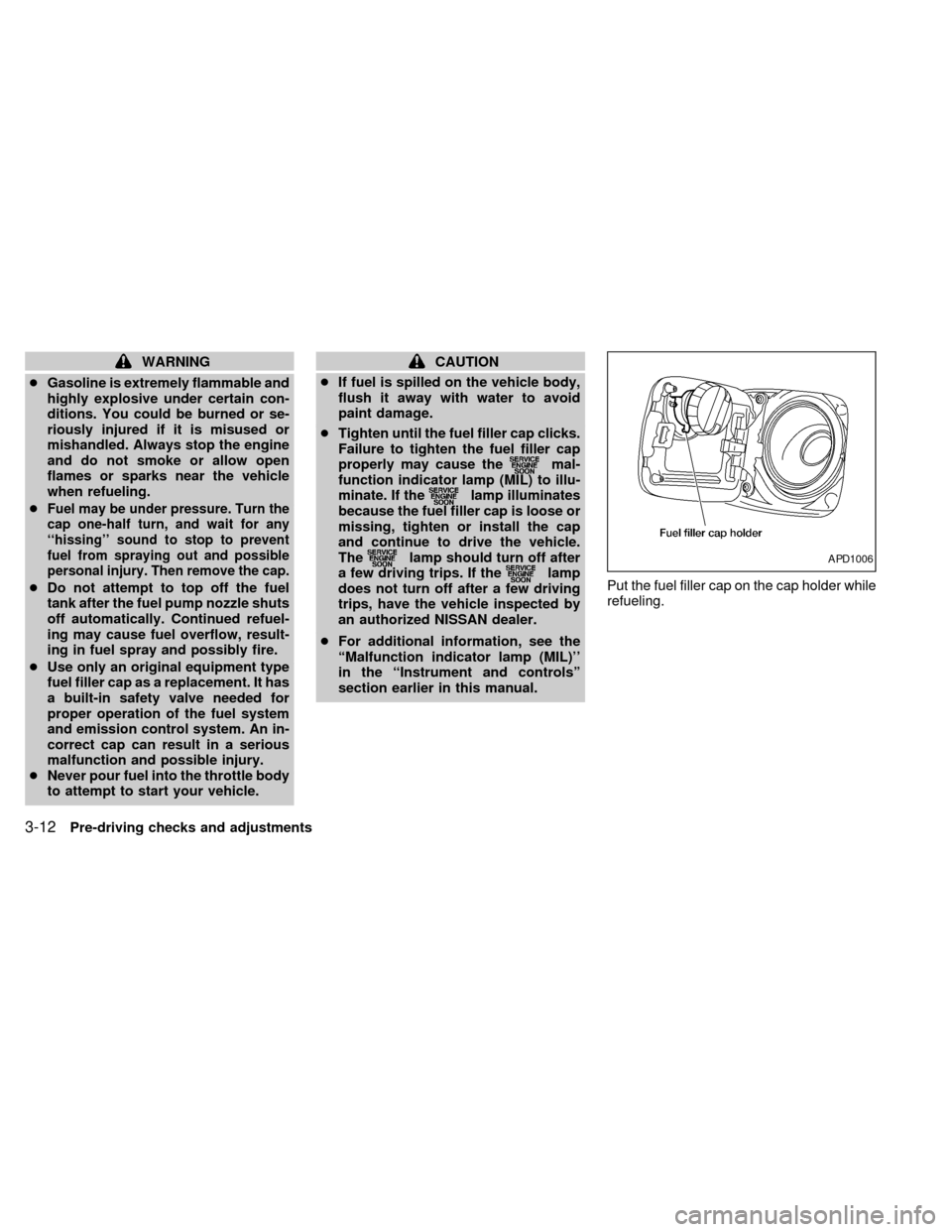
section earlier in this manual.Put the fuel filler cap on the cap holder while
refueling.APD1006
3-12Pre-driving checks and adjustments
ZX
Page 165 of 242

When performing any inspection or mainte-
nance work on your vehicle, always take
care to prevent serious accidental injury to
yourself or damage to the vehicle. The
following are general precautions which
should be closely observed.
WARNING
cPark the vehicle on a level surface,
apply the parking brake securely and
block the wheels to prevent the ve-
hicle from moving. For manual trans-
mission models, move the shift lever
to (N) Neutral. For an automatic
transmission models, move the shift
selector lever to P (Park).
cBe sure the ignition key is in the OFF
or LOCK position when performing
any parts replacement or repairs.
cYour vehicle is equipped with an
automatic engine cooling fan. It may
come on at any time without warn-
ing, even if the ignition key is in the
OFF position and the engine is not
running. To avoid injury, always dis-
connect the negative battery cable
before working near the fan.c
If you must work with the engine run-
ning, keep your hands, clothing, hair
and tools away from moving fans,
belts and any other moving parts.
cIt is advisable to secure or remove
any loose clothing and remove any
jewelry, such as rings, watches, etc.
before working on your vehicle.
cAlways wear eye protection when-
ever you work on your vehicle.
cIf you must run the engine in an
enclosed space such as a garage, be
sure there is proper ventilation for
exhaust gases to escape.
cNever get under the vehicle while it
is supported only by a jack. If it is
necessary to work under the vehicle,
support it with safety stands.
c
Keep smoking materials, flame and
sparks away from the fuel tank and
battery.cOn gasoline engine models with the
multiport fuel injection (MFI) system,
the fuel filter or fuel lines should be
serviced by an authorized NISSAN
dealer because the fuel lines are un-
der high pressure even when the en-
gine is off.
CAUTION
cDo not work under the hood while
the engine is hot. Turn off the engine
and wait until it cools down.
cNever connect or disconnect the bat-
tery or any transistorized compo-
nent while the ignition is in the ON
position.
cNever leave the engine or automatic
transmission related component
harnesses disconnected while the
ignition is in the ON position.
c
Avoid contact with used engine oil.
Improperly disposed engine oil
and/or other vehicle fluids can dam-
age the environment. Always con-
form to local regulations for disposal
of vehicle fluid.
MAINTENANCE
PRECAUTIONS
8-2Do-it-yourself
ZX
Page 175 of 242
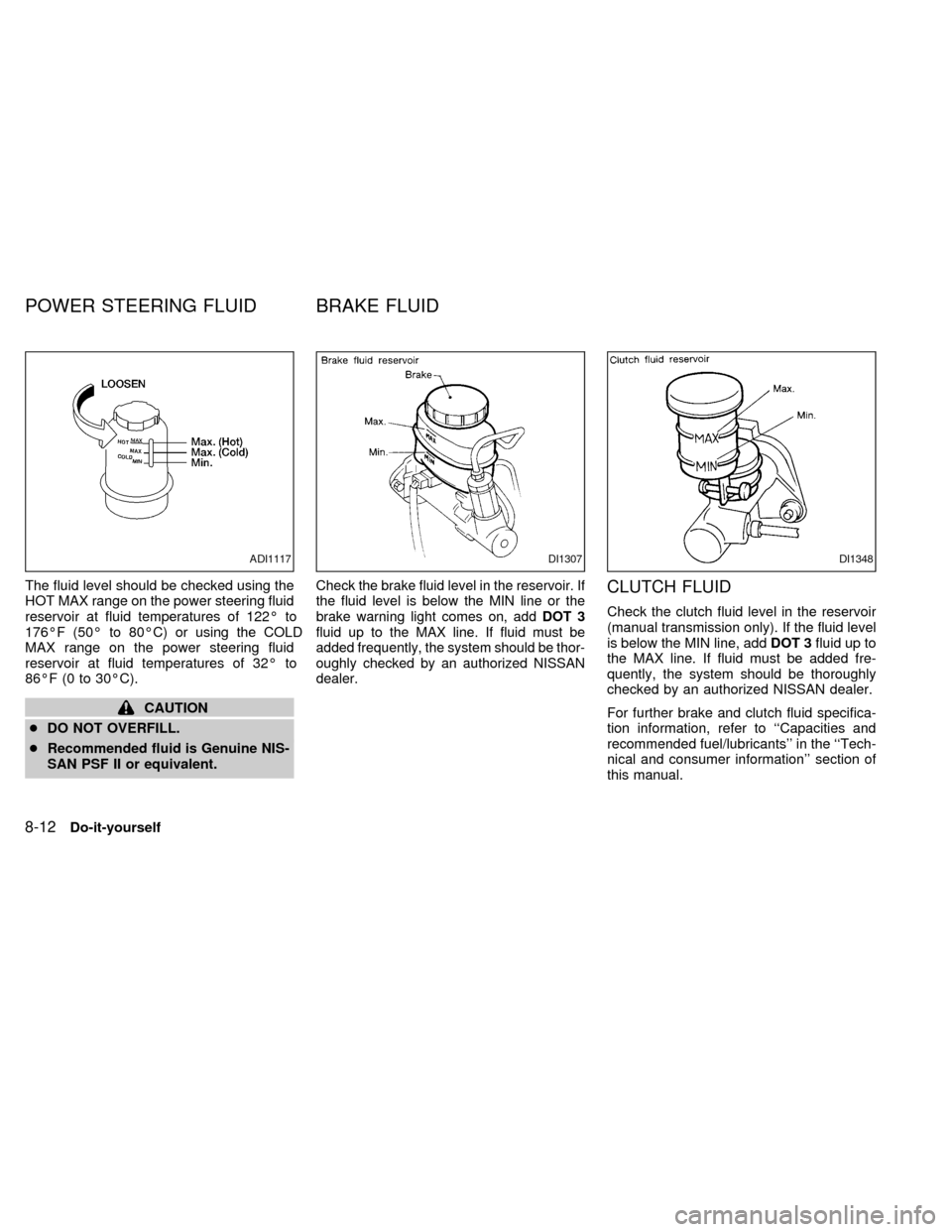
The fluid level should be checked using the
HOT MAX range on the power steering fluid
reservoir at fluid temperatures of 122É to
176ÉF (50É to 80ÉC) or using the COLD
MAX range on the power steering fluid
reservoir at fluid temperatures of 32É to
86ÉF (0 to 30ÉC).
CAUTION
cDO NOT OVERFILL.
cRecommended fluid is Genuine NIS-
SAN PSF II or equivalent.
Check the brake fluid level in the reservoir. If
the fluid level is below the MIN line or the
brake warning light comes on, addDOT 3
fluid up to the MAX line. If fluid must be
added frequently, the system should be thor-
oughly checked by an authorized NISSAN
dealer.CLUTCH FLUID
Check the clutch fluid level in the reservoir
(manual transmission only). If the fluid level
is below the MIN line, addDOT 3fluid up to
the MAX line. If fluid must be added fre-
quently, the system should be thoroughly
checked by an authorized NISSAN dealer.
For further brake and clutch fluid specifica-
tion information, refer to ``Capacities and
recommended fuel/lubricants'' in the ``Tech-
nical and consumer information'' section of
this manual.
ADI1117DI1307DI1348
POWER STEERING FLUID BRAKE FLUID
8-12Do-it-yourself
ZX
Page 214 of 242
10 Technical and consumer information
Capacities and recommended fuel/lubricants ......10-2
Fuel recommendation...........................................10-3
Engine oil and oil filter recommendation..............10-5
Recommended SAE viscosity number.................10-6
Air conditioner system refrigerant and
lubricant recommendations ..................................10-7
Specifications .......................................................10-8
Engine ..................................................................10-8
Wheels and tires ..................................................10-9
Dimensions and weights ......................................10-9
When traveling or registering your vehicle in
another country ..................................................10-10
Vehicle identification ..........................................10-10
Vehicle identification number (VIN) plate...........10-10
Vehicle identification number
(chassis number) ................................................10-10
Engine serial number .........................................10-11
F.M.V.S.S. certification label ..............................10-11
Emission control information label .....................10-12Tire placard ........................................................10-12
Air conditioner specification label.......................10-12
Installing front license plate................................10-13
Vehicle loading information ................................10-13
Terms .................................................................10-13
Determining vehicle load capacity .....................10-14
Loading tips ........................................................10-14
Towing a trailer...................................................10-15
Maximum load limits...........................................10-15
Towing load/specification chart ..........................10-16
Towing safety .....................................................10-16
Uniform tire quality grading ................................10-18
Emission control system warranty .....................10-19
Reporting safety defects (US only) ....................10-19
Readiness for inspection/maintenance (I/M)
test (US only) .....................................................10-20
Owner's manual/service manual order
information ..........................................................10-21
ZX
Page 215 of 242
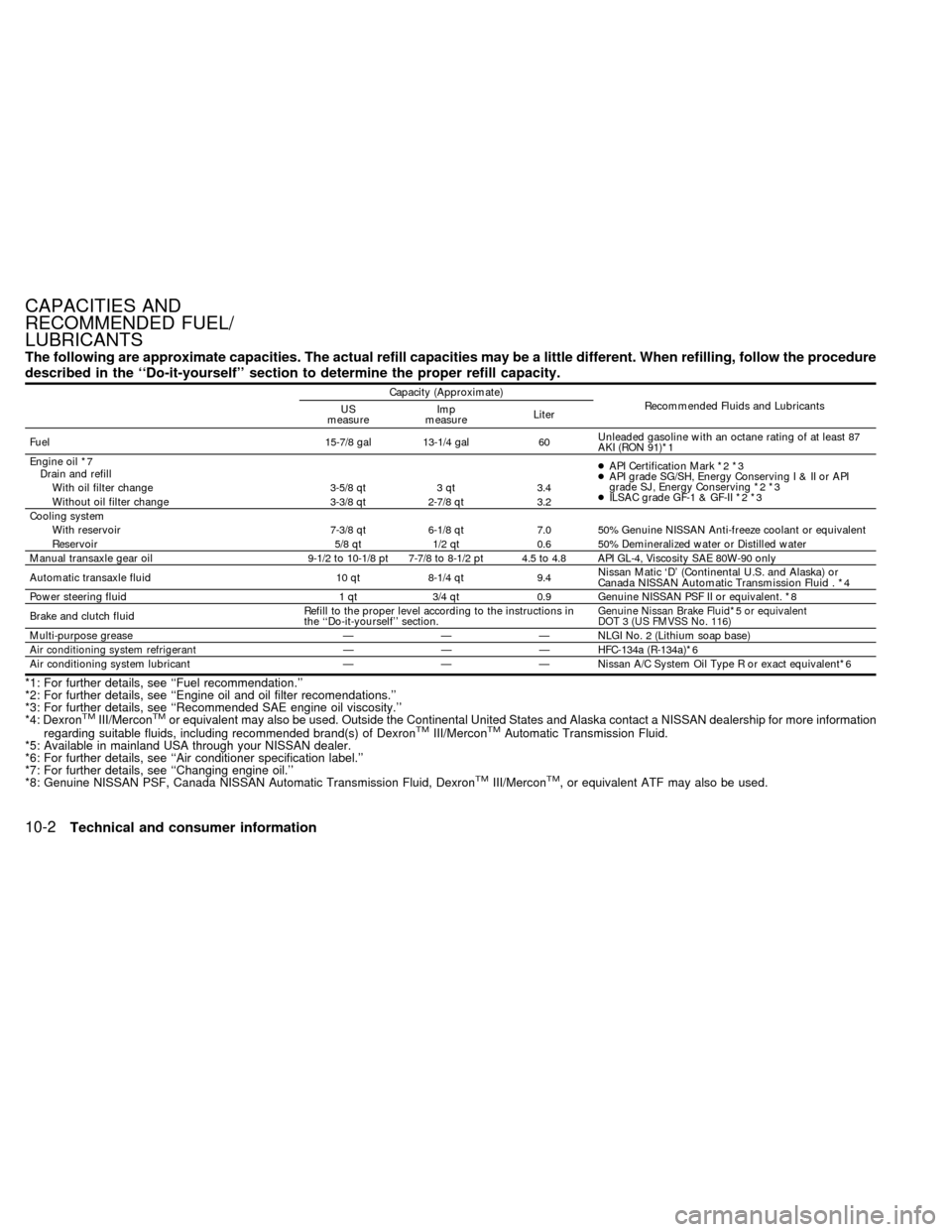
The following are approximate capacities. The actual refill capacities may be a little different. When refilling, follow the procedure
described in the ``Do-it-yourself'' section to determine the proper refill capacity.
Capacity (Approximate)
Recommended Fluids and Lubricants
US
measureImp
measureLiter
Fuel 15-7/8 gal 13-1/4 gal 60Unleaded gasoline with an octane rating of at least 87
AKI (RON 91)*1
Engine oil *7
Drain and refillcAPI Certification Mark *2 *3
cAPI grade SG/SH, Energy ConservingI&IIorAPI
grade SJ, Energy Conserving *2 *3
cILSAC grade GF-1 & GF-II *2 *3 With oil filter change 3-5/8 qt 3 qt 3.4
Without oil filter change 3-3/8 qt 2-7/8 qt 3.2
Cooling system
With reservoir 7-3/8 qt 6-1/8 qt 7.0 50% Genuine NISSAN Anti-freeze coolant or equivalent
Reservoir 5/8 qt 1/2 qt 0.6 50% Demineralized water or Distilled water
Manual transaxle gear oil 9-1/2 to 10-1/8 pt 7-7/8 to 8-1/2 pt 4.5 to 4.8 API GL-4, Viscosity SAE 80W-90 only
Automatic transaxle fluid 10 qt 8-1/4 qt 9.4
Nissan Matic `D' (Continental U.S. and Alaska) or
Canada NISSAN Automatic Transmission Fluid . *4
Power steering fluid 1 qt 3/4 qt 0.9 Genuine NISSAN PSF II or equivalent. *8
Brake and clutch fluidRefill to the proper level according to the instructions in
the ``Do-it-yourself'' section.Genuine Nissan Brake Fluid*5 or equivalent
DOT 3 (US FMVSS No. 116)
Multi-purpose grease Ð Ð Ð NLGI No. 2 (Lithium soap base)Air conditioning system refrigerantÐ Ð Ð HFC-134a (R-134a)*6
Air conditioning system lubricant Ð Ð Ð Nissan A/C System Oil Type R or exact equivalent*6
*1: For further details, see ``Fuel recommendation.''
*2: For further details, see ``Engine oil and oil filter recomendations.''
*3: For further details, see ``Recommended SAE engine oil viscosity.''
*4: Dexron
TMIII/MerconTMor equivalent may also be used. Outside the Continental United States and Alaska contact a NISSAN dealership for more information
regarding suitable fluids, including recommended brand(s) of DexronTMIII/MerconTMAutomatic Transmission Fluid.
*5: Available in mainland USA through your NISSAN dealer.
*6: For further details, see ``Air conditioner specification label.''
*7: For further details, see ``Changing engine oil.''
*8: Genuine NISSAN PSF, Canada NISSAN Automatic Transmission Fluid, Dexron
TMIII/MerconTM, or equivalent ATF may also be used.
CAPACITIES AND
RECOMMENDED FUEL/
LUBRICANTS
10-2Technical and consumer information
ZX