2000 MITSUBISHI CARISMA fuel
[x] Cancel search: fuelPage 107 of 280

STARTING AND DRIVING
5–7
(3)City traffic
Frequent starting and stopping in-
creases the average fuel consumption.
Use roads with smooth traffic flow
whenever possible. When driving on
congested roads, avoid use of a low
gear at high engine speeds.
(4) Idling
The vehicle consumes fuel even during
idling. Avoid extended idling whenever
possible.
(5)Speed
The higher the vehicle speed, the more
fuel consumed. Avoid driving at full
speed. Even a slight release of the ac-
celerator pedal will save a significant
amount of fuel.
(6)Tyre inflation pressure
Check the tyre inflation pressures at
regular intervals. Low tyre inflation pres-
sure increases road resistance and fuel
consumption. In addition, low tyre pres-
sures adversely affect tyre wear and
driving stability.(7)Load
Do not drive with unnecessary articles in
the luggage compartment. Especially
during city driving where frequent start-
ing and stopping is necessary, the in-
creased weight of the vehicle will greatly
affect fuel consumption. Also avoid driv-
ing with unnecessary luggage, etc., on
the roof; the increased air resistance will
increase fuel consumption.
(8)Cold engine starting
Starting of a cold engine consumes
more fuel.
Unnecessary fuel consumption is also
caused by keeping a hot engine run-
ning. After the engine is started, com-
mence driving as soon as possible.
(9)Air conditioning*
The use of the air conditioning will in-
crease the fuel consumption.Trailer towingEC21AMFg
In order to tow a trailer with your vehicle, a
trailer towing device that meets all relevant
regulations in your area has to be mounted.
The regulations concerning the towing of a
trailer may differ from country to country. You
are advised to obey the regulations in each
area.
CAUTION
Danger of accident!
A towing bar should be fitted by an
authorized MITSUBISHI dealer.
Page 109 of 280

STARTING AND DRIVING
5–9
(6) The heavier weight and higher rolling
and air resistance will increase fuel con-
sumption.
Additional precautions for vehicles
equipped with an automatic
transmission
The “2” position (INVECS–II 4A/T) or 2nd
gear (INVECS–II Sport Mode 4A/T) is re-
commended on slopes or at low speed. Use
the “L” position (INVECS–II 4A/T) or 1st gear
(INVECS–II Sport Mode 4A/T) in mountain-
ous areas in order to make better use of en-
gine braking and to assist the brake system.
However, be sure that the speed does not
exceed the maximum speed limit for the se-
lected gear.
For maximum speed of the vehicles
equipped with INVECS–II 4A/T, refer to the
description of the “Possible driving speed”
on page 5–24.Vehicles with automatic transmission
I21A070a
Ignition switchEI21AAGe
1-The engine is stopped, and the steer-
ing wheel is locked. The key can only
be inserted and removed only when
the switch is in this position.
2-The engine is stopped, but the radio,
cigarette lighter and other electrical
devices can be operated.
3-The engine is running and all the ve-
hicle’s electrical devices can be oper-
ated.
4-The starter motor operates. After the
engine has started, release the key
and it will automatically return to the
“ON” position.
Vehicles with manual transmission
I21A031a
Page 112 of 280

STARTING AND DRIVING
5–12
StartingEI02FAIh
Tips for starting
(1) Do not operate the starter motor con-
tinuously for anything longer than 10
seconds; doing so could run down the
battery. If the engine does not start, turn
the ignition switch back to “LOCK”, wait
a few seconds, and then try again.
Trying repeatedly with the starter mo-
tor still turning will damage the starter
mechanism.
(2) If the engine cannot be started because
the battery is weak or dead, refer to the
“Emergency starting” section for instruc-
tions on starting the engine.
(3) The engine is well warmed up if the
coolant temperature gauge needle
starts to move (the engine speed de-
creases). Extended warming - up oper-
ation will result in excessive fuel con-
sumption.
WARNING
Never run the engine in a closed or
poorly ventilated area any longer than
is needed to move your vehicle in or
out of the area. Carbon monoxide
gases are odourless and can be fatal.
CAUTION
(1) Never attempt to start the engine
by pushing or pulling the vehicle.
Especially in the automatic trans-
mission since the structure is dif-
ferent from a manual transmis-
sion, it is not possible to start the
engine by using this technique.
Never attempt this or it could
damage the automatic transmis-
sion.
(2) Do not run the engine at high rpm
or drive the vehicle at high speed
until the engine has a chance to
warm up.
(3) Release the ignition key as soon
as the engine starts to avoid dam-
aging the starter motor.
(4) If your vehicle is equipped with a
turbocharger, do not stop the en-
gine immediately after operating
the vehicle at high speeds. Allow
the engine to idle for approxi-
mately 60 seconds or more to
give the turbocharger a chance to
cool down.
NOTE
After replacing the battery, the electronic
control system data for the engine, auto-
matic transmission, etc., will be erased. As a
result, the engine speed may become un-
stable and shift shocks may occur.
If the engine speed becomes unstable, initial
engine adjustments will need to be per-
formed.
Refer to the section ”What to do if the engine
speed becomes unstable after the battery is
replaced” on page 8–22.
Shift shocks will become smoother after sev-
eral changes in speed.
Page 113 of 280

STARTING AND DRIVING
5–13
I27A036a
Starting the engine
(Petrol-powered vehicles)
This vehicle is equipped with an electroni-
cally controlled fuel injection system which
is automatically controlled. When starting
the engine, do not depress the accelerator
pedal.
Normal conditions
The starting procedure is as follows :
1. Insert the ignition key and fasten the
seat belt.
2. Apply the parking brake.
3. Depress and hold the brake pedal.
4. Place the gearshift lever (manual
transmission) in the “N” (Neutral) or
the selector lever (automatic trans-
mission) in the “P” (PARK) position.
5. Fully depress the clutch pedal (man-
ual transmission).
6. After turning the ignition key to the
“ON” position, make certain that all
warning lamps are functioning proper-
ly before starting the engine.
7. Turn the ignition key to the “START”
position without depressing the accel-
erator pedal, and release it when the
engine starts.
NOTE
A ticking noise may be heard after starting
the engine. This is not an abnormal condi-
tion. The noise will disappear after a short
time of engine running.
If the ticking noise continues after the engine
is warmed up, have your vehicle checked at
an authorized MITSUBISHI dealer.
Flooded engine
If the engine has become flooded during
starting, first operate the starter for 5 to 6 sec-
onds while fully depressing the accelerator
pedal, then start the engine without depres-
sing the accelerator pedal.
At extreme cold ambient
temperature
If the engine won’t start, depress the accel-
erator pedal about halfway while cranking
the engine. Once the engine starts, re-
lease the accelerator pedal.
CAUTION
When starting the engine, make sure
that you press on the brake pedal. At
extreme cold ambient temperature,
move your foot to the brake pedal im-
mediately after the engine has
started.
Page 116 of 280
STARTING AND DRIVING
5–16
Changing gearsEI03CMKg
Always use care to change the gear with the
vehicle speed matched to the engine speed.
Proper shifting will improve fuel economy
and prolong engine life.
Avoid shifting down at high speed, as this
may cause excessive engine speed (on ve-
hicles with a tachometer, the tachometer
needle into the red zone) and damage the
engine.
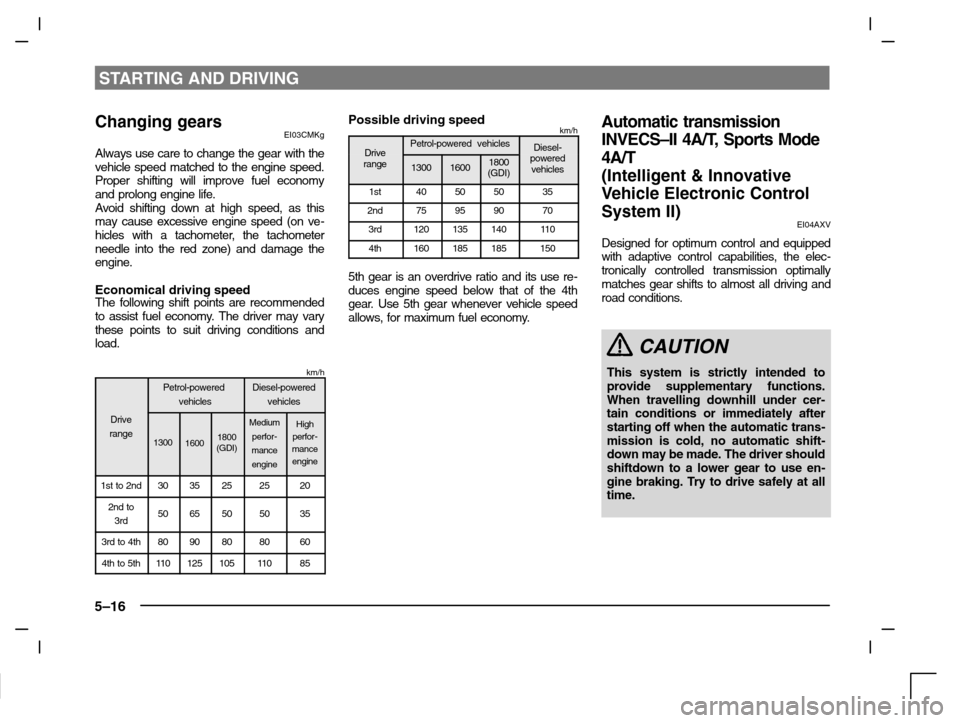
Economical driving speedThe following shift points are recommended
to assist fuel economy. The driver may vary
these points to suit driving conditions and
load.
km/h
Petrol-powered
vehiclesDiesel-powered
vehicles
Drive
range
130016001800
(GDI)
Medium
perfor-
mance
engineHigh
perfor-
mance
engine
1st to 2nd3035252520
2nd to
3rd5065505035
3rd to 4th8090808060
4th to 5th11 012510511 085
Possible driving speedkm/h
DrivePetrol-powered vehiclesDiesel-Driverange130016001800
(GDI)powered
vehicles
1st40505035
2nd75959070
3rd12013514011 0
4th160185185150
5th gear is an overdrive ratio and its use re-
duces engine speed below that of the 4th
gear. Use 5th gear whenever vehicle speed
allows, for maximum fuel economy.
Automatic transmission
INVECS–II 4A/T, Sports Mode
4A/T
(Intelligent & Innovative
Vehicle Electronic Control
System II)
EI04AXV
Designed for optimum control and equipped
with adaptive control capabilities, the elec-
tronically controlled transmission optimally
matches gear shifts to almost all driving and
road conditions.
CAUTION
This system is strictly intended to
provide supplementary functions.
When travelling downhill under cer-
tain conditions or immediately after
starting off when the automatic trans-
mission is cold, no automatic shift-
down may be made. The driver should
shiftdown to a lower gear to use en-
gine braking. Try to drive safely at all
time.
Page 121 of 280
STARTING AND DRIVING
5–21
3 - THIRD/2 - SECOND
(Except for vehicles with Sports
mode)
This position is for extra power when driving
up moderately steep hills, and for engine
braking when descending moderately steep
gradients.
L - LOW
(Except for vehicles with Sports
mode)
This position is for driving up very steep hills
and for engine braking at low speeds when
descending steep gradients.
WARNING
This position can be used for maxi-
mum engine braking.
Be very careful not to shift into “L”
suddenly. Sudden engine braking
may cause the tyres to skid.
Select this position according to the
road conditions and vehicle speed.
I04J053a
A/T mode changeover switch
(Except for vehicles with Sports
mode)
EI04JADa
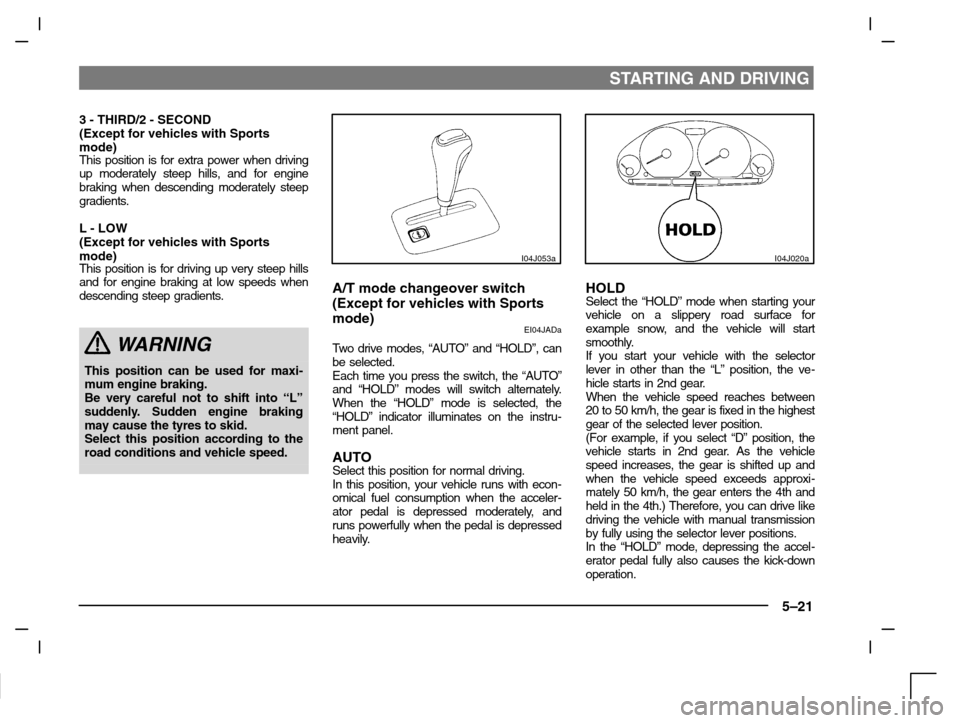
Two drive modes, “AUTO” and “HOLD”, can
be selected.
Each time you press the switch, the “AUTO”
and “HOLD” modes will switch alternately.
When the “HOLD” mode is selected, the
“HOLD” indicator illuminates on the instru-
ment panel.
AUTOSelect this position for normal driving.
In this position, your vehicle runs with econ-
omical fuel consumption when the acceler-
ator pedal is depressed moderately, and
runs powerfully when the pedal is depressed
heavily.
I04J020a
HOLDSelect the “HOLD” mode when starting your
vehicle on a slippery road surface for
example snow, and the vehicle will start
smoothly.
If you start your vehicle with the selector
lever in other than the “L” position, the ve-
hicle starts in 2nd gear.
When the vehicle speed reaches between
20 to 50 km/h, the gear is fixed in the highest
gear of the selected lever position.
(For example, if you select “D” position, the
vehicle starts in 2nd gear. As the vehicle
speed increases, the gear is shifted up and
when the vehicle speed exceeds approxi-
mately 50 km/h, the gear enters the 4th and
held in the 4th.) Therefore, you can drive like
driving the vehicle with manual transmission
by fully using the selector lever positions.
In the “HOLD” mode, depressing the accel-
erator pedal fully also causes the kick-down
operation.
Page 201 of 280

For emergencies
If the vehicle breaks down 8–2. . . . . . . . . . . . . . . . .
Operation under adverse driving conditions 8–2. .
Tools and jack 8–3. . . . . . . . . . . . . . . . . . . . . . . . . . . .
Jacking up the vehicle 8–4. . . . . . . . . . . . . . . . . . . . .
Spare wheel 8–6. . . . . . . . . . . . . . . . . . . . . . . . . . . . . .
Wheel covers* 8–8. . . . . . . . . . . . . . . . . . . . . . . . . . . .
If a tyre is punctured 8–9. . . . . . . . . . . . . . . . . . . . . .
Towing 8–12. . . . . . . . . . . . . . . . . . . . . . . . . . . . . . . . . .
Engine overheating 8–15. . . . . . . . . . . . . . . . . . . . . . .
Emergency starting 8–17. . . . . . . . . . . . . . . . . . . . . .
Bleeding the fuel system
(diesel-powered vehicles only) 8–21. . . . . . . . . . . . .
Removal of water from the fuel filter
(diesel-powered vehicles only) 8–21. . . . . . . . . . . . .
What to do if the engine speed becomes
unstable after the battery is replaced: 8–22. . . . . .
Fuses 8–22. . . . . . . . . . . . . . . . . . . . . . . . . . . . . . . . . . .
Changing a fuse 8–25. . . . . . . . . . . . . . . . . . . . . . . . .
Replacement of lamp bulbs 8–26. . . . . . . . . . . . . . .
Page 221 of 280
FOR EMERGENCIES
8–21
N07A017a
Bleeding the fuel system
(diesel-powered vehicles
only)
EN07A-Ma
The fuel system should be bled to remove air
as described below if the fuel supply is ex-
hausted during travel.
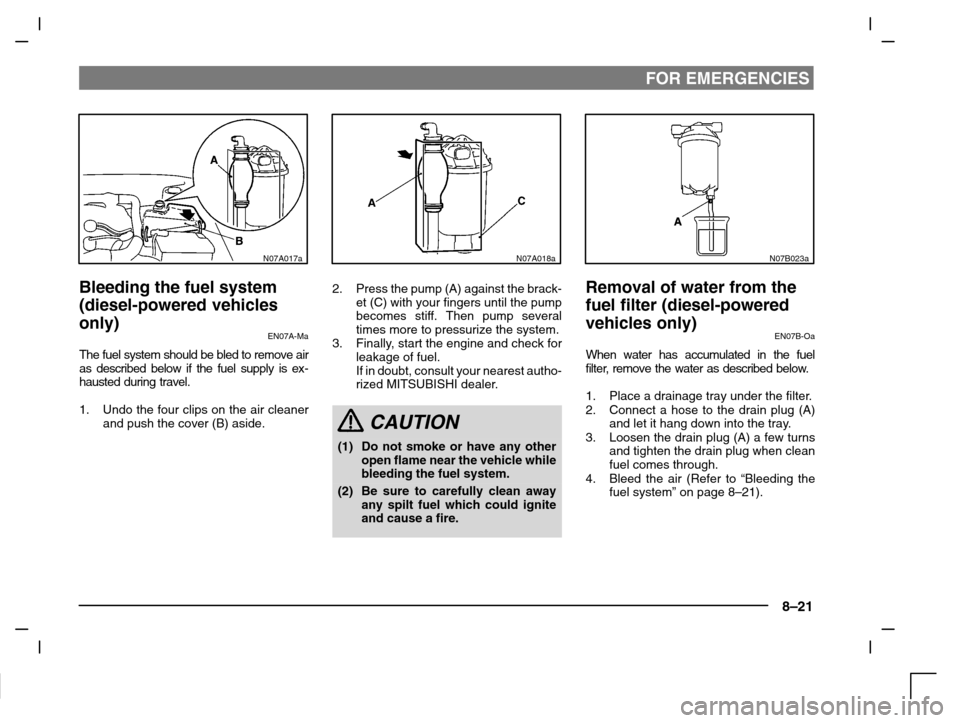
1. Undo the four clips on the air cleaner
and push the cover (B) aside.
N07A018a
2. Press the pump (A) against the brack-
et (C) with your fingers until the pump
becomes stiff. Then pump several
times more to pressurize the system.
3. Finally, start the engine and check for
leakage of fuel.
If in doubt, consult your nearest autho-
rized MITSUBISHI dealer.
CAUTION
(1) Do not smoke or have any other
open flame near the vehicle while
bleeding the fuel system.
(2) Be sure to carefully clean away
any spilt fuel which could ignite
and cause a fire.
N07B023a
Removal of water from the
fuel filter (diesel-powered
vehicles only)
EN07B-Oa
When water has accumulated in the fuel
filter, remove the water as described below.
1. Place a drainage tray under the filter.
2. Connect a hose to the drain plug (A)
and let it hang down into the tray.
3. Loosen the drain plug (A) a few turns
and tighten the drain plug when clean
fuel comes through.
4. Bleed the air (Refer to “Bleeding the
fuel system” on page 8–21).