2000 MITSUBISHI CARISMA child lock
[x] Cancel search: child lockPage 47 of 280
SEATS AND SEATBELTS
3–19
G18C021a
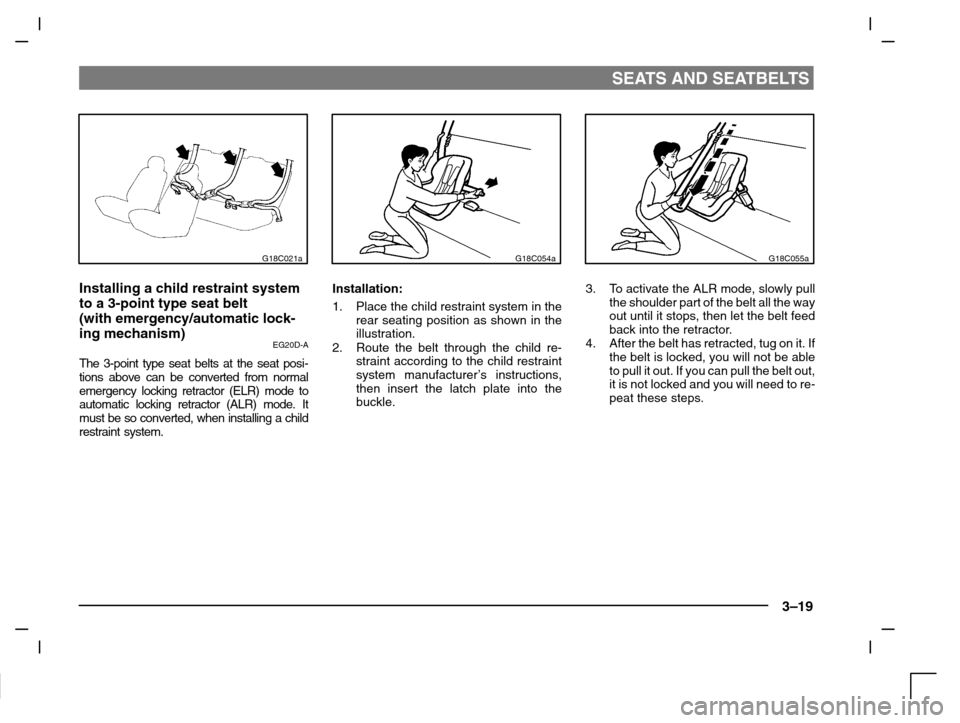
Installing a child restraint system
to a 3-point type seat belt
(with emergency/automatic lock-
ing mechanism)
EG20D-A
The 3-point type seat belts at the seat posi-
tions above can be converted from normal
emergency locking retractor (ELR) mode to
automatic locking retractor (ALR) mode. It
must be so converted, when installing a child
restraint system.
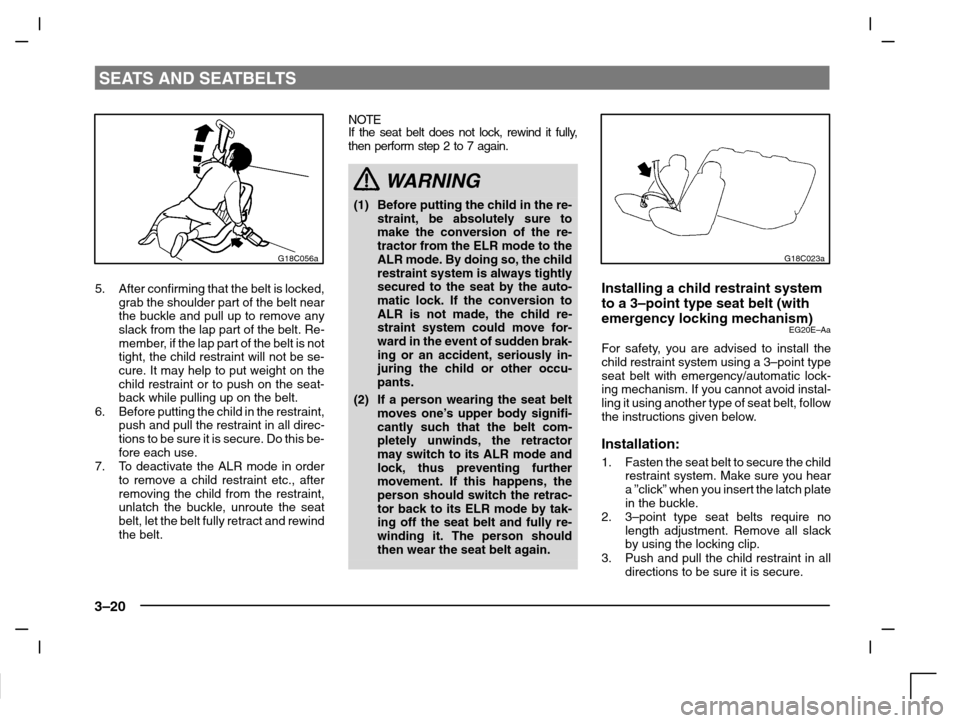
G18C054a
Installation:
1. Place the child restraint system in the
rear seating position as shown in the
illustration.
2. Route the belt through the child re-
straint according to the child restraint
system manufacturer’s instructions,
then insert the latch plate into the
buckle.
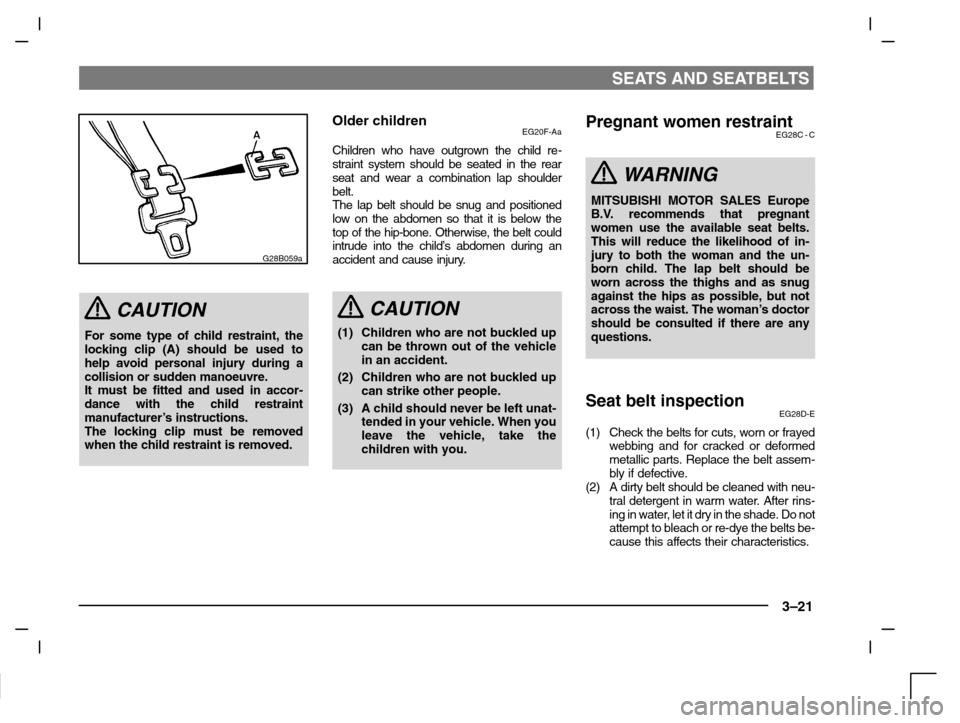
G18C055a
3. To activate the ALR mode, slowly pull
the shoulder part of the belt all the way
out until it stops, then let the belt feed
back into the retractor.
4. After the belt has retracted, tug on it. If
the belt is locked, you will not be able
to pull it out. If you can pull the belt out,
it is not locked and you will need to re-
peat these steps.
Page 48 of 280
SEATS AND SEATBELTS
3–20
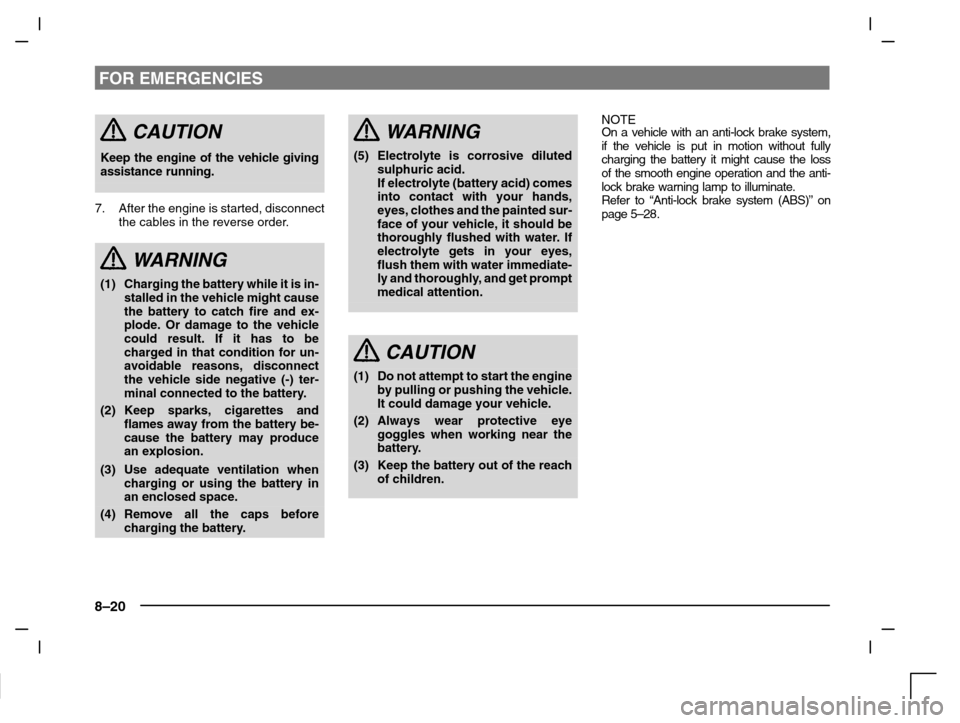
G18C056a
5. After confirming that the belt is locked,
grab the shoulder part of the belt near
the buckle and pull up to remove any
slack from the lap part of the belt. Re-
member, if the lap part of the belt is not
tight, the child restraint will not be se-
cure. It may help to put weight on the
child restraint or to push on the seat-
back while pulling up on the belt.
6. Before putting the child in the restraint,
push and pull the restraint in all direc-
tions to be sure it is secure. Do this be-
fore each use.
7. To deactivate the ALR mode in order
to remove a child restraint etc., after
removing the child from the restraint,
unlatch the buckle, unroute the seat
belt, let the belt fully retract and rewind
the belt.NOTE
If the seat belt does not lock, rewind it fully,
then perform step 2 to 7 again.
WARNING
(1) Before putting the child in the re-
straint, be absolutely sure to
make the conversion of the re-
tractor from the ELR mode to the
ALR mode. By doing so, the child
restraint system is always tightly
secured to the seat by the auto-
matic lock. If the conversion to
ALR is not made, the child re-
straint system could move for-
ward in the event of sudden brak-
ing or an accident, seriously in-
juring the child or other occu-
pants.
(2) If a person wearing the seat belt
moves one’s upper body signifi-
cantly such that the belt com-
pletely unwinds, the retractor
may switch to its ALR mode and
lock, thus preventing further
movement. If this happens, the
person should switch the retrac-
tor back to its ELR mode by tak-
ing off the seat belt and fully re-
winding it. The person should
then wear the seat belt again.
G18C023a
Installing a child restraint system
to a 3–point type seat belt (with
emergency locking mechanism)
EG20E–Aa
For safety, you are advised to install the
child restraint system using a 3–point type
seat belt with emergency/automatic lock-
ing mechanism. If you cannot avoid instal-
ling it using another type of seat belt, follow
the instructions given below.
Installation:
1. Fasten the seat belt to secure the child
restraint system. Make sure you hear
a ”click” when you insert the latch plate
in the buckle.
2. 3–point type seat belts require no
length adjustment. Remove all slack
by using the locking clip.
3. Push and pull the child restraint in all
directions to be sure it is secure.
Page 49 of 280
SEATS AND SEATBELTS
3–21
G28B059a
CAUTION
For some type of child restraint, the
locking clip (A) should be used to
help avoid personal injury during a
collision or sudden manoeuvre.
It must be fitted and used in accor-
dance with the child restraint
manufacturer’s instructions.
The locking clip must be removed
when the child restraint is removed.
Older childrenEG20F-Aa
Children who have outgrown the child re-
straint system should be seated in the rear
seat and wear a combination lap shoulder
belt.
The lap belt should be snug and positioned
low on the abdomen so that it is below the
top of the hip-bone. Otherwise, the belt could
intrude into the child’s abdomen during an
accident and cause injury.
CAUTION
(1) Children who are not buckled up
can be thrown out of the vehicle
in an accident.
(2) Children who are not buckled up
can strike other people.
(3) A child should never be left unat-
tended in your vehicle. When you
leave the vehicle, take the
children with you.
Pregnant women restraintEG28C - C
WARNING
MITSUBISHI MOTOR SALES Europe
B.V. recommends that pregnant
women use the available seat belts.
This will reduce the likelihood of in-
jury to both the woman and the un-
born child. The lap belt should be
worn across the thighs and as snug
against the hips as possible, but not
across the waist. The woman’s doctor
should be consulted if there are any
questions.
Seat belt inspectionEG28D-E
(1) Check the belts for cuts, worn or frayed
webbing and for cracked or deformed
metallic parts. Replace the belt assem-
bly if defective.
(2) A dirty belt should be cleaned with neu-
tral detergent in warm water. After rins-
ing in water, let it dry in the shade. Do not
attempt to bleach or re-dye the belts be-
cause this affects their characteristics.
Page 220 of 280
FOR EMERGENCIES
8–20
CAUTION
Keep the engine of the vehicle giving
assistance running.
7. After the engine is started, disconnect
the cables in the reverse order.
WARNING
(1) Charging the battery while it is in-
stalled in the vehicle might cause
the battery to catch fire and ex-
plode. Or damage to the vehicle
could result. If it has to be
charged in that condition for un-
avoidable reasons, disconnect
the vehicle side negative (-) ter-
minal connected to the battery.
(2) Keep sparks, cigarettes and
flames away from the battery be-
cause the battery may produce
an explosion.
(3) Use adequate ventilation when
charging or using the battery in
an enclosed space.
(4) Remove all the caps before
charging the battery.
WARNING
(5) Electrolyte is corrosive diluted
sulphuric acid.
If electrolyte (battery acid) comes
into contact with your hands,
eyes, clothes and the painted sur-
face of your vehicle, it should be
thoroughly flushed with water. If
electrolyte gets in your eyes,
flush them with water immediate-
ly and thoroughly, and get prompt
medical attention.
CAUTION
(1) Do not attempt to start the engine
by pulling or pushing the vehicle.
It could damage your vehicle.
(2) Always wear protective eye
goggles when working near the
battery.
(3) Keep the battery out of the reach
of children.
NOTE
On a vehicle with an anti-lock brake system,
if the vehicle is put in motion without fully
charging the battery it might cause the loss
of the smooth engine operation and the anti-
lock brake warning lamp to illuminate.
Refer to “Anti-lock brake system (ABS)” on
page 5–28.
Page 276 of 280

10–18
Accessory boxes 6–47. . . . . . . . . . . . . . . . . . . . .
Additional equipment
(For regions where snow is encountered) 9–19
Anti–lock brake system (ABS)* 5–28. . . . . . . . .
Armrest* 3–9. . . . . . . . . . . . . . . . . . . . . . . . . . . . .
Ashtray 6–46. . . . . . . . . . . . . . . . . . . . . . . . . . . . . .
Audio system anti-theft feature 6–26. . . . . . . . . .
Auto–speed (cruise) control* 5–36. . . . . . . . . . . .
Automatic air conditioning* 6–36. . . . . . . . . . . . .
Automatic transmission fluid* 9–4. . . . . . . . . . .
Automatic transmission INVECS–II 4A/T,
Sports Mode 4A/T
(Intelligent & Innovative Vehicle Electronic
Control System II) 5–16. . . . . . . . . . . . . . . . . .
Battery 9–7. . . . . . . . . . . . . . . . . . . . . . . . . . . . . .
Bleeding the fuel system
(diesel-powered vehicles only) 8–21. . . . . . . .
Bonnet 2–8. . . . . . . . . . . . . . . . . . . . . . . . . . . . . .
Boot lid (or tailgate) 2–10. . . . . . . . . . . . . . . . . . .
Brake fluid 9–8. . . . . . . . . . . . . . . . . . . . . . . . . . .
Brake pedal free play 9–17. . . . . . . . . . . . . . . . . .
Braking 5–27. . . . . . . . . . . . . . . . . . . . . . . . . . . . .
Capacities 10–16. . . . . . . . . . . . . . . . . . . . . . . . . . .
Cargo net* 6–51. . . . . . . . . . . . . . . . . . . . . . . . . . .
Catalytic converter 5–5. . . . . . . . . . . . . . . . . . . .
Central door locks 2–7. . . . . . . . . . . . . . . . . . . . .
Changing a fuse 8–25. . . . . . . . . . . . . . . . . . . . . .
Changing gears 5–16. . . . . . . . . . . . . . . . . . . . . .
Chassis number 10–2. . . . . . . . . . . . . . . . . . . . . .
Child restraint 3–15. . . . . . . . . . . . . . . . . . . . . . . .
“Child-protection” rear doors 2–6. . . . . . . . . . . .
Cigarette lighter 6–45. . . . . . . . . . . . . . . . . . . . . . .
Cleaning the inside of your vehicle 7–2. . . . . . .
Cleaning the outside of your vehicle 7–3. . . . . .
Clutch fluid* 9–10. . . . . . . . . . . . . . . . . . . . . . . . . .
Clutch pedal free play* 9–17. . . . . . . . . . . . . . . . .
Combination headlamps, dipper and turn
signal switch 4–12. . . . . . . . . . . . . . . . . . . . . . .
Digital clock 4–26. . . . . . . . . . . . . . . . . . . . . . . . . .
Dimensions 10–5. . . . . . . . . . . . . . . . . . . . . . . . . .
Doors 2–4. . . . . . . . . . . . . . . . . . . . . . . . . . . . . . . Driving and alcohol 1–11. . . . . . . . . . . . . . . . . . . .
Economical driving 5–6. . . . . . . . . . . . . . . . . . . .
Electric remote–controlled outside rear–view
mirrors* 5–32. . . . . . . . . . . . . . . . . . . . . . . . . . .
Electric window control* 2–12. . . . . . . . . . . . . . . .
Electrical system 10–11. . . . . . . . . . . . . . . . . . . . . .
Electronic immobilizer
(Anti-theft starting system) 2–2. . . . . . . . . . .
Emergency starting 8–17. . . . . . . . . . . . . . . . . . .
Engine 10–9. . . . . . . . . . . . . . . . . . . . . . . . . . . . . .
Engine coolant 9–5. . . . . . . . . . . . . . . . . . . . . . .
Engine number 10–2. . . . . . . . . . . . . . . . . . . . . . .
Engine oil 9–2. . . . . . . . . . . . . . . . . . . . . . . . . . . .
Engine overheating 8–15. . . . . . . . . . . . . . . . . . . .
Exterior and interior lamp operation 9–16. . . . . .
Filling the fuel tank 5–3. . . . . . . . . . . . . . . . . . . .
Front fog lamp switch* 4–20. . . . . . . . . . . . . . . . .
Fuel consumption 10–13. . . . . . . . . . . . . . . . . . . . .
Fuel gauge 4–4. . . . . . . . . . . . . . . . . . . . . . . . . .
Fuel selection 5–3. . . . . . . . . . . . . . . . . . . . . . . .
Fuel, engine coolant, oil and exhaust gas
leakage 9–16. . . . . . . . . . . . . . . . . . . . . . . . . . .
Fuses 8–22. . . . . . . . . . . . . . . . . . . . . . . . . . . . . . .
Genuine parts 1–10. . . . . . . . . . . . . . . . . . . . . . . .
Hazard warning flasher switch 4–18. . . . . . . . . .
Head restraints 3–7. . . . . . . . . . . . . . . . . . . . . . .
Headlamp levelling switch 4–13. . . . . . . . . . . . . .
Headlamp washer switch* 4–17. . . . . . . . . . . . . .
Heated seats* 3–10. . . . . . . . . . . . . . . . . . . . . . . .
Heater/Manual air conditioning* 6–30. . . . . . . . .
Hinges and latches lubrication 9–18. . . . . . . . . .
Horn switch 4–22. . . . . . . . . . . . . . . . . . . . . . . . . .
If a tyre is punctured 8–9. . . . . . . . . . . . . . . . . .
If the vehicle breaks down 8–2. . . . . . . . . . . . . .
Ignition switch 5–9. . . . . . . . . . . . . . . . . . . . . . . .
Indication and warning lamps 4–6. . . . . . . . . . .
Inside rear-view mirror 5–31. . . . . . . . . . . . . . . . .
Installation of accessories 1–8. . . . . . . . . . . . . . Installation position for first–aid kit 6–50. . . . . . .
Instruments 4–2. . . . . . . . . . . . . . . . . . . . . . . . . .
Jacking up the vehicle 8–4. . . . . . . . . . . . . . . . .
Keyless entry system* 2–5. . . . . . . . . . . . . . . . .
Keys 2–2. . . . . . . . . . . . . . . . . . . . . . . . . . . . . . . .
Manual remote-controlled outside rear-view
mirrors* 5–32. . . . . . . . . . . . . . . . . . . . . . . . . . .
Manual transmission 5–14. . . . . . . . . . . . . . . . . .
Manual window control* 2–11. . . . . . . . . . . . . . . .
Meter, gauge and indication/ warning lamp
operation 9–16. . . . . . . . . . . . . . . . . . . . . . . . . .
Modification / alterations to the electric or fuel
systems 1–9. . . . . . . . . . . . . . . . . . . . . . . . . . .
Multi centre display 4–24. . . . . . . . . . . . . . . . . . . .
Notes regarding diesel fuel 10–17. . . . . . . . . . . . .
Odometer/Tripmeter 4–3. . . . . . . . . . . . . . . . . .
Operation of the automatic transmission
INVECS-II 5–23. . . . . . . . . . . . . . . . . . . . . . . . .
Operation under adverse driving conditions 8–2
Other specifications 10–12. . . . . . . . . . . . . . . . . . .
Outside rear-view mirror 5–31. . . . . . . . . . . . . . .
Parking 5–26. . . . . . . . . . . . . . . . . . . . . . . . . . . . . .
Parking brake 5–25. . . . . . . . . . . . . . . . . . . . . . . .
Parking brake lever stroke 9–17. . . . . . . . . . . . . .
Performance 10–5. . . . . . . . . . . . . . . . . . . . . . . . .
Power steering fluid 9–9. . . . . . . . . . . . . . . . . . .
Power steering system 5–31. . . . . . . . . . . . . . . . .
Pregnant women restraint 3–21. . . . . . . . . . . . . .
Rear fog lamp switch 4–21. . . . . . . . . . . . . . . . . .
Rear seat 3–5. . . . . . . . . . . . . . . . . . . . . . . . . . . .
Rear shelf panel
(Hatchback) . . . . . . . . . . . . . . . . . . . . . . . .
NO TAG
Rear window demister switch 4–19. . . . . . . . . . .