Page 836 of 1111

SF0NL±05
B09506
B01608
B01982
LEXUS
Hand±Held
Tester SF±32
± SFI (2JZ±GE)THROTTLE BODY
1498 Author�: Date�:
2000 LEXUS GS300/GS400 (RM718U)
THROTTLE BODY
ON±VEHICLE INSPECTION
1. REMOVE ENGINE COVER
Remove the 4 nuts and engine cover.
2. INSPECT SYSTEM OPERATION
(a) Check that the throttle linkage moves smoothly.
(b) Inspect the throttle control motor for operating sound.
(1) Turn the ignition switch ON.
(2) When turning the accelerator pedal position sensor
lever, check the running sound of the motor. Also,
check that there is no friction sound.
If operation is not as specified, check the throttle control motor,
wiring and ECM.
(c) Inspect the throttle position sensor and accelerator pedal
position sensor function.
(1) Connect the LEXUS hand±held tester to the DLC3.
(2) When turning the accelerator pedal position sensor
lever to the full±open position, check that the
throttle valve opening percentage (THROTTLE
POS) of the CURRENT DATA showns the standard
value.
Throttle valve opening percentage: 60 % or more
If operation is not as specified, check that the throttle position
sensor, accelerator pedal position sensor, wiring and ECM.
(d) Start the engine, and check that the Malfunction Indicator
Lamp (MIL) does not light up.
(e) Inspect the air assist system.
(1) Allow the engine to warm up to normal operating
temperature.
Page 837 of 1111

B09507
B01620
Ohmmeter3 (CL±)
4 (CL+)
1 (M+)
2 (M±)
B01942VCOhmmeter
E2
B01943
VC Ohmmeter
E2
± SFI (2JZ±GE)THROTTLE BODY
SF±33
1499 Author�: Date�:
2000 LEXUS GS300/GS400 (RM718U)
(2) Turn the A/C switch ON and OFF, and check the idle
speed.
Idle speed (Transmission in neutral):
700 ± 50 rpm (A/C OFF)
750 ± 50 rpm (A/C ON)
NOTICE:
Perform inspection under condition without electrical load.
(3) With engine idling, pinch the air assist hose and
check that engine speed drops, and then returns
back up to idle speed.
If operation is not as specified, check the throttle body, wiring
and ECM.
(f) After checking the above (b) to (e), perform the diving test
and check that there is no sense of incongruity.
3. INSPECT THROTTLE CONTROL MOTOR
(a) Disconnect the throttle control motor connector.
(b) Using an ohmmeter, measure the resistance between ter-
minal 3 (CL±) and 4 (CL+).
Resistance: 4.2 ± 5.2 W at 20°C (68°F)
(c) Using an ohmmeter, measure the resistance between ter-
minal 1 (M+) and 2 (M±).
Resistance: 0.3 ± 100 W at 20°C (68°F)
If the resistance is not as specified, replace the throttle control
motor. (See page SF±37)
(d) Reconnect the throttle control motor connector.
4. INSPECT THROTTLE POSITION SENSOR
(a) Disconnect the throttle position sensor connector.
(b) Using an ohmmeter, measure the resistance between ter-
minals VC and E2.
Resistance: 1.2 ± 3.2 kW at 20°C (68°F)
If the resistance is not as specified, replace the throttle position
sensor. (See page SF±37)
(c) Reconnect the throttle position sensor connector.
5. INSPECT ACCELERATOR PEDAL POSITION SEN-
SOR
(a) Disconnect the accelerator pedal position sensor con-
nector.
(b) Using an ohmmeter, measure the resistance between ter-
minals VC and E2.
Resistance: 1.2 ± 3.2 kW at 20°C (68°F)
If the resistance is not as specified, replace the accelerator ped-
al position sensor. (See page SF±37)
Page 845 of 1111
A02640
Ohmmeter
SF0NR±03
± SFI (2JZ±GE)CAMSHAFT TIMING OIL CONTROL VALVE
SF±41
1507 Author�: Date�:
2000 LEXUS GS300/GS400 (RM718U)
CAMSHAFT TIMING OIL CONTROL
VA LV E
ON±VEHICLE INSPECTION
1. INSPECT CAMSHAFT TIMING OIL CONTROL VALVE
RESISTANCE
(a) Disconnect the oil control valve connector.
(b) Using an ohmmeter, measure the resistance between the
terminals.
Resistance: 5.5 ± 12 W at 20°C (68°F)
If the resistance is not as specified, replace the valve.
(c) Reconnect the oil control valve connector.
2. INSPECT VVT±i OPERATION
(a) Allow the engine to warm up to normal operating tempera-
ture.
(b) Check that the engine stalls or becomes in rough±idling
state when the battery positive voltage is applied to the oil
control valve with the engine idling.
If operation is not as specified, check the oil control valve (see
page SF±43), VVT±i pulley, intake camshaft, wiring and ECM.
Page 848 of 1111

SF0NT±03
B01583
ActuatorVacuum Gauge
VSV
P10710
No Vacuum
Vacuum Gauge
P10844
Approx.
33.3 kPa
Pull
Actuator
Rod Vacuum Gauge SF±44
± SFI (2JZ±GE)ACOUSTIC CONTROL INDUCTION SYSTEM (ACIS)
1510 Author�: Date�:
2000 LEXUS GS300/GS400 (RM718U)
ACOUSTIC CONTROL INDUCTION
SYSTEM (ACIS)
ON±VEHICLE INSPECTION
1. REMOVE ENGINE COVER
Remove the 4 nuts and engine cover.
2. CONNECT VACUUM GAUGE
Using a 3±way connector, connect vacuum gauge to the hose
between the actuator and VSV.
3. START ENGINE
4. INSPECT INTAKE AIR CONTROL VALVE
(a) While the engine is idling, check that the vacuum gauge
needle does not move.
(b) Rapidly depress the accelerator pedal to fully open posi-
tion and check that the vacuum gauge needle momentari-
ly fluctuates approx. 33.3 kPa (250 mmHg, 9.84 in.Hg) or
more. (The actuator rod is pulled down.)
5. REMOVE VACUUM GAUGE
Remove the vacuum gauge, and reconnect the vacuum hoses
to their proper locations.
6. REINSTALL ENGINE COVER
Reinstall the engine cover with the 4 nuts.
Page 856 of 1111
SF0O0±04
B01604
Ohmmeter
Continuity
B01605
No ContinuityOhmmeter
B01606
Air
B01607
Air
Battery SF±52
± SFI (2JZ±GE)VSV FOR EVAPORATIVE EMISSION (EVAP)
1518 Author�: Date�:
2000 LEXUS GS300/GS400 (RM718U)
INSPECTION
1. REMOVE ENGINE COVER
Remove the 4 nuts and engine cover.
2. REMOVE VSV
3. INSPECT VSV
(a) Inspect the VSV for open circuit.
Using an ohmmeter, check that there is continuity be-
tween the terminals.
Resistance: 27 ± 33 W at 20°C (68°F)
If there is no continuity, replace the VSV.
(b) Inspect the VSV for ground.
Using an ohmmeter, check that there is no continuity be-
tween each terminal and the body.
If there is continuity, replace the VSV.
(c) Inspect the VSV operation.
(1) Check that air does not flows from the ports.
(2) Apply battery positive voltage across the terminals.
(3) Check that air flows from the ports.
If operation is not specified, replace the VSV.
4. REINSTALL VSV
5. REINSTALL ENGINE COVER
Reinstall the engine cover with the 4 nuts.
Page 858 of 1111

SF0O2±04
B01664
B01588
VSV Connect
Vacuum Hose
P02688
Ohmmeter
Continuity
P02687
Ohmmeter
No Continuity SF±54
± SFI (2JZ±GE)VSV FOR ACOUSTIC CONTROL INDUCTION
SYSTEM (ACIS)
1520 Author�: Date�:
2000 LEXUS GS300/GS400 (RM718U)
INSPECTION
1. REMOVE ENGINE COVER
Remove the 4 nuts and engine cover.
2. REMOVE OIL DIPSTICK AND GUIDE FOR A/T
(See page EM±62)
3. REMOVE VACUUM CONTROL VALVE SET
(a) Remove the 2 nuts, and disconnect the vacuum tank from
the intake manifold.
(b) Disconnect VSV connector and vacuum hoses, and re-
move the vacuum control valve set.
4. REMOVE VSV
Remove the screw, vacuum hose and VSV.
5. INSPECT VSV
(a) Inspect the VSV for open circuit.
Using an ohmmeter, check that there is continuity be-
tween the terminals.
Resistance: 38.5 ± 44.5 W at 20°C (68°F)
If there is no continuity, replace the VSV.
(b) Inspect the VSV for ground.
Using an ohmmeter, check that there is no continuity be-
tween each terminal and the body.
If there is continuity, replace the VSV.
Page 859 of 1111
P02689
Air
E
Filter
P02690
Air
E
F
Battery
± SFI (2JZ±GE)VSV FOR ACOUSTIC CONTROL INDUCTION
SYSTEM (ACIS)SF±55
1521 Author�: Date�:
2000 LEXUS GS300/GS400 (RM718U)
(c) Inspect the VSV operation.
(1) Check that air flows from port E to the filter.
(2) Apply battery positive voltage across the terminals.
(3) Check that air flows from ports E to F.
6. REINSTALL VSV
(a) Install the VSV with the screw to the vacuum tank.
(b) Install the vacuum hose.
7. REINSTALL VACUUM CONTROL VALVE SET
Torque: 21 N´m (210 kgf´cm, 15 ft´lbf)
8. REINSTALL OIL DIPSTICK AND GUIDE FOR A/T
HINT:
Using a new O±ring.
9. REINSTALL SEGINE COVER
Reinstall the engine cover with the 4 nuts.
Page 864 of 1111
B01982
LEXUS
Hand±Held
TesterSF0N2±05
B09511
Up
Screw
Pulsation Damper
B01958
Fuel Inlet Hose
A02818
SST
SST
(Union)
SST
(Adapter)
SF±6
± SFI (2JZ±GE)FUEL PUMP
1472 Author�: Date�:
2000 LEXUS GS300/GS400 (RM718U)
FUEL PUMP
ON±VEHICLE INSPECTION
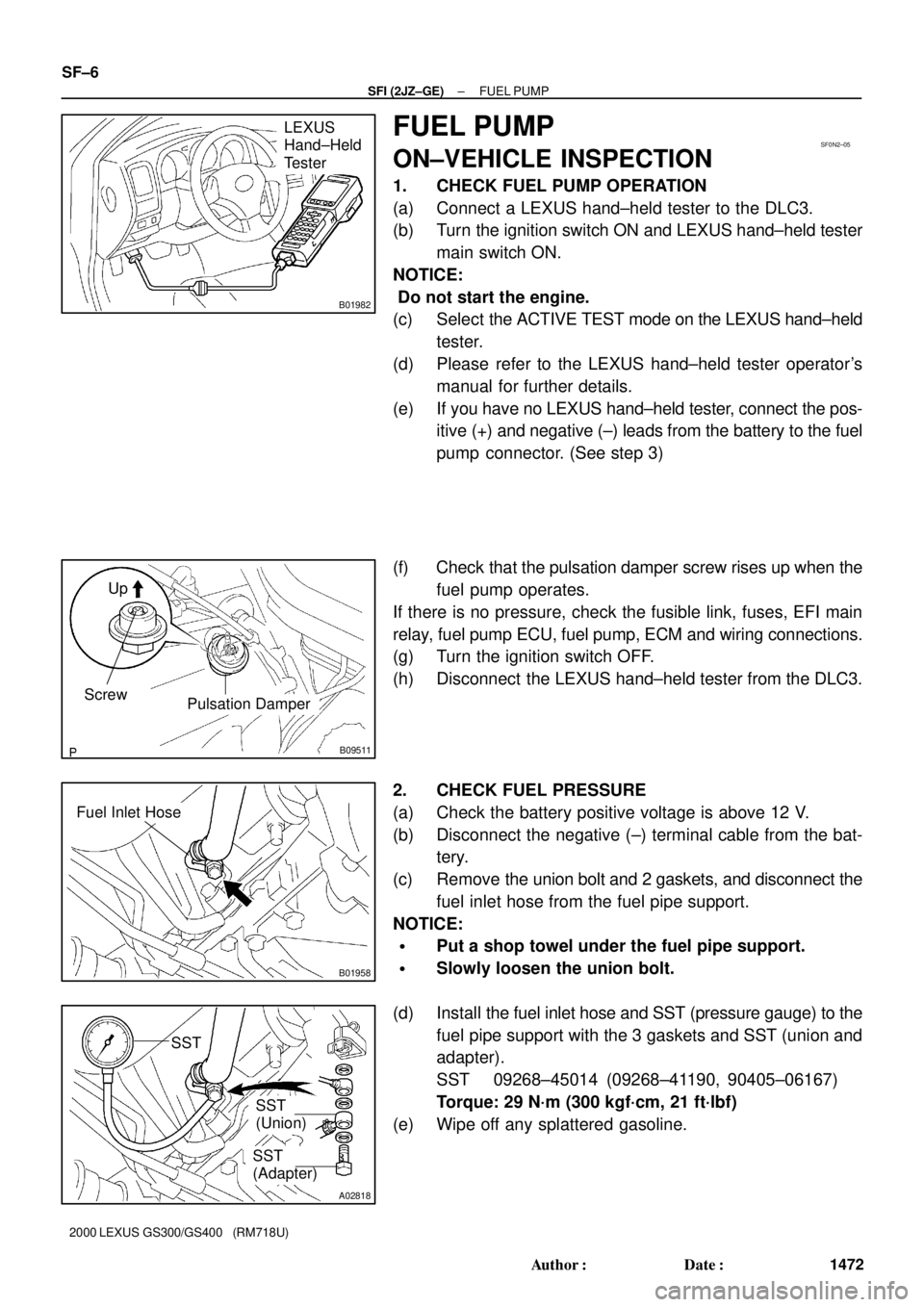
1. CHECK FUEL PUMP OPERATION
(a) Connect a LEXUS hand±held tester to the DLC3.
(b) Turn the ignition switch ON and LEXUS hand±held tester
main switch ON.
NOTICE:
Do not start the engine.
(c) Select the ACTIVE TEST mode on the LEXUS hand±held
tester.
(d) Please refer to the LEXUS hand±held tester operator's
manual for further details.
(e) If you have no LEXUS hand±held tester, connect the pos-
itive (+) and negative (±) leads from the battery to the fuel
pump connector. (See step 3)
(f) Check that the pulsation damper screw rises up when the
fuel pump operates.
If there is no pressure, check the fusible link, fuses, EFI main
relay, fuel pump ECU, fuel pump, ECM and wiring connections.
(g) Turn the ignition switch OFF.
(h) Disconnect the LEXUS hand±held tester from the DLC3.
2. CHECK FUEL PRESSURE
(a) Check the battery positive voltage is above 12 V.
(b) Disconnect the negative (±) terminal cable from the bat-
tery.
(c) Remove the union bolt and 2 gaskets, and disconnect the
fuel inlet hose from the fuel pipe support.
NOTICE:
�Put a shop towel under the fuel pipe support.
�Slowly loosen the union bolt.
(d) Install the fuel inlet hose and SST (pressure gauge) to the
fuel pipe support with the 3 gaskets and SST (union and
adapter).
SST 09268±45014 (09268±41190, 90405±06167)
Torque: 29 N´m (300 kgf´cm, 21 ft´lbf)
(e) Wipe off any splattered gasoline.