Page 230 of 273
This indicator should come on when
the ignition switch is
ON (II), and go
out after the engine starts.
If it
comes on brightly when the engine
is running, it indicates that the
charging system has stopped
charging the battery. Immediately
turn off
all electrical
accessories: radio, heater, A/C,
cruise control, etc.
Try not to use
other electrically-operated controls
such as
the power windows. Keep
the engine running and take extra
care not to stall
it. Starting the
engine
will discharge the battery
rapidly.
Charging System Indicator
By eliminating as much of the
electrical load as possible, you can
drive several miles (kilometers)
before
the battery is too discharged
to keep the engine running. Drive to
a service station or garage where
you can get technical assistance.
Taking Care of the Unexpected 227
Page 231 of 273

Malfunction Indicator Lamp
This indicator comes on for a few
seconds when you turn the ignition
switch
ON (II). If it comes on at any
other time, it indicates one of the
engine's emissions control systems
may have a problem. Even though
you may feel
no difference in your
car's performance, it can reduce
your fuel economy and cause your
car to put out excessive emissions.
Continued operation may cause
serious damage.
228 Taking Care of the Unexpected
If you have recently refueled your
car, the cause of this indicator
coming on could be a loose or
missing fuel
fill cap. Check the cap
and tighten it until it clicks at least
three times. Replace the fuel
fill cap
if it is missing. Tightening the cap
will not make the indicator turn off
immediately; it takes three driving
trips.
If the indicator remains on past three
driving trips, or the fuel cap was not
loose or missing, have the car
checked by the dealer as soon as
possible. Drive moderately until the
dealer has inspected the problem.
Avoid full-throttle acceleration and
driving at high speed.
You should also have the dealer
inspect your car
if this indicator
comes on repeatedly, even though it
may turn off as you continue driving.
NOTICE
If you keep driving with the
malfunction indicator lamp on, you can
damage your car's emissions controls
and engine. Those repairs may not be
covered by your car's warranties.
Page 232 of 273

The Brake System Indicator light
comes on when you turn the ignition
ON (II). If the parking brake is not
set, it goes off after you start the
engine.
If the parking brake is set, it
goes off when you fully release the
parking brake with the engine
running. If
it comes on at any other time, it
indicates a problem with
the car's
brake system. In most cases, the
problem is a low fluid level in
the
brake fluid reservoir. Press lightly on
the brake pedal to see if it feels
normal.
If it does, check the brake
fluid level the next time you stop at a
service station (see page
170 ) . If the
fluid level is
low, take the car to your
dealer and have the brake system
inspected for leaks or worn brake
pads.
However,
if the brake pedal does not
feel normal, you should take
immediate action. Because
of the
brake system's dual-circuit design, a
problem
in one part of the system
will still give you braking at two
wheels.
You will feel the brake pedal
go down much farther before the car
begins to slow down, and you
will
have to press harder on the pedal.
The distance needed to stop will be
much longer.
Brake System Indicator
Slow down by shifting to a lower
gear, and pull to the side of the road
when it is safe. Because
of the
longer distance needed to stop, it is
hazardous to drive the car.
You
should have it towed, and repaired as
soon as possible.
If you must drive the car a short
distance in this condition, drive
slowly and cautiously.
Taking Care of the Unexpected 229
Page 234 of 273
All the electrical circuits in your car
have fuses to protect them from a
short circuit or overload.
These
fuses are located in three fuse boxes.
The interior fuse box is underneath
the dashboard on the driver's side.
Fuses
There are two under-hood fuse
boxes
in the engine compartment.
The main fuse box is located on the
passenger's side near the battery. To
open it, push the two tabs as shown.
CONTINUED
Taking Care of the Unexpected 231
Page 237 of 273
Fuses
INTERIOR FUSE BOX
No: Amps. Circuits Protected No. Amps. Circuits Protected
1 7.5A Windshield Wiper, 14 lOA Daytime Running Lights*
Auto
Stop Signal 15 lOA Keyless Entry
2
15A Washer Motor 16 7.5A Back-up
3
-Not used 17 7.5A Interior Light
4
-Not used 18 lOA Small Lights
5
lOA Accessory Socket 19 15A Radio
6
20A Windshield Wiper 20 7.5A Starter Signal
7 7.5A Tum Light 21 7.5A Heater Control,
8 15A ACG Cooling Fan
Relay
9
7.5A Instrument Light, Back·up 22 7.5A Power Mirrors
Lights
23 20A Right Power Window
10 15A Ignition Coil 24 20A Left Power Window
11 7.5A Engine Start 25 -Not used
12 15A Fuel Pump, SRS 26 -Not used
13 lOA SRS 27 -Not used
* : Canadian Model
234 Taking Care of the Unexpected
Page 245 of 273
Identification Numbers
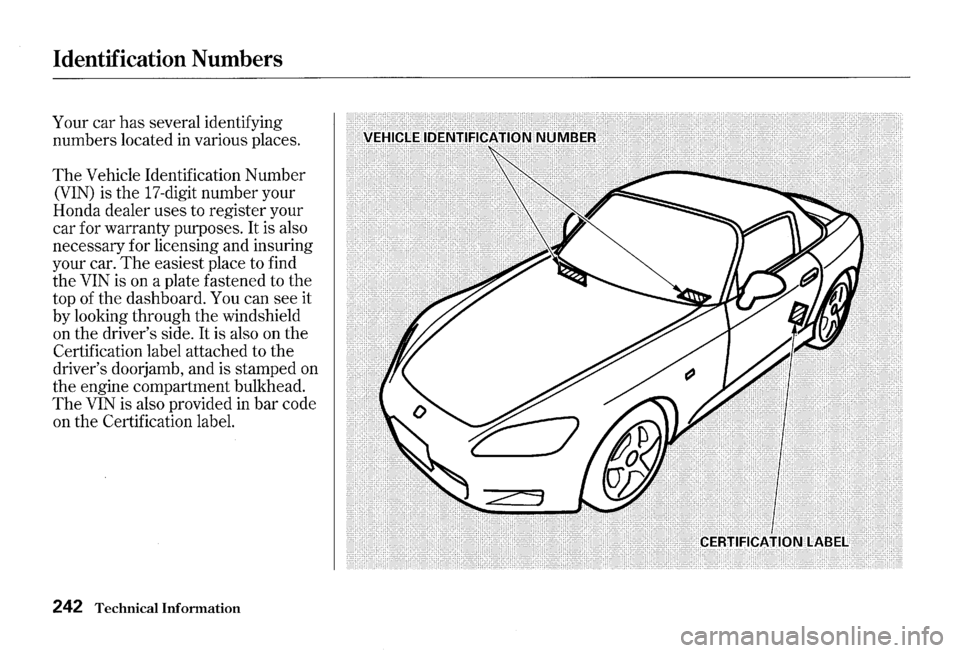
Your car has several identifying
numbers located
in various places.
The Vehicle Identification Number
(VIN) is the 17-digit number your
Honda dealer uses to register your
car for warranty purposes. It is also
necessary for licensing and insuring
your car.
The easiest place to find
the
VIN is on a plate fastened to the
top of the dashboard. You can see it
by looking through the windshield
on the driver's side.
It is also on the
Certification label attached to the
driver's doorjamb, and is stamped on
the engine compartment bulkhead.
The VIN is also provided in bar code
on the Certification label.
242 Technical Information
Page 246 of 273
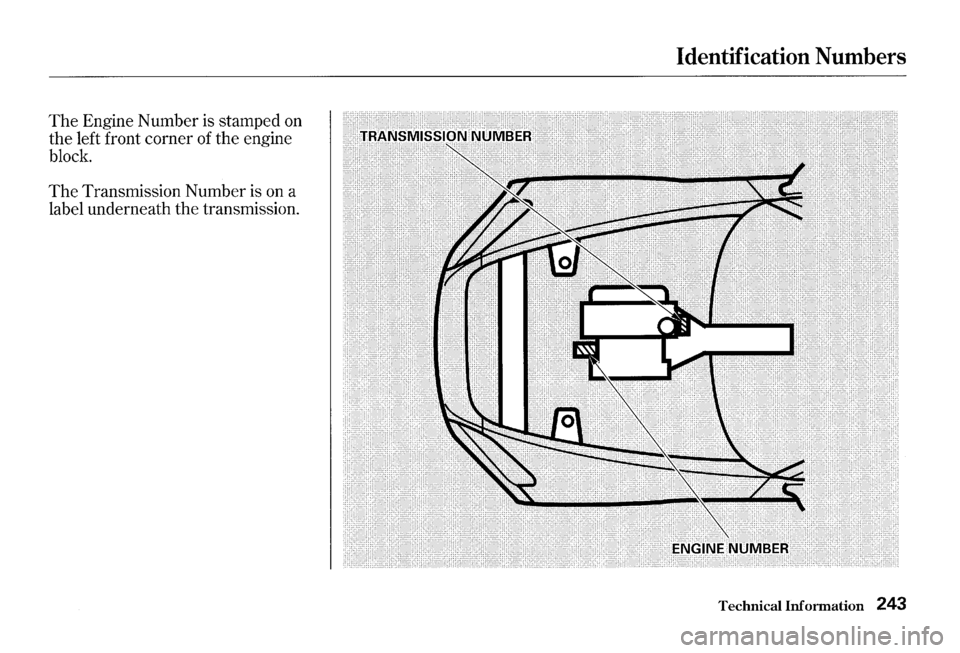
The Engine Number is stamped on
the left front corner of the engine
block.
The Transmission Number is on a
label underneath the transmission.
Identification Numbers
Technical Information 243
Page 247 of 273

Specifications
Dimensions
Length
Width Height
Wheelbase Track Front
Rear
Engine
Type
Bore x Stroke
Displacement
Compression ratio
Spark plugs
244 Technical Information
162.0in(4,115mm) 68.9 in (1,750 mm)
50.6 in (1,285 mm) 94.5 in (2,400 mm)
57.9 in (1,470 mm)
59.4 in (1,510 mm)
See the certification label attached to the driver's door"amb.
Water cooled 4-stroke DOHC
VTEC 4-cylinder l=)asoline engine
3.43 x 3.31 in (87.0 x 84.0 mm)
121.8 cu-in (1,997 cm3
)
11.0 : 1 See spark plug maintenance
section page
174.
c apac1t1es
Fuel tank 13.2 US
aal (50 ll, 11.0 Imp qal)
Engine coolant
Change*'
1.72 US aal (6.51\, 1.43 Imp qal)
Total 2.01 US l=)al (7.61\, 1.67 Imp gal)
Engine oil Change*'
Including filter 5.1 US qt (4.81\, 4.2 Imp qt)
Without
filter 4.8 USgt (4.51\, 4.0 Imp qt)
Total 5.9 US qt (5.61\, 4.9 Imp qt)
Manual Chanl=)e 1.6 US_g_t (1.51\, 1.31mp qt)
transmission Total 1.7 US qt (1.61\, 1.41mp qt) fluid
Differential Chan_g_e 0.78 US qt (0.741\, 0.65 Imp qt)
oil Total 0.81 US qt (0.77 ll, 0.68 Imp at)
Windshield U.S. Cars 2.7 US qt (2.61\, 2.3 ImP at)
washer Canadian Cars 4.4 US qt (4.21\, 3.7 Imp qt)
reservoir
* 1 : Including the coolant in the reserve tank and that remaining in the
engine. Reserve tank capacity:
0.16 US gal (0.61\, 0.131mp gal)
* 2: Excluding the oil remaining in the engine.