2000 HONDA S2000 ESP
[x] Cancel search: ESPPage 68 of 273

Remove the old battery and note the
polarity. Make sure the polarity of
the new battery is the same (
+ side
facing up), then insert it
in the
transmitter.
Align the
v mark on the cover
with the
0 mark on the
transmitter, then set the cover
in
place and turn it clockwise.
Transmitter Care
Avoid severe shock to the trans
mitter, such as dropping or throwing
it. Also, protect it from extreme hot
or cold temperatures.
Clean the transmitter case with a
soft cloth.
Do not use strong
cleaners or solvents that could harm
the case. Immersing the transmitter
in any liquid will harm the trans
mitter and cause it to not function
properly.
If you lose a transmitter, you will
need to have the replacement
programmed to your vehicle's
system by your Honda dealer. Any
other transmitters you have
will also
need to be reprogrammed.
Keys and Locks
As required by the FCC:
This device complies with Part 15 of the
FCC rules. Operation is subject to the
following two conditions:
(1) This device
may not cause harmful interference, and
(2) this device must accept any
interference received, including
interference that
may cause undesired
operation.
Changes
or modifications not expressly
approved
by the party responsible for
compliance could void
the user's
authority to operate
the equipment.
111is device complies with Industry
Canada Standard RSS-210.
Operation is subject
to the following two
conditions:
(1) this device may not cause
interference,
and (2) this device must
accept any interference that may cause
undesired operation
of the device.
Instruments and Controls 65
Page 105 of 273
Audio System
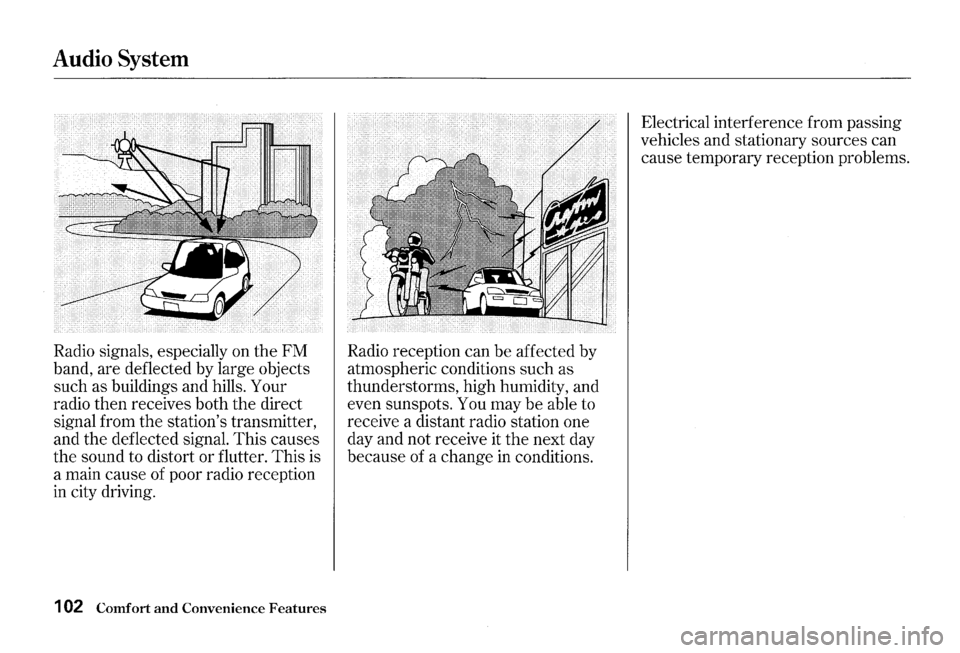
Radio signals, especially on the FM
band, are deflected by large objects
such as buildings and hills. Your
radio then receives both the direct
signal from the station's transmitter,
and the deflected signal. This causes
the sound to distort or flutter. This is
a main cause of poor radio reception
in city driving.
1 02 Comfort and Convenience Features
Radio reception can be affected by
atmospheric conditions such as
thunderstorms, high humidity, and
even sunspots. You may be able to
receive a distant radio station one
day and not receive it
the next day
because of a change
in conditions. Electrical
interference from passing
vehicles and stationary sources can
cause temporary reception problems.
Page 106 of 273
As required by the FCC:
Changes or modifications not expressly
approved
by the party responsible for
compliance could void
the user's
authority to operate the equipment.
Audio System
Comfort and Convenience Features 1 03
Page 143 of 273

Driving in Bad Weather
Rain, fog, and snow conditions re
quire a different driving technique
because of reduced traction and
visibility. Keep your car well
maintained and exercise greater
caution when you need to drive in
bad weather.
The cruise control
should not be used in these condi
tions.
140 Driving
Driving Technique -Always drive
slower than you would
in dry
weather.
It takes your car longer to
react, even
in conditions that may
seem just barely damp. Apply
smooth, even pressure to
all the
controls. Abrupt steering wheel
movements or sudden, hard appli
cation of the brakes can cause loss of
control in wet weather. Be extra
cautious for the first few miles
(kilometers) of driving while you
adjust to the change in driving
conditions.
This is especially true in
snow. A person can forget some
snow-driving techniques during the
summer months.
Practice is needed
to relearn those skills.
Exercise extra caution when driving
in rain after a long dry spell. After
months of dry weather, the first
rains bring
oil to the surface of the
roadway, making it slippery.
Visibility -Being able to see
clearly in
all directions and being
visible to other drivers are important
in all weather conditions. This is
more difficult
in bad weather. To be
seen more clearly during daylight
hours, turn on your headlights.
Inspect your windshield wipers and
washers frequently. Keep the wind
shield washer reservoir full of the
proper fluid. Have the windshield
wiper blades replaced
if they start to
streak the windshield or leave parts
unwiped.
Use the defrosters and air
conditioning to keep the windows
from fogging up on
the inside (see
page
91 ).
Page 207 of 273
Exterior Care
Washing
Frequent washing helps preserve
your car's beauty. Dirt and grit can
scratch the paint, while tree sap and
bird droppings can permanently ruin
the finish.
Wash your car
in a shady area, not in
direct sunlight. If the car is parked in
the sun, move it into the shade and
let the exterior cool down before you
start.
Only use the solvents and cleaners
recommended
in this Owner's
Manual.
204 Appearance Care
NOTICE
Chemical solvents and strong cleaners
can
damar;e the paint, metal, and
plastic on your car.
• Rinse the car thoroughly with cool
water to remove loose dirt.
• Fill a bucket with cool water. Mix
in a mild detergent, such as
dishwashing liquid or a product
made especially for car washing.
• Wash the car, using the water and
neutral detergent solution and
sponge or soft cloth.
Start at a top
and work your way down. Rinse
frequently.
• Check the body for road tar, tree
sap, etc. Remove
these stains with
tar remover or turpentine. Rinse it
off immediately so it does not
harm the finish. Remember to re
wax these areas, even
if the rest of the
car does not need waxing.
Do not use harsh chemicals to
remove stains from the
convertible top
or rear window.
Use a mild detergent/water
solution with a soft-bristle brush
on the top, and with a soft cloth on
the rear window.
• When you have washed and rinsed
the whole exterior, dry it with a
chamois or soft towel. Letting it
air-dry
will cause dulling and water
spots.
Make sure the top is completely
dry before you fold
it.
As you dry the car, inspect it for
chips and scratches that could allow
corrosion to start. Repair
them with
touch-up paint (see page
206 ).
Page 210 of 273
Carpeting
Vacuum the carpeting frequently to
remove dirt. Ground-in dirt
will make
the carpet wear out faster.
Periodically shampoo the carpet to
keep it looking new.
Use one of the
foam-type carpet cleaners on the
market. Follow the instructions
that
come with the cleaner, applying it
with a sponge
or soft brush. Keep
the carpeting as dry as possible by
not adding water to the foam.
Fabric
Vacuum dirt and dust out of the
material frequently. For general
cleaning, use a solution of mild soap
and lukewarm water, letting it air dry.
To clean off stubborn spots, use a
commercially-available fabric cleaner.
Test it on a hidden area of the fabric
first, to make sure it does not bleach
or stain the fabric. Follow the
instructions
that come with the
cleaner.
Vinyl
Remove dirt and dust with a vacuum
cleaner. Wipe
the vinyl with a soft
cloth dampened in a solution of mild
soap and water.
Use the same
solution with a soft-bristle
brush on
more difficult spots. You can also use
commercially-available spray
or
foam-type vinyl cleaners.
Leather
Vacuum dirt and dust from the
leather frequently. Pay particular
attention to the pleats and seams.
Clean the leather with a soft cloth
dampened with clear water,
then
buff it with a clean, dry cloth. If
further cleaning is needed, use a
soap specifically for leather, such as
saddle soap. Apply this soap with a
damp, soft cloth. Wipe down and
buff as described above.
Interior Care
Rear Window
Clean the rear window with either
clean water or a mild
detergent/
water solution and a soft, damp cloth.
Never use a brush or dry cloth, and
do not use any harsh chemicals or
abrasive cleaners. You
will damage
the window.
Polish the rear window periodically
with a
commerCially available plastic
polish made especially for
convertible rear windows.
Seat Belts
If your seat belts get dirty, you can
use a soft brush with a mixture of
mild soap and warm water to clean
them. Do not use bleach, dye,
or
cleaning solvents. They can weaken
the belt material. Let the belts air
dry before you use
the car.
Appearance Care 207
Page 212 of 273

Many corrosion-preventive measures
are built into your Honda.
You can
help keep your car from corroding
by performing some simple periodic
maintenance:
• Repair chips and scratches in the
paint as soon as you discover them.
• Inspect and clean out the drain
holes
in the bottom of the doors
and body.
• Check the floor coverings for
dampness. Carpeting and floor
mats may remain damp for a long
time, especially
in winter. This
dampness can eventually cause
the floor panels to corrode.
• Use a high-pressure spray to clean
the underside of your car. This is
especially important
in areas that
use road salt
in winter. It is also a
good idea
in humid climates and
areas subject to salt air. Be careful
of the
ABS wheel sensors and
wiring
at each wheel.
• Have the corrosion-preventive
coatings on the underside of your
car inspected and repaired
periodically.
Corrosion Protection
Appearance Care 209
Page 215 of 273

Compact Spare Tire
Your car has a compact spare tire
that takes up less space.
Use this
spare tire as a temporary replace
ment only. Get your regular tire
repaired or replaced and put back on
your car as soon as you can.
Check the inflation pressure of the
compact spare tire every time you
check the other tires.
It should be
inflated
to:
60 psi (420 kPa , 4.2 kgf/cm2
)
212 Taking Care of the Unexpected
Follow these precautions whenever
you are using the compact spare tire:
• Do not exceed 50 mph (80 km/h)
under any circumstances.
• This tire gives a harsher ride and
less traction on some road sur
faces than the regular tire.
Use
greater caution while driving on
this tire.
• Do not mount snow chains on the
compact spare.
• The wheel of the compact spare
tire is designed especially to fit
your car.
Do not use your spare
tire on another vehicle unless it is
the same make and model.
The compact spare tire has a shorter
tread life than a regular tire. Replace
it when you can see
the tread wear
indicator bars.
The replacement
should be the same size and design
tire, mounted on
the same wheel.
The compact spare tire is not
designed to be mounted on a regular
wheel, and
the compact wheel is not
designed for mounting a regular tire.