2000 HONDA PASSPORT steering
[x] Cancel search: steeringPage 165 of 267
indicator in three or more places
around the tire.
Maintenanc e
In addition to proper inflation,
correct wheel alignment helps to decrease tire wear. You should get
your vehicle's suspension parts inspected often, and aligned when
needed.
The tires were properly balanced at the factory. They may need to
be rebalanced at some time before they are worn out. Have your
dealer check the tires if you feel a consistent vibration while driving.
A tire should always be
rebalanced if it is removed fromthe wheel for repair.
Make sure the installer balances
the wheels when you have new
tires installed. This increases riding comfort and tire life. Your
vehicle's original tires were
dynamic or "spin" balanced at the
factory. For best results, have the installer perform a dynamic
balance.
Tir e Rotatio n
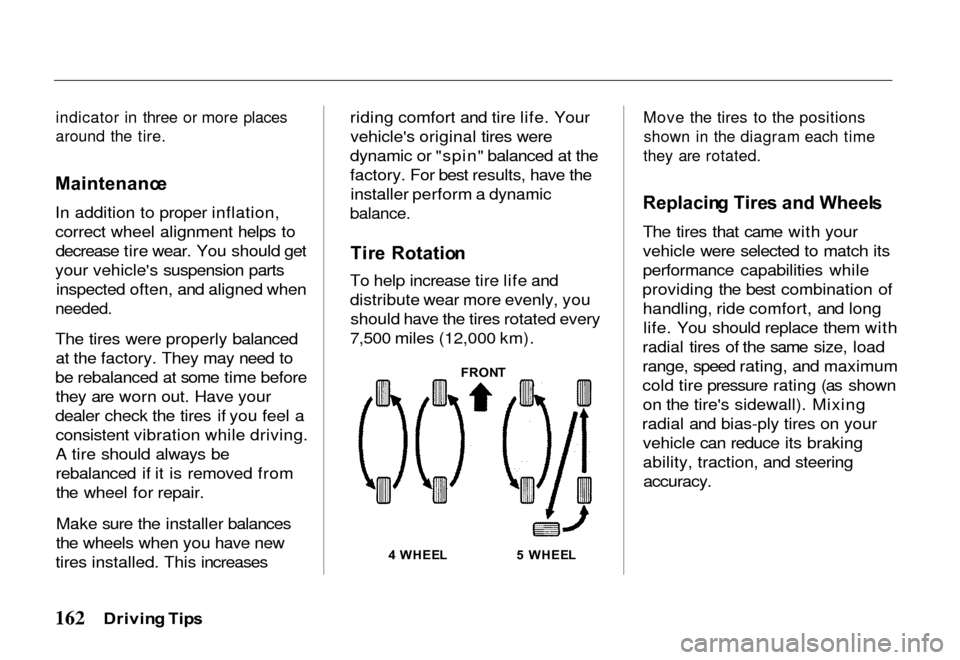
To help increase tire life and
distribute wear more evenly, you should have the tires rotated every
7,500 miles (12,000 km).
Move the tires to the positions
shown in the diagram each time
they are rotated.
Replacin g Tire s an d Wheel s
The tires that came with your
vehicle were selected to match its
performance capabilities while
providing the best combination of handling, ride comfort, and longlife. You should replace them with
radial tires of the same size, load
range, speed rating, and maximum
cold tire pressure rating (as shown on the tire's sidewall). Mixing
radial and bias-ply tires on your vehicle can reduce its braking
ability, traction, and steering
accuracy.
Drivin g Tip s
FRON
T
4 WHEE L
5 WHEE L
Page 173 of 267

systems, such as the SRS and
anti-lock brake system.
However, if electronic accessories
are improperly installed, or
exceed your vehicle's electrical
system capacity, they can interfere with the operation of your vehicle,
or even cause the airbags to
deploy.
Before installing any accessory: Make sure the accessory does
not obscure any lights, or interfere with proper vehicle
operation or performance. Be sure electronic accessories
do not overload electrical
circuits (see page 236). Have the installer contact your
Honda dealer for assistance
before installing any electronic
accessory.
If possible, have your dealer
inspect the final installation.
Modification s
Do not remove any original
equipment or modify your vehicle in any way that would alter its
design or operation. This could
make your vehicle unsafe and illegal to drive.
For example, do not make any modifications that would change
the ride height of your vehicle, or
install wheels and tires with a
different overall diameter.
Such modifications can adversely
affect handling, and interfere with
the operation of the vehicle's
anti-lock brakes and other
systems.
In addition, any modifications that
decrease ground clearance increase the chance of
undercarriage parts striking a
curb, speed bump, or other raised object, which could cause your
airbags to deploy.
Do not modify your steering wheel or any other part of your
Supplemental Restraint System.Modifications could make the
system ineffective.
Additiona l Safet y Precautio n
Do not attach or place objects on
the airbag covers. Any object
attached to, or placed on, the
covers marked "SRS," in the
center of the steering wheel and on top of the dashboard, could
interfere with the proper operation
of the airbags. Or, if the airbags
inflate, the objects could be
propelled inside the vehicle and hurt someone.
Drivin g Tip s
Page 177 of 267
Traile
r Towin g
Your Honda vehicle is designed
for passenger and cargo transportation. With the proper
equipment installed, your vehicle
can also tow a trailer under certain
conditions, as detailed in this section. Be sure to read this entire
section and follow all
requirements.
Towing a trailer will have an
effect on handling, performance,
braking, durability and fuel
consumption.
Honda recommends that you do
not tow a trailer with a new Honda vehicle or one with a new
powertrain component (engine, transmission, differential) for the
first 500 miles. For your safety and the safety
of others, use equipment
specifically designed for your
vehicle. Improper towing
equipment and improper installation of same can cause
damage to your vehicle and may also result in personal injury.
Additional care and cautious
driving habits are essential to trailer towing.
Do not exceed 45 mph or the
posted towing speed limit, whichever is lower. Higher speed
may cause loss of vehicle control.
Drivin g Tip s
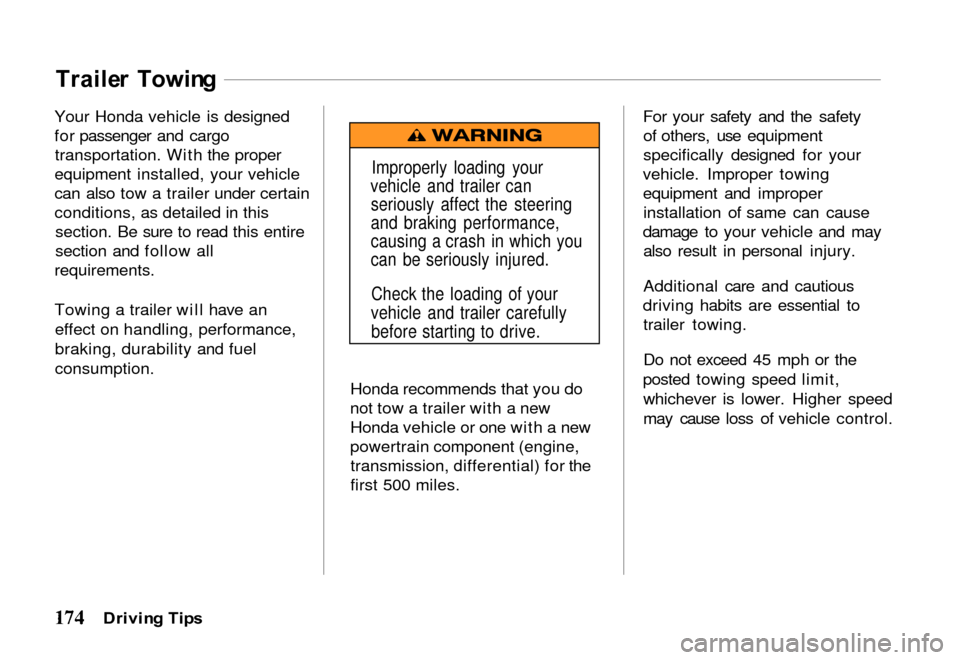
Improperly loading your
vehicle and trailer can seriously affect the steering
and braking performance,
causing a crash in which you
can be seriously injured.
Check the loading of your
vehicle and trailer carefully before starting to drive.
Page 190 of 267

find a leak, it must be repaired
before you can continue
driving. (See
Towing on page
187.)
If you don't find an obvious leak, check the coolant level inthe radiator reserve tank. If the
level is below the MIN mark, add
coolant to halfway between the
MIN and MAX marks.
If there was no coolant in the
reserve tank, you may also
have to add coolant to the
radiator.
Let the engine cool down until
the pointer reaches the middle
of the temperature gauge, orlower, before checking the
radiator. If needed, add coolant to the
radiator to bring the level up to the filler neck, and to the
reservoir up to the level indicated on the reservoir tank. Proper equipment must be used to
prevent damage to vehicles during
any towing. State and local laws
that apply to vehicles in tow must
be followed. Get detailed towing
instructions from your Honda
dealer.
Should it become necessary to
tow your vehicle, follow these
directions.
Precaution s
Before towing, make sure that
the power train, axle,
transmission, wheels and steering system are in good
condition.
If any of these items are
damaged, a flatbed trailer must
be used.
In Cas e o f Emergenc y
Towin
g
Removing the radiator cap
while the engine is hot can
cause the coolant to spray out, seriously scalding you.
Always let the engine andradiator cool down before
removing the radiator cap.
Page 192 of 267

Rear Wheels off the Ground
1. Transfer case in 2H (4WD model only).
2. Transmission in Neutral position.
3. Maximum speed 30 mph (50 km/h).
4. Maximum distance 50 miles (80 kilometers).
If you need to tow your vehicle by
this method, secure the steering
wheel to keep the front wheels
pointed straight ahead. Do not
rely on the steering column lock; it is not strong enough to hold the
front wheels straight while
towing. The ignition switch must
be in the OFF position.
Inoperativ
e Electrica l Device s
If you have electrical problems without extreme damage to any
electrical parts, check for burned out fuses, broken wires, poor
connections or poor grounding. Correct as necessary.
The fuse boxes are located under
the left hand side of theinstrument panel and in the right
hand side of the engine compartment. (See "Fuses" on
page 236.)
Replacing a fuse with one that has
a higher rating greatly increases
the chances of damaging the
electrical system. If you do not
have a replacement fuse with the
proper rating for the circuit,
install one with a lower rating.
In Cas e o f Emergenc y
NOTIC
E
Page 195 of 267
Front (4WD Only) and
Rear Propeller Shaft ... 218
Exhaust System ....... 218 Fuel Line and Fuel Tank/Cap ............ 218
Drive Belt ............ 218
Timing Belt ........... 218 Valve Clearance ........ 218SparkPlugs ........... 219
Clutch ............... 219
Fluid or Lubricant Levels 219
Power Steering ........ 219 Accelerator Pedal Linkage 220
Wheel Alignment ...... 220
Exterior ................ 220 Washing Your Vehicle . . 220
Polishing and Waxing Your Vehicle ......... 220
Protection of Exterior Bright Metal Parts ..... 220
Care of Aluminum Wheels 220 Foreign Material Deposits 220
Finish Damage ........ 221
Corrosion Protection .... 221
Sheet Metal Damage .... 221
Underbody Maintenance 221
Interior ................ 222 Basic StepsBefore Cleaning ...... 222
Cleaning Fabric ........ 223 Cleaning General Soilageor Water Spots From
Fabric Trim ........ 223
Spot Cleaning Fabric With Solvent Cleaner 223
Removal of Specific Stains ...... 224
Cleaning Vinyl or Leather Trim ....... 225
Seat Belt Care ......... 225
Cleaning Glass Surfaces . 226
Car e an d Maintenanc e
Page 207 of 267

Owne
r Safet y Check s
Promptly take any safety
problems to your Honda dealer for service advice.
Parkin g brak e — Park on a fairly
steep hill and hold the vehicle
with the parking brake only. This
checks its holding ability.
Starte r safet y switc h (automati c
transmission ) — Check the safety
switch by trying to start the
engine in each gear. The starter should work only with the shift
lever in the "P" (Park) or "N" (Neutral) position.
Starte r safet y switc h (manua l
transmission ) — To check the
safety switch, place the shift lever
in "Neutral," push the clutch
pedal halfway and try to start the engine. The starter should not
work. The starter should work only when the clutch pedal is fully
depressed.
Transmissio n shif t indicato r
(automati c transmission ) —
Check that the indicator points to
the gear chosen.
Steerin g — Be alert for any
changes in steering action. An inspection or service is needed
when the steering wheel is harder
to turn or has too much free play,
or if there are unusual sounds when turning or parking.
Whee l alignment , balanc e an d
tire s — Uneven or abnormal tire
wear, or pulling to the right or left
on a straight and level road may show the need for a wheel
alignment. A vibration of the
steering wheel or seat at normal
highway speeds means wheel balancing is needed. Check tire
pressures (including the spare) at
least monthly and whenever the
vehicle is serviced (see page 159).
Brake s — Watch for the
"BRAKE" light coming on. Other signs of possible brake trouble are
such things as repeated pulling to
one side when braking, unusual sounds when braking or between
brake applications, or increased
brake pedal travel. If you note one
of these conditions, have the system checked at once and
repaired if needed.
Car e an d Maintenanc e
Page 221 of 267
Fron
t (4W D Only ) an d Rea r
Propelle r Shaf t
Lubricate the sliding yoke with
EP chassis grease. Lubricate
universal joints with grease
containing MoS 2 (molybdenum
disulfide-type grease) at the intervals shown in the
Maintenance Schedule. Also
check the propeller shaft
flange-to-pinion bolts for proper
torque of 64 N.m (46.3 Ib-ft).
Most lubrication recommendations
and procedures for four-wheel drive-
equipped vehicles are the same
for the corresponding components in conventional drive vehicles.
Exhaus t Syste m
Check the complete exhaust
system and nearby body areas for
damaged, missing, or
mispositioned parts, open seams, holes, loose connections, or other
deterioration that could allow
exhaust fumes to seep into the
passenger compartment or cause
heat build-up in the floor pan. Any
necessary corrections should be made immediately. For continuedsafety, exhaust system pipes and
resonators rearward of the muffler must be replaced whenever a new
muffler is installed.
Fue l Lin e an d Fue l Tank/Ca p
Inspect the fuel tank, cap and lines
for damage that could cause
leakage. Inspect the fuel cap and
gasket for correct sealing ability
and indications of physical
damage. Replace any damaged or
malfunctioning parts.
Driv
e Bel t
Check the belt driving the
alternator, power steering pump,
and air conditioning compressor.
Look for cracks, fraying, and wear. Replace as necessary.
Timin g Bel t
The timing belt should normally
be replaced at the intervals shown
in the Maintenance Schedule.
Valv e Clearanc e
Incorrect valve clearance will
result in increased engine noise and lower engine output, thereby
adversely affecting engine
performance.
Car e an d Maintenanc e