2000 HONDA PASSPORT steering
[x] Cancel search: steeringPage 101 of 267

The anti-theft steering column
lock is not interconnected with the
parking brake. You must alwaysset the parking brake when
leaving the vehicle.
To prevent discharging the battery, avoid use of electrical accessories
with the engine shut off.
For easier key operation when
unlocking, rotate the steering
wheel slightly to relieve pressure
on the steering lock.
Ke y Remova l
Manual Transmission With the vehicle fully stopped,remove the key from the switch
by turning it to the "LOCK"
position and removing it. Automatic Transmission
With the vehicle fully stopped, place
the automatic transmission shift
lever in "P" (Park) position. Turn
the key to the "LOCK" position.
Ke y Reminde r
The key reminder circuit causes a beeper to sound when the door is
held open with the key left in theignition switch. This is to help
prevent accidentally locking the
key inside the vehicle.
The beeper stops when the door is
closed or when the key is removed.
Guar d Agains t Thef t
Your new Passport has features to
help prevent theft of the vehicle, its equipment, and its contents.
These anti-theft features work
depending on how well you use
them.
Park in a well-lighted areawhenever possible.
Lock the steering column and
take the key with you.
— Turn the ignition switch to "LOCK" and remove the key.
This locks both the ignition switch and steering control.
Interio r Feature s
Removing the key from the
ignition switch while driving
locks the steering. This can
cause you to lose control.
Remove the key from the
ignition switch only when
parked.
Page 114 of 267
Assis
t Gri p
An assist grip is located above
each window. Hor
n Butto n
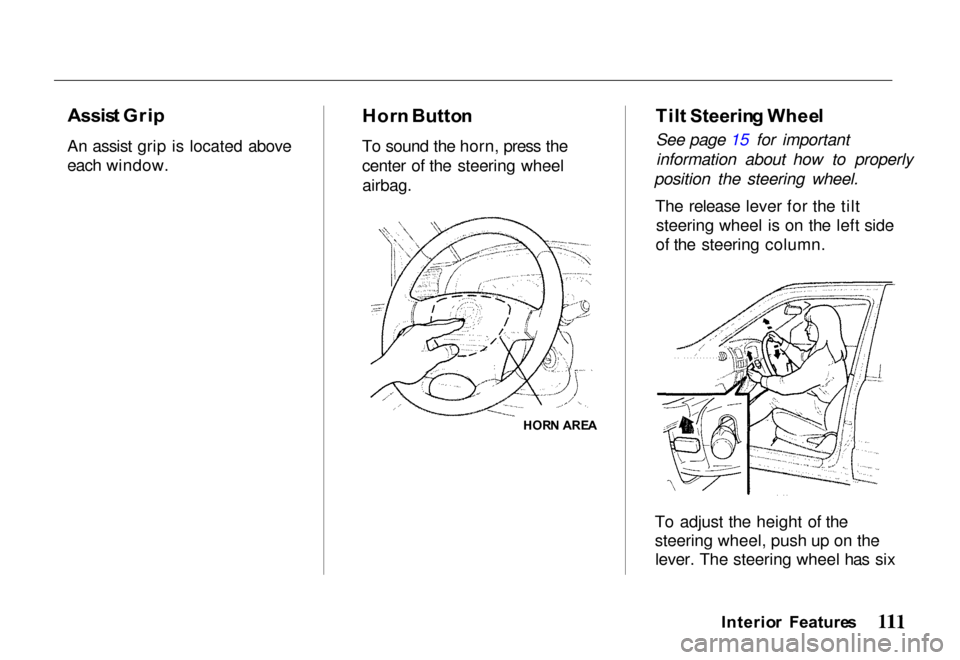
To sound the horn, press the
center of the steering wheel
airbag.
Til
t Steerin g Whee l
See page 15 for important information about how to properly
position the steering wheel.
The release lever for the tiltsteering wheel is on the left side
of the steering column.
To adjust the height of the
steering wheel, push up on the lever. The steering wheel has six
Interior Feature s
HOR
N ARE A
Page 115 of 267
positions. Move the steering
wheel to the desired position, then
release the lever. Try to move the steering wheel up and down to
make sure it is locked in position.
Make sure the steering wheel does
not block your view of any of the instrument panel gauges or
indicators.
Cigarett
e Lighte r
The cigarette lighter is on the instrument panel. The ignition
switch must be in ACCESSORY
or ON for the cigarette lighter to
work. To operate, push it in.
When it heats, it automatically
pops out ready for use. Avoid
holding the lighter in by handwhile it is heating, as damage to
the heating element may result.
Ashtray
s
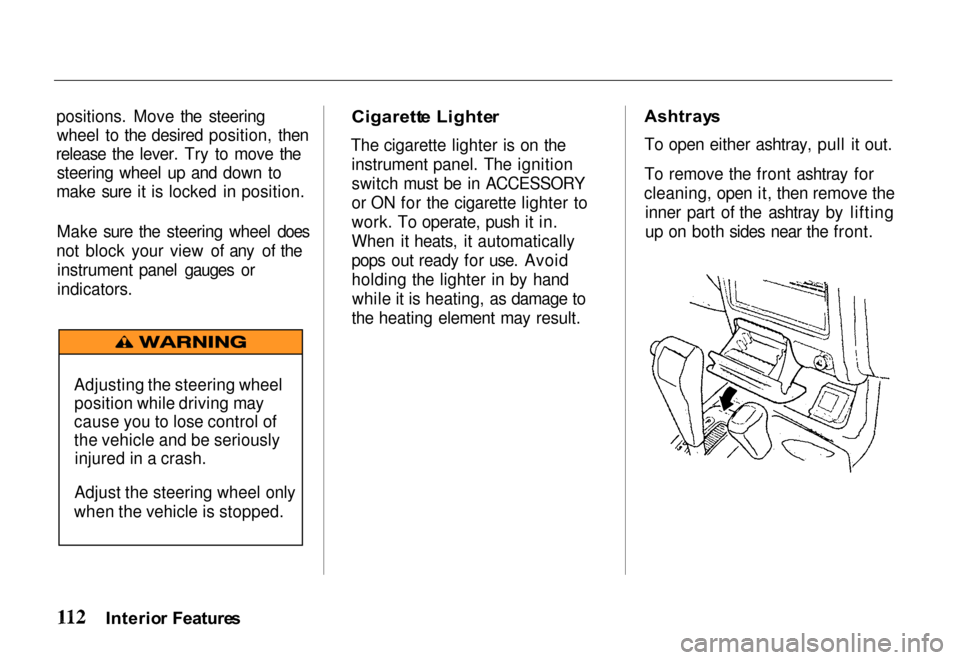
To open either ashtray, pull it out.
To remove the front ashtray for
cleaning, open it, then remove the inner part of the ashtray by lifting
up on both sides near the front.
Interio r Feature s
Adjusting the steering wheel
position while driving may
cause you to lose control of
the vehicle and be seriously injured in a crash.
Adjust the steering wheel only
when the vehicle is stopped.
Page 158 of 267
If your vehicle is equipped with
an automatic transmission, set
the parking brake before you
leave the driver's seat. If the
vehicle is parked on a grade and the transmission shift leveris placed in "P" (Park) position
before you set the parking
brake, the weight of the vehicle may exert so much force on the
transmission that you may have
difficulty moving the shift
lever out of "P" (Park)
position. To prevent this, apply the parking brake BEFORE
moving the shift lever to "P" (Park). When you want to drive
away, move the shift lever out
of the "P" (Park) position
BEFORE releasing the parking
brake. It is good driving
practice to set the parking
brake first, then place the
transmission in "PARK"
position, even on level
surfaces.
If the parking brake does not
seem to hold the vehicle as
well as before, have the vehicle
serviced by your Honda dealer.
Do not park your vehicle over
high grass, dry leaves or other
combustible materials. The
catalytic converter gets very
hot and could set fire to these
materials.
Anti-Loc
k Brake s
Your vehicle has an Anti-lock
Brake System (ABS) as standard
equipment. ABS helps to prevent
the wheels from locking up and skidding during hard braking,
allowing you to retain steering
control.
When the front tires skid, you lose steering control; the vehicle
continues straight ahead even
though you turn the steering
wheel. The ABS helps to prevent
lock-up and retain steering control
by pumping the brakes rapidly;
much faster than a person can do it.
Yo u shoul d neve r pum p th e
brak e pedal , this defeats the
purpose of the ABS. Let the ABS work for you by always keeping
firm, steady pressure on the brake
pedal as you steer away from the
Driving Tip s
Brake
s
Page 159 of 267

hazard. This is sometimes referred
to as "stomp and steer."
You will feel a pulsation in the
brake pedal when the ABS activates, and you may hear some
noise. This is normal, it is theABS rapidly pumping the brakes.
Activation varies with the amount
of traction your tires have. On dry
pavement, you will need to press on the brake pedal very hard
before you activate the ABS. However, you may feel the ABSactivate immediately if you are
trying to stop on snow or ice.
Important Safety Reminders AB S doe s no t reduc e th e tim e
o r distanc e it take s t o sto p th e
vehicle , it only helps with steering
control during braking. You
should always maintain a safe following distance from other
vehicles.
AB
S wil l no t preven t a ski d tha t
result s fro m changin g directio n
abruptly , such as trying to take a
corner too fast or making a sudden lane change. Always drive
at a safe, prudent speed for the
road and weather conditions.
AB S canno t preven t a los s o f
stability . Always steer moderately
when you are braking hard. Severe or sharp steering wheel
movement can still cause your
vehicle to veer into oncoming traffic or off the road.
A vehicl e wit h AB S ma y requir e
a longe r distanc e t o sto p o n
loose or uneven surfaces, such as
gravel or snow, than a vehicle
without anti-lock. Slow down and allow a greater distance between
vehicles under those conditions.
AB S Indicato r
The ABS is self-checking. You may feel a slight movement of the
brake pedal just after you start the engine. This is the ABS performing
a check. It also checks itself
whenever you use the brakes.
Drivin g Tip s
Page 160 of 267

If anything goes wrong, the ABS
indicator on the instrument panel
comes on (see page 65). This
means th
e anti-lock function of
the braking system has shut down.
The brakes still work like a conventional system without
anti-lock, providing normal stopping ability. You should have
the dealer inspect your vehicle as soon as possible if this light stays
on after you start the engine, or
comes on while driving. Drivin
g Wit h We t Brake s
Driving through deep water may get the brakes wet and reduce
their effectiveness. As a result, the
vehicle may not slow down
normally or may pull in one direction or the other.
If you drive through deep water,apply the brakes lightly to see if
the water has affected them. To
dry the brakes quickly, press
lightly on the brake pedal while
maintaining the same speed with the accelerator pedal. Continue
this until the brakes operate
normally.
Powe
r Brake s
The braking system uses engine vacuum to provide power assist. If
the power assist fails because of astalled engine or other reason, the
reserve vacuum in the system will usually allow you to apply the
brakes at least one time.
The reserve vacuum is partly used up each time the brake pedal isapplied and released. Do not
pump the brakes when the power assist has been lost, except when
needed to maintain steering
control on slippery surfaces.
You can still stop the vehicle
without the power assist by pushing
harder on the brake pedal.
However, the stopping distance
may be longer, even though the
brakes themselves remain fully
operational.
Driving Tip s
Page 161 of 267

Self-Adjustin
g Brake s
The brakes on this vehicle are self-adjusting. They have been
designed so that periodic brake
adjustment is not needed.
The brakes adjust themselves each time you firmly apply them.
Thus, if the brake pedal goes down
farther than normal due to a lack of adjustment, drive backward and
forward a few times. Apply the
brakes intermittently.
See your Honda dealer if the
brake pedal height does not return
to normal or if there is a rapidincrease in pedal travel. Either is a
sign of other brake trouble. Also,
see your Honda dealer if the
parking brake needs adjustment.
Brakin
g Tip s
Control your vehicle's speed on a steep or long downhill grade by
shifting the transmission to a
lower gear. Constantly using the
brakes can cause them to overheat
and lose effectiveness.
Resting your foot on the brake
pedal when you are not intending to brake ("riding the brakes") can
cause them to overheat. This
reduces their effectiveness, wears them out faster, and can reduce
fuel mileage. It also causes your
brake lights to stay on all the time, confusing drivers behind you.
Brak e Wea r Indicator s
The front and rear brakes have built-in wear indicators. These make a high-pitched squealing or
cricket-like warning sound when the brake pads or linings are worn
to the point of replacement. Thesound may come and go or be
heard all the time when the vehicle is moving, but may stop when the
brake pedal is pushed down firmly.
Expensive damage can result if
pads or linings are not replaced immediately when needed.
Drivin g o n Slipper y Surface s
Driving, steering, and braking
traction are reduced when the
road is coated with water, snow, ice, gravel, or other materials.
Slow down and adjust your
driving to such conditions. It is important to slow down when it is
slippery because stopping
Drivin g Tip s
Page 162 of 267
distances will be longer and
vehicle control more limited.
While driving on a surface with
reduced traction, avoid maneuvers involving sudden steering,
acceleration, or braking (including
engine braking due to shifting to
lower gear), that could cause the
tires to skid.
Drivers may not realize the surface is slippery until the
vehicle is skidding.
Learn to recognize warning
clues — such as enough water or ice on the road to make a
"mirrored surface"— and slow
down when there is any doubt.
Also see "Traction" under "Tires" in this section. To safely operate your vehicle,
your tires must be the proper type
and size, in good condition with
adequate tread, and correctly
inflated. The following pages give
more detailed information on how
and when to check air pressure,
how to inspect your tires for damage and wear, and what to do
when your tires need to be
replaced.
Driving Tip s
Rapid slowing down or
speeding-up can cause loss
of control on slippery
surfaces. If you crash, you
can be injured.
Use extra care when driving
on slippery surfaces.
Using tires that are excessivelyworn or improperly inflated can
cause a crash in which you
can be seriously hurt or killed.
Follow all instructions in this
owner's manual regarding tire inflation and maintenance.
Tire
s