2000 HONDA PASSPORT mirror
[x] Cancel search: mirrorPage 111 of 267
Courtes
y Light s
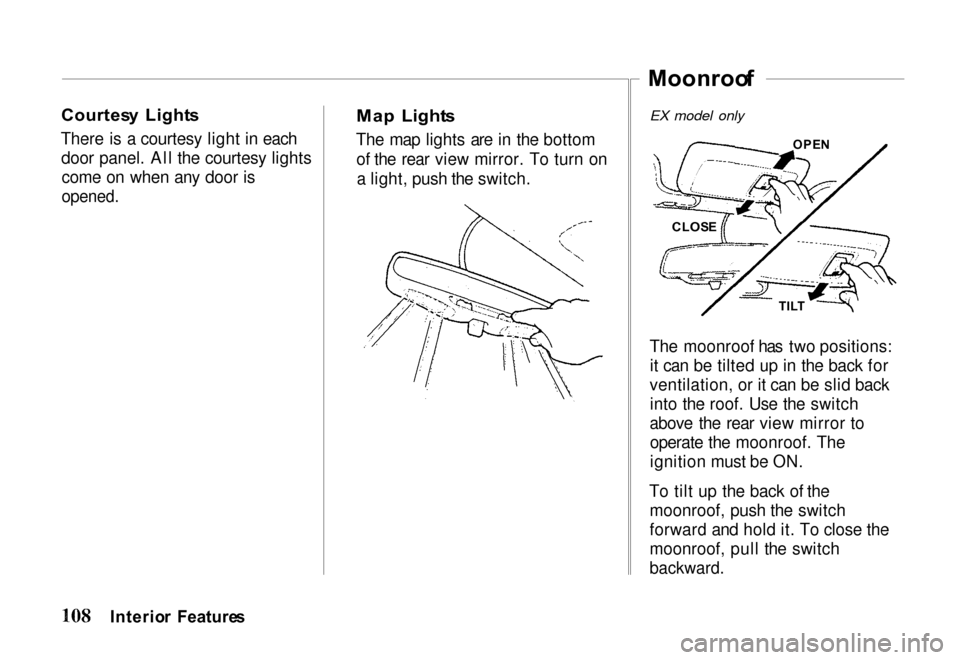
There is a courtesy light in each door panel. All the courtesy lightscome on when any door is
opened.
Ma
p Light s
The map lights are in the bottom of the rear view mirror. To turn ona light, push the switch.
Moonroo
f
OPEN
The moonroof has two positions: it can be tilted up in the back for
ventilation, or it can be slid back into the roof. Use the switch
above the rear view mirror to operate the moonroof. The
ignition must be ON.
To tilt up the back of the moonroof, push the switch
forward and hold it. To close the
moonroof, pull the switch
backward.
Interio r Feature s
EX model only
CLOS E
TILT
Page 155 of 267
Befor
e Drivin g
Drivin g Guideline s
Your Honda has higher ground
clearance than a passenger car
designed for use only on
pavement. Higher ground clearance has many advantages
for off-road driving. It allows you
to travel over bumps, obstacles,
and rough terrain. It also provides
good visibility so you can
anticipate problems earlier.
These advantages come at some
cost. Because your vehicle is
taller and rides higher off the
ground, it has a high center of
gravity. This means that your
vehicle can tip or roll over if you make abrupt turns. Utility
vehicles have a significantly
higher rollover rate than other types of vehicles. To prevent rollover or loss of
control:
Take corners at slower speeds
than you would with a
passenger car. Avoid sharp turns and abrupt
maneuvers whenever possible.
Do not modify your vehicle in
any way that would raise the
center of gravity (see page 170). Do not carry heavy cargo on
the roof (see page 173).
For off-road driving guidelines, see the Off-Road Driving
Information booklet that came with your vehicle.
Befor e Enterin g th e Vehicl e
1. Check that the windows,
mirrors, lights and reflectors
are clean and unobstructed.
2. Check the tires to see if they
are low or flat. You will need
a pressure gauge to tell if tires
are properly inflated.
3. Check that all lights work.
4. Check for fluid leaks.
5. Be sure everything is properly
stowed.
6. Check the area behind the vehicle if you are about to
back up.
Befor e Drivin g th e Vehicl e
1. Lock all doors.
2. Adjust the seat and any movable head restraints.
3. Adjust the inside and outside mirrors.
4. Check that all the indicator lights work when the key
Drivin g Tip s
Page 162 of 267
distances will be longer and
vehicle control more limited.
While driving on a surface with
reduced traction, avoid maneuvers involving sudden steering,
acceleration, or braking (including
engine braking due to shifting to
lower gear), that could cause the
tires to skid.
Drivers may not realize the surface is slippery until the
vehicle is skidding.
Learn to recognize warning
clues — such as enough water or ice on the road to make a
"mirrored surface"— and slow
down when there is any doubt.
Also see "Traction" under "Tires" in this section. To safely operate your vehicle,
your tires must be the proper type
and size, in good condition with
adequate tread, and correctly
inflated. The following pages give
more detailed information on how
and when to check air pressure,
how to inspect your tires for damage and wear, and what to do
when your tires need to be
replaced.
Driving Tip s
Rapid slowing down or
speeding-up can cause loss
of control on slippery
surfaces. If you crash, you
can be injured.
Use extra care when driving
on slippery surfaces.
Using tires that are excessivelyworn or improperly inflated can
cause a crash in which you
can be seriously hurt or killed.
Follow all instructions in this
owner's manual regarding tire inflation and maintenance.
Tire
s
Page 181 of 267
There are no provisions in your
vehicle to tap into its hydraulic
braking system. Any attempt toattach the trailer's brakes to your
vehicle's hydraulic braking system, no matter how successfulit may seem, will lower braking
effectiveness and create a
potential hazard.
Equipmen t Chec k
Before operating your vehicle,
check all safety equipment to
ensure safe operation. Be sure
your vehicle is properly serviced
to avoid mechanical failure.
Check that your vehicle remains
level when the loaded or unloadedtrailer is hitched. Do not drive if
the rear end of your vehicle is abnormally higher or lower.
Check for proper tongue weight,
overload, improper weight
distribution, worn suspension, or
other possible causes.
Make sure the trailer load is
properly positione
d and secured
so its does not shift around whil
e
driving.
Chec k
if your rearview mirrors
comply with federal, state and
local regulations. If not, confirm
the proper mirrors required for
towing and have them installed.
Perform an equipment check of
all braking, lighting and safety
equipment to ensure they are working properly.
Your safety depends on proper
operation and installation of
equipment. Never operate a
vehicle with faulty equipment.
Limite
d Sli p Differentia l
Standard on 4WD models
The limited slip differential is
designed to improve traction by limiting wheelspin. If one rear
wheel begins to spin on a slipperysurface, the limited slip
differential will automatically
transmit driving force to the other
rear wheel.
Drivin g Tip s
Page 208 of 267

Sit in the driver's seat and
perform these checks:
1. With the engine stopped, depress the brake pedal severaltimes; the travel distance and
effective pedal stroke should
remain unchanged.
2. Start the engine with the brake pedal fully depressed.
The brake pedal should go downa little as the engine starts.
3. Depress the brake pedal, stop the engine and hold the pedal
depressed for about 30
seconds; the brake pedal
should remain in position
without rising or going down.
4. Restart the engine and run it for about a minute, then turn it
off and depress the brake
pedal firmly several times; the
brake pedal travel should decrease each time the brake
pedal is depressed.
If the brakes do not operate
normally, have them checked and
corrected by your Honda dealer.
Exhaus t syste m — Be alert to any
changes in the sound of the exhaust system or any smell of fumes.
These are signs the system may be leaking or overheating. Have the
system checked and/or repaired at
once if these conditions exist. (Also see "Carbon Monoxide Hazard" in
the "Driver and Passenger Safety"
section and "Three-Way Catalytic
Converter" in the "Driving Tips"
section.)
Windshiel d wiper s an d
washer s — Check the operation
and condition of the wiper blades.
Check the flow and aim of the
washer spray.
Defroster
s — Check performance
by moving the controls to the
defrost setting and noting the amount of air directed against the
windshield.
Rea r vie w mirror s an d su n
visor s — Check that the friction
joints hold the mirrors and sun visors firmly in place.
Hor n — Blow the horn now and
then to be sure it works.
La p an d shoulde r belt s — Check
the belt system, including
webbing, buckles, latch plates,
retractors, guide loops and anchors for proper operation and
damage.
Sea t adjuster s — When adjusting
a seat, be sure the seat adjusters
latch securely by pushing the seat
forward and backward.
Car e an d Maintenanc e
Page 254 of 267

Inde
x
ABS. See Anti-Lock Brake
System
Accessories, Installation .... 169
ACCESSORY
(Ignition Key Position) ...... 97
Accessory Power Outlets ..... 113
Adding AutomaticTransmission Fluid .... 212
Brake Fluid ............ 215
Clutch Fluid ............ 219
Engine Oil ............ 208
Manual Transmission Fluid .... 211
Power Steering Fluid ..... 219
Radiator Coolant ........ 214
Windshield Washer Fluid ..
194
Adjustments
Head
Restraints .......... 12
Mirrors
Exterior ............ 101Interior ............. 101
Power. ............. 101
Seat-Backs .......... 11,
89
Reclining the Rear ...... 93
Seats, Front ......... 10,
89
Steering Wheel ..... 15,
111
Adults, Protecting ........... 10
Airbags (SRS) ............. 7
Serious Risk to Children .... 19
Air Cleaner Filter ......
166, 210
Air Conditioning
Maintenance ........... 217
Usage ................. 116
Air Filter. See Air Cleaner Filter
Air Outlets (Vents) ......... 120
Air Pressure, Tires ......... 235
Alcohol and Driving ........ 4
Alcohol in Gasoline ........ 196
Alternator Belt. See Drive Belts
Antifreeze ................ 213
Anti-Lock Brake System
Indicator Lights .......... 65
Operation .............. 155
Anti-Theft Steering Column Lock ..... 98
System .................
..... 148
Appearance Care. See Cleaning
Ashtray .................. 112
Assist Grip ..............
111
Audio System ............. 121
Page 260 of 267

Hot Coolant, Warning About . 214
Hydroplaning ............. 164
Identification Number,
Vehicle ................. 228
If Your Vehicle Has to Be
Towed .................. 187
Ignition Keys ................... 97Switch ................. 97
Timing Control System . . . 246
Illumination Control ....... 71 Important Safety Precautions ... 4
Indicator Lights, Instrument Panel .......... 55
Indicators and Gauges ....... 55
Infants, Protecting ........... 25 Inflation, Proper Tire . . . 160, 235
Inside Mirror ............. 101
Inspection, Tire ........... 161
Instrument Panel Brightness. See Illumination Control
Interior Cleaning .......... 222
Interior Lights ............ 106
Introduction ................
i
Jack, Tire ................ 183
Jacking up the Vehicle ..... 183
Jump Starting ............. 180
Keyless Entry .............. 147
Keys ..................... 97
Label, Certification ........ 230
Labels, Safety, Location of . . 45
Lane Change, Signaling ...... 73
Lap Belt ................. 39
Lap/Shoulder Belts ........ 38
Leaking of Exhaust into Car . 44
Lever, Transfer .......... 78, 82
Lifting Points ............. 183
Lighter, Cigarette .......... 112
Lights Bul b
Replacement ....... 239
Dome Light ............ 107
Indicator ................ 59
Luggage ............... 106
Turn Signal ............. 62
Limited Slip Differential .... 178
Page 261 of 267
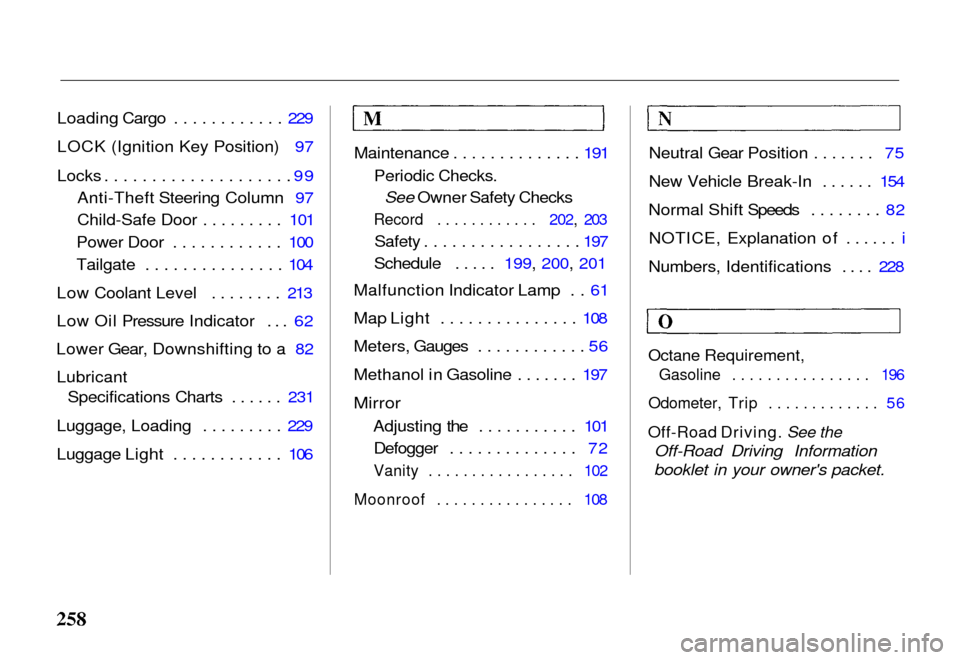
Loading Cargo ............ 229
LOCK (Ignition Key Position) 97
Locks .................... 99
Anti-Theft Steering Column 97
Child-Safe Door ......... 101
Power Door ............ 100
Tailgate ............... 104
Low Coolant Level ........ 213
Low Oil Pressure Indicator ... 62
Lower Gear, Downshifting to a 82 Lubricant Specifications Charts ...... 231
Luggage, Loading ......... 229
Luggage Light ............ 106 Maintenance .............. 191
Periodic Checks.See Owner Safety Checks
Record ............ 202, 203
Safety ................. 197
Schedule ..... 199, 200, 201
Malfunction Indicator Lamp . . 61
Map Light ............... 108
Meters, Gauges ............ 56
Methanol in Gasoline ....... 197
Mirror
Adjusting the ........... 101Defogger .............. 72
Vanity ................. 102
Moonroof ................ 108
Neutral Gear Position ....... 75
New Vehicle Break-In ...... 154
Normal Shift Speeds ........ 82 NOTICE, Explanation of ...... i
Numbers, Identifications .... 228
Octane Requirement,
Gasoline ................ 196
Odometer, Trip ............. 56
Off-Road Driving. See the
Off-Road Driving Information
booklet in your owner's packet.