Page 233 of 352
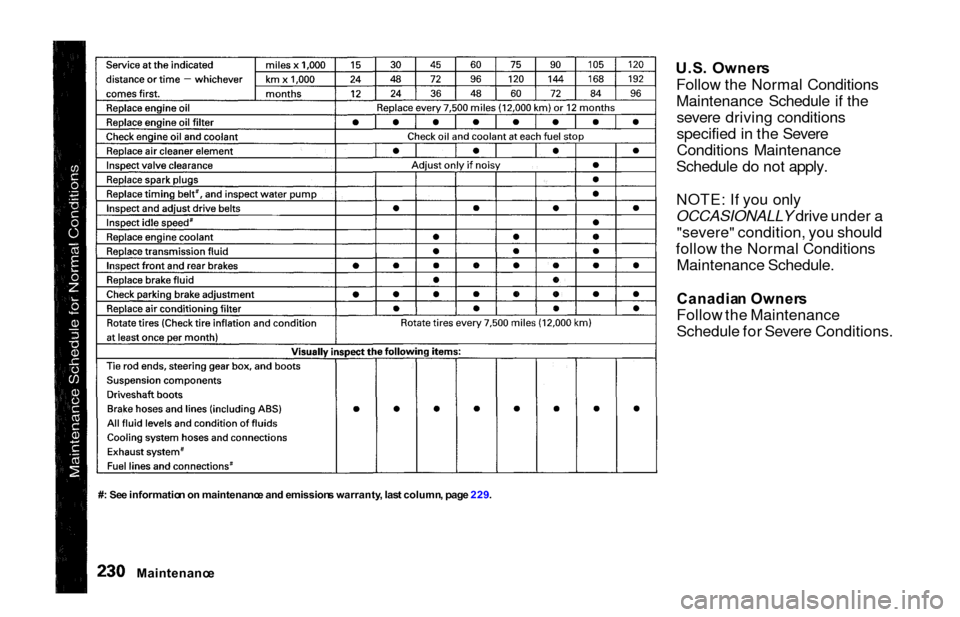
U.S. Owner s
Follow the Normal Conditions
Maintenance Schedule if the severe driving conditions
specified in the Severe
Conditions Maintenance
Schedule do not apply.
NOTE: If you only
OCCASIONALLY drive under a "severe" condition, you should
follow the Normal Conditions Maintenance Schedule.
Canadia n Owner s
Follow the Maintenance
Schedule for Severe Conditions.
#: Se e informatio n o n maintenanc e an d emission s warranty , las t column , pag e 229 .
Maintenanc e
Page 234 of 352
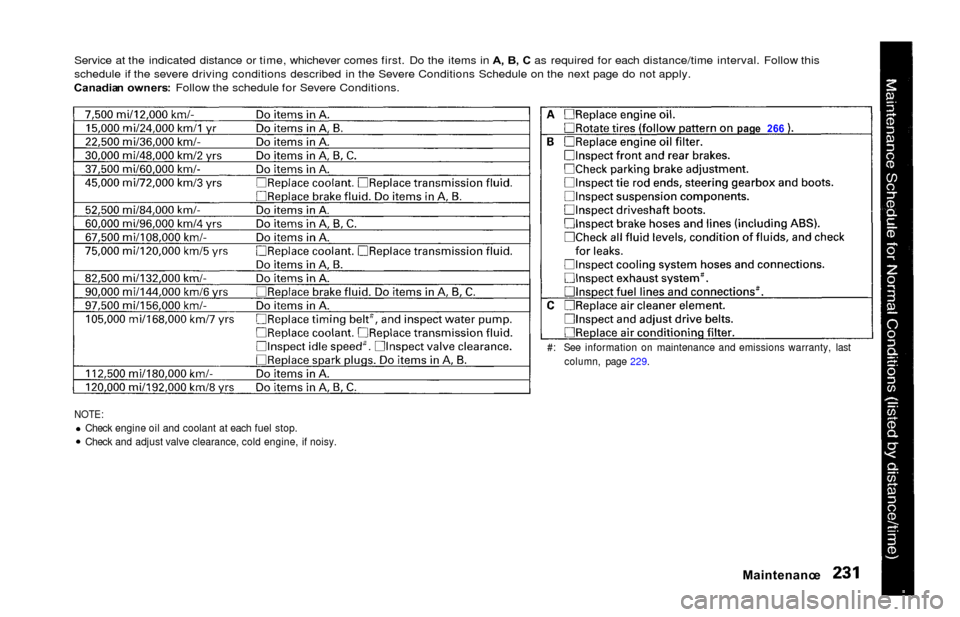
Service at the indicated distance or time, whichever comes first. Do the items in A, B , C as required for each distance/time interval. Follow this
schedule if the severe driving conditions described in the Severe Conditions Schedule on the next page do not apply.
Canadia n owners : Follow the schedule for Severe Conditions.
NOTE:Check engine oil and coolant at each fuel stop.
Check and adjust valve clearance, cold engine, if noisy.
Maintenanc e
#: See information on maintenance and emissions warranty, last
column, page 229. pag
e 26 6
Page 235 of 352
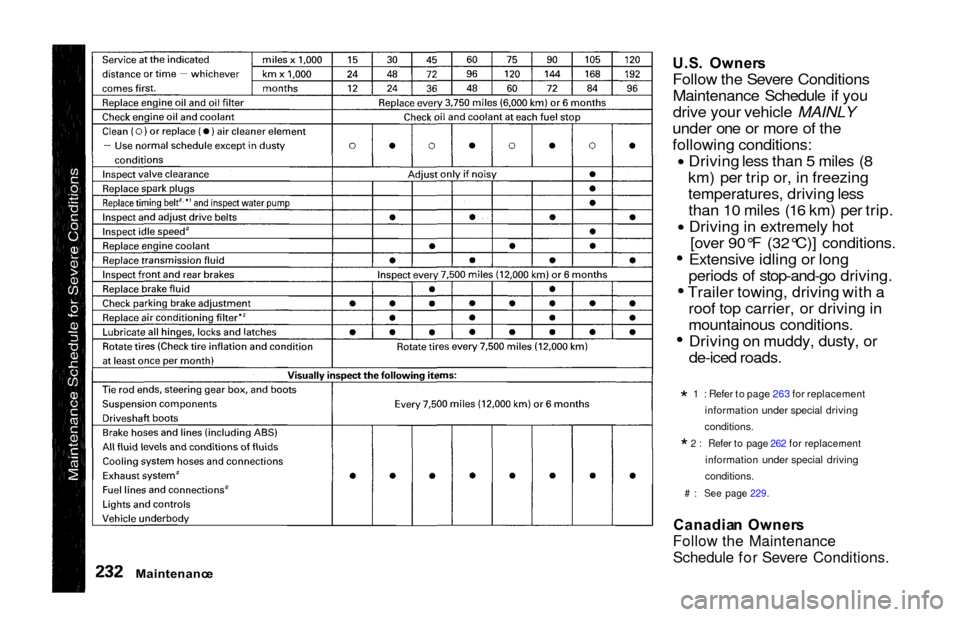
U.S. Owner s
Follow the Severe Conditions
Maintenance Schedule if you
drive your vehicle MAINLY
under one or more of the
following conditions: Driving less than 5 miles (8
km) per trip or, in freezing
temperatures, driving less than 10 miles (16 km) per trip.Driving in extremely hot [over 90°F (32°C)] conditions.
Extensive idling or long
periods of stop-and-go driving.
Trailer towing, driving with a roof top carrier, or driving in
mountainous conditions.Driving on muddy, dusty, or
de-iced roads.
*1: Refer to page 263 for replacement
information under special driving
conditions.
*2: Refer to page 262 for replacement
information under special driving
conditions.
# : See page 229.
Canadia n Owner s
Follow the Maintenance
Schedule for Severe Conditions.
Maintenanc e
Page 236 of 352
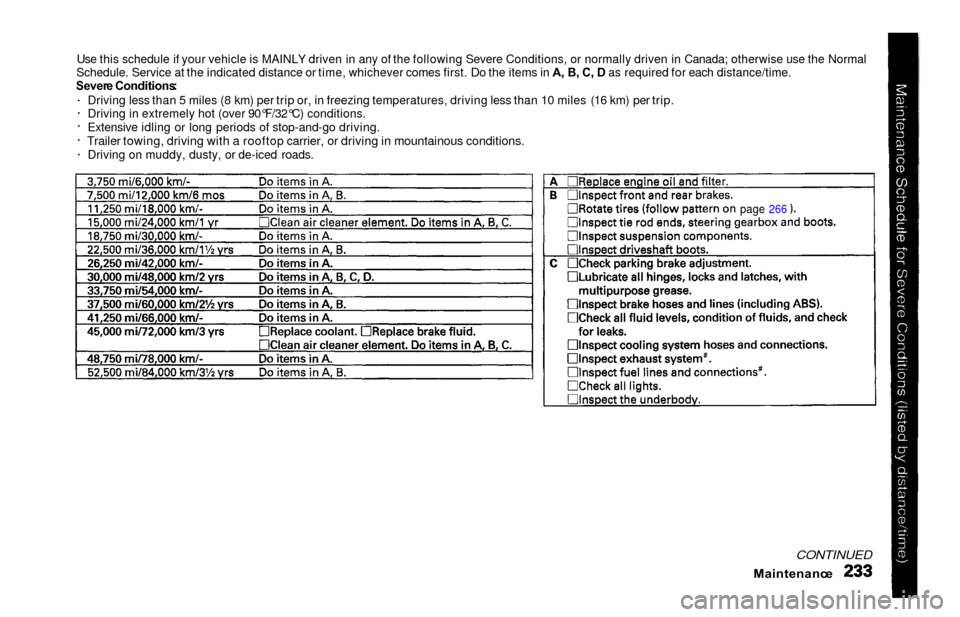
Use this schedule if your vehicle is MAINLY driven in any of the following Severe Conditions, or normally driven in Canada; otherwise use the Normal
Schedule. Service at the indicated distance or time, whichever comes first. Do the items in A , B , C , D as required for each distance/time.
Sever e Conditions :
Driving less than 5 miles (8 km) per trip or, in freezing temperatures, driving less than 10 miles (16 km) per trip.
Driving in extremely hot (over 90°F/32°C) conditions.
Extensive idling or long periods of stop-and-go driving.
Trailer towing, driving with a rooftop carrier, or driving in mountainous conditions.Driving on muddy, dusty, or de-iced roads.
Maintenanc e
CONTINUED
page 266
Page 264 of 352
Air Conditionin g Syste m
Your vehicle's air conditioning is a
sealed system. Any major mainte-
nance, such as recharging, should be done by a qualified mechanic. You
can do a couple of things to make sure the air conditioning works
efficiently.
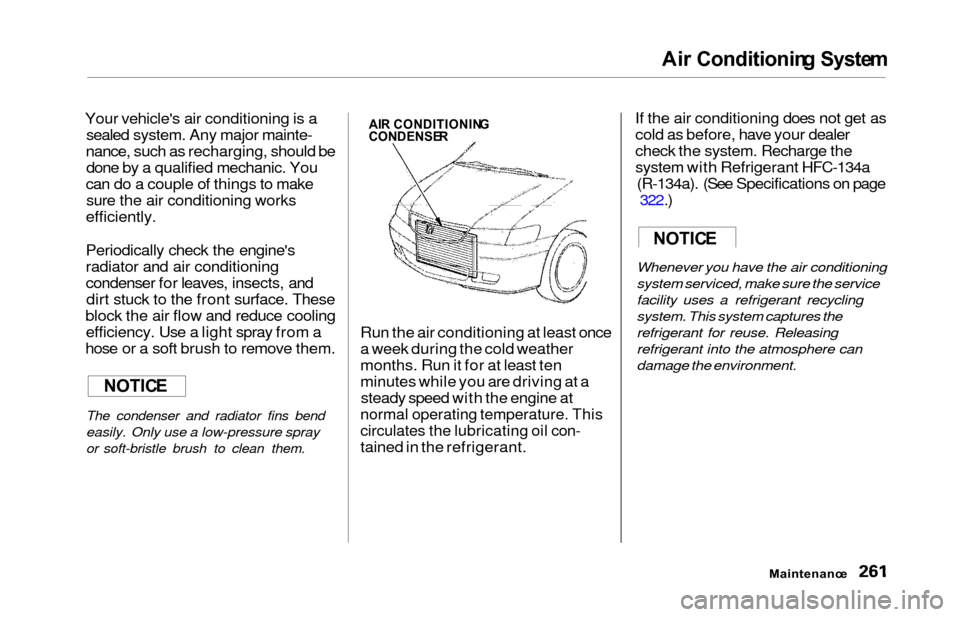
Periodically check the engine's
radiator and air conditioning
condenser for leaves, insects, and dirt stuck to the front surface. These
block the air flow and reduce cooling efficiency. Use a light spray from a
hose or a soft brush to remove them.
The condenser and radiator fins bend
easily. Only use a low-pressure spray
or soft-bristle brush to clean them.
Run the air conditioning at least once
a week during the cold weather
months. Run it for at least ten
minutes while you are driving at a steady speed with the engine at
normal operating temperature. This
circulates the lubricating oil con-
tained in the refrigerant. If the air conditioning does not get as
cold as before, have your dealer
check the system. Recharge the
system with Refrigerant HFC-134a
(R-134a). (See Specifications on page 322.)
Whenever you have the air conditioning
system serviced, make sure the service
facility uses a refrigerant recycling
system. This system captures the
refrigerant for reuse. Releasing
refrigerant into the atmosphere can
damage the environment.
Maintenanc e
NOTICE
AIR CONDITIONIN GCONDENSER
NOTICE
Page 267 of 352
Tires
Use a gauge to measure the air
pressure at least once a month. Even
tires that are in good condition may
lose one to two psi (10 to 20 kPa, 0.1
to 0.2 kgf/cm
2) per month.
Remember to check the spare tire at
the same time you check all the other tires.
Check the pressure in the tires when
they are cold. This means the vehicle has been parked for at least three
hours. If you have to drive the
vehicle before checking the tire pressure, the tires can still be
considered "cold" if you drive less
than 1 mile (1.6 km). If you check the pressure when the
tires are hot (the vehicle has been
driven several miles), you will see
readings 4 to 6 psi (30 to 40 kPa, 0.3
to 0.4 kgf/cm2) higher than the cold
reading. This is normal. Do not let air out to match the specified cold
pressure. The tire will be
underinflated.
You should get your own tire pressure gauge and use it whenever
you check your tire pressures. This
will make it easier for you to tell if a pressure loss is due to a tire problem
and not due to a variation between
gauges.
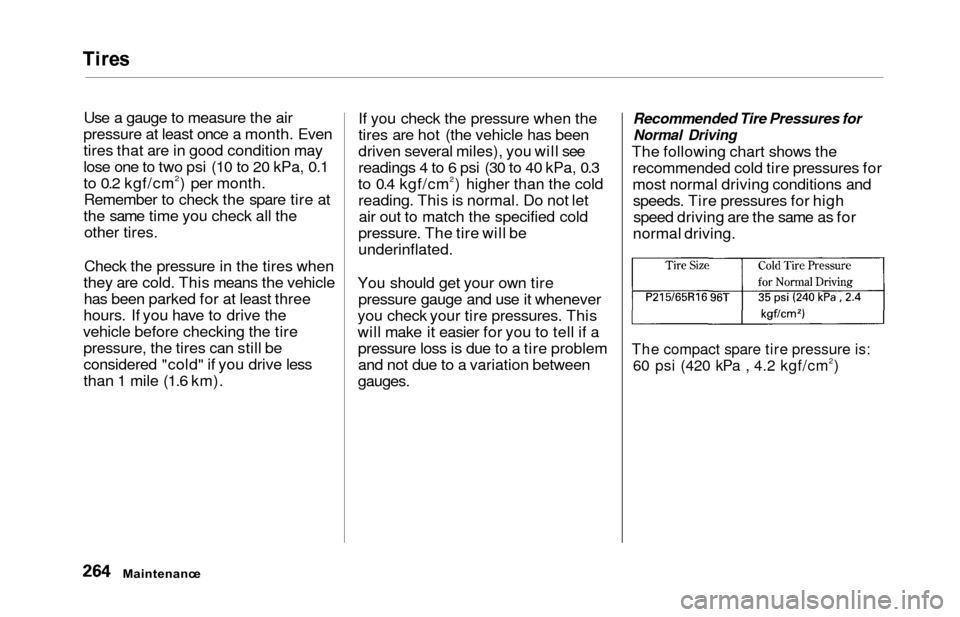
Recommended Tire Pressures for
Normal Driving
The following chart shows the recommended cold tire pressures for
most normal driving conditions andspeeds. Tire pressures for highspeed driving are the same as for
normal driving.
The compact spare tire pressure is: 60 psi (420 kPa , 4.2 kgf/cm2)
Maintenanc e
Page 269 of 352
Tires
Maintenanc e
In addition to proper inflation,
correct wheel alignment helps to
decrease tire wear. If you find a tire
is worn unevenly, have your dealer check the wheel alignment.
The tires were properly balanced by the factory. They may need to be
rebalanced at some time before theyare worn out. Have your dealer
check the tires if you feel a consis-
tent vibration while driving. A tire should always be rebalanced if it is
removed from the wheel for repair. Make sure the installer balances the
wheels when you have new tires installed. This increases riding
comfort and tire life. Your vehicle's
original tires were dynamic or "spin"
balanced at the factory. For best results, have the installer perform adynamic balance.
On some models
Improper wheel weights can damage
your vehicle's aluminum wheels. Use only Genuine Honda wheel weights for
balancing.
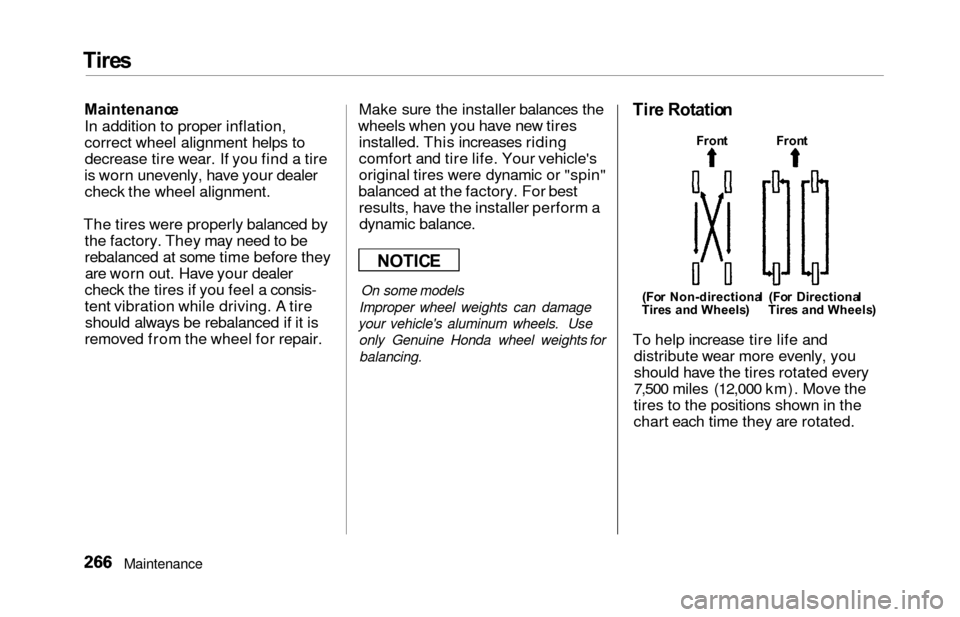
Tir e Rotatio n
(For Non-directiona l (Fo r Directiona l
Tire s an d Wheels ) Tire s an d Wheels )
To help increase tire life and
distribute wear more evenly, you
should have the tires rotated every
7,500 miles (12,000 km). Move the
tires to the positions shown in the
chart each time they are rotated.
Maintenance
NOTIC E
Front
Fron t
Page 271 of 352

Tires
The ABS works by comparing the
speed of the wheels. When replacing
tires, use the same size originally supplied with the vehicle. Tire size
and construction can affect wheelspeed and may cause the system to
work inconsistently.
If you ever need to replace a wheel,
make sure the wheel's specifications
match those of the original wheel
that came on your vehicle. Re-
placement wheels are available at
your Honda dealer. Wheel
s an d Tire s
Wheel: 16 x 6 1/ 2 J J
Tire:
P215/65R1 6 96 T
See page 324 for information about
DOT Tire Quality Grading.
Winte r Drivin g
Tires that are marked "M + S" or
"All Season" on the sidewall have an
all-weather tread design. They
should be suitable for most winter
driving conditions. Tires without
these markings are designed for optimum traction in dry conditions.
They may not provide adequate performance in winter driving.For the best performance in snowy
or icy conditions, you should install
snow tires or tire chains. They may
be required by local laws under
certain conditions.
Maintenanc e