Page 300 of 352
Changing a Fla t Tir e
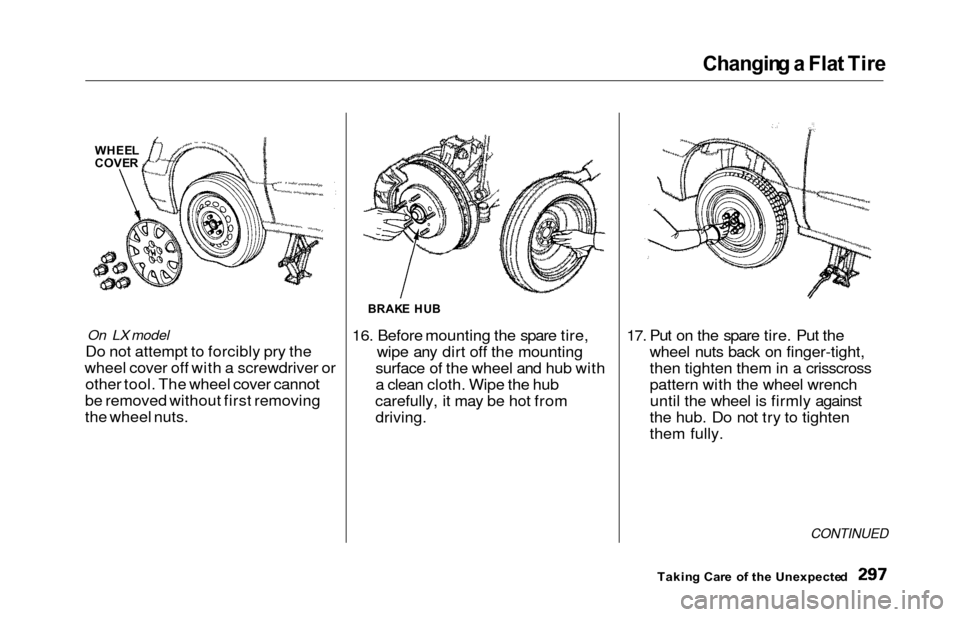
On LX model
Do not attempt to forcibly pry the
wheel cover off with a screwdriver or other tool. The wheel cover cannot
be removed without first removing
the wheel nuts. 16. Before mounting the spare tire,
wipe any dirt off the mounting
surface of the wheel and hub with
a clean cloth. Wipe the hub
carefully, it may be hot from
driving.
17. Put on the spare tire. Put the wheel nuts back on finger-tight,
then tighten them in a crisscross
pattern with the wheel wrenchuntil the wheel is firmly against
the hub. Do not try to tighten
them fully.
CONTINUED
Takin g Car e o f th e Unexpecte d
BRAKE HU B
WHEE L
COVE R
Page 301 of 352
Changing a Fla t Tir e
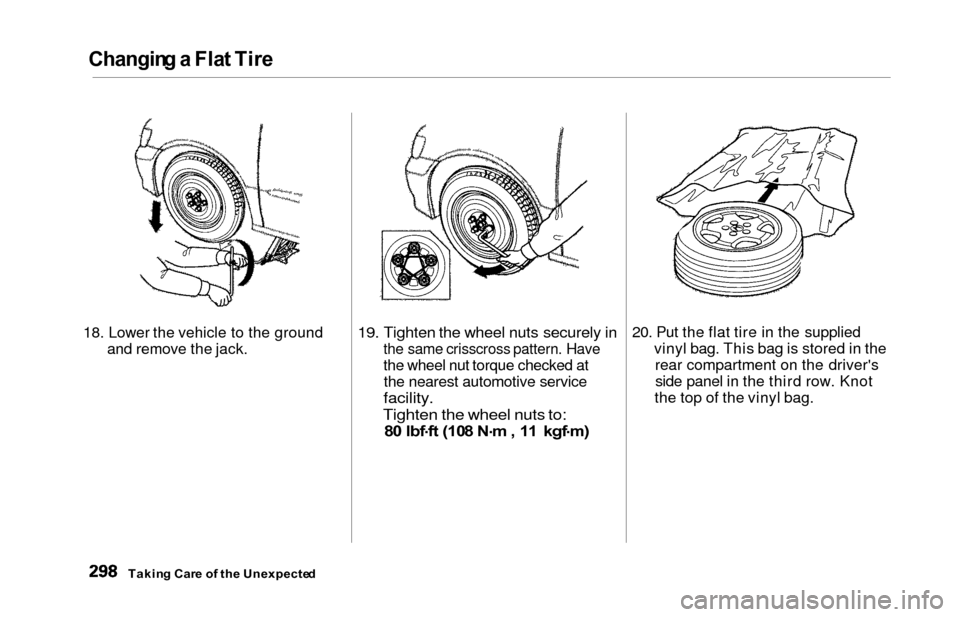
18. Lower the vehicle to the ground
and remove the jack.19. Tighten the wheel nuts securely in
the same crisscross pattern. Have
the wheel nut torque checked at
the nearest automotive service
facility.
Tighten the wheel nuts to:8 0 lbf .
f t (10 8 N .
m , 1 1 kgf .
m )
20. Put the flat tire in the supplied
vinyl bag. This bag is stored in therear compartment on the driver'sside panel in the third row. Knot
the top of the vinyl bag.
Takin g Car e o f th e Unexpecte d
Page 303 of 352
Changing a Flat Tire
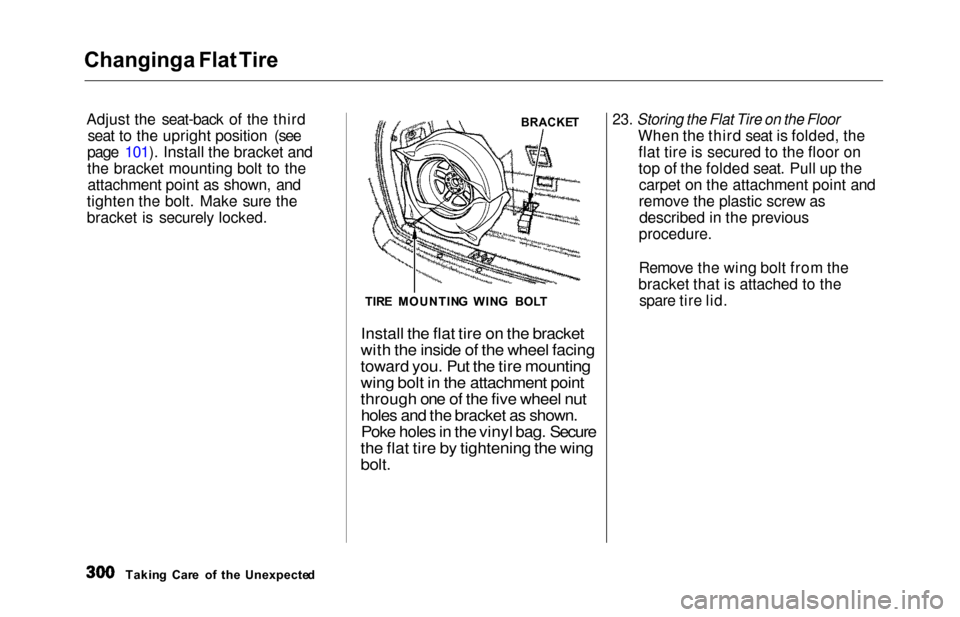
Adjust th
e seat-back of the third
seat to the upright position (see
page 101). Install the bracket and
the bracket mounting bolt to the attachment point as shown, and
tighten the bolt. Make sure the
bracket is securely locked.
23. Storing the Flat Tire on the Floor
When the third seat is folded, the
flat tire is secured to the floor on
top of the folded seat. Pull up thecarpet on the attachment point and
remove the plastic screw asdescribed in the previous
procedure.
Remove the wing bolt from the
bracket that is attached to the spare tire lid.
Takin g Car e o f th e Unexpecte d
BRACKE T
TIR E MOUNTIN G
WIN
G BOL T
Install the flat tire on the bracket
with the inside of the wheel facing
toward you. Put the tire mounting
wing bolt in the attachment point
through one of the five wheel nut
holes and the bracket as shown.
Poke holes in the vinyl bag. Secure
the flat tire by tightening the wing
bolt.
Page 304 of 352
Changin
g a Fla t Tir e
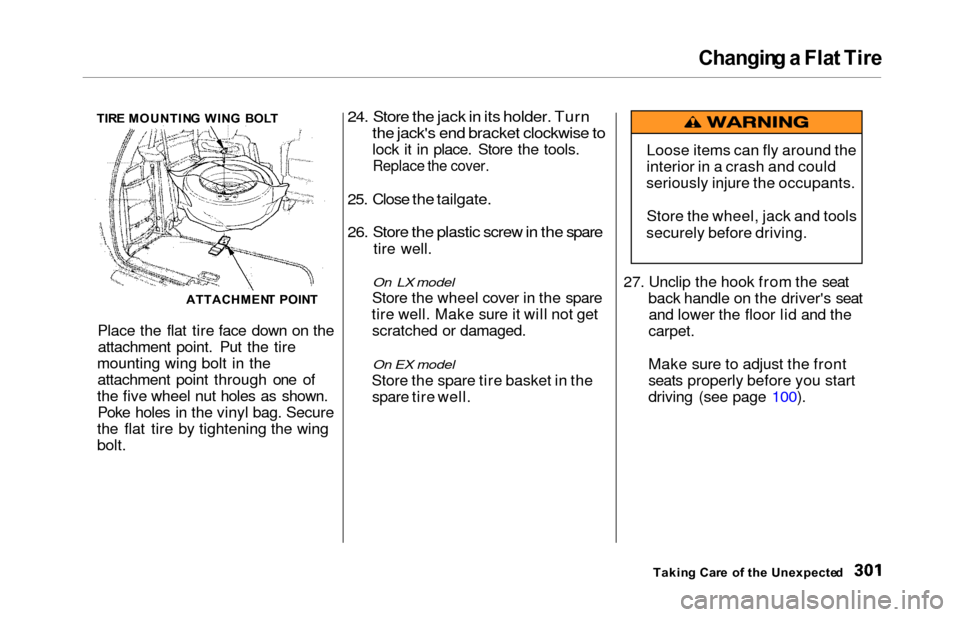
TIR E MOUNTIN G WIN G BOL T
ATTACHMEN T POIN T
Place the flat tire face down on the attachment point. Put the tire
mounting wing bolt in the attachment point through one of
the five wheel nut holes as shown. Poke holes in the vinyl bag. Secure
the flat tire by tightening the wing
bolt.
24. Store the jack in its holder. Turn
the jack's end bracket clockwise to
lock it in place. Store the tools.
Replace the cover.
25. Close the tailgate.
26. Store the plastic screw in the spare
tire well.
On LX model
Store
th
e wheel cover in the spare
tire well. Make sure it will not get scratched or damaged.
On EX model
Store th
e spare tire basket in the
spare tire well. 27. Unclip the hook from the seat
back handle on the driver's seat
and lower the floor lid and the
carpet.
Make sure to adjust the front
seats properly before you start
driving (see page 100).
Takin g Car e
o
f th e Unexpecte d
Loose items can fly around the
interior in a crash and could
seriously injure the occupants.
Store the wheel, jack and tools
securely before driving.
Page 313 of 352
Brake Syste m Indicato r
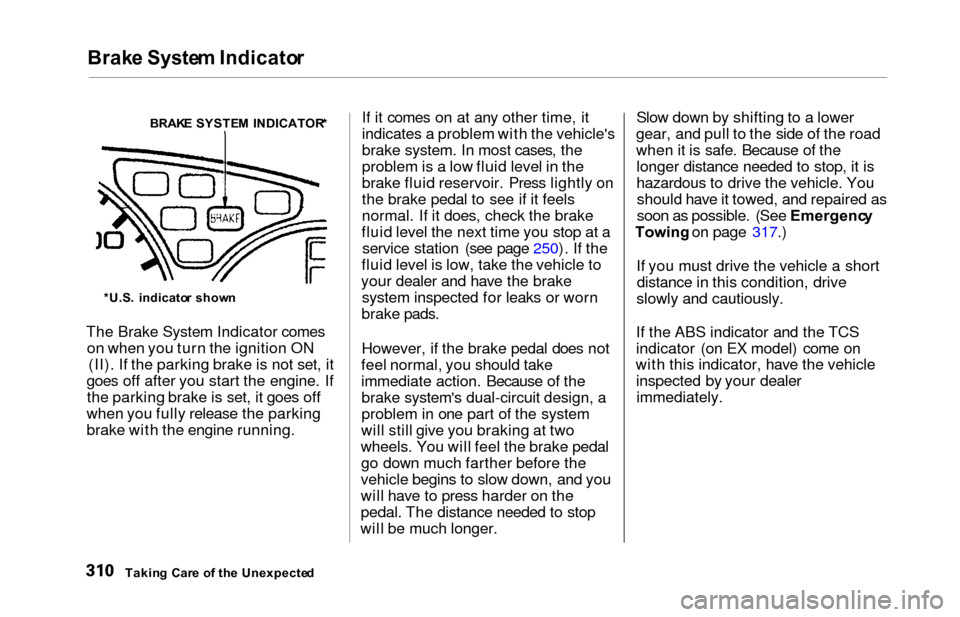
The Brake System Indicator comes
on when you turn the ignition ON (II). If the parking brake is not set, it
goes off after you start the engine. If the parking brake is set, it goes off
when you fully release the parking
brake with the engine running. If it comes on at any other time, it
indicates a problem with the vehicle's
brake system. In most cases, the
problem is a low fluid level in the
brake fluid reservoir. Press lightly on
the brake pedal to see if it feels
normal. If it does, check the brake
fluid level the next time you stop at a service station (see page 250). If the
fluid level is low, take the vehicle to
your dealer and have the brake system inspected for leaks or worn
brake pads.
However, if the brake pedal does not
feel normal, you should take
immediate action. Because of the brake system's dual-circuit design, a
problem in one part of the system
will still give you braking at two
wheels. You will feel the brake pedal go down much farther before the
vehicle begins to slow down, and you
will have to press harder on the
pedal. The distance needed to stop
will be much longer. Slow down by shifting to a lower
gear, and pull to the side of the road
when it is safe. Because of the longer distance needed to stop, it is
hazardous to drive the vehicle. Youshould have it towed, and repaired as
soon as possible. (See Emergenc y
Towing on page 317.)
If you must drive the vehicle a short distance in this condition, drive
slowly and cautiously.
If the ABS indicator and the TCS
indicator (on EX model) come on
with this indicator, have the vehicle inspected by your dealerimmediately.
Takin g Car e o f th e Unexpecte d
BRAK
E SYSTE M INDICATOR *
*U.S . indicato r show n
Page 320 of 352
Emergenc
y Towin g
If your vehicle needs to be towed, call a professional towing service or,
if you belong to one, an organization
that provides roadside assistance. Never tow your vehicle behind
another vehicle with just a rope or
chain. It is very dangerous.
There are three popular types of professional towing equipment:
Flat-bed Equipment — The operator
loads your vehicle on the back of a truck. Thi s i s th e bes t wa y t o trans -
por t you r Honda .
Wheel-Lift Equipment — The tow
truck uses two pivoting arms that go under the tires (front or rear) and lift
them off the ground. The other two
tires remain on the ground. Thi s i s
a n acceptabl e wa y t o to w you r
Honda .
Sling-type Equipment — The tow
truck uses metal cables with hooks on the ends. These hooks go around
parts of the frame or suspension and the cables lift that end of the vehicleoff the ground. Your vehicle's sus-
pension and body can be seriously damaged. Thi s metho d o f towin g
i s unacceptable .
If your Honda cannot be transported
by flat-bed, it should be towed by
wheel-lift equipment with the front
wheels off the ground. If, due to damage, your vehicle must be towed
with the front wheels on the ground, do the following.
Release the parking brake.
Start the engine.
Shift to D4, then to N.
Turn off the engine.
Improper towing preparation will
damage the transmission. Follow the
above procedure exactly. If you cannot
shift the transmission or start the
engine, your vehicle must be trans-
ported with the front wheels off the
ground.
With the front wheels on the ground,it is best to tow the vehicle no farther
than 50 miles (80 km), and keep the speed below 35 mph (55 km/h).
CONTINUED
Takin g Car e o f th e Unexpecte d
NOTIC
E
Page 321 of 352
Emergency Towin g
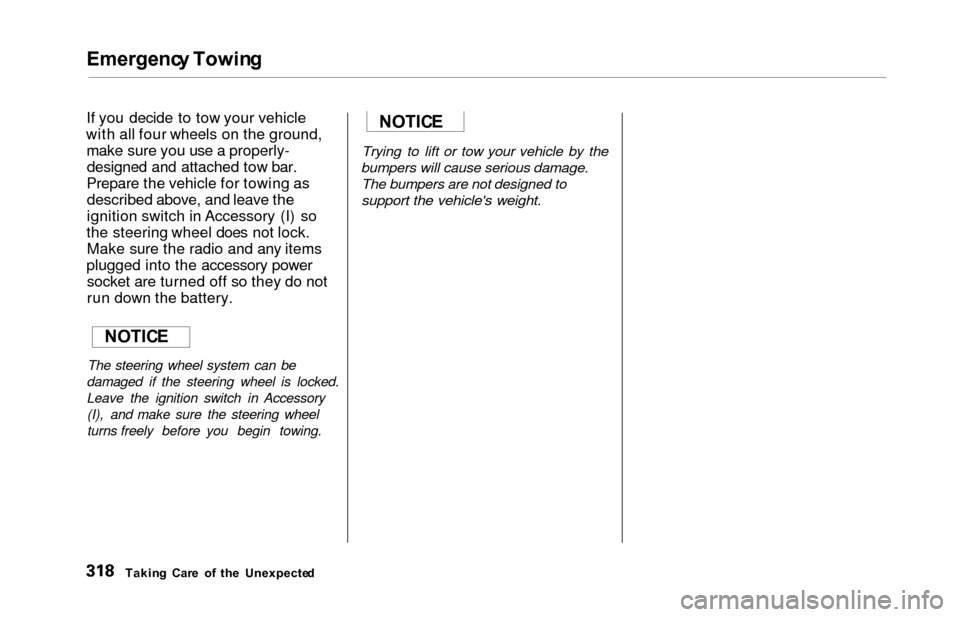
If you decide to tow your vehicle
with all four wheels on the ground, make sure you use a properly-designed and attached tow bar.
Prepare the vehicle for towing as described above, and leave the
ignition switch in Accessory (I) so
the steering wheel does not lock. Make sure the radio and any items
plugged into the accessory power socket are turned off so they do not
run down the battery.
The steering wheel system can be
damaged if the steering wheel is locked.
Leave the ignition switch in Accessory (I), and make sure the steering wheel
turns freely before you begin towing.
Trying to lift or tow your vehicle by the
bumpers will cause serious damage.
The bumpers are not designed to
support the vehicle's weight.
Takin g Car e o f th e Unexpecte d
NOTICE NOTIC
E
Page 328 of 352

DO
T Tir e Qualit y Gradin g (U.S . Vehicles )
Temperatur e
The temperature grades are A (the highest), B, and C, representing thetire's resistance to the generation of
heat and its ability to dissipate heat
when tested under controlledconditions on a specified indoor
laboratory test wheel. Sustained high
temperature can cause the materialof the tire to degenerate and reduce
tire life, and excessive temperature can lead to sudden tire failure. The
grade C corresponds to a level of
performance which all passenger car
tires must meet under the FederalMotor Vehicle Safety Standard No. 109. Grades B and A represent
higher levels of performance on the laboratory test wheel than the
minimum required by law. Warning: The temperature grade for
this tire is established for a tire that
is properly inflated and not over-
loaded. Excessive speed, underinfla-
tion, or excessive loading eitherseparately or in combination, can
cause heat build-up and possible tire
failure.
Technical Informatio n