Page 301 of 352
Changing a Fla t Tir e
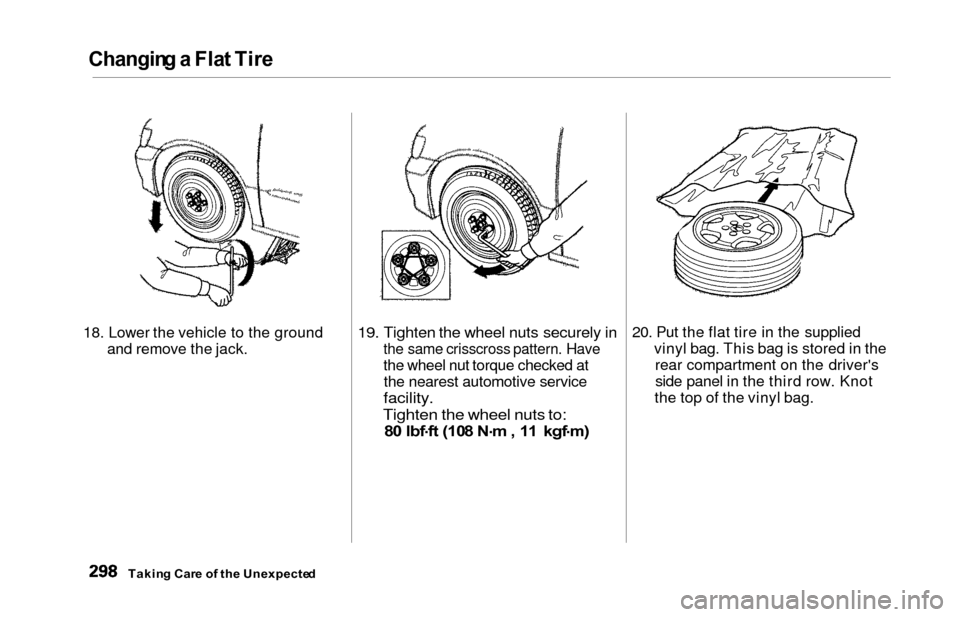
18. Lower the vehicle to the ground
and remove the jack.19. Tighten the wheel nuts securely in
the same crisscross pattern. Have
the wheel nut torque checked at
the nearest automotive service
facility.
Tighten the wheel nuts to:8 0 lbf .
f t (10 8 N .
m , 1 1 kgf .
m )
20. Put the flat tire in the supplied
vinyl bag. This bag is stored in therear compartment on the driver'sside panel in the third row. Knot
the top of the vinyl bag.
Takin g Car e o f th e Unexpecte d
Page 302 of 352
Changing a Fla t Tir e
21. Storing the flat tire behind the third
seat
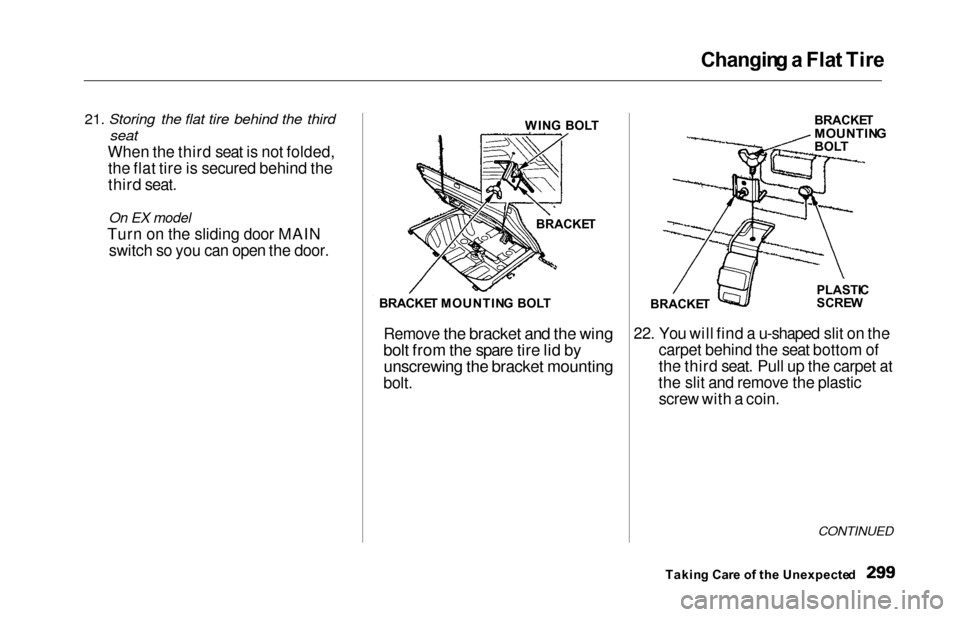
When the third seat is not folded,
the flat tire is secured behind the
third seat.
On EX model
Turn on the sliding door MAIN switch so you can open the door.
Remove the bracket and the wing
bolt from the spare tire lid by unscrewing the bracket mounting
bolt. 22. You will find a u-shaped slit on the
carpet behind the seat bottom of
the third seat. Pull up the carpet at
the slit and remove the plastic screw with a coin.
CONTINUED
Takin g Car e o f th e Unexpecte d
WIN
G BOL T
BRACKE T
BRACKE T MOUNTIN G BOL T BRACKE
T
MOUNTIN GBOLT
PLASTI C
SCRE W
BRACKE T
Page 303 of 352
Changing a Flat Tire
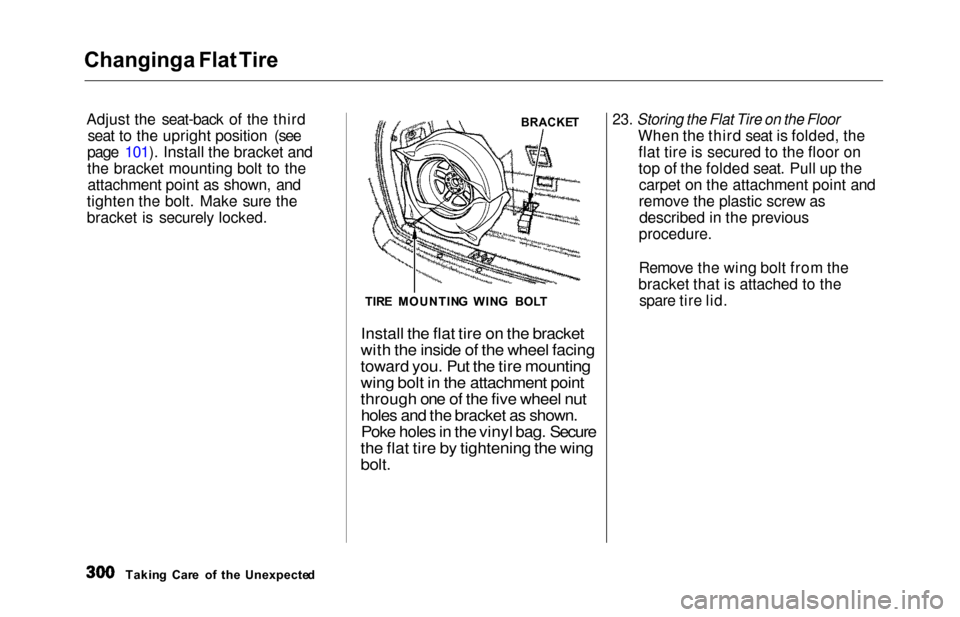
Adjust th
e seat-back of the third
seat to the upright position (see
page 101). Install the bracket and
the bracket mounting bolt to the attachment point as shown, and
tighten the bolt. Make sure the
bracket is securely locked.
23. Storing the Flat Tire on the Floor
When the third seat is folded, the
flat tire is secured to the floor on
top of the folded seat. Pull up thecarpet on the attachment point and
remove the plastic screw asdescribed in the previous
procedure.
Remove the wing bolt from the
bracket that is attached to the spare tire lid.
Takin g Car e o f th e Unexpecte d
BRACKE T
TIR E MOUNTIN G
WIN
G BOL T
Install the flat tire on the bracket
with the inside of the wheel facing
toward you. Put the tire mounting
wing bolt in the attachment point
through one of the five wheel nut
holes and the bracket as shown.
Poke holes in the vinyl bag. Secure
the flat tire by tightening the wing
bolt.
Page 304 of 352
Changin
g a Fla t Tir e
TIR E MOUNTIN G WIN G BOL T
ATTACHMEN T POIN T
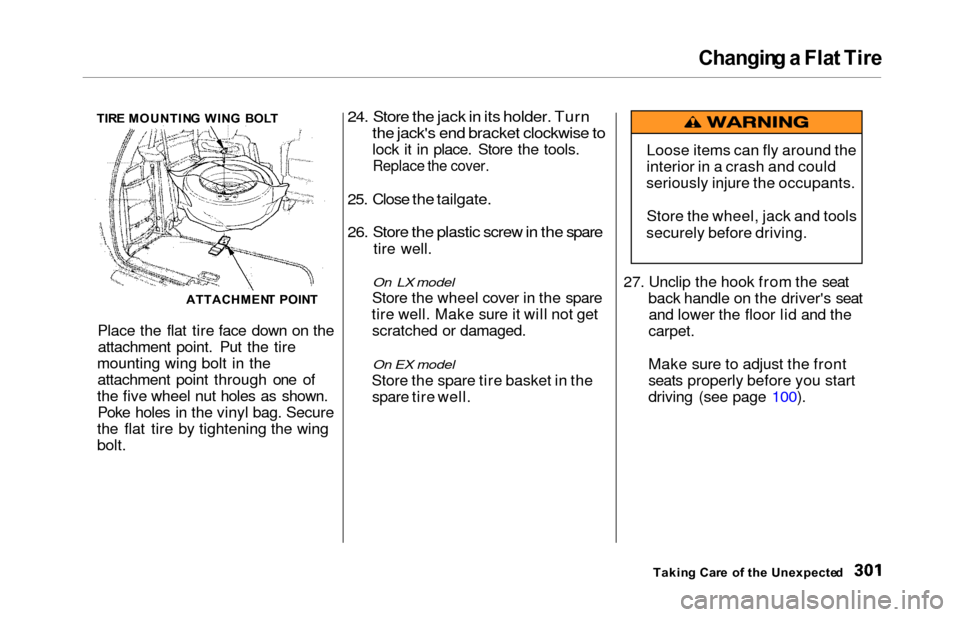
Place the flat tire face down on the attachment point. Put the tire
mounting wing bolt in the attachment point through one of
the five wheel nut holes as shown. Poke holes in the vinyl bag. Secure
the flat tire by tightening the wing
bolt.
24. Store the jack in its holder. Turn
the jack's end bracket clockwise to
lock it in place. Store the tools.
Replace the cover.
25. Close the tailgate.
26. Store the plastic screw in the spare
tire well.
On LX model
Store
th
e wheel cover in the spare
tire well. Make sure it will not get scratched or damaged.
On EX model
Store th
e spare tire basket in the
spare tire well. 27. Unclip the hook from the seat
back handle on the driver's seat
and lower the floor lid and the
carpet.
Make sure to adjust the front
seats properly before you start
driving (see page 100).
Takin g Car e
o
f th e Unexpecte d
Loose items can fly around the
interior in a crash and could
seriously injure the occupants.
Store the wheel, jack and tools
securely before driving.
Page 320 of 352

Emergenc
y Towin g
If your vehicle needs to be towed, call a professional towing service or,
if you belong to one, an organization
that provides roadside assistance. Never tow your vehicle behind
another vehicle with just a rope or
chain. It is very dangerous.
There are three popular types of professional towing equipment:
Flat-bed Equipment — The operator
loads your vehicle on the back of a truck. Thi s i s th e bes t wa y t o trans -
por t you r Honda .
Wheel-Lift Equipment — The tow
truck uses two pivoting arms that go under the tires (front or rear) and lift
them off the ground. The other two
tires remain on the ground. Thi s i s
a n acceptabl e wa y t o to w you r
Honda .
Sling-type Equipment — The tow
truck uses metal cables with hooks on the ends. These hooks go around
parts of the frame or suspension and the cables lift that end of the vehicleoff the ground. Your vehicle's sus-
pension and body can be seriously damaged. Thi s metho d o f towin g
i s unacceptable .
If your Honda cannot be transported
by flat-bed, it should be towed by
wheel-lift equipment with the front
wheels off the ground. If, due to damage, your vehicle must be towed
with the front wheels on the ground, do the following.
Release the parking brake.
Start the engine.
Shift to D4, then to N.
Turn off the engine.
Improper towing preparation will
damage the transmission. Follow the
above procedure exactly. If you cannot
shift the transmission or start the
engine, your vehicle must be trans-
ported with the front wheels off the
ground.
With the front wheels on the ground,it is best to tow the vehicle no farther
than 50 miles (80 km), and keep the speed below 35 mph (55 km/h).
CONTINUED
Takin g Car e o f th e Unexpecte d
NOTIC
E
Page 322 of 352

Technical Informatio n
The diagrams in this section give
you the dimensions and capacities of
your Honda, and the locations of theidentification numbers. The expla-
nations of several electronic and mechanical systems on your Honda
are for the more technically-oriented
owner. Identification Numbers................. 320
Specifications................................. 322
DOT Tire Quality Grading........... 324
Treadwear.................................. 324
Traction....................................... 324
Temperature............................. . 325Oxygenated Fuels.......................... 326
Driving in Foreign Countries....... 327
Emissions Controls........................ 328 The Clean Air Act...................... 328Crankcase Emissions Control System.................................... . 328
Evaporative Emissions Control System.................................... . 328
Exhaust Emissions Controls.... 329
PGM-FI System..................... 329
Ignition Timing Control System................................. 329
Exhaust Gas Recirculation (EGR) System.................... 329
Three Way Catalytic Converter............................ 329
Replacement Parts..................... 329
Three Way Catalytic Converter... 330
Technica l Informatio n
Page 327 of 352

DOT Tir e Qualit y Gradin g (U.S . Vehicles )
The tires on your vehicle meet all
U.S. Federal Safety Requirements.
All tires are also graded for
treadwear, traction, and temperature
performance according to
Department of Transportation (DOT) standards. The following
explains these gradings.
Unifor m Tir e Qualit y Gradin g
Quality grades can be found where applicable on the tire sidewall
between the tread shoulder and the maximum section width. For
example:
Treadwea r 20 0
Tractio n A A
Temperatur e ATreadwea r
The treadwear grade is a compara-
tive rating based on the wear rate of
the tire when tested under controlled conditions on a specified government
test course. For example, a tire
graded 150 would wear one and one
half (1-1/2) times as well on the
government course as a tire graded 100. The relative performance of
tires depends upon the actual condi-
tions of their use, however, and may depart significantly from the norm
due to variations in driving habits,
service practices, and differences in
road characteristics and climate. Tractio
n
The traction grades, from highest to lowest, are AA, A, B, and C. Those
grades represent the tire's ability tostop on wet pavement as measured
under controlled conditions on
specified government test surfaces of
asphalt and concrete. A tire marked C
may have poor traction performance.
Warning: The traction grade assigned to this tire is based on straight-ahead
braking traction tests, and does notinclude acceleration, cornering,
hydroplaning, or peak traction
characteristics.
Technica l Informatio n
Page 328 of 352

DO
T Tir e Qualit y Gradin g (U.S . Vehicles )
Temperatur e
The temperature grades are A (the highest), B, and C, representing thetire's resistance to the generation of
heat and its ability to dissipate heat
when tested under controlledconditions on a specified indoor
laboratory test wheel. Sustained high
temperature can cause the materialof the tire to degenerate and reduce
tire life, and excessive temperature can lead to sudden tire failure. The
grade C corresponds to a level of
performance which all passenger car
tires must meet under the FederalMotor Vehicle Safety Standard No. 109. Grades B and A represent
higher levels of performance on the laboratory test wheel than the
minimum required by law. Warning: The temperature grade for
this tire is established for a tire that
is properly inflated and not over-
loaded. Excessive speed, underinfla-
tion, or excessive loading eitherseparately or in combination, can
cause heat build-up and possible tire
failure.
Technical Informatio n