Page 284 of 352

Storing You r Vehicl e
If you need to park your vehicle for
an extended period (more than one
month), there are several things you
should do to prepare it for storage.
Proper preparation helps prevent
deterioration and makes it easier to
get your vehicle back on the road. If
possible, store your vehicle indoors.
Fill the fuel tank.Change the engine oil and filter
(see page 241).
Wash and dry the exterior
completely.
Clean the interior. Make sure the
carpeting, floor mats, etc. are
completely dry.
Leave the parking brake off. Put
the transmission in Park.
Block the rear wheels.
If the vehicle is to be stored for a
longer period, it should be
supported on jackstands so the
tires are off the ground. Leave one window open slightly (if
the vehicle is being stored
indoors).
Disconnect the battery.
Support the front and rear wiper
blade arms with a folded towel or rag so they do not touch the
windshield.
To minimize sticking, apply a silicone spray lubricant to all door
and tailgate seals. Also, apply a
vehicle body wax to the painted surfaces that mate with the door
and tailgate seals.
Cover the vehicle with a
"breathable" cover, one made
from a porous material such as cotton. Nonporous materials, such
as plastic sheeting, trap moisture,
which can damage the paint.
If possible, run the engine for a
while periodically (preferably once a month).
If you store your vehicle for 12
months or longer, have your Honda
dealer perform the inspections called
for in the 24 months/30,000 miles (48,000 km) maintenance schedule
(Normal Conditions) as soon as you
take it out of storage (see page 230).
The replacements called for in the maintenance schedule are not
needed unless the vehicle hasactually reached that time or mileage.
Maintenanc e
Page 294 of 352

Taking Car e o f th e Unexpecte d
This section covers the more-
common problems that motorists
experience with their vehicles. It
gives you information about how to safely evaluate the problem and what
to do to correct it. If the problem has stranded you on the side of the road,
you may be able to get going again. If not, you will also find instructionson getting your vehicle towed. Compact Spare Tire....................... 292
Changing a Flat Tire..................... 293
If Your Engine Won't Start........... 302 Nothing Happens or the Starter Motor OperatesVery Slowly......................... 302
The Starter Operates Normally................................ . 303
Jump Starting................................. 303
If Your Engine Overheats............. 305
Low Oil Pressure Indicator.......... 307Charging System Indicator........... 308
Malfunction Indicator Lamp ........ 309
Brake System Indicator................ 310
Fuses............................................... 311 Checking and Replacing........... 312
Emergency Towing....................... 317
Takin g Car e o f th e Unexpecte d
Page 295 of 352

Compact Spar e Tir e
Your vehicle has a compact spare
tire that takes up less space. Use thisspare tire as a temporary replace-
ment only. Get your regular tire
repaired or replaced and put back on
your vehicle as soon as you can.
Check the inflation pressure of the
compact spare tire every time you
check the other tires. It should be
inflated to: 60 psi (420 kPa , 4.2 kgf/cm
2)
Follow these precautions whenever
you are using the compact spare tire:
Do not exceed 50 mph (80 km/h)
under any circumstances.
This tire gives a harsher ride and less traction on some road sur-
faces than the regular tire. Use
greater caution while driving on
this tire. Do not mount snow chains on the
compact spare.
Do not use the compact spare tire
if you are towing a trailer.
The wheel of the compact spare
tire is designed especially to fit
your vehicle. Do not use your
spare tire on another vehicle
unless it is the same make and
model.
On EX model
Turn off the Traction ControlSystem (see page 213 ). Driving
with the compact spare tire may
activate the TCS.
The compact spare tire has a shorter
tread life than a regular tire. Replace
it when you can see the tread wear
indicator bars. The replacement
should be the same size and design
tire, mounted on the same wheel.
The compact spare tire is not
designed to be mounted on a regular
wheel, and the compact wheel is not
designed for mounting a regular tire.
Takin g Car e o f th e Unexpecte d
INDICATOR LOCATIO N MAR K
TREA D WEA R INDICATO R BA R
Page 296 of 352
Changing a Fla t Tir e
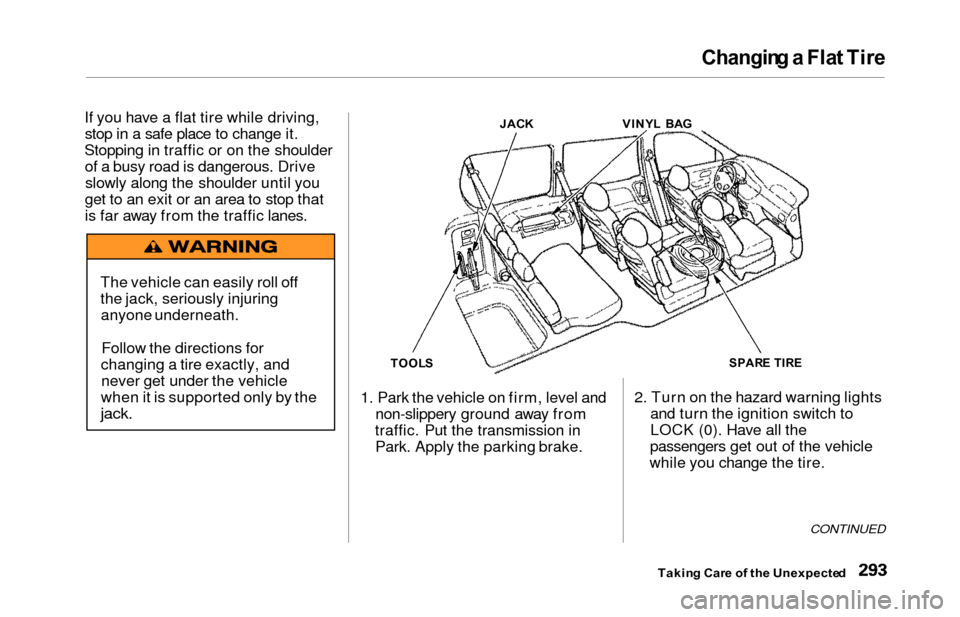
If you have a flat tire while driving,
stop in a safe place to change it.
Stopping in traffic or on the shoulder of a busy road is dangerous. Driveslowly along the shoulder until you
get to an exit or an area to stop that
is far away from the traffic lanes.
1. Park the vehicle on firm, level andnon-slippery ground away from
traffic. Put the transmission in Park. Apply the parking brake. 2. Turn on the hazard warning lights
and turn the ignition switch to
LOCK (0). Have all the
passengers get out of the vehicle
while you change the tire.
CONTINUED
Takin g Car e o f th e Unexpecte d
The vehicle can easily roll off
the jack, seriously injuring
anyone underneath.
Follow the directions for
changing a tire exactly, and never get under the vehicle
when it is supported only by the
jack.
TOOL S JAC
K VINYL BA GSPAR E TIR E
Page 297 of 352
Changing a Fla t Tir e
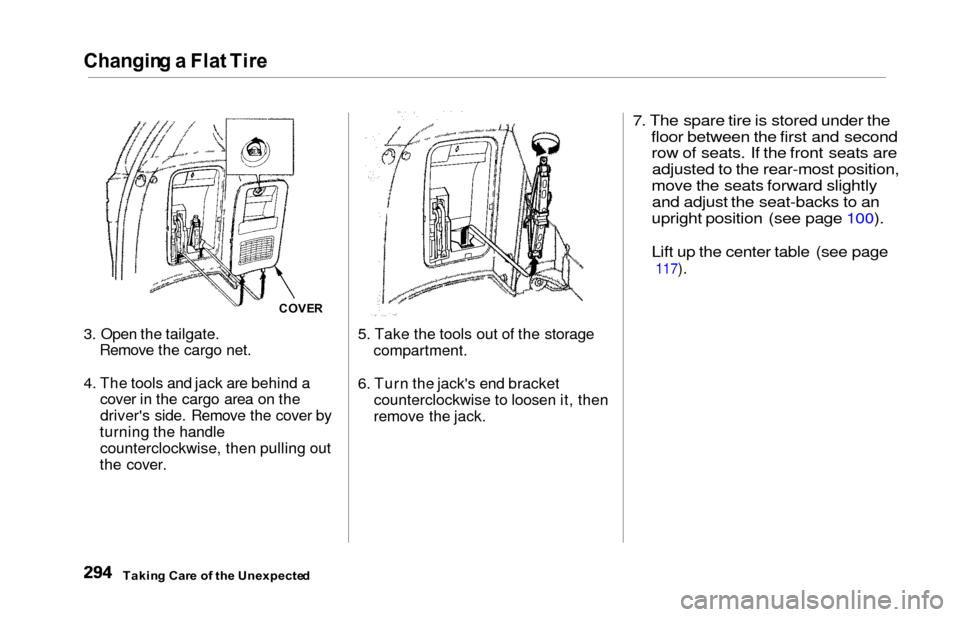
3. Open the tailgate.
Remove the cargo net.
4. The tools and jack are behind a cover in the cargo area on the
driver's side. Remove the cover by
turning the handle counterclockwise, then pulling out
the cover. 5. Take the tools out of the storage
compartment.
6. Turn the jack's end bracket counterclockwise to loosen it, then
remove the jack.
7. The spare tire is stored under the
floor between the first and second row of seats. If the front seats areadjusted to the rear-most position,
move the seats forward slightly and adjust the seat-backs to an
upright position (see page 100).
Lift up the center table (see page
117).
Takin g Car e o f th e Unexpecte d
COVER
Page 298 of 352
Changing a Fla t Tir e
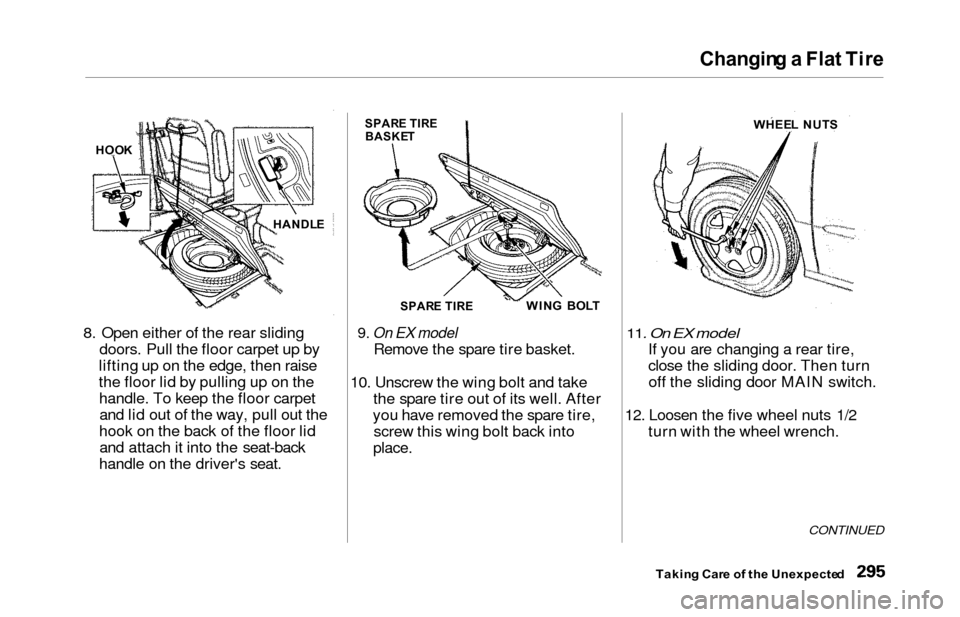
8. Open either of the rear sliding
doors. Pull the floor carpet up by
lifting up on the edge, then raise
the floor lid by pulling up on the handle. To keep the floor carpetand lid out of the way, pull out the
hook on the back of the floor lid and attach it into the seat-back
handle on the driver's seat.9. On EX model
Remove the spare tire basket.
10. Unscrew the wing bolt and take the spare tire out of its well. After
you have removed the spare tire, screw this wing bolt back into
place.
11. On EX model
If you are changing a rear tire,
close the sliding door. Then turnoff the sliding door MAIN switch.
12. Loosen the five wheel nuts 1/2 turn with the wheel wrench.
CONTINUED
Takin g Car e o f th e Unexpecte d
HOOK
WHEE L NUT S
HANDL E
SPARE TIR E
BASKE T
SPAR E TIR E
WIN G BOL T
Page 299 of 352
Changing a Fla t Tir e
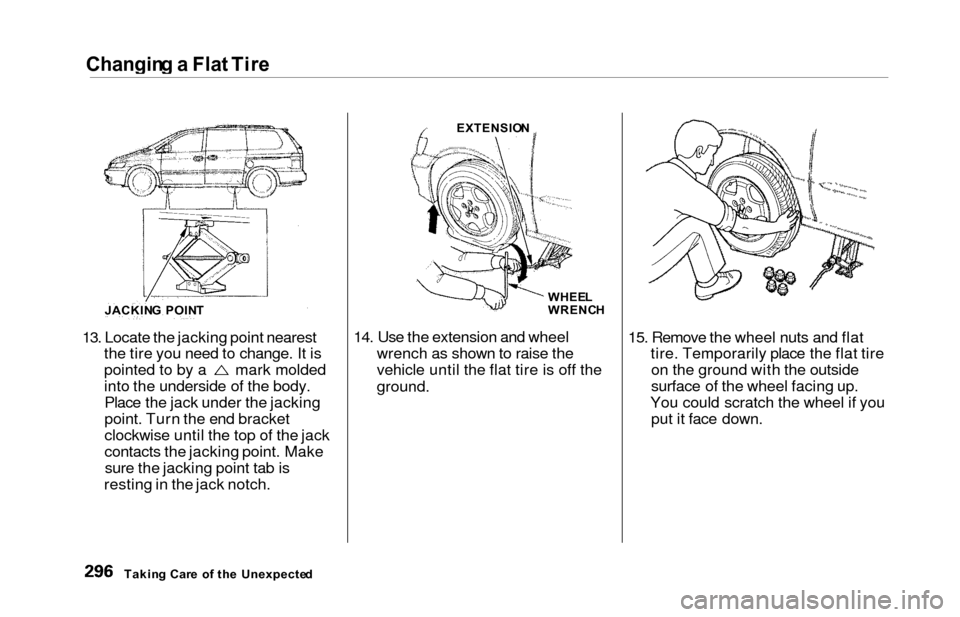
13. Locate the jacking point nearest
the tire you need to change. It is
pointed to by a mark molded
into the underside of the body.Place the jack under the jacking
point. Turn the end bracket
clockwise until the top of the jack
contacts the jacking point. Makesure the jacking point tab is
resting in the jack notch. 14. Use the extension and wheel
wrench as shown to raise the
vehicle until the flat tire is off the
ground.
15. Remove the wheel nuts and flattire. Temporarily place the flat tireon the ground with the outside
surface of the wheel facing up.
You could scratch the wheel if you put it face down.
Takin g Car e o f th e Unexpecte d
JACKIN
G POIN T EXTENSIO
N
WHEE L
WRENC H
Page 300 of 352
Changing a Fla t Tir e
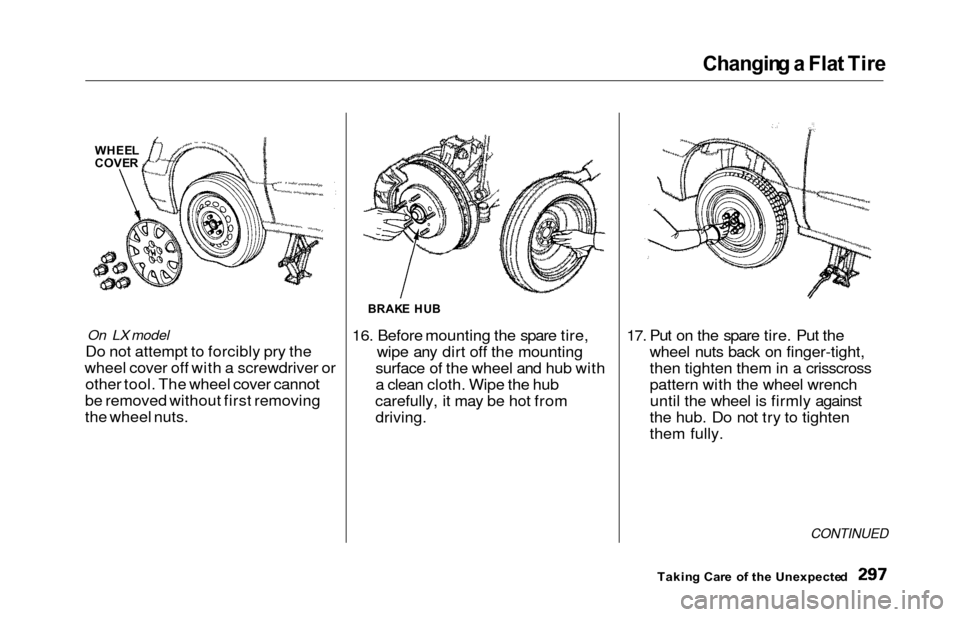
On LX model
Do not attempt to forcibly pry the
wheel cover off with a screwdriver or other tool. The wheel cover cannot
be removed without first removing
the wheel nuts. 16. Before mounting the spare tire,
wipe any dirt off the mounting
surface of the wheel and hub with
a clean cloth. Wipe the hub
carefully, it may be hot from
driving.
17. Put on the spare tire. Put the wheel nuts back on finger-tight,
then tighten them in a crisscross
pattern with the wheel wrenchuntil the wheel is firmly against
the hub. Do not try to tighten
them fully.
CONTINUED
Takin g Car e o f th e Unexpecte d
BRAKE HU B
WHEE L
COVE R