Page 261 of 352
Battery
If you need to connect the battery to
a charger, disconnect both cables to
prevent damage to the vehicle's electrical system.On EX model
If your vehicle's battery is
disconnected or goes dead, the audio
system will disable itself. The next
time you turn on the radio you will
see in the frequency
display. Use the Preset buttons to
enter the five-digit code (see page
186).
Charging the battery with the cables
connected can seriously damage your
vehicle's electronic controls. Detach the battery cables before connecting
the battery to a charger.
On EX model
If your vehicle's battery is
disconnected or goes dead while thesliding doors are open, the power
sliding door system needs to be
resynchronized (see page 93).
Maintenanc e
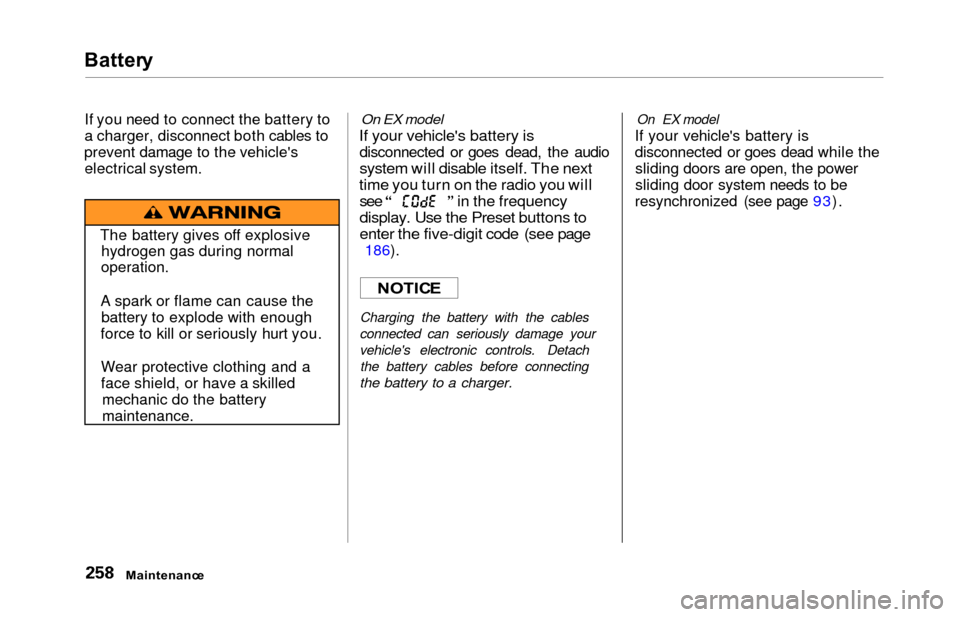
The battery gives off explosive
hydrogen gas during normal
operation.
A spark or flame can cause the battery to explode with enough
force to kill or seriously hurt you.
Wear protective clothing and a
face shield, or have a skilled mechanic do the battery
maintenance.
NOTIC E
Page 266 of 352
Timing Belt , Tire s
Timin g Bel t
The timing belt should normally be replaced at the intervals shown in
the maintenance schedule.
Replace the belt at 60,000 miles (U.S.)
or 100,000 km (Canada) if you regu-
larly drive your vehicle in one or more of these conditions:
In very high temperatures
(over 110°F,43°C).
In very low temperatures
(under — 20°F, — 29°C).
Tire s
To safely operate your vehicle, your tires must be the proper type andsize, in good condition with adequate
tread, and correctly inflated. The
following pages give more detailed information on how and when tocheck air pressure, how to inspect
your tires for damage and wear, and
what to do when your tires need to be replaced.Inflatio n
Keeping the tires properly inflated
provides the best combination of
handling, tread life and riding comfort. Underinflated tires wear
unevenly, adversely affect handlingand fuel economy, and are more
likely to fail from being overheated. Overinflated tires can make your
vehicle ride more harshly, are more prone to damage from road hazards,and wear unevenly.
We recommend that you visually check your tires every day. If you
think a tire might be low, check it immediately with a tire gauge.
CONTINUED
Maintenanc e
Using tires that are excessively
worn or improperly inflated can
cause a crash in which you can be seriously hurt or killed.
Follow all instructions in this
owner's manual regarding tire inflation and maintenance.
Page 269 of 352
Tires
Maintenanc e
In addition to proper inflation,
correct wheel alignment helps to
decrease tire wear. If you find a tire
is worn unevenly, have your dealer check the wheel alignment.
The tires were properly balanced by the factory. They may need to be
rebalanced at some time before theyare worn out. Have your dealer
check the tires if you feel a consis-
tent vibration while driving. A tire should always be rebalanced if it is
removed from the wheel for repair. Make sure the installer balances the
wheels when you have new tires installed. This increases riding
comfort and tire life. Your vehicle's
original tires were dynamic or "spin"
balanced at the factory. For best results, have the installer perform adynamic balance.
On some models
Improper wheel weights can damage
your vehicle's aluminum wheels. Use only Genuine Honda wheel weights for
balancing.
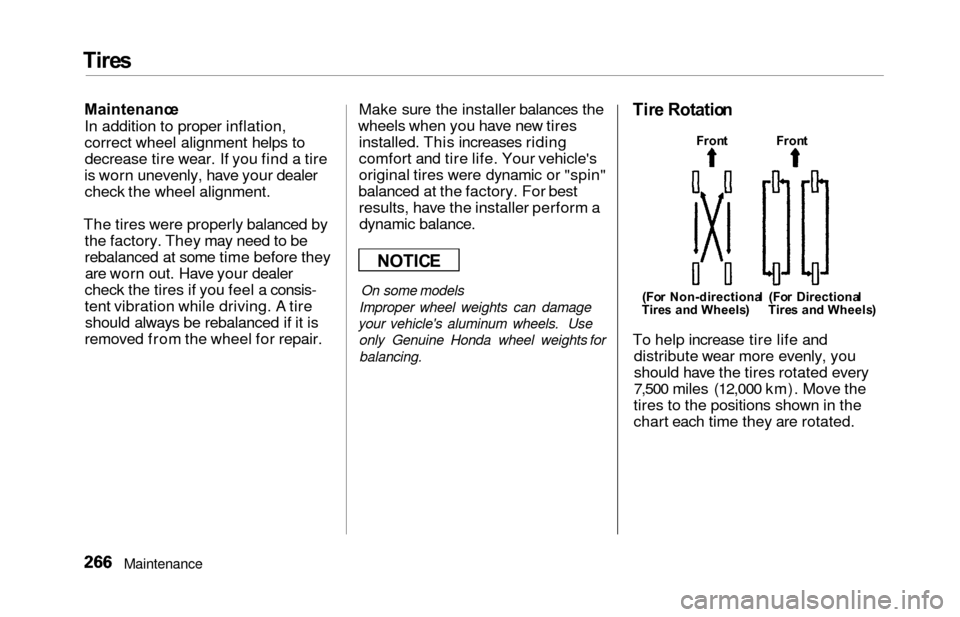
Tir e Rotatio n
(For Non-directiona l (Fo r Directiona l
Tire s an d Wheels ) Tire s an d Wheels )
To help increase tire life and
distribute wear more evenly, you
should have the tires rotated every
7,500 miles (12,000 km). Move the
tires to the positions shown in the
chart each time they are rotated.
Maintenance
NOTIC E
Front
Fron t
Page 274 of 352
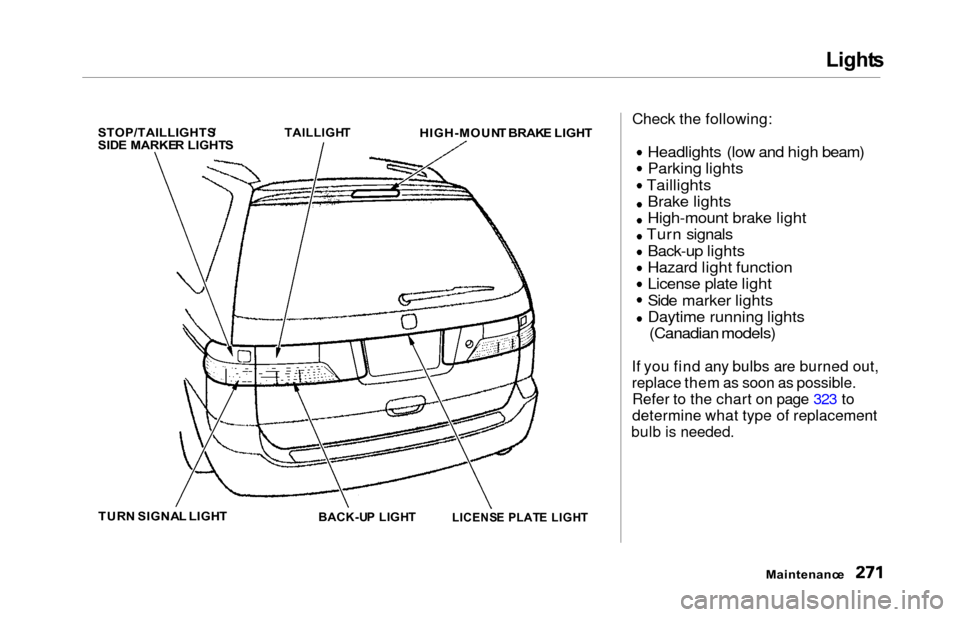
Light
s
STOP/TAILLIGHTS /
SID E MARKE R LIGHT S
TAILLIGH
T
HIGH-MOUN T BRAK E LIGH T
TUR N SIGNA L LIGH T
BACK-UP LIGH T
Check the following:
Headlights (low and high beam)
Parking lights
Taillights Brake lights
High-mount brake light
Turn signals
Back-up lights
Hazard light function
License plate light
Side marker lights
Daytime running lights
(Canadian models)
If you find any bulbs are burned out,
replace them as soon as possible.
Refer to the chart on page 323 to
determine what type of replacement
bulb is needed.
Maintenance
LICENS
E PLAT E LIGH T
Page 284 of 352
Storing You r Vehicl e
If you need to park your vehicle for
an extended period (more than one
month), there are several things you
should do to prepare it for storage.
Proper preparation helps prevent
deterioration and makes it easier to
get your vehicle back on the road. If
possible, store your vehicle indoors.
Fill the fuel tank.Change the engine oil and filter
(see page 241).
Wash and dry the exterior
completely.
Clean the interior. Make sure the
carpeting, floor mats, etc. are
completely dry.
Leave the parking brake off. Put
the transmission in Park.
Block the rear wheels.
If the vehicle is to be stored for a
longer period, it should be
supported on jackstands so the
tires are off the ground. Leave one window open slightly (if
the vehicle is being stored
indoors).
Disconnect the battery.
Support the front and rear wiper
blade arms with a folded towel or rag so they do not touch the
windshield.
To minimize sticking, apply a silicone spray lubricant to all door
and tailgate seals. Also, apply a
vehicle body wax to the painted surfaces that mate with the door
and tailgate seals.
Cover the vehicle with a
"breathable" cover, one made
from a porous material such as cotton. Nonporous materials, such
as plastic sheeting, trap moisture,
which can damage the paint.
If possible, run the engine for a
while periodically (preferably once a month).
If you store your vehicle for 12
months or longer, have your Honda
dealer perform the inspections called
for in the 24 months/30,000 miles (48,000 km) maintenance schedule
(Normal Conditions) as soon as you
take it out of storage (see page 230).
The replacements called for in the maintenance schedule are not
needed unless the vehicle hasactually reached that time or mileage.
Maintenanc e
Page 291 of 352
Corrosion Protectio n
Two factors normally contribute to
causing corrosion in your vehicle:
1. Moisture trapped in body cavities. Dirt and road salt that collects in
hollows on the underside of the
vehicle stays damp, promoting corrosion in that area.
2. Removal of paint and protective coatings from the exterior and
underside of the vehicle. Many corrosion-preventive measures
are built into your Honda. You can
help keep your vehicle from corroding by performing somesimple periodic maintenance:
Repair chips and scratches in the
paint as soon as you discover them.
Inspect and clean out the drain
holes in the bottom of the doors and body.
Check the floor coverings fordampness. Carpeting and floor
mats may remain damp for a long
time, especially in winter. This dampness can eventually cause
the floor panels to corrode. Use a high-pressure spray to clean
the underside of your vehicle. This
is especially important in areas
that use road salt in winter. It is also a good idea in humid climates
and areas subject to salt air. Be
careful of the ABS wheel sensors
and wiring at each wheel.
Have the corrosion-preventive
coatings on the underside of your
vehicle inspected and repaired periodically.
Appearanc e Car e
Page 331 of 352
Emissions Control s
The burning of gasoline in your
vehicle's engine produces several by-products. Some of these are carbon
monoxide (CO), oxides of nitrogen (NO
x) and hydrocarbons (HC).
Gasoline evaporating from the tank
also produces hydrocarbons. Con-
trolling the production of NOx, CO, and HC is important to the environ-
ment. Under certain conditions ofsunlight and climate, NOx and HC
react to form photochemical "smog." Carbon monoxide does not contri-
bute to smog creation, but it is a
poisonous gas.
Th e Clea n Ai r Ac t
The United States Clean Air Act*
sets standards for automobile
emissions. It also requires that
automobile manufacturers explain to
owners how their emissions controls
work and what to do to maintain
them. This section summarizes how
the emissions controls work.
Scheduled maintenance is on page
230.
* In Canada, Honda vehicles comply
with the Canadian Motor Vehicle
Safety Standards (CMVSS) for
Emissions valid at the time they are
manufactured.
Crankcas e Emission s Contro l
System
Your vehicle has a Positive
Crankcase Ventilation System. This
keeps gasses that build up in the engine's crankcase from going into
the atmosphere. The Positive Crank- case Ventilation valve routes them
from the crankcase back to the
intake manifold. They are then drawn into the engine and burned.
Evaporativ e Emission s Contro l
Syste m
As gasoline evaporates in the fuel tank, an evaporative emissions
control canister filled with charcoaladsorbs the vapor. It is stored in this
canister while the engine is off. After
the engine is started and warmed up,
the vapor is drawn into the engine and burned during driving.
Technica l Informatio n
Page 341 of 352
Authorize
d Manual s
These Publications cannot be returned for credit without receiving advance authorization within 14 days of delivery. On returns, a restocking fee may be applied against the original order.
P.O. BOX 07280 DETROIT, MICHIGAN 48207 1-800-782-4356
Servic
e Manual :
This manual covers maintenance and recommended procedures for repair to engine and chassis components.
It is written for the Journeyman mechanic, but is simple
enough for most mechanically-inclined owners to under-
stand.
Electrica l Troubleshootin g Manual :
This manual complements the Service Manual by providing in-depth troubleshooting information for each
electrical circuit in your vehicle.
Bod y Repai r Manual :
This manual describes the procedures involved in the replacement of damaged body parts.