Page 238 of 352
Required Maintenanc e Recor d (fo r Norma l an d Sever e Schedules )
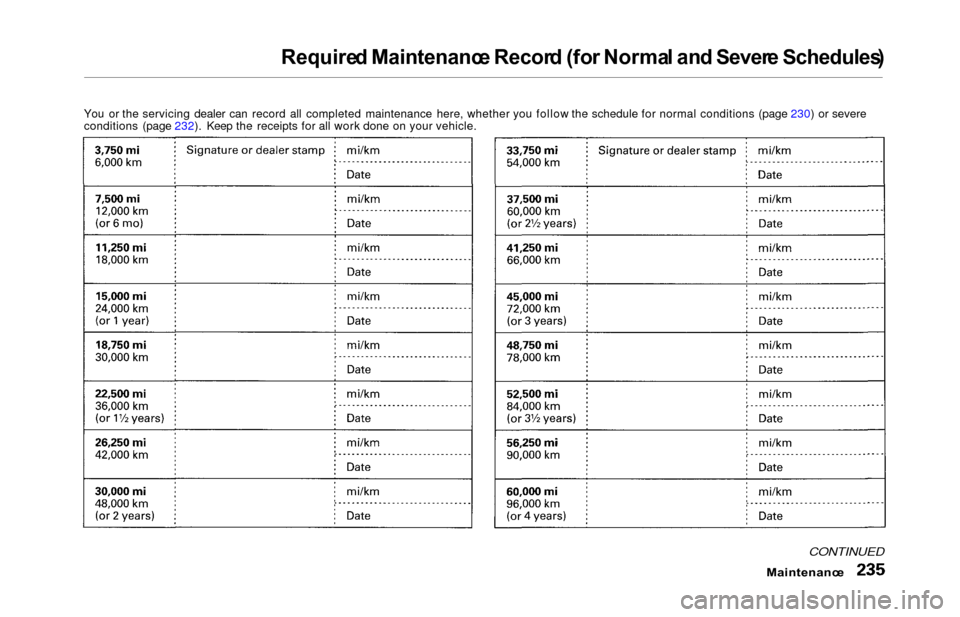
You or the servicing dealer can record all completed maintenance here, whether you follow the schedule for normal conditions (page 230) or severe
conditions (page 232). Keep the receipts for all work done on your vehicle.
Maintenanc e
CONTINUED
Page 243 of 352
Engine Oi l
The oil container may also display
the API Certification seal. Make sure
it says "For Gasoline Engines."
AP I CERTIFICATIO N SEA L
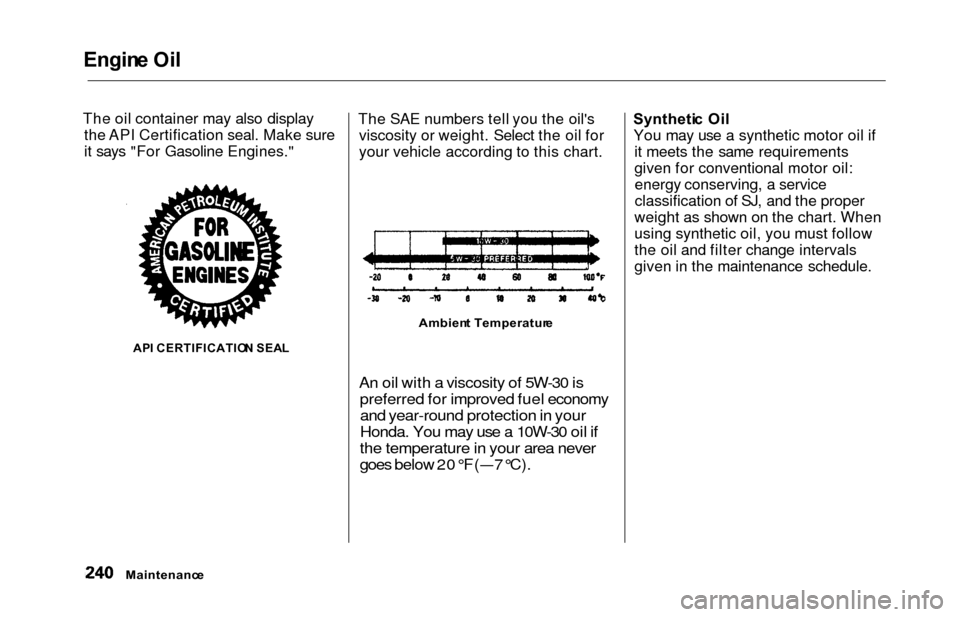
The SAE numbers tell you the oil's
viscosity or weight. Select the oil for
your vehicle according to this chart.
An oil with a viscosity of 5W-30 ispreferred for improved fuel economy
and year-round protection in your
Honda. You may use a 10W-30 oil if
the temperature in your area never
goes below 20°F(— 7°C).
Syntheti c Oi l
You may use a synthetic motor oil if it meets the same requirements
given for conventional motor oil:energy conserving, a service
classification of SJ, and the proper
weight as shown on the chart. When
using synthetic oil, you must follow
the oil and filter change intervals
given in the maintenance schedule.
Maintenanc e
Ambient Temperatur e
Page 244 of 352
Engine Oi l
Additive s
Your Honda does not need any oil additives. Purchasing additives for
the engine or transmission will not increase your vehicle's performance
or longevity. It only increases the
cost of operating your vehicle. Changin
g th e Oi l an d Filte r
Always change the oil and filter according to the time and distance (miles/kilometers) recommenda-
tions in the maintenance schedule.
The oil and filter collect contami- nants that can damage your engine if
they are not removed regularly.
Changing the oil and filter requires
special tools and access from
underneath the vehicle. The vehicle should be raised on a service station-
type hydraulic lift for this service. Unless you have the knowledge and
proper equipment, you should have
this maintenance done by a skilled mechanic.
1. Run the engine until it reaches normal operating temperature,
then shut it off. 2. Open the hood and remove the
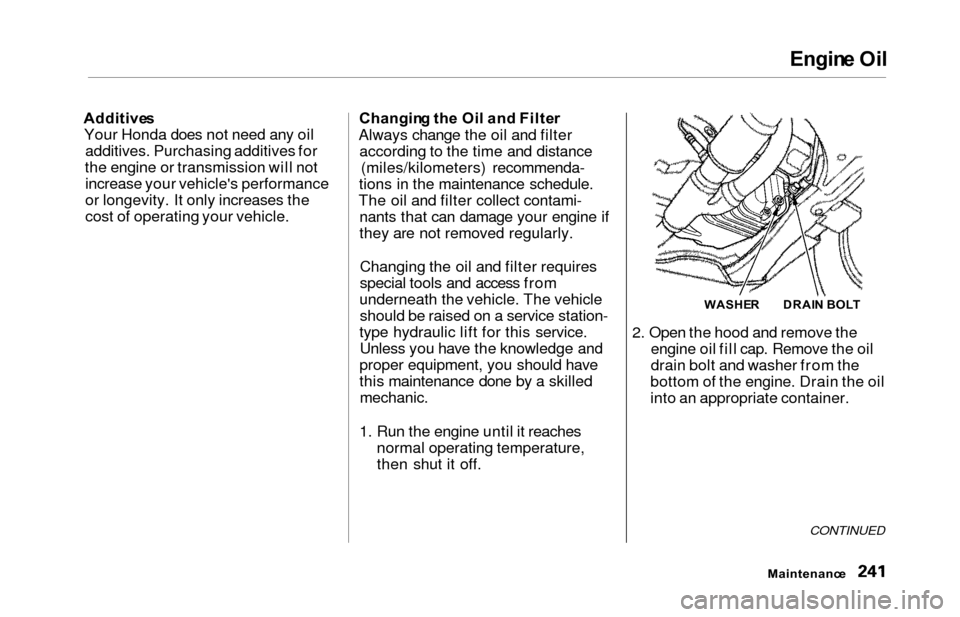
engine oil fill cap. Remove the oil
drain bolt and washer from the
bottom of the engine. Drain the oil
into an appropriate container.
CONTINUED
Maintenanc e
WASHERDRAIN BOL T
Page 248 of 352
Cooling Syste m
Replacin g Engin e Coolan t
The cooling system should be completely drained and refilled with
new coolant according to the time
and distance recommendations in
the maintenance schedule. Only use Genuine Honda Antifreeze/Coolant.
Draining the coolant requires access
to the underside of the vehicle. Unless you have the tools and
knowledge, you should have this maintenance done by a skilled
mechanic.
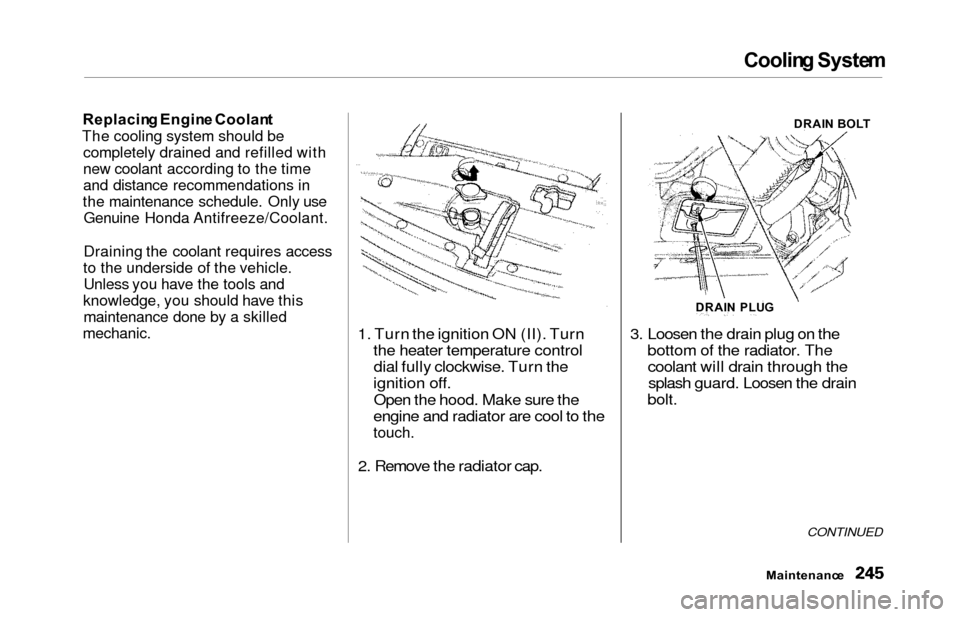
1. Turn the ignition ON (II). Turn the heater temperature controldial fully clockwise. Turn the
ignition off.
Open the hood. Make sure the
engine and radiator are cool to the
touch.
2. Remove the radiator cap. 3. Loosen the drain plug on the
bottom of the radiator. Thecoolant will drain through thesplash guard. Loosen the drain
bolt.
CONTINUED
Maintenanc e
DRAIN PLU G DRAI
N BOL T
Page 252 of 352
Automatic Transmissio n Flui d
Check the fluid level with the engine
at normal operating temperature.
1. Park the vehicle on level ground. Shut off the engine.
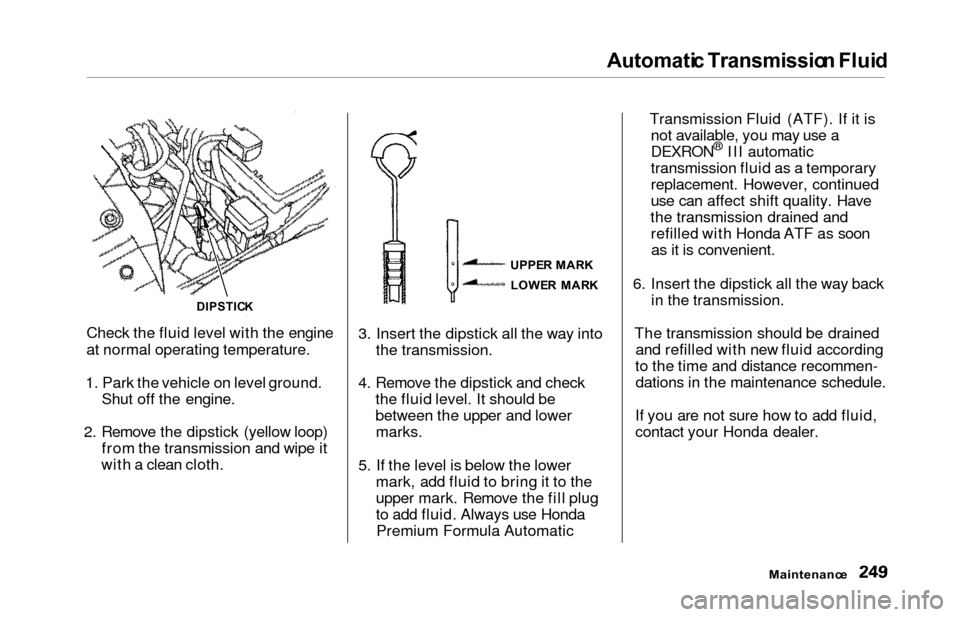
2. Remove the dipstick (yellow loop) from the transmission and wipe it
with a clean cloth. 3. Insert the dipstick all the way into
the transmission.
4. Remove the dipstick and check the fluid level. It should be
between the upper and lowermarks.
5. If the level is below the lower mark, add fluid to bring it to the
upper mark. Remove the fill plug
to add fluid. Always use HondaPremium Formula Automatic Transmission Fluid (ATF). If it is
not available, you may use a
DEXRON
® III automatic
transmission fluid as a temporary
replacement. However, continued
use can affect shift quality. Have
the transmission drained and refilled with Honda ATF as soonas it is convenient.
6. Insert the dipstick all the way back in the transmission.
The transmission should be drained and refilled with new fluid according
to the time and distance recommen- dations in the maintenance schedule.
If you are not sure how to add fluid,
contact your Honda dealer.
Maintenanc e
DIPSTICK
UPPER MAR K
LOWE R MAR K
Page 255 of 352
Air Cleane r Elemen t
The air cleaner element should be
cleaned or replaced according to the
time and distance recommendations
in the maintenance schedule.
Cleanin g (Sever e Conditions )
Clean the air cleaner element by
blowing compressed air through it in
the opposite direction to normal air
flow. If you do not have access to compressed air (such as a servicestation), ask your Honda dealer to do
this service.
Follow the replacement procedure
for removal and reinstallation.
Replacemen t
The air cleaner element is inside the
air cleaner housing on the driver's
side of the engine compartment.
To replace it:
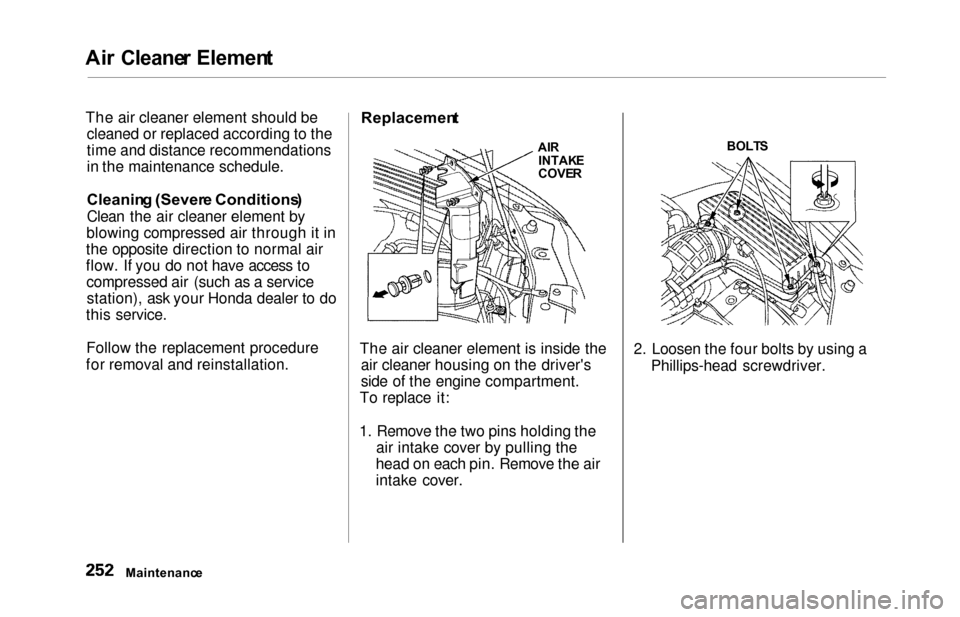
1. Remove the two pins holding the air intake cover by pulling the
head on each pin. Remove the air
intake cover. 2. Loosen the four bolts by using a
Phillips-head screwdriver.
Maintenanc e AI
R
INTAK E
COVER BOLT
S
Page 257 of 352
Hood Latch , Spar k Plug s
Hood Latc h
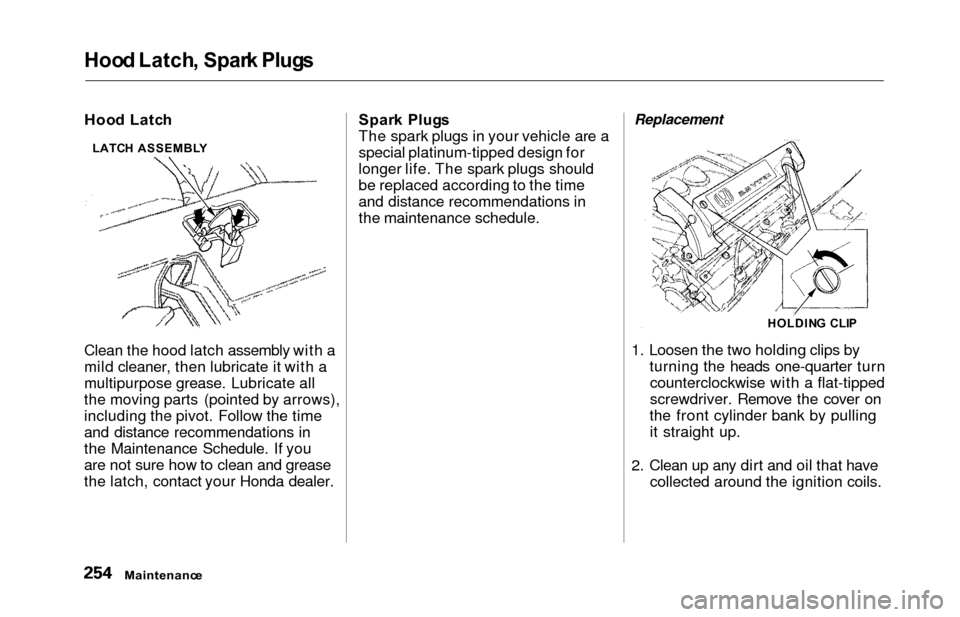
Clean the hood latch assembly with a
mild cleaner, then lubricate it with a
multipurpose grease. Lubricate all
the moving parts (pointed by arrows), including the pivot. Follow the time
and distance recommendations in
the Maintenance Schedule. If you
are not sure how to clean and grease
the latch, contact your Honda dealer. Spar
k Plug s
The spark plugs in your vehicle are a
special platinum-tipped design for
longer life. The spark plugs should
be replaced according to the time
and distance recommendations in
the maintenance schedule.Replacement
1. Loosen the two holding clips by turning the heads one-quarter turncounterclockwise with a flat-tipped
screwdriver. Remove the cover on
the front cylinder bank by pulling it straight up.
2. Clean up any dirt and oil that have collected around the ignition coils.
Maintenanc e
LATCH ASSEMBL Y
HOLDING CLI P
Page 259 of 352
Spark Plug s
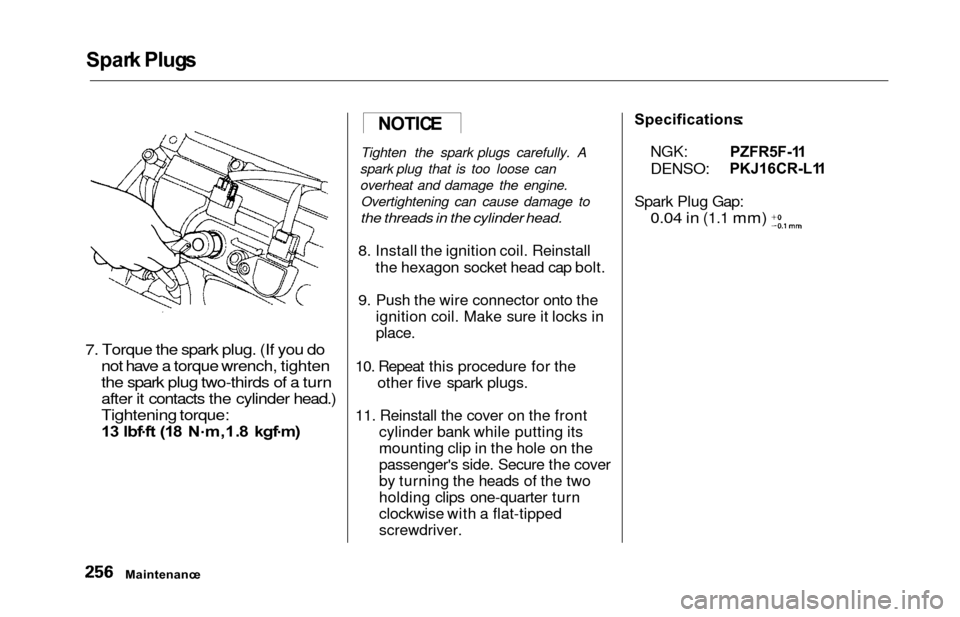
7. Torque the spark plug. (If you do
not have a torque wrench, tighten
the spark plug two-thirds of a turn
after it contacts the cylinder head.)
Tightening torque:
13 lbf .
f t (1 8 N .
m,1. 8 kgf .
m )
Tighten the spark plugs carefully. A
spark plug that is too loose can
overheat and damage the engine. Overtightening can cause damage to
the threads in the cylinder head.
8. Install the ignition coil. Reinstall the hexagon socket head cap bolt.
9. Push the wire connector onto the ignition coil. Make sure it locks in
place.
10. Repeat this procedure for the other five spark plugs.
11. Reinstall the cover on the front cylinder bank while putting its
mounting clip in the hole on the
passenger's side. Secure the cover
by turning the heads of the two
holding clips one-quarter turn
clockwise with a flat-tipped
screwdriver.
Specifications :
NGK:
DENSO:
PZFR5F-11
PKJ16CR-L1 1
Spark Plug Gap:
0.04 in (1.1 mm)
Maintenance
NOTICE