Page 229 of 352
Maintenance Safet y
Regularly maintaining your vehicle is
the best way to protect your investment. Proper maintenance is
essential to your safety and the
safety of your passengers. It will also
reward you with more economical,
trouble-free driving and help reduce air pollution. This section includes instructions for
simple maintenance tasks, such as
checking and adding oil. Any service
items not detailed in this section
should be performed by a Honda
technician or other qualified mechanic. Some of the most important safety
precautions are given here. However,
we cannot warn you of every conceivable hazard that can arise in
performing maintenance. Only you
can decide whether or not youshould perform a given task.
Maintenanc e
Improperly maintaining this
vehicle or failing to correct a problem before driving can
cause a crash in which you can be seriously hurt or killed.
Always follow the inspection
and maintenance recommendations and
schedules in this owner's manual. Failure to properly follow
maintenance instructions and
precautions can cause you to
be seriously hurt or killed.
Always follow the procedures
and precautions in this owner's manual.
Page 230 of 352
Maintenance Safet y
Importan t Safet y Precaution s
Before you begin any maintenance,
make sure your vehicle is parked on
level ground and that the parking
brake is set. Also, be sure the engine is off. This will help to eliminate several potential hazards:
Carbo n monoxid e poisonin g
from engin e exhaust . Be sure
there is adequate ventilation
whenever you operate the engine.
Burn s fro m ho t parts . Let the
engine and exhaust system cool
before touching any parts.
Injur y fro m movin g parts . D o
not run the engine unless in- structed to do so. Read the instructions before you
begin, and make sure you have the tools and skills required.
To reduce the possibility of fire or explosion, be careful when workingaround gasoline or batteries. Use a
commercially available degreaser or
parts cleaner, not gasoline, to clean
parts. Keep cigarettes, sparks, and
flames away from the battery and all
fuel-related parts.
You should wear eye protection and protective clothing when working
near the battery or when using
compressed air.
Maintenanc e
Page 231 of 352
Maintenance Schedul e
The Maintenance Schedule specifies
how often you should have your
vehicle serviced and what things
need attention. It is essential that
you have your vehicle serviced as
scheduled to retain its high level of
safety, dependability, and emissions
control performance.
The services and time or distance
intervals shown in the maintenance
schedule assume you will use your
vehicle as normal transportation for
passengers and their possessions.
You should also follow these
recommendations:
Avoid exceeding your vehicle's
load limit. This puts excess stress
on the engine, brakes, and many
other parts of your vehicle. The
load limit is shown on the tire
information label on the driver's
doorjamb.Operate your vehicle on
reasonable roads within the legal
speed limit.
Drive your vehicle regularly over a
distance of several miles
(kilometers).
Always use unleaded gasoline with the proper octane rating (see page
188). Whic
h Schedul e t o Follow :
Service your vehicle according to the
time and mileage periods on one of
the Maintenance Schedules on the
following pages. Select the schedule
for "Severe Conditions" if most of
your driving is done under one or more of the conditions listed on that
page. Otherwise, follow the schedule
for "Normal Conditions."
Maintenanc e
Page 232 of 352

Maintenance Schedul e
Your authorized Honda dealer
knows your vehicle best and can
provide competent, efficient service.
However, service at a dealer is not
mandatory to keep your warranties
in effect. Maintenance may be done
by any qualified service facility or
person who is skilled in this type of automotive service. Keep all the
receipts as proof of completion, and
have the person who does the work
fill out the Maintenance Record. Check your warranty booklet for
more information. We recommend the use of Genuine
Honda parts and fluids whenever you
have maintenance done. These are
manufactured to the same high- quality standards as the original
components, so you can be confident
of their performance and durability.
U.S. Vehicles:
Maintenance , replacemen t o r
repai r o f emission s contro l
device s an d system s ma y b e don e
b y an y automotiv e repai r
establishmen t o r individua l usin g
part s tha t ar e "certified " t o EP A
standards . According to state and federal
regulations, failure to perform
maintenance on the items marked
with
# will not void your emissions
warranties. However, Honda recommends that all maintenance services be performed at the
recommended time or mileage
period to ensure long-term reliability.
Maintenanc e
Page 233 of 352
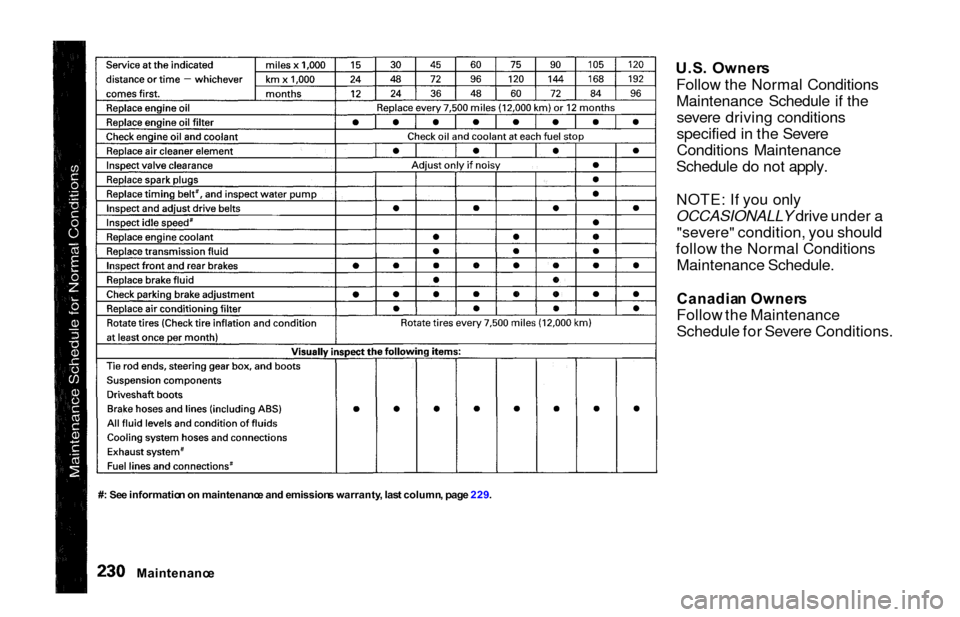
U.S. Owner s
Follow the Normal Conditions
Maintenance Schedule if the severe driving conditions
specified in the Severe
Conditions Maintenance
Schedule do not apply.
NOTE: If you only
OCCASIONALLY drive under a "severe" condition, you should
follow the Normal Conditions Maintenance Schedule.
Canadia n Owner s
Follow the Maintenance
Schedule for Severe Conditions.
#: Se e informatio n o n maintenanc e an d emission s warranty , las t column , pag e 229 .
Maintenanc e
Page 234 of 352
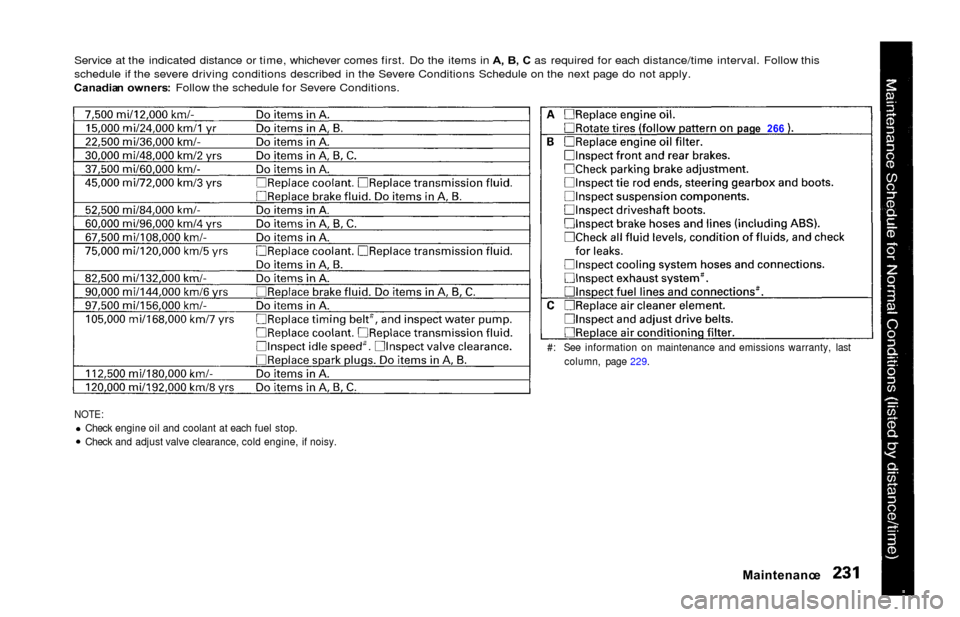
Service at the indicated distance or time, whichever comes first. Do the items in A, B , C as required for each distance/time interval. Follow this
schedule if the severe driving conditions described in the Severe Conditions Schedule on the next page do not apply.
Canadia n owners : Follow the schedule for Severe Conditions.
NOTE:Check engine oil and coolant at each fuel stop.
Check and adjust valve clearance, cold engine, if noisy.
Maintenanc e
#: See information on maintenance and emissions warranty, last
column, page 229. pag
e 26 6
Page 235 of 352
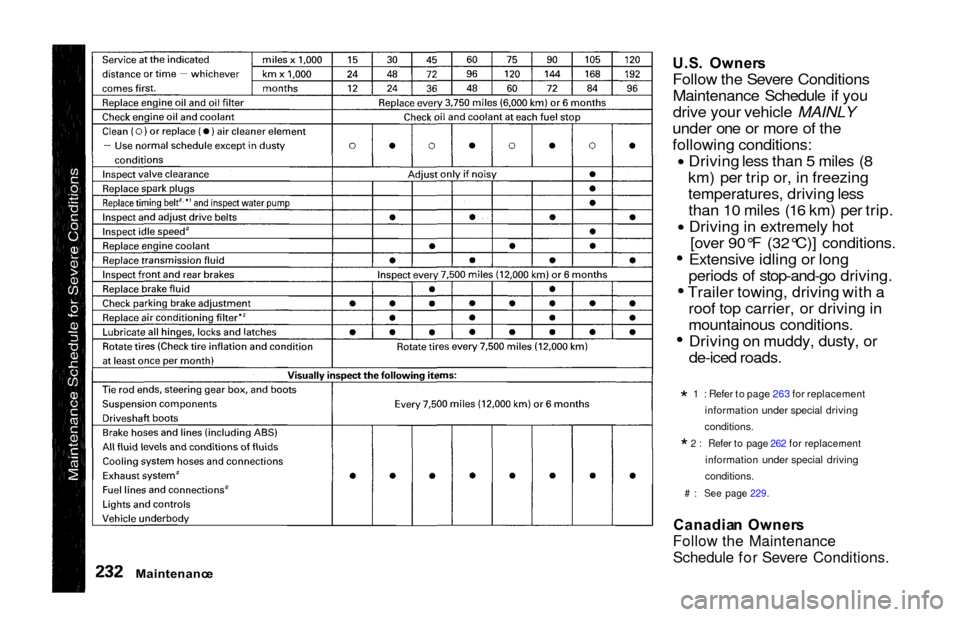
U.S. Owner s
Follow the Severe Conditions
Maintenance Schedule if you
drive your vehicle MAINLY
under one or more of the
following conditions: Driving less than 5 miles (8
km) per trip or, in freezing
temperatures, driving less than 10 miles (16 km) per trip.Driving in extremely hot [over 90°F (32°C)] conditions.
Extensive idling or long
periods of stop-and-go driving.
Trailer towing, driving with a roof top carrier, or driving in
mountainous conditions.Driving on muddy, dusty, or
de-iced roads.
*1: Refer to page 263 for replacement
information under special driving
conditions.
*2: Refer to page 262 for replacement
information under special driving
conditions.
# : See page 229.
Canadia n Owner s
Follow the Maintenance
Schedule for Severe Conditions.
Maintenanc e
Page 237 of 352
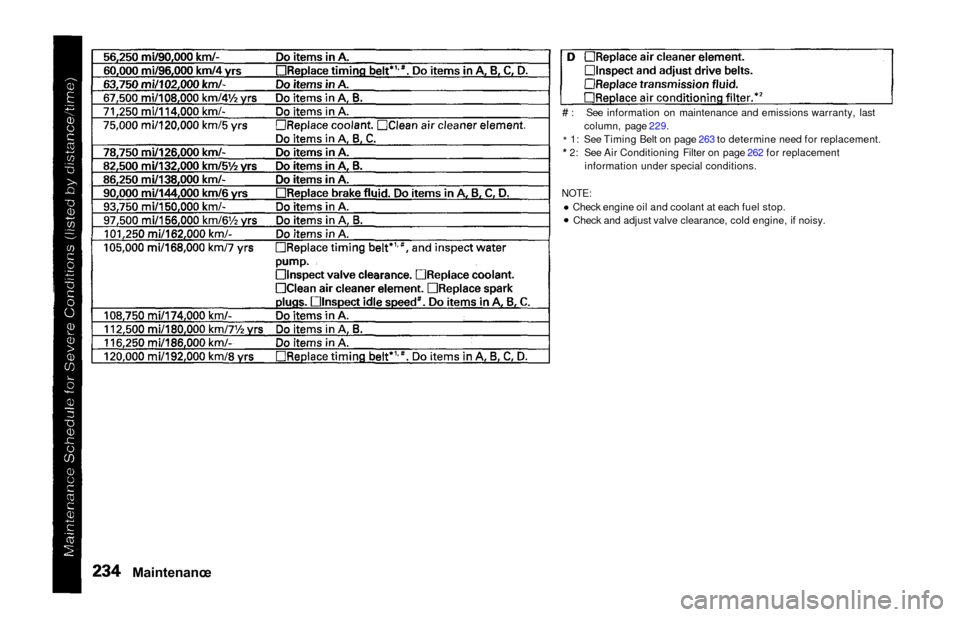
# : See information on maintenance and emissions warranty, lastcolumn, page 229.
* 1: See Timing Belt on page 263 to determine need for replacement.
* 2: See Air Conditioning Filter on page 262 for replacement
information under special conditions.
NOTE:Check engine oil and coolant at each fuel stop.Check and adjust valve clearance, cold engine, if noisy.
Maintenanc e