Page 113 of 352
Seats
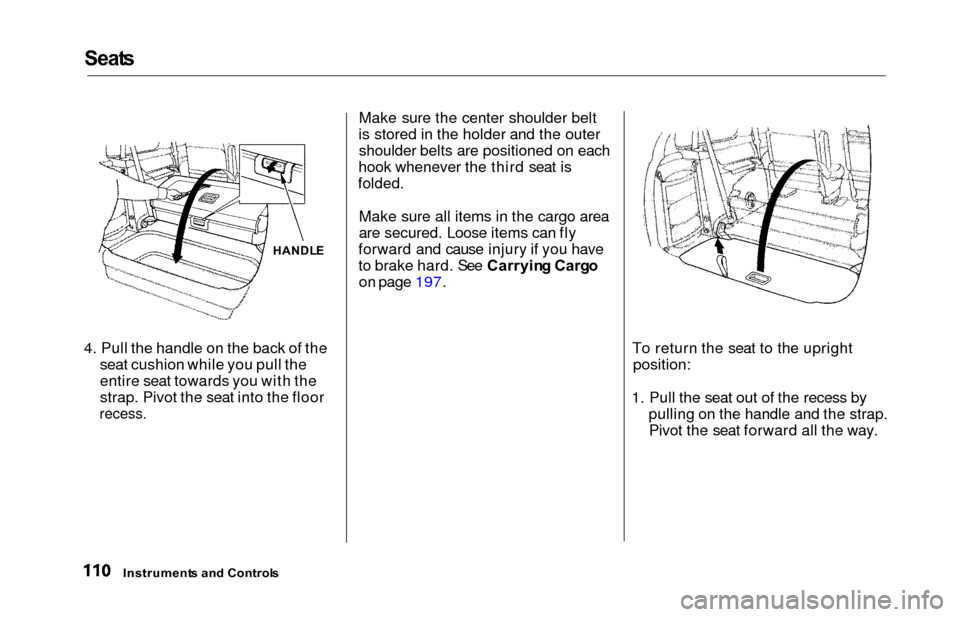
4. Pull the handle on the back of the
seat cushion while you pull the
entire seat towards you with the
strap. Pivot the seat into the floor
recess.
Make sure the center shoulder belt
is stored in the holder and the outer shoulder belts are positioned on each
hook whenever the third seat is
folded.
Make sure all items in the cargo area
are secured. Loose items can fly
forward and cause injury if you have
to brake hard. See Carryin g Carg o
on page 197.
To return the seat to the uprightposition:
1. Pull the seat out of the recess by pulling on the handle and the strap.Pivot the seat forward all the way.
Instrument s an d Control s
HANDLE
Page 114 of 352
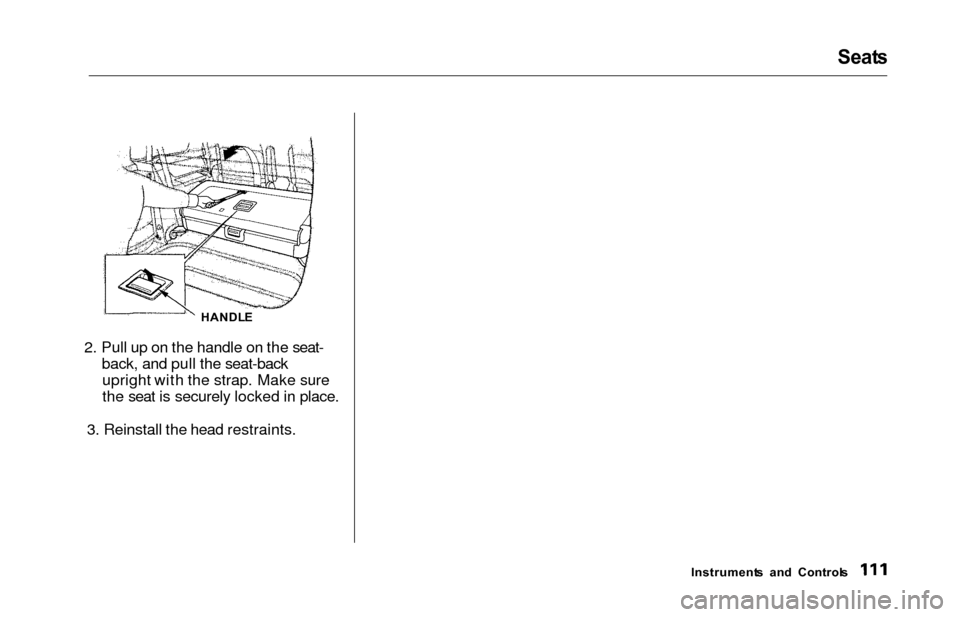
2. Pull up on the handle on the seat-back, and pull the seat-backupright with the strap. Make sure
the seat is securely locked in place.
3. Reinstall the head restraints.
Seat s
Instrument s an d Control s
HANDL
E
Page 194 of 352
Servic
e Statio n Procedure s
If you can open the hood without
lifting the hood latch handle, or the
hood latch handle moves stiffly or does not spring back as before, the
mechanism should be cleaned and
lubricated (see page 254).
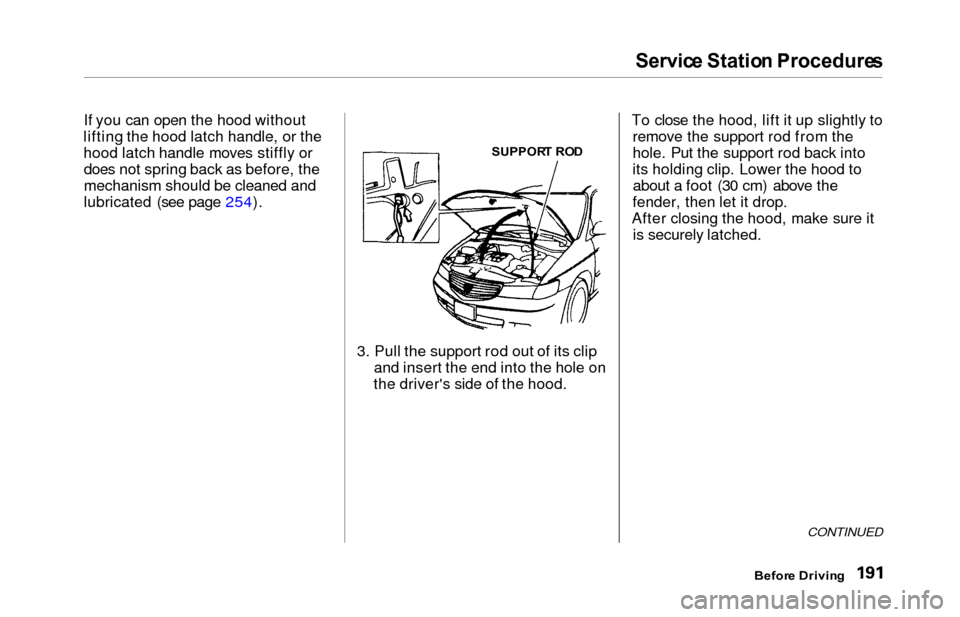
SUPPOR
T RO D
3. Pull the support rod out of its clip and insert the end into the hole on
the driver's side of the hood. To close the hood, lift it up slightly to
remove the support rod from the
hole. Put the support rod back into
its holding clip. Lower the hood toabout a foot (30 cm) above the
fender, then let it drop.
After closing the hood, make sure it is securely latched.
CONTINUED
Befor e Drivin g
Page 201 of 352
Carrying Carg o
Load Limi t
The maximum load for your vehicle
is 1,277 Ibs (580 kg).
This figure includes the total weight
of all occupants, cargo, accessories,
and the tongue weight if you are
towing a trailer.
To figure out how much cargo you
can carry:
Add up the weight of all occupants.
If you are towing a trailer, add the
tongue weight to the number
above.
Subtract the total from 1,277 Ibs
(580 kg).
The final number is the total weight
of cargo you can carry.
When you load luggage, the total
weight of the vehicle, all passengers, cargo, and trailer tongue load must
not exceed the Gross Vehicle
Weight Rating (GVWR). The load for the front and rear axles also must not exceed the Gross Axle Weight
Rating (GAWR). The GVWR andGAWR are printed on the tire
information label attached to the
driver's doorjamb (see page 322). Carryin
g Item s i n th e Passenge r
Compartmen t
Store or secure all items that could
be thrown around and hurt someone during a crash.
Be sure items placed on the floor
behind the front seats cannot roll
under the seats and interfere with the driver's ability to operate the
pedals, or with the properoperation of the seats.
Keep the glove box closed while
driving. If the lid is open, a
passenger could injure their knees during a crash or sudden stop.
Befor e Drivin g
Overloading or improper
loading can affect handling and
stability and cause a crash in
which you can be hurt or killed.
Follow all load limits and other
loading guidelines in this
manual.
Page 202 of 352
Carrying Carg o
Carryin g Carg o in th e Carg o Are a
o r o n a Roo f Rac k
Distribute cargo evenly on the
floor of the cargo area, placing the heaviest items on the bottom and as far forward as possible. Tie
down items that could be thrown
about the vehicle during a crash or
sudden stop.
If you carry large items that
prevent you from closing the
tailgate, exhaust gas can enter the
passenger area. To avoid thepossibility of carbo n monoxid e
poisoning , follow the instructions
on page 53 .
If you can carry any items on a
roof rack, be sure the total weight of the rack and the items on it
does not exceed 150 Ib.
If you use an accessory roof rack,
the roof rack weight limit may be
lower. Refer to the information that came with your roof rack. Sid
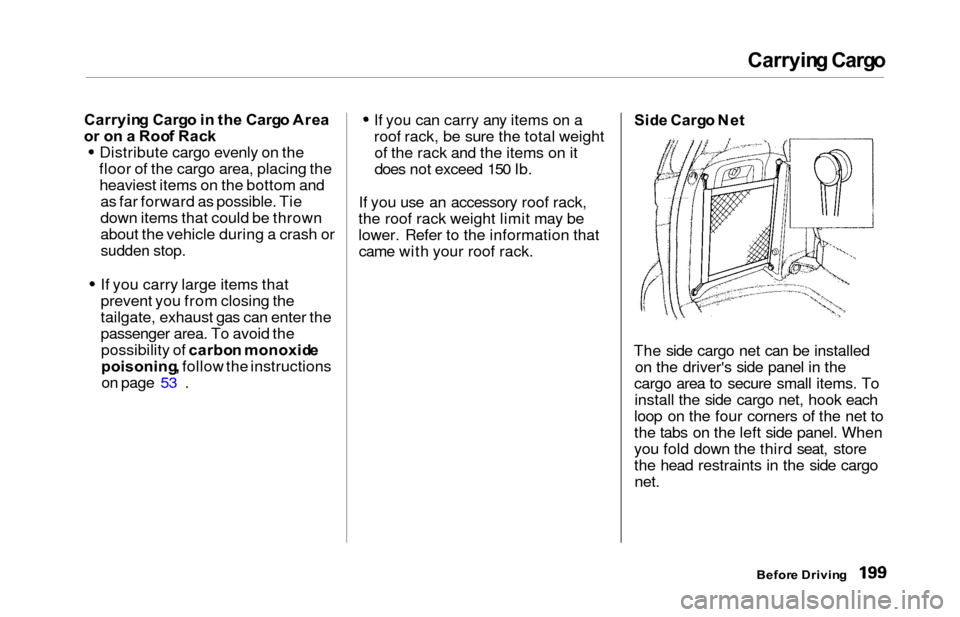
e Carg o Ne t
The side cargo net can be installed on the driver's side panel in the
cargo area to secure small items. To install the side cargo net, hook each
loop on the four corners of the net to
the tabs on the left side panel. When
you fold down the third seat, store
the head restraints in the side cargo net.
Befor e Drivin g
Page 203 of 352
Carrying Carg o
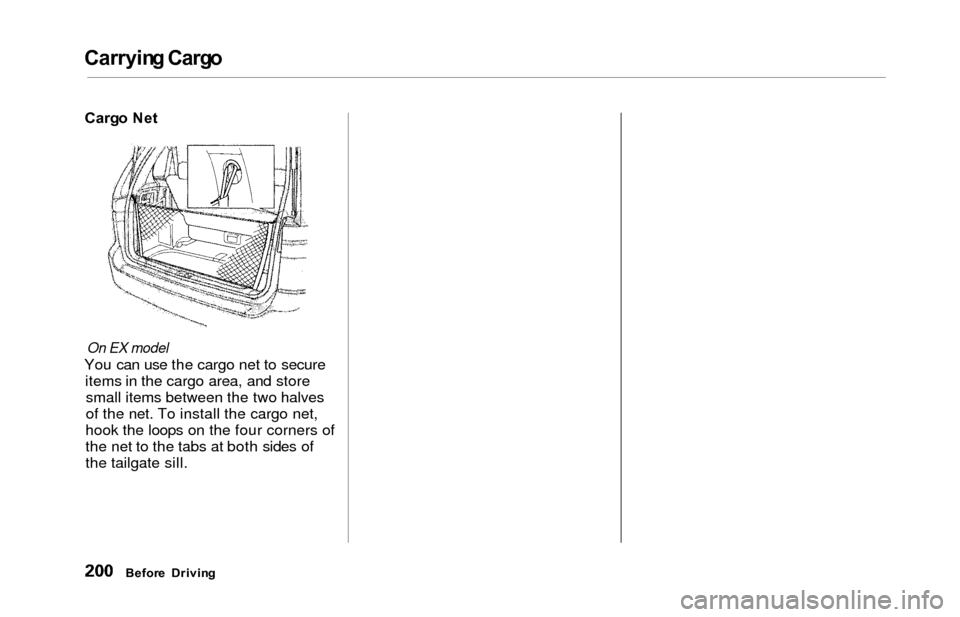
On EX model
You can use the cargo net to secure
items in the cargo area, and storesmall items between the two halves
of the net. To install the cargo net,
hook the loops on the four corners of
the net to the tabs at both sides of
the tailgate sill.
Befor e Drivin g
Cargo Ne t
Page 205 of 352
Preparing to Driv e
You should do the following checks
and adjustments every day before
you drive your vehicle.
1. Make sure all windows, mirrors, and outside lights are clean and
unobstructed. Remove frost, snow,or ice.
2. Check that the hood and tailgate are fully closed.
3. Visually check the tires. If a tire looks low, use a gauge to check its
pressure.
4. Check that any items you may be carrying with you inside are stored
properly or fastened down
securely.
5. Check the adjustment of the seat
(see page 100).
6. Check the adjustment of the inside and outside mirrors (see
page 115).
7. Check the adjustment of the steering wheel (see page 72).
8. Make sure the doors and tailgate are securely closed and locked.
9. Fasten your seat belt. Check that your passengers have fastenedtheir seat belts (see page 15). 10. Turn the ignition switch ON (II).
Check the indicator lights in the
instrument panel.
11. Start the engine (see page 203).
12. Check the gauges and indicator lights in the instrument panel (see
page 57).
Drivin g
Page 223 of 352
Towing a Traile r
Towin g Equipmen t an d
Accessorie s
Towing can require a variety of equipment, depending on the size of
your trailer, how it will be used, and how much load you are towing.
Discuss your needs with your trailer
sales or rental agency, and follow the
guidelines in the rest of this section.
Also make sure that all equipment is properly installed and that it meets
federal, state, province, and local
regulations.
Hitches
Any hitch used on your vehicle mustbe properly bolted to the underbody, using the six threaded holes
provided. A hitch designed especially
for your Odyssey can be obtained
from your Honda dealer.
Weight Distributing Hitch
If the total trailer weight is more
than 2,000 Ibs (900 kg), you must
also use a weight distributing hitch.
This device transfers weight from the vehicle's rear wheels to the front
wheels, and to the trailer's wheels. Carefully follow the hitch maker's
instructions for proper installation
and adjustment.
Safety Chain
Always use a safety chain. Make sure that it is secured to both the
trailer and hitch, and that it crosses under the tongue so it can catch the
trailer if it becomes unhitched. Leave enough slack to allow the
trailer to turn corners easily, but do not let the chain drag on the ground.
Sway Control
If the total trailer weight exceeds
2,000 Ibs (900 kg), you should install
a sway control device to minimize swaying that can occur in crosswinds
and in normal and emergency
driving maneuvers. Your trailer
maker can tell you what kind of sway
control you need and how to install it.
Transmission Fluid Cooler
If the total trailer weight is more
than 2,000 Ibs (900 kg), you must also have a transmission fluid cooler
installed. This device will help
prevent transmission overheating,
which could cause serious damage.
A transmission fluid cooler designed for your Odyssey can be obtained
from your Honda dealer.
Drivin g