2000 HONDA ODYSSEY ABS
[x] Cancel search: ABSPage 280 of 352
Lights
6. Put the socket back into the light
assembly and turn it clockwise to
lock it in place.
7. Test the light to make sure the new bulb is working.
8. Put the light assembly back into the tailgate. Install the screw and
tighten it securely. Reinstall the
lens piece.
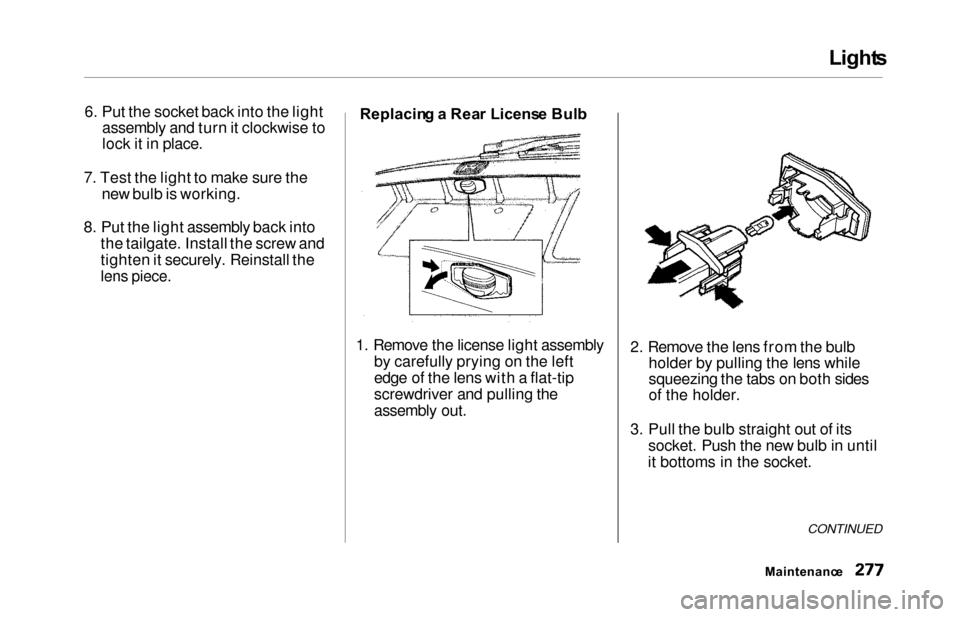
Replacin g a Rea r Licens e Bul b
1. Remove the license light assembly by carefully prying on the left
edge of the lens with a flat-tip
screwdriver and pulling the
assembly out. 2. Remove the lens from the bulb
holder by pulling the lens while
squeezing the tabs on both sides
of the holder.
3. Pull the bulb straight out of its socket. Push the new bulb in until
it bottoms in the socket.
CONTINUED
Maintenanc e
Page 282 of 352
Lights
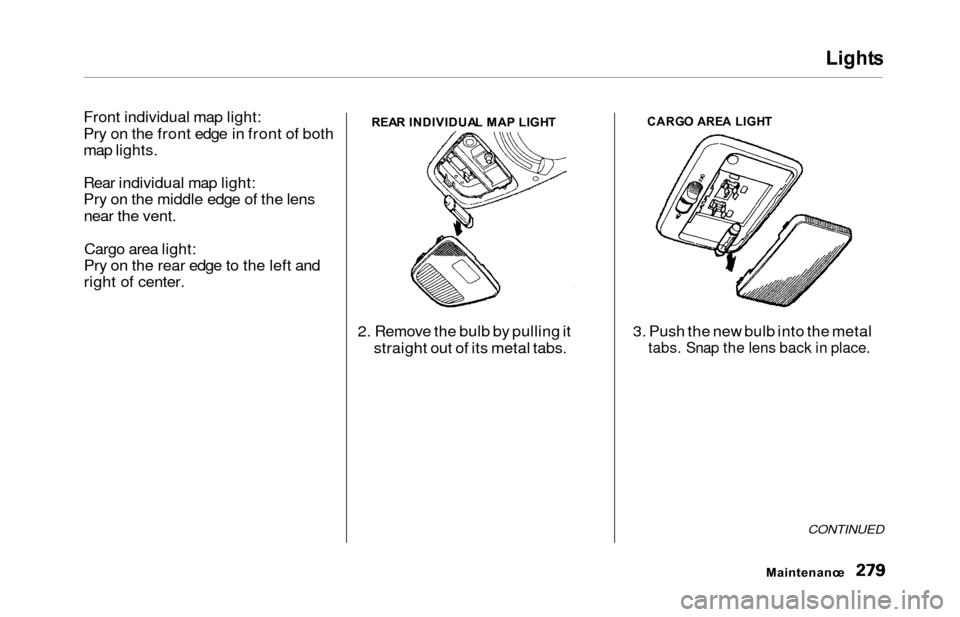
Front individual map light:
Pry on the front edge in front of both
map lights.
Rear individual map light:
Pry on the middle edge of the lens
near the vent.
Cargo area light:
Pry on the rear edge to the left and
right of center.REA R INDIVIDUA L MA P LIGH T
2. Remove the bulb by pulling it
straight out of its metal tabs.
CARG O ARE A LIGH T
3. Push the new bulb into the metal
tabs. Snap the lens back in place.
CONTINUED
Maintenanc e
Page 291 of 352
Corrosion Protectio n
Two factors normally contribute to
causing corrosion in your vehicle:
1. Moisture trapped in body cavities. Dirt and road salt that collects in
hollows on the underside of the
vehicle stays damp, promoting corrosion in that area.
2. Removal of paint and protective coatings from the exterior and
underside of the vehicle. Many corrosion-preventive measures
are built into your Honda. You can
help keep your vehicle from corroding by performing somesimple periodic maintenance:
Repair chips and scratches in the
paint as soon as you discover them.
Inspect and clean out the drain
holes in the bottom of the doors and body.
Check the floor coverings fordampness. Carpeting and floor
mats may remain damp for a long
time, especially in winter. This dampness can eventually cause
the floor panels to corrode. Use a high-pressure spray to clean
the underside of your vehicle. This
is especially important in areas
that use road salt in winter. It is also a good idea in humid climates
and areas subject to salt air. Be
careful of the ABS wheel sensors
and wiring at each wheel.
Have the corrosion-preventive
coatings on the underside of your
vehicle inspected and repaired periodically.
Appearanc e Car e
Page 313 of 352
Brake Syste m Indicato r
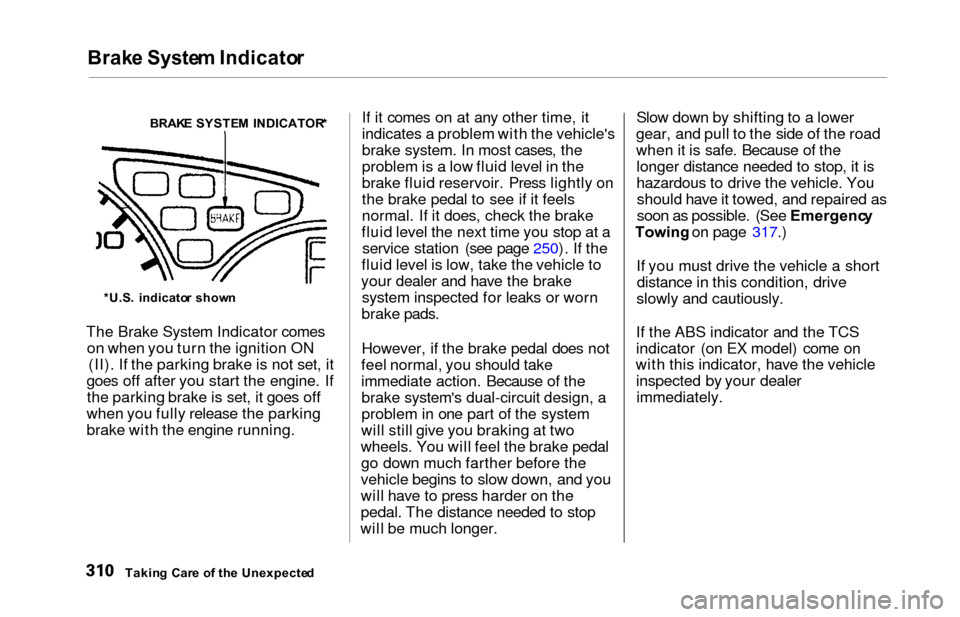
The Brake System Indicator comes
on when you turn the ignition ON (II). If the parking brake is not set, it
goes off after you start the engine. If the parking brake is set, it goes off
when you fully release the parking
brake with the engine running. If it comes on at any other time, it
indicates a problem with the vehicle's
brake system. In most cases, the
problem is a low fluid level in the
brake fluid reservoir. Press lightly on
the brake pedal to see if it feels
normal. If it does, check the brake
fluid level the next time you stop at a service station (see page 250). If the
fluid level is low, take the vehicle to
your dealer and have the brake system inspected for leaks or worn
brake pads.
However, if the brake pedal does not
feel normal, you should take
immediate action. Because of the brake system's dual-circuit design, a
problem in one part of the system
will still give you braking at two
wheels. You will feel the brake pedal go down much farther before the
vehicle begins to slow down, and you
will have to press harder on the
pedal. The distance needed to stop
will be much longer. Slow down by shifting to a lower
gear, and pull to the side of the road
when it is safe. Because of the longer distance needed to stop, it is
hazardous to drive the vehicle. Youshould have it towed, and repaired as
soon as possible. (See Emergenc y
Towing on page 317.)
If you must drive the vehicle a short distance in this condition, drive
slowly and cautiously.
If the ABS indicator and the TCS
indicator (on EX model) come on
with this indicator, have the vehicle inspected by your dealerimmediately.
Takin g Car e o f th e Unexpecte d
BRAK
E SYSTE M INDICATOR *
*U.S . indicato r show n
Page 315 of 352
Fuses
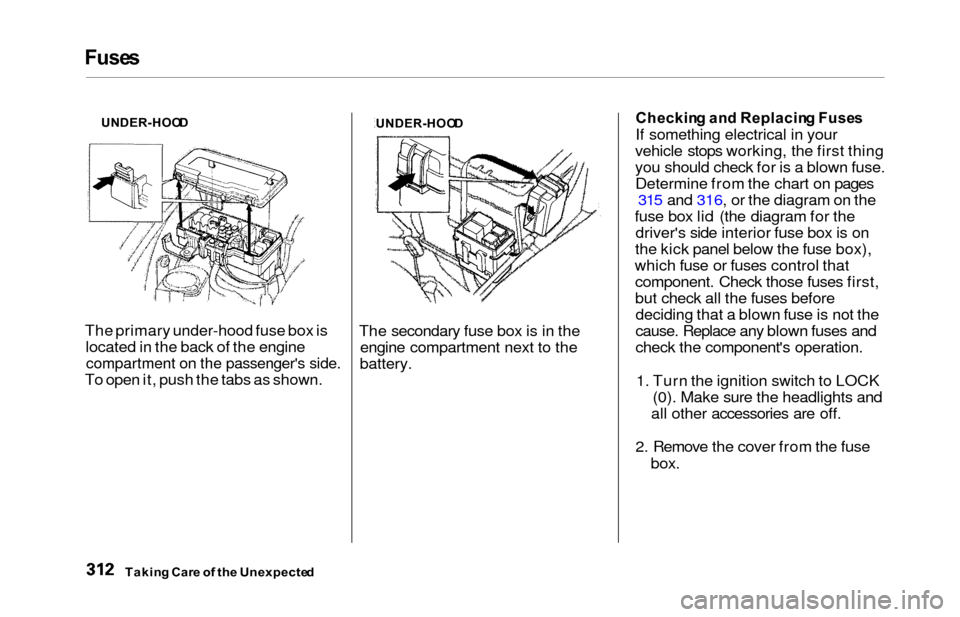
The primary under-hood fuse box is
located in the back of the engine
compartment on the passenger's side.
To open it, push the tabs as shown. The secondary fuse box is in the
engine compartment next to the
battery.
Checkin g an d Replacin g Fuse s
If something electrical in your
vehicle stops working, the first thing
you should check for is a blown fuse. Determine from the chart on pages 315 and 316, or the diagram on the
fuse box lid (the diagram for the driver's side interior fuse box is on
the kick panel below the fuse box),
which fuse or fuses control that component. Check those fuses first,
but check all the fuses beforedeciding that a blown fuse is not the
cause. Replace any blown fuses and
check the component's operation.
1. Turn the ignition switch to LOCK (0). Make sure the headlights and
all other accessories are off.
2. Remove the cover from the fuse box.
Takin g Car e o f th e Unexpecte d
UNDER-HOO D
UNDER-HOOD
Page 342 of 352
Index
Accessories and Modifications.... 195
Accessories................................. 195
Additional Safety Precaution.... 196
Modifications............................. 196
ACCESSORY (Ignition Key Position)........................................ 79
Accessory Power Sockets............. 124
Adding Automatic Transmission
Fluid........................................ 249
Brake Fluid................................. 250
Engine Coolant........................... 243
Engine Oil.................................. 239
Power Steering Fluid................. 251
Windshield Washer Fluid......... 248
Additional Information About
Your Seat Belts........................ 45
Lap/Shoulder Belt....................... 45
Seat Belt Maintenance................ 47
Seat Belt System Components... 45
Additional Information About
Your SRS ................................
48
Additional Safet
y Precautions.... 52
How the Automatic Seat Belt
Tensioners Work..................... 50
How the SRS Indicator
Works........................................ 50
How Your Airbags Work............ 48
SRS Components......................... 48
Additives, Engine Oil..................... 24 1
Adjustments Head Restraints......................... 104
Mirrors........................................ 115
Seats............................................ 100
Steering Wheel............................ 72
Airbag (SRS)............................... 9, 4 9
Air Cleaner Element...................... 252
Air Conditioning Filter.................. 262
Air Conditioning System....... 130, 138
Maintenance............................... 261
Rear A/C Control...................... 152
Usage................................. 130, 138
Air Outlets (Vents)............... 132, 138
Air Pressure, Tires........................ 263
Alcohol in Gasoline........................ 326
Aluminum Wheels, Cleaning........ 285
Antifreeze....................................... 243
Anti-lock Brakes (ABS)
Indicator Light..................... 59 , 212Operation.................................... 211
Anti-theft, Audio System............... 186
Anti-theft Steering Column Lock.. 78
Appearance Care........................... 283
Armrests........................................ . 103
Audio Controls, Remote................ 185
Audio System........................ 155, 167
Automatic Seat Belt Tensioners.... 50
Automatic Lighting Off Feature.... 67
Automatic Speed Control................ 73
Automatic Transmission............... 204
Capacity, Fluid........................... 322
Checking Fluid Level................ 249
Shifting........................................ 205
Shift Lever Position Indicator.. 204
Shift Lever Positions................. 205
Shift Lock Release..................... 208CONTINUED
Page 343 of 352
Index
Battery
Charging SystemIndicator............................ 58, 308
Jump Starting............................. 303
Maintenance............................... 257
Specifications............................. 323
Before Driving.............................. . 187
Belts, Seat.................................... . 8, 4 5
Beverage Holder............................ 118
Body Repair.................................... 289
Brakes Anti-lock System (ABS)............
211
Break-in, Ne
w Linings .............. 188
Fluid............................................ 250
Light, Burned-out...................... 274
Parking........................................ 116
System Indicator.................. 58, 310
Wear Indicators......................... 210
Brakes, ABS Operation................................... . 211
System Indicator.................. 59, 212
Braking System............................. . 210
Break-in, New Vehicle .................. 188
Brightness Control, Instruments...
67 Brights, Headlights......................... 66
Bulb Replacement
Back-up Lights........................... 275
Brake Lights............................... 274
Cargo Area Light....................... 278
Front Parking Lights................. 273
Front Side Marker Lights......... 273 Headlights.................................. 272
High-mount Brake Light.......... 276
Individual Map Lights............... 278
License Plate Light.................... 277
Rear Bulbs.......................... 274, 275
Specifications............................. 323
Turn Signal Lights..................... 273
Bulbs, Halogen............................... 272
Cables, Jump Starting With.......... 304
Cancel Button.................................. . 75
Capacities Chart............................. 322
Carbon Monoxide Hazard............. . 53
Cargo Area Light........................... 127
Cargo Net ...................................... 200
Carrying Cargo.............................. 197
Cassette Player
Care............................................. 184
Operation........................... 160, 181
CAUTION, Explanation of............... ii
CD Changer.......................... 163, 177
CD Player.............................. 163, 175
Center Pocket .............................. . 122
Center Table................................... 117
Certification Label......................... 320
Chains............................................. 269
Change Oil How to ......................................
241
When to ....................................
230
Changing a Flat Tire ..................... 293
Changing Engine Coolant............. 245 Charging System Indicator.... 58, 308
Checking Automatic Transmission Fluid....................................... . 249
Battery Condition...................... 257
Brake Fluid................................ . 250
Drive Belts.................................. 262
Engine Coolant........................... 193
Engine Oil................................... 192
Fuses.......................................... 312
Power Steering Fluid................. 251