2000 HONDA ODYSSEY rear
[x] Cancel search: rearPage 31 of 352
Protecting Childre n
Placing a Child Seat
This page briefly summarizes
Honda's recommendations on where
to place rear-facing and forward-
facing child seats in your vehicle.
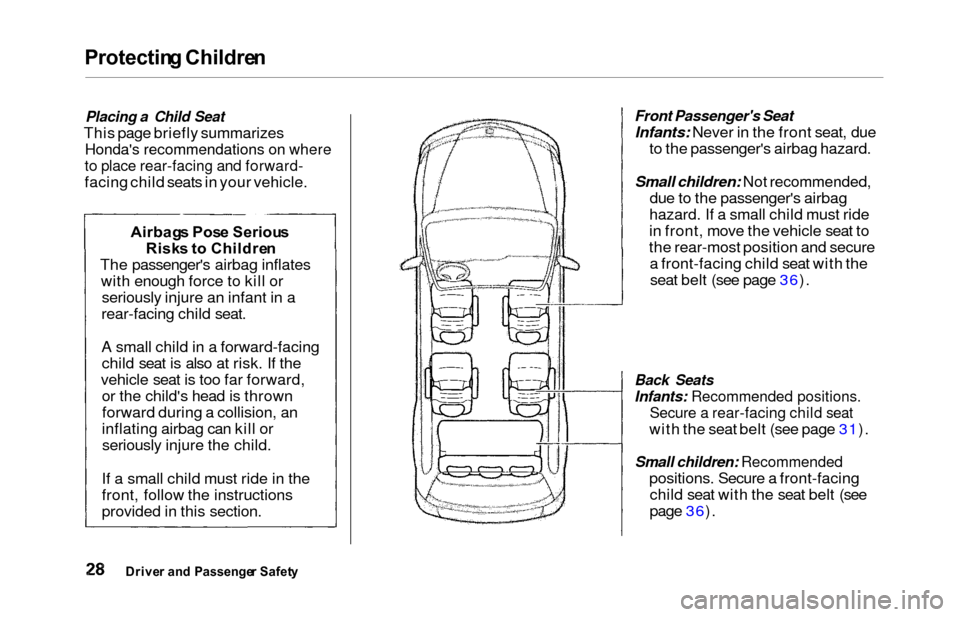
Front Passenger's Seat
Infants: Never in the front seat, due
to the passenger's airbag hazard.
Small children: Not recommended,
due to the passenger's airbag
hazard. If a small child must ride
in front, move the vehicle seat to
the rear-most position and secure a front-facing child seat with theseat belt (see page 36).
Back Seats
Infants: Recommended positions.
Secure a rear-facing child seat
with the seat belt (see page 31).
Small children: Recommended
positions. Secure a front-facingchild seat with the seat belt (see
page 36).
Drive r an d Passenge r Safet y
Airbag s Pos e Seriou s
Risk s t o Childre n
The passenger's airbag inflates with enough force to kill orseriously injure an infant in a
rear-facing child seat.
A small child in a forward-facing child seat is also at risk. If the
vehicle seat is too far forward, or the child's head is thrownforward during a collision, an
inflating airbag can kill or seriously injure the child.
If a small child must ride in the
front, follow the instructions
provided in this section.
Page 33 of 352
Protectin
g Childre n
Protectin g Infant sChild Seat Type
Only a
rear-facing child seat provides
proper support for a baby's head, neck, and back. Infants up to about
one year of age must be restrained in
a rear-facing child seat.
Two types of seats may be used: a seat designed exclusively for infants,
or a convertible seat used in the rear-
facing, reclining mode. We recommend that an infant be
restrained in a rear-facing child seat
until the infant reaches the seat
maker's weight or height limit and isable to sit up without support.
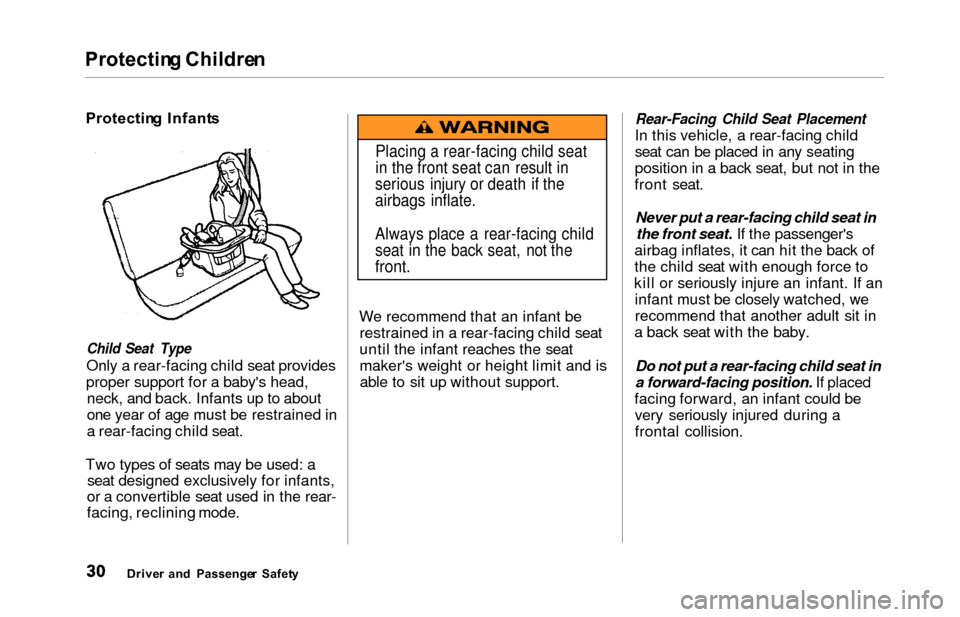
Rear-Facing Child Seat Placement
In thi
s vehicle, a rear-facing child
seat can be placed in any seating
position in a back seat, but not in the
front seat.
Never put a rear-facing child seat in
the front seat. If the passenger's
airbag inflates, it can hit the back of
the child seat with enough force to
kill or seriously injure an infant. If an infant must be closely watched, we
recommend that another adult sit in
a back seat with the baby.
Do not put a rear-facing child seat in
a forward-facing position. If placed
facing forward, an infant could be very seriously injured during a
frontal collision.
Drive r an d Passenge r Safet y
Placing a rear-facing child seat
in the front seat can result in
serious injury or death if the
airbags inflate.
Always place a rear-facing child
seat in the back seat, not the
front.
Page 34 of 352
Protecting Childre n
Installing a Rear-Facing Child Seat
with a Lap/Shoulder Belt
The lap/shoulder belts in the outer
back seats have a lockingmechanism that must be activated tosecure a child seat.
The following pages provide instructions on how to secure a rear-
facing child seat with this type of seat belt.
See page 33 for how to secure a rear-
facing child seat in the center position on the third seat with the lap
part of the lap/shoulder belt.
For tips on installing a rear-facingchild seat with either type of seat
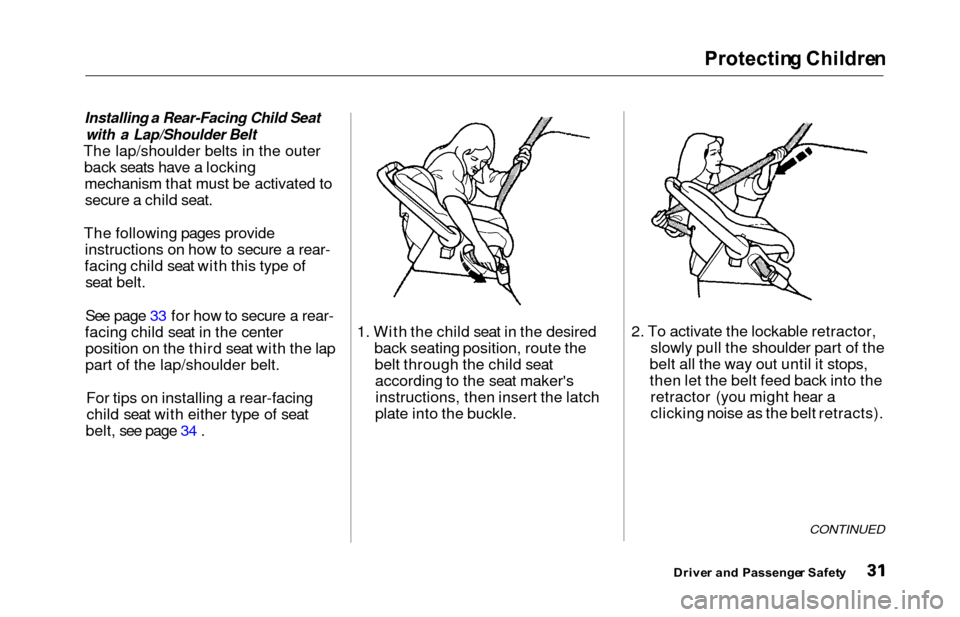
belt, see page 34 . 1. With the child seat in the desired
back seating position, route thebelt through the child seataccording to the seat maker'sinstructions, then insert the latch
plate into the buckle. 2. To activate the lockable retractor,
slowly pull the shoulder part of the
belt all the way out until it stops,
then let the belt feed back into the retractor (you might hear a
clicking noise as the belt retracts).
CONTINUED
Drive r an d Passenge r Safet y
Page 36 of 352
Protecting Childre n
To deactivate the locking
mechanism and remove a child seat,
unlatch the buckle, unroute the seat
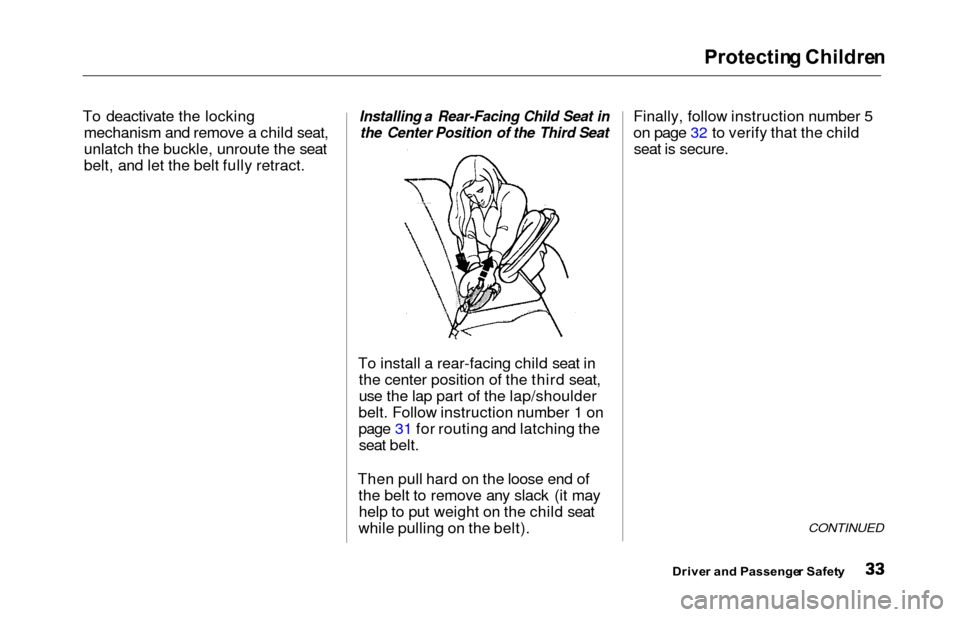
belt, and let the belt fully retract.Installing a Rear-Facing Child Seat in
the Center Position of the Third Seat
To install a rear-facing child seat inthe center position of the third seat,
use the lap part of the lap/shoulder
belt. Follow instruction number 1 on
page 31 for routing and latching the seat belt.
Then pull hard on the loose end of the belt to remove any slack (it mayhelp to put weight on the child seat
while pulling on the belt). Finally, follow instruction number 5
on page 32 to verify that the child
seat is secure.
CONTINUED
Drive r an d Passenge r Safet y
Page 37 of 352
Protecting Childre n
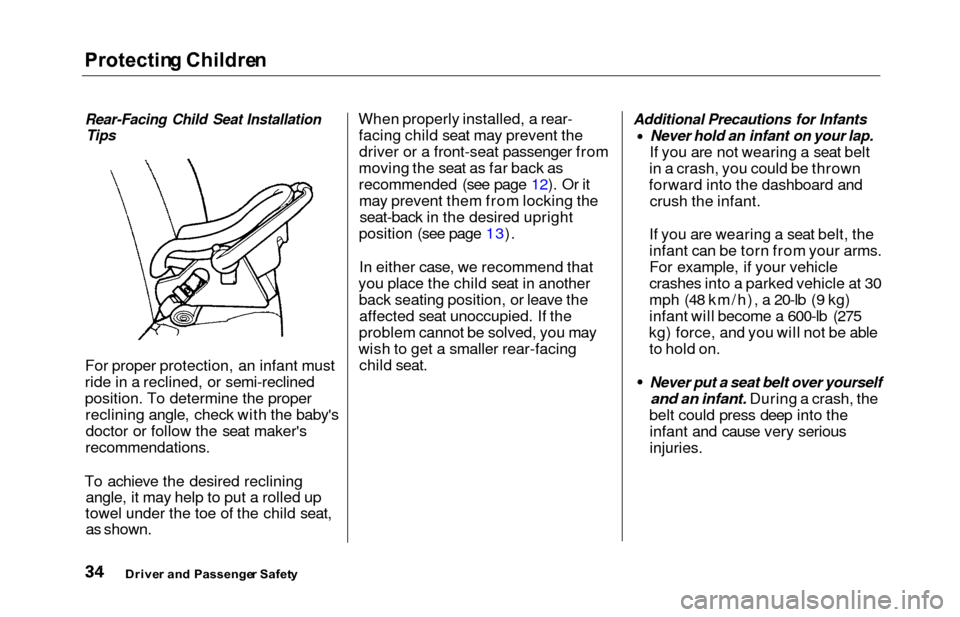
Rear-Facing Child Seat Installation
Tips
For proper protection, an infant must
ride in a reclined, or semi-reclined
position. To determine the proper
reclining angle, check with the baby'sdoctor or follow the seat maker's
recommendations.
To achieve the desired reclining angle, it may help to put a rolled up
towel under the toe of the child seat, as shown. When properly installed, a rear-
facing child seat may prevent thedriver or a front-seat passenger from
moving the seat as far back as
recommended (see page 12). Or it may prevent them from locking theseat-back in the desired upright
position (see page 13).
In either case, we recommend that
you place the child seat in another back seating position, or leave theaffected seat unoccupied. If the
problem cannot be solved, you may
wish to get a smaller rear-facing child seat.
Additional Precautions for Infants
Never hold an infant on your lap.
If you are not wearing a seat belt
in a crash, you could be thrown
forward into the dashboard and crush the infant.
If you are wearing a seat belt, the
infant can be torn from your arms.
For example, if your vehicle
crashes into a parked vehicle at 30
mph (48 km/h), a 20-lb (9 kg)
infant will become a 600-lb (275
kg) force, and you will not be able to hold on.
Never put a seat belt over yourself
and an infant. During a crash, the
belt could press deep into the infant and cause very serious
injuries.
Drive r an d Passenge r Safet y
Page 39 of 352
Protecting Childre n
If it is necessary to put a forward-
facing child seat in the front, move
the vehicle seat as far to the rear as
possible, be sure the child seat is
firmly secured to the vehicle, and thechild is properly strapped in the seat.
Installing a Child Seat with a Lap/ Shoulder Belt
The lap/shoulder belts in the outerback and front passenger seating
positions have a locking mechanism
that must be activated to secure achild seat.
The following pages provide instructions on how to secure a
forward-facing child seat with this type of seat belt.
See page 38 for how to secure a
forward-facing child seat in the center position on the third seat with
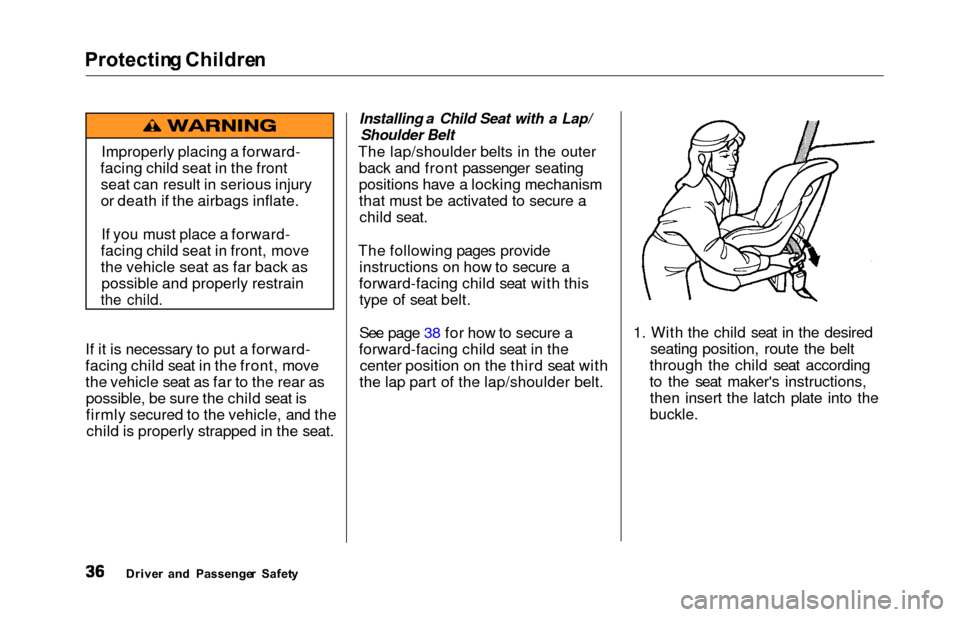
the lap part of the lap/shoulder belt. 1. With the child seat in the desired
seating position, route the belt
through the child seat according
to the seat maker's instructions, then insert the latch plate into the
buckle.
Drive r an d Passenge r Safet y
Improperly placing a forward-
facing child seat in the front seat can result in serious injury
or death if the airbags inflate.
If you must place a forward-
facing child seat in front, move
the vehicle seat as far back as possible and properly restrain
the child.
Page 45 of 352
Protecting Childre n
Physical Size
Physically, a child must be large
enough for the lap/shoulder belt to
properly fit over the hips, chest, and shoulder (see pages 15 and 39). If
the seat belt does not fit properly,
the child should not sit in the front.
Maturity
To safely ride in front, a child must be able to follow the rules, including sitting properly and wearing the seat
belt properly throughout a ride. If you decide that a child can safely
ride up front, be sure to:
Carefully read the owner's manual
and make sure you understand all
seat belt instructions and all safety
information.
Move the vehicle seat to the rear-
most position.
Have the child sit up straight, back
against the seat, and feet on or
near the floor.
Check that the child's seat belt is
properly positioned and secured.
Supervise the child. Even mature
children sometimes need to be
reminded to fasten the seat beltsor sit properly.
Drive r an d Passenge r Safet y
Page 58 of 352

Instrument
s an d Control s
This section gives information about
the controls and displays that
contribute to the daily operation of
your Honda. All the essential
controls are within easy reach.
Control Locations............................
56
Indicator Lights...............................
. 57
Gauges.............................................. 62
Controls Near the Steering
Wheel........................................ 65
Headlights.................................... 66
Automatic Lighting Off
Feature......................................
67
Daytime Runnin
g Lights.............
67
Instrument
Pane
l Brightness.....
67
Turn
Signals................................
.
68
Windshield
Wipers.....................
. 68
Windshield Washers................... 70
Rear Window Wiper and Washer...................................... 70
Hazard Warning........................ 70
Rear Windo
w Defogger.............. 71
Steering Wheel Adjustment....... 72
Steering Wheel Controls................ 73
Cruise Control.............................. 73
Remote Audio Controls .............. 76
Keys and Locks................................ 76
Keys............................................... 76
Immobilizer System..................... 77
Ignition Switch............................. 78
Power Door Locks....................... 79
Remote Transmitter.................... 81
Childproof Door Locks............... 85
Tailgate......................................... 85
Glove Box..................................... 87
Manual Sliding Doors...................... 88
Power Sliding Doors........................ 89
HomeLink Universal Transmitter.................................. 95
Seats.................................................. 99
Passenger Seating....................... 99
Seat Adjustments....................... 100
Driver's Seat Power
Adjustments........................... 102
Armrests..................................... 103
Head Restraints......................... 104
Third Seat Access...................... 105 Moving the Second Row Bucket Seat............................ 106
Removing the Bucket Seats in the Second Row................. 108
Folding the Third Seat.............. 109
Power Windows............................. 112
Mirrors............................................ 115
Parking Brake................................ 116
Digital Clock................................... 117 Center Table................................... 117
Beverage Holder............................ 118
Sunglasses Holder......................... 120
Sun Visor......................................... 121
Vanity Mirror................................. 121 Rear Compartment........................ 122
Center Pocket................................ 122Coin Holder.................................... 122
Storage Box.................................... 123
Coat Hook....................................... 123
Accessory Power Sockets............. 124 Interior Lights................................ 125
Instrument s an d Control s