Page 254 of 352
Power Steerin g
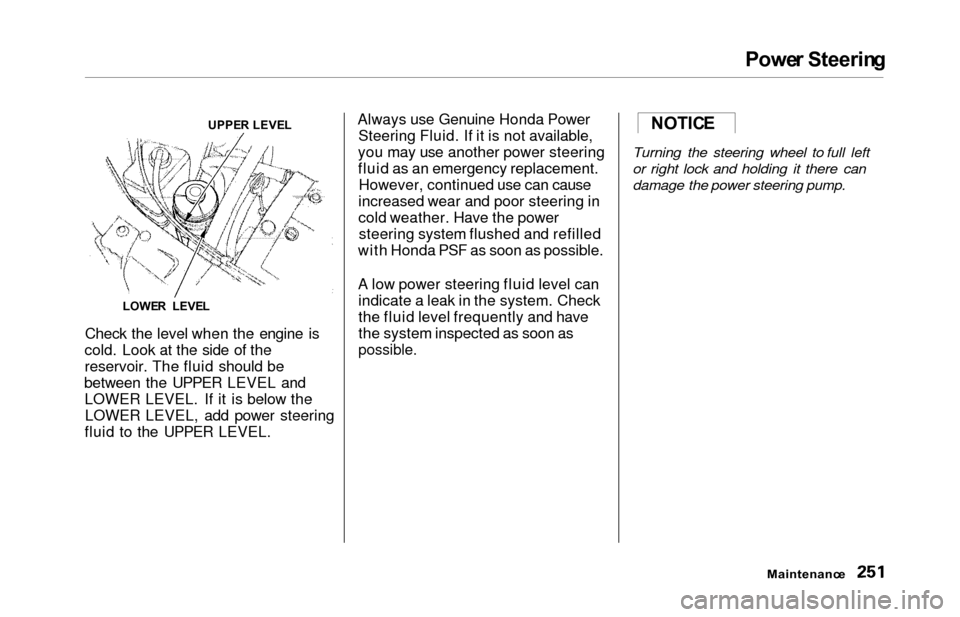
Check the level when the engine is
cold. Look at the side of the
reservoir. The fluid should be
between the UPPER LEVEL and LOWER LEVEL. If it is below theLOWER LEVEL, add power steering
fluid to the UPPER LEVEL. Always use Genuine Honda Power
Steering Fluid. If it is not available,
you may use another power steering
fluid as an emergency replacement. However, continued use can cause
increased wear and poor steering in
cold weather. Have the power steering system flushed and refilled
with Honda PSF as soon as possible.
A low power steering fluid level can indicate a leak in the system. Check
the fluid level frequently and have
the system inspected as soon as
possible.
Turning the steering wheel to full left
or right lock and holding it there can
damage the power steering pump.
Maintenanc e
UPPER LEVE L
LOWE R LEVE LNOTICE
Page 255 of 352
Air Cleane r Elemen t
The air cleaner element should be
cleaned or replaced according to the
time and distance recommendations
in the maintenance schedule.
Cleanin g (Sever e Conditions )
Clean the air cleaner element by
blowing compressed air through it in
the opposite direction to normal air
flow. If you do not have access to compressed air (such as a servicestation), ask your Honda dealer to do
this service.
Follow the replacement procedure
for removal and reinstallation.
Replacemen t
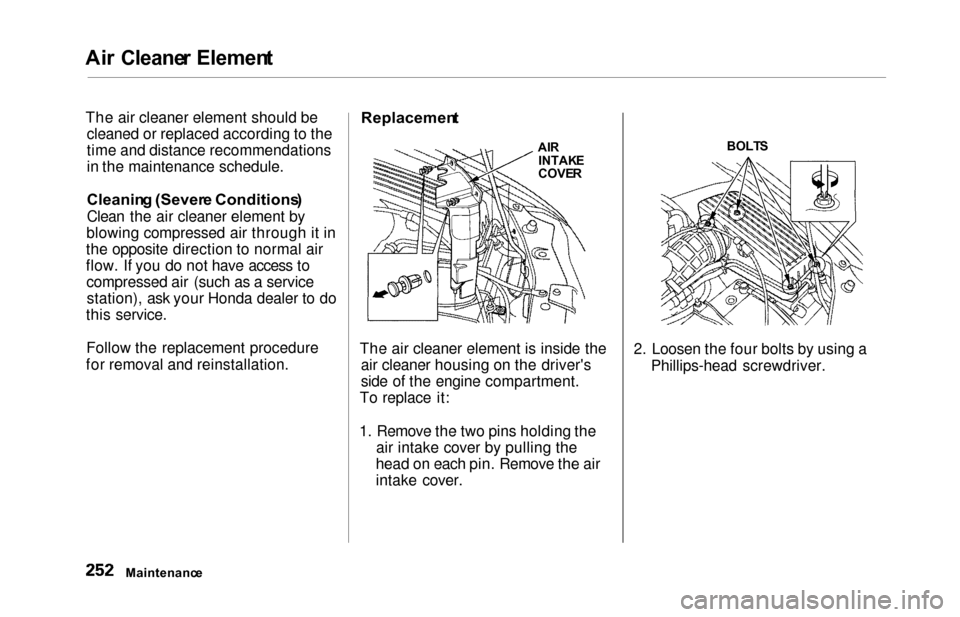
The air cleaner element is inside the
air cleaner housing on the driver's
side of the engine compartment.
To replace it:
1. Remove the two pins holding the air intake cover by pulling the
head on each pin. Remove the air
intake cover. 2. Loosen the four bolts by using a
Phillips-head screwdriver.
Maintenanc e AI
R
INTAK E
COVER BOLT
S
Page 257 of 352
Hood Latch , Spar k Plug s
Hood Latc h
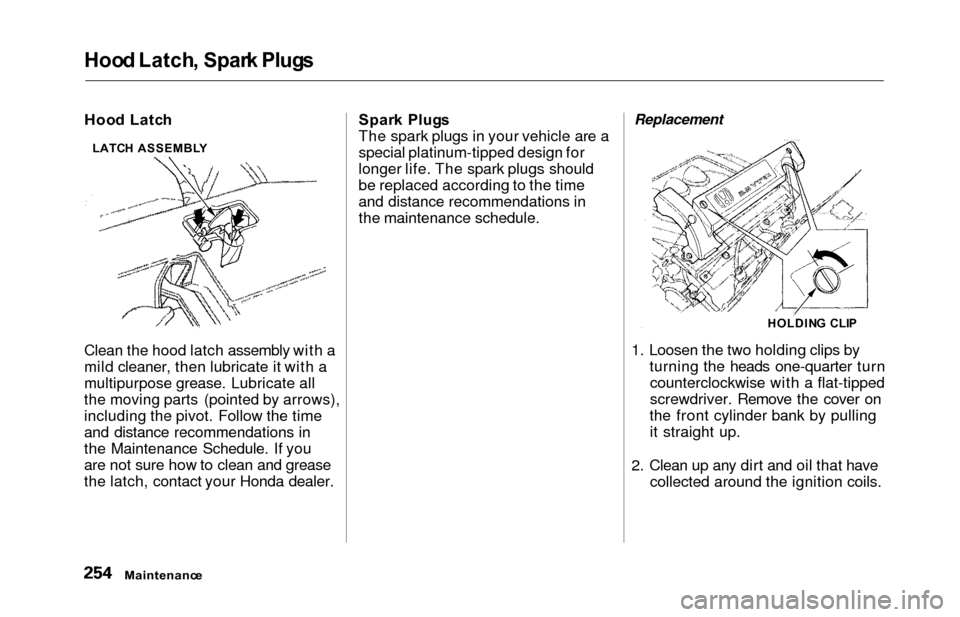
Clean the hood latch assembly with a
mild cleaner, then lubricate it with a
multipurpose grease. Lubricate all
the moving parts (pointed by arrows), including the pivot. Follow the time
and distance recommendations in
the Maintenance Schedule. If you
are not sure how to clean and grease
the latch, contact your Honda dealer. Spar
k Plug s
The spark plugs in your vehicle are a
special platinum-tipped design for
longer life. The spark plugs should
be replaced according to the time
and distance recommendations in
the maintenance schedule.Replacement
1. Loosen the two holding clips by turning the heads one-quarter turncounterclockwise with a flat-tipped
screwdriver. Remove the cover on
the front cylinder bank by pulling it straight up.
2. Clean up any dirt and oil that have collected around the ignition coils.
Maintenanc e
LATCH ASSEMBL Y
HOLDING CLI P
Page 270 of 352

Tires
When shopping for replacement
tires, you may find that some tires
are "directional." This means they
are designed to rotate only in one direction. If you use directional tires,
they should be rotated only front-to-
back. Replacin
g Tire s an d Wheel s
The tires that came with your
vehicle were selected to match the performance capabilities of the
vehicle while providing the best combination of handling, ride
comfort, and long life. You should
replace them with radial tires of thesame size, load range, speed rating,
and maximum cold tire pressure
rating (as shown on the tire's sidewall). Mixing radial and bias-ply
tires on your vehicle can reduce its
braking ability, traction, and steering
accuracy.It is best to replace all four tires at
the same time. If that is not possible or necessary, then replace the two
front tires or the two rear tires as a pair. Replacing just one tire can
seriously affect your vehicle's han-
dling.
CONTINUED
Maintenanc e
Installing improper tires on your
vehicle can affect handling and stability. This can cause a crashin which you can be seriously
hurt or killed.
Always use the size and type of
tires recommended in this
owner's manual.
Page 274 of 352
Light
s
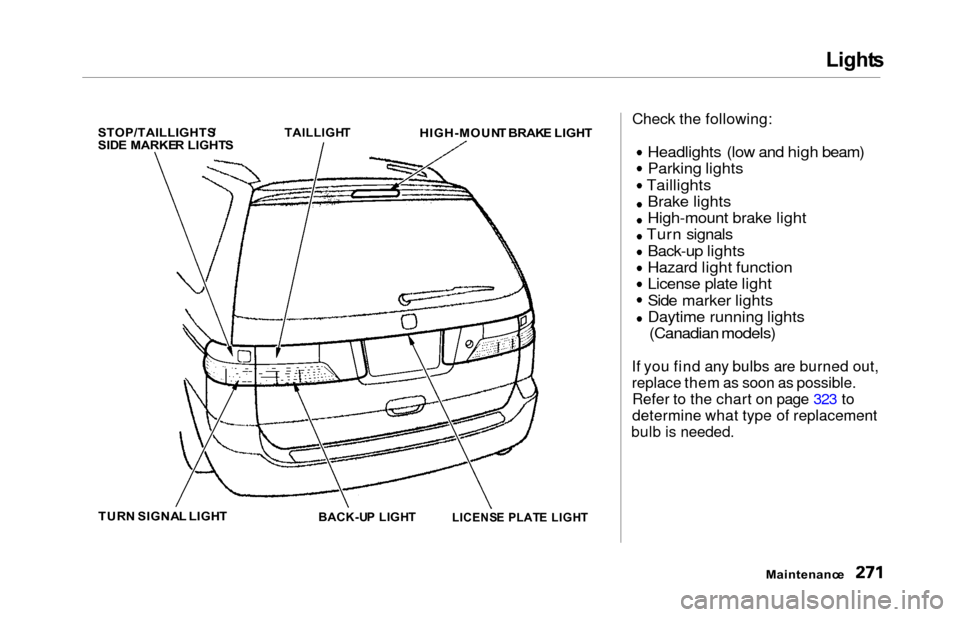
STOP/TAILLIGHTS /
SID E MARKE R LIGHT S
TAILLIGH
T
HIGH-MOUN T BRAK E LIGH T
TUR N SIGNA L LIGH T
BACK-UP LIGH T
Check the following:
Headlights (low and high beam)
Parking lights
Taillights Brake lights
High-mount brake light
Turn signals
Back-up lights
Hazard light function
License plate light
Side marker lights
Daytime running lights
(Canadian models)
If you find any bulbs are burned out,
replace them as soon as possible.
Refer to the chart on page 323 to
determine what type of replacement
bulb is needed.
Maintenance
LICENS
E PLAT E LIGH T
Page 284 of 352
Storing You r Vehicl e
If you need to park your vehicle for
an extended period (more than one
month), there are several things you
should do to prepare it for storage.
Proper preparation helps prevent
deterioration and makes it easier to
get your vehicle back on the road. If
possible, store your vehicle indoors.
Fill the fuel tank.Change the engine oil and filter
(see page 241).
Wash and dry the exterior
completely.
Clean the interior. Make sure the
carpeting, floor mats, etc. are
completely dry.
Leave the parking brake off. Put
the transmission in Park.
Block the rear wheels.
If the vehicle is to be stored for a
longer period, it should be
supported on jackstands so the
tires are off the ground. Leave one window open slightly (if
the vehicle is being stored
indoors).
Disconnect the battery.
Support the front and rear wiper
blade arms with a folded towel or rag so they do not touch the
windshield.
To minimize sticking, apply a silicone spray lubricant to all door
and tailgate seals. Also, apply a
vehicle body wax to the painted surfaces that mate with the door
and tailgate seals.
Cover the vehicle with a
"breathable" cover, one made
from a porous material such as cotton. Nonporous materials, such
as plastic sheeting, trap moisture,
which can damage the paint.
If possible, run the engine for a
while periodically (preferably once a month).
If you store your vehicle for 12
months or longer, have your Honda
dealer perform the inspections called
for in the 24 months/30,000 miles (48,000 km) maintenance schedule
(Normal Conditions) as soon as you
take it out of storage (see page 230).
The replacements called for in the maintenance schedule are not
needed unless the vehicle hasactually reached that time or mileage.
Maintenanc e
Page 292 of 352

Body Repair s
Body repairs can affect your vehicle's
resistance to corrosion. If your
vehicle needs repairs after a collision, pay close attention to the parts usedin the repair and the quality of the
work.
Make sure the repair facility usesGenuine Honda replacement body
parts. Some companies make sheet
metal pieces that seem to duplicate
the original Honda body parts, but are actually inferior in fit, finish, and
corrosion resistance. Once installed,
they do not give the same high- quality appearance.When reporting your collision to the insurance company, tell them you
want Genuine Honda parts used in the repair. Although most insurers
recognize the quality of original
parts, some may try to specify that
the repairs be done with otheravailable parts. You should investi-
gate this before any repairs have
begun.
Take your vehicle to your authorized Honda dealer for inspection after the
repairs are completed. Your dealer can make sure that quality materials
were used, and that corrosion- preventive coatings were applied to all repaired and replaced parts.
Appearanc e Car e
Page 295 of 352

Compact Spar e Tir e
Your vehicle has a compact spare
tire that takes up less space. Use thisspare tire as a temporary replace-
ment only. Get your regular tire
repaired or replaced and put back on
your vehicle as soon as you can.
Check the inflation pressure of the
compact spare tire every time you
check the other tires. It should be
inflated to: 60 psi (420 kPa , 4.2 kgf/cm
2)
Follow these precautions whenever
you are using the compact spare tire:
Do not exceed 50 mph (80 km/h)
under any circumstances.
This tire gives a harsher ride and less traction on some road sur-
faces than the regular tire. Use
greater caution while driving on
this tire. Do not mount snow chains on the
compact spare.
Do not use the compact spare tire
if you are towing a trailer.
The wheel of the compact spare
tire is designed especially to fit
your vehicle. Do not use your
spare tire on another vehicle
unless it is the same make and
model.
On EX model
Turn off the Traction ControlSystem (see page 213 ). Driving
with the compact spare tire may
activate the TCS.
The compact spare tire has a shorter
tread life than a regular tire. Replace
it when you can see the tread wear
indicator bars. The replacement
should be the same size and design
tire, mounted on the same wheel.
The compact spare tire is not
designed to be mounted on a regular
wheel, and the compact wheel is not
designed for mounting a regular tire.
Takin g Car e o f th e Unexpecte d
INDICATOR LOCATIO N MAR K
TREA D WEA R INDICATO R BA R