Page 109 of 224
If R (Reverse) is not engaged, push the clutch
pedal down and put the gearshift back into
Neutral. Then, release the clutch pedal for a
moment and repeat steps 3 through 6.
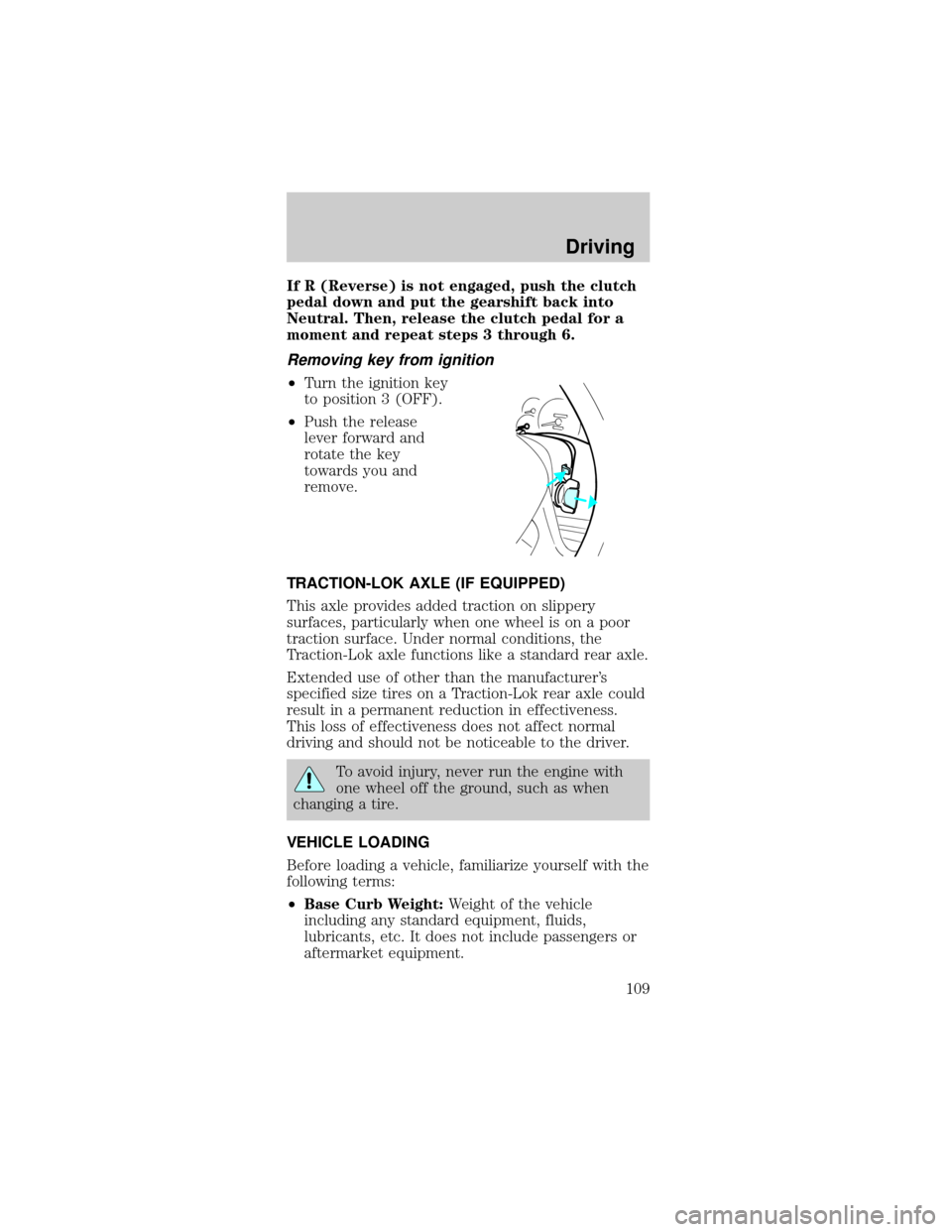
Removing key from ignition
²Turn the ignition key
to position 3 (OFF).
²Push the release
lever forward and
rotate the key
towards you and
remove.
TRACTION-LOK AXLE (IF EQUIPPED)
This axle provides added traction on slippery
surfaces, particularly when one wheel is on a poor
traction surface. Under normal conditions, the
Traction-Lok axle functions like a standard rear axle.
Extended use of other than the manufacturer's
specified size tires on a Traction-Lok rear axle could
result in a permanent reduction in effectiveness.
This loss of effectiveness does not affect normal
driving and should not be noticeable to the driver.
To avoid injury, never run the engine with
one wheel off the ground, such as when
changing a tire.
VEHICLE LOADING
Before loading a vehicle, familiarize yourself with the
following terms:
²Base Curb Weight:Weight of the vehicle
including any standard equipment, fluids,
lubricants, etc. It does not include passengers or
aftermarket equipment.
Driving
109
Page 118 of 224
After a collision, if the engine cranks but does not
start, the fuel pump shut-off switch may have been
activated.
The fuel pump shut-off
switch is located on
the left side of the
trunk behind the trunk
liner.
Use the following procedure to reset the fuel pump
shut-off switch.
1. Turn the ignition to the OFF position.
2. Check the fuel system for leaks.
3. If no fuel leak is apparent, reset the fuel pump
shut-off switch by pushing in on the reset button.
4. Turn the ignition to the ON position. Pause for a
few seconds and return the key to the OFF position.
5. Make a further check for leaks in the fuel system.
FUSES AND RELAYS
Fuses
If electrical
components in the
vehicle are not
working, a fuse may
have blown. Blown
fuses are identified by a broken wire within the fuse.
15
Roadside emergencies
118
Page 127 of 224

8. Lower the wheel by turning the jack handle
counterclockwise.
9. Remove the jack and
fully tighten the lug
nuts in the order
shown.
10. Put flat tire, jack
and lug wrench away.
Make sure jack is
fastened so it does not
rattle when you drive.
11. Unblock the wheels.
Anti-theft lug nuts (if equipped)
If your vehicle is equipped with this feature, one of
the lug nuts on each wheel must be removed and
replaced with a special key. The key and registration
card are attached to the lug wrench and stored with
the spare tire. If you lose the key, send the
registration card to the manufacturer (not the
dealer) to get a replacement key. If the lug
wrench/lug nut key assembly is lost, see your
nearest Ford or Lincoln/Mercury dealer who has
access to the master set of keys.Do not use an
impact wrench with the anti-theft key.
To remove the
anti-theft lug nut:
1. Insert the key over
the locking lug nut.
Make sure you hold the key square to the lug nut. If
you hold the key at an angle, you could damage the
key and the lug nut.
2. Place the lug nut wrench over the lug nut key and
apply pressure on the key with the wrench.
3. Turn the wrench in a counterclockwise direction
to remove the lug nut.
To install the anti-theft lug nut:
1. Insert the key over the locking lug nut.
1
4 3
2 5
Roadside emergencies
127
Page 128 of 224

2. Place the lug nut wrench over the lug nut key and
apply pressure on the key with the wrench.
3. Install the lug nut.
JUMP STARTING YOUR VEHICLE
The gases around the battery can explode if
exposed to flames, sparks, or lit cigarettes.
An explosion could result in injury or vehicle
damage.
Do not push start your vehicle. You could
damage the catalytic converter.
Batteries contain sulfuric acid which can
burn skin, eyes, and clothing, if contacted.
Do not attempt to push start your vehicle.
Automatic transmissions do not have
push-start capability.
Preparing your vehicle
1.Use only a 12±volt supply to start your
vehicle.
2. Do not disconnect the battery of the disabled
vehicle as this could damage the vehicle's electrical
system.
3. Park the booster vehicle close to the hood of the
disabled vehicle making sure the two vehiclesdo
nottouch. Set the parking brake on both vehicles
and stay clear of the engine cooling fan and other
moving parts.
4. Check all battery terminals and remove any
excessive corrosion before you attach the battery
cables. Ensure that vent caps are tight and level.
5. Turn the heater fan on in both vehicles to protect
any electrical surges. Turn all other accessories off.
Roadside emergencies
128
Page 134 of 224
2. Turn off the engine and remove the key.
3. Block the wheels to prevent the vehicle from
moving unexpectedly.
²Manual transmission:
1. Set the parking brake.
2. Depress the clutch and place the gearshift in 1
(First).
3. Turn off the engine and remove the key.
4. Block the wheels to prevent the vehicle from
moving unexpectedly.
Working with the engine on
²Automatic transmission:
1. Set the parking brake and ensure the gearshift is
securely latched in P (Park).
2. Block the wheels to prevent the vehicle from
moving unexpectedly.
Do not start your engine with the air cleaner
removed and do not remove it while the
engine is running.
²Manual transmission:
1. Set the parking brake, depress the clutch and
place the gearshift in N (Neutral).
2. Block the wheels to prevent the vehicle from
moving unexpectedly.
Do not start your engine with the air cleaner
removed and do not remove it while the
engine is running.
Maintenance and care
134
Page 215 of 224

GAWR (Gross Axle
Weight Rating) ........ 109
definition ............... 109
driving with
a heavy load .......... 109
location .................. 109
GVWR (Gross Vehicle
Weight Rating) ........ 109
calculating ............. 109
definition ............... 109
driving with
a heavy load .......... 109
location .................. 109
Hazard flashers ....... 117
Head restraints ......... 62
Headlamps ................. 18
aiming .................... 183
bulb
specifications ........ 182
daytime
running lights .......... 18
flash to pass ............ 41
high beam ............ 8,18
replacing bulbs ..... 178
turning on and off .. 18
warning chime ........ 13
Heating ...................... 20
heating and air
conditioning
system ..................... 20
Hood ........................ 135
Ignition ..................... 194
positions of the
ignition .................... 41
removing the key .. 109
Infant seats (see
Safety seats) ........ 82,83
Inspection/maintenance
(I/M) testing ............ 177
Instrument panel
cleaning ................. 188
cluster ................. 8,188lighting up panel
and interior ............. 19
location of
components ............... 8
Jump-starting
your vehicle ............. 128
Keys
key in
ignition chime ......... 13
positions of the
ignition .................... 41
removing from
the ignition ............ 109
Lamps
bulb replacement
specifications
chart ...................... 182
cargo lamps ............. 19
daytime
running light ........... 18
fog lamps ................. 48
headlamps ........ 18,178
headlamps,
flash to pass ............ 41
instrument panel,
dimming ................... 19
interior
lamps ......... 45,181,182
replacing bulbs ..... 177
178,179,180,181
Lane change indicator
(see Turn signal) ...... 40
Lights, warning and
indicator ...................... 8
air bag ........................ 9
anti-lock
brakes (ABS) ..... 12,96
anti-theft ................... 9
brake ........................ 12
charging system ........ 9
check coolant .......... 12
high beam ................. 8
Index
215
Page:
< prev 1-8 9-16 17-24