Page 222 of 365
5-
yellowblue
5-1
Section 5 Problems on the Road
Here you'll find what to do about some problems that can occur on the road.
5
-2 Hazard Warning Flashers
5
-3 Other Warning Devices
5
-3 Jump Starting
5
-9 Towing Your Vehicle
5
-10 Engine Overheating5
-13 Cooling System
5
-23 If A Tire Goes Flat
5
-24 Changing a Flat Tire
5
-34 Compact Spare Tire
5
-35 If You're Stuck: In Sand, Mud, Ice or Snow
Page 246 of 365
yellowblue
5-25 Removing the Spare Tire and Tools
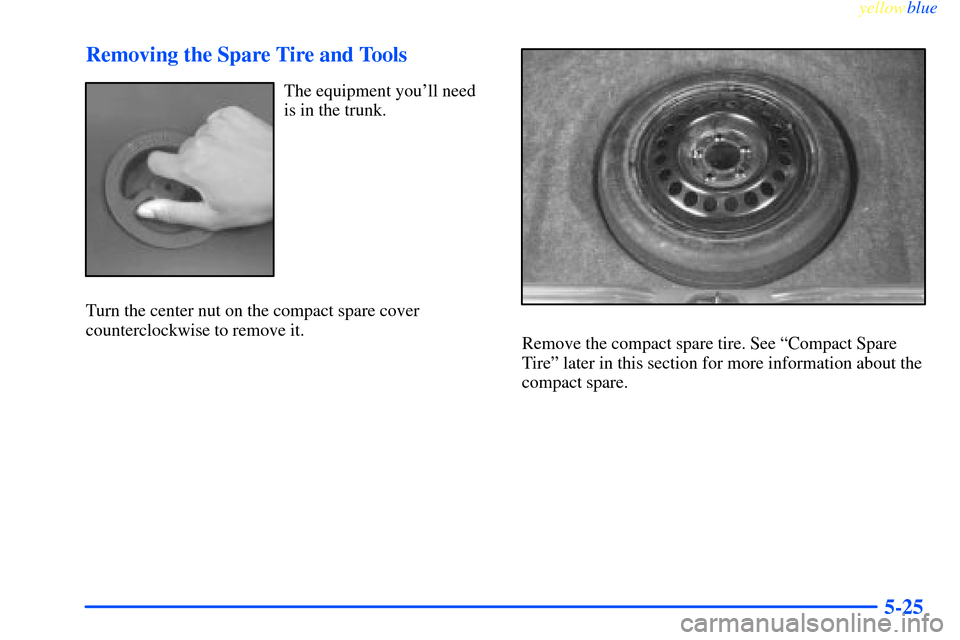
The equipment you'll need
is in the trunk.
Turn the center nut on the compact spare cover
counterclockwise to remove it.
Remove the compact spare tire. See ªCompact Spare
Tireº later in this section for more information about the
compact spare.
Page 248 of 365
yellowblue
5-27 Removing the Flat Tire and Installing
the Spare Tire
1. Using the wheel wrench, loosen all the wheel nuts.
Don't remove them yet.
The diagram shows you where you should place
your jack. Use the bolts (A) as a guide when
positioning the the jack lift head (C) near the rear
edge of the front wheel opening (B). Turn the jack
handle clockwise to raise the jack lift head a
few inches.
For jacking at the vehicle's front location, put jack
lift about 8.5 inches (21.5 cm) from the rear edge of
the front wheel opening in the cutout of the rocker
panel molding.
Page 249 of 365
yellowblue
5-28
The diagram shows you where to place your jack.
Use the notch (B) as a guide when positioning the
jack lift head (A) near the front edge of the rear
wheel opening (C).
For jacking at the vehicle's rear location, put the jack
lift head about 4 inches (10 cm) from the front edge
of the rear wheel opening in the cutout of the rocker
panel molding.
Put the compact spare tire near you.
CAUTION:
Getting under a vehicle when it is jacked up is
dangerous. If the vehicle slips off the jack, you
could be badly injured or killed. Never get under
a vehicle when it is supported only by a jack.
CAUTION:
Raising your vehicle with the jack improperly
positioned can damage the vehicle and even make
the vehicle fall. To help avoid personal injury and
vehicle damage, be sure to fit the jack lift head
into the proper location before raising
the vehicle.
Page 250 of 365
yellowblue
5-29
2. Raise the vehicle by turning the jack handle
clockwise. Raise the vehicle far enough off the
ground for the spare tire to fit under the vehicle.
Remove all wheel nuts and take off the flat tire.
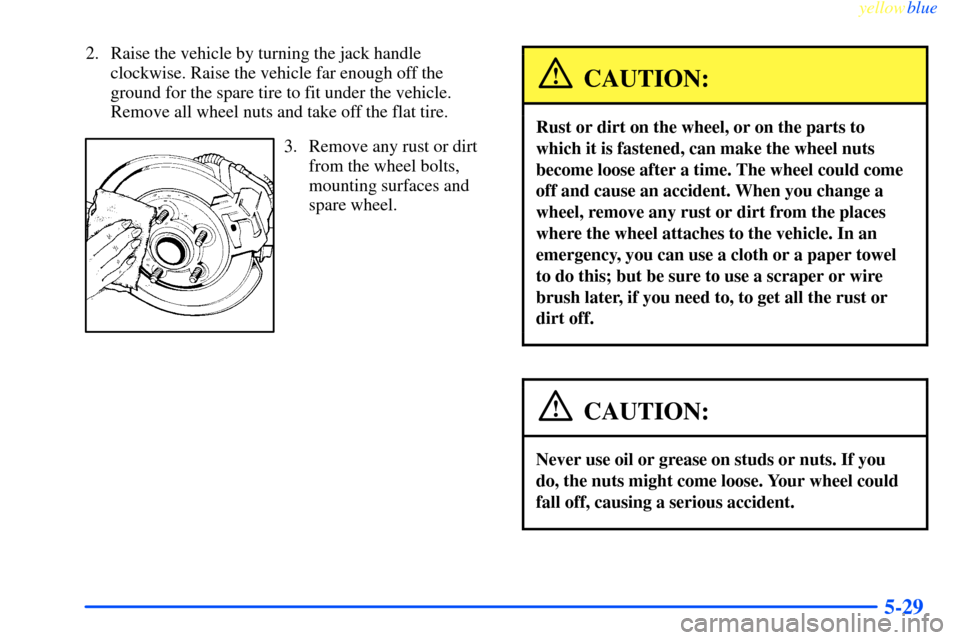
3. Remove any rust or dirt
from the wheel bolts,
mounting surfaces and
spare wheel.
CAUTION:
Rust or dirt on the wheel, or on the parts to
which it is fastened, can make the wheel nuts
become loose after a time. The wheel could come
off and cause an accident. When you change a
wheel, remove any rust or dirt from the places
where the wheel attaches to the vehicle. In an
emergency, you can use a cloth or a paper towel
to do this; but be sure to use a scraper or wire
brush later, if you need to, to get all the rust or
dirt off.
CAUTION:
Never use oil or grease on studs or nuts. If you
do, the nuts might come loose. Your wheel could
fall off, causing a serious accident.
Page 251 of 365
yellowblue
5-30
4. Install the spare tire.
5. Replace the wheel nuts with the rounded end of the
nuts toward the wheel. Tighten each nut by hand
until the wheel is held against the hub.
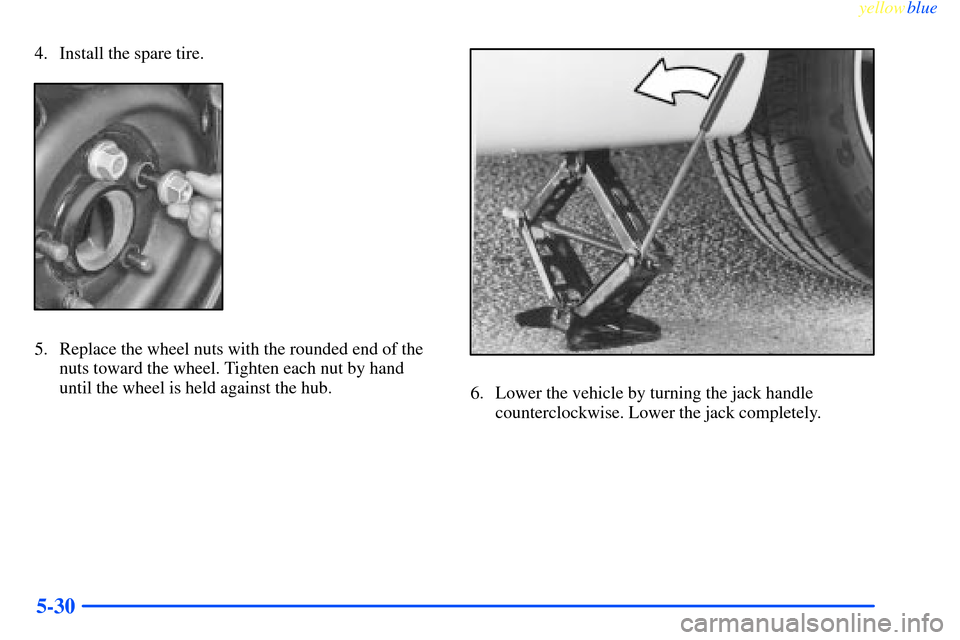
6. Lower the vehicle by turning the jack handle
counterclockwise. Lower the jack completely.
Page 252 of 365
yellowblue
5-31
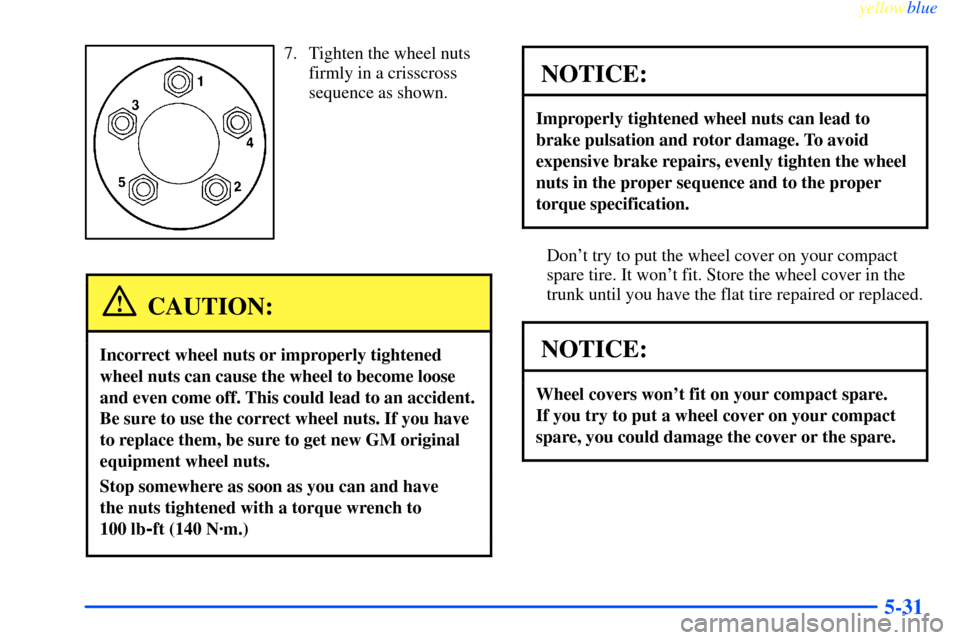
7. Tighten the wheel nuts
firmly in a crisscross
sequence as shown.
CAUTION:
Incorrect wheel nuts or improperly tightened
wheel nuts can cause the wheel to become loose
and even come off. This could lead to an accident.
Be sure to use the correct wheel nuts. If you have
to replace them, be sure to get new GM original
equipment wheel nuts.
Stop somewhere as soon as you can and have
the nuts tightened with a torque wrench to
100 lb
-ft (140 N´m.)
NOTICE:
Improperly tightened wheel nuts can lead to
brake pulsation and rotor damage. To avoid
expensive brake repairs, evenly tighten the wheel
nuts in the proper sequence and to the proper
torque specification.
Don't try to put the wheel cover on your compact
spare tire. It won't fit. Store the wheel cover in the
trunk until you have the flat tire repaired or replaced.
NOTICE:
Wheel covers won't fit on your compact spare.
If you try to put a wheel cover on your compact
spare, you could damage the cover or the spare.
Page 253 of 365
yellowblue
5-32 Storing the Flat Tire and Tools
CAUTION:
Storing a jack, a tire or other equipment in the
passenger compartment of the vehicle could
cause injury. In a sudden stop or collision, loose
equipment could strike someone. Store all these
in the proper place.
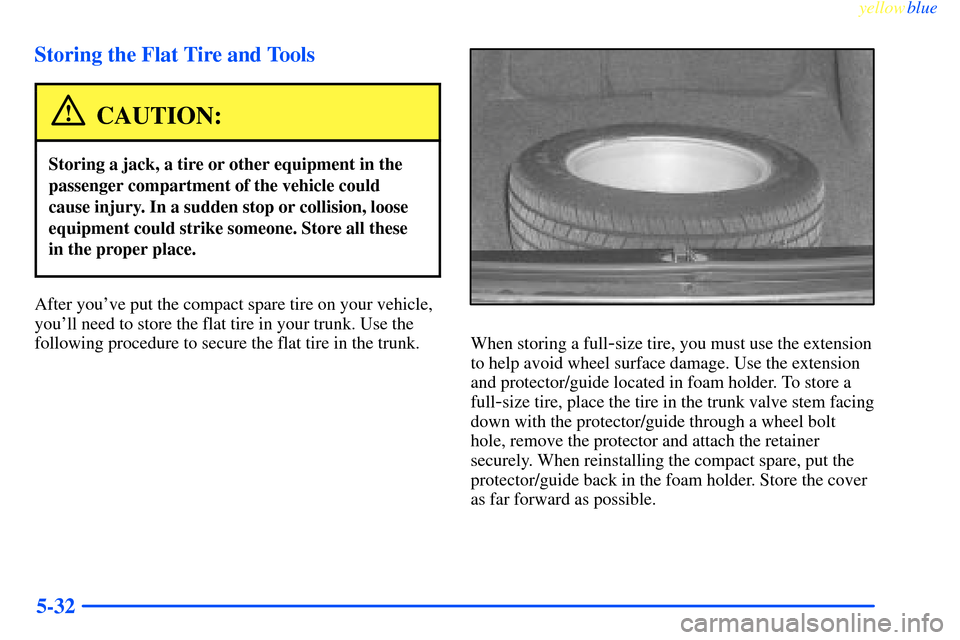
After you've put the compact spare tire on your vehicle,
you'll need to store the flat tire in your trunk. Use the
following procedure to secure the flat tire in the trunk.
When storing a full-size tire, you must use the extension
to help avoid wheel surface damage. Use the extension
and protector/guide located in foam holder. To store a
full
-size tire, place the tire in the trunk valve stem facing
down with the protector/guide through a wheel bolt
hole, remove the protector and attach the retainer
securely. When reinstalling the compact spare, put the
protector/guide back in the foam holder. Store the cover
as far forward as possible.