Page 254 of 365
yellowblue
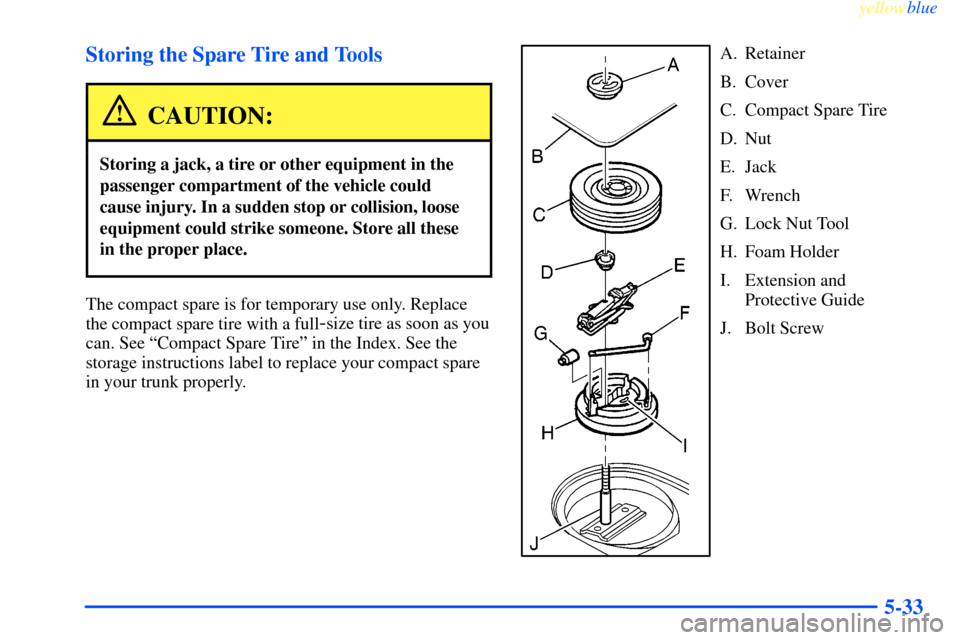
5-33 Storing the Spare Tire and Tools
CAUTION:
Storing a jack, a tire or other equipment in the
passenger compartment of the vehicle could
cause injury. In a sudden stop or collision, loose
equipment could strike someone. Store all these
in the proper place.
The compact spare is for temporary use only. Replace
the compact spare tire with a full
-size tire as soon as you
can. See ªCompact Spare Tireº in the Index. See the
storage instructions label to replace your compact spare
in your trunk properly.
A. Retainer
B. Cover
C. Compact Spare Tire
D. Nut
E. Jack
F. Wrench
G. Lock Nut Tool
H. Foam Holder
I. Extension and
Protective Guide
J. Bolt Screw
Page 255 of 365
yellowblue
5-34
Compact Spare Tire
Although the compact spare tire was fully inflated w
hen your vehicle was new, it can lose air after a time.
Check the inflation pressure regularly. It should be
60 psi (420 kPa).
After installing the compact spare on your vehicle, you
should stop as soon as possible and make sure your
spare tire is correctly inflated. The compact spare is
made to perform well at speeds up to 65 mph (105
km/h) for distances up to 3,000 miles (5 000 km), so you
can finish your trip and have your full
-size tire repaired
or replaced where you want. You must calibrate the tire
inflation monitor system after installing or removing the
compact spare. See ªTire Inflation Monitorº in the
Index. The system may not work correctly when the
compact spare is installed on the vehicle. Of course, it's
best to replace your spare with a full
-size tire as soon as
you can. Your spare will last longer and be in good
shape in case you need it again.
NOTICE:
When the compact spare is installed, don't take
your vehicle through an automatic vehicle wash
with guide rails. The compact spare can get
caught on the rails. That can damage the tire and
wheel, and maybe other parts of your vehicle.
Don't use your compact spare on other vehicles.
And don't mix your compact spare tire or wheel with
other wheels or tires. They won't fit. Keep your spare
tire and its wheel together.
NOTICE:
Tire chains won't fit your compact spare. Using
them can damage your vehicle and can damage
the chains too. Don't use tire chains on your
compact spare.
Page 301 of 365
yellowblue
6-44 Inflation -- Tire Pressure
The Tire-Loading Information label, which is on the
inside of the trunk lid, shows the correct inflation
pressures for your tires when they're cold. ªColdº
means your vehicle has been sitting for at least
three hours or driven no more than 1 mile (1.6 km).
NOTICE:
Don't let anyone tell you that underinflation or
overinflation is all right. It's not. If your tires
don't have enough air (underinflation), you can
get the following:
�Too much flexing
�Too much heat
�Tire overloading
�Bad wear
�Bad handling
�Bad fuel economy.
NOTICE: (Continued)
NOTICE: (Continued)
If your tires have too much air (overinflation),
you can get the following:
�Unusual wear
�Bad handling
�Rough ride
�Needless damage from road hazards.
When to Check
Check your tires once a month or more.
Don't forget your compact spare tire. It should be
at 60 psi (420 kPa).
How to Check
Use a good quality pocket
-type gage to check tire
pressure. You can't tell if your tires are properly inflated
simply by looking at them. Radial tires may look
properly inflated even when they're underinflated.
Be sure to put the valve caps back on the valve
stems. They help prevent leaks by keeping out dirt
and moisture.
Page 304 of 365
yellowblue
6-47
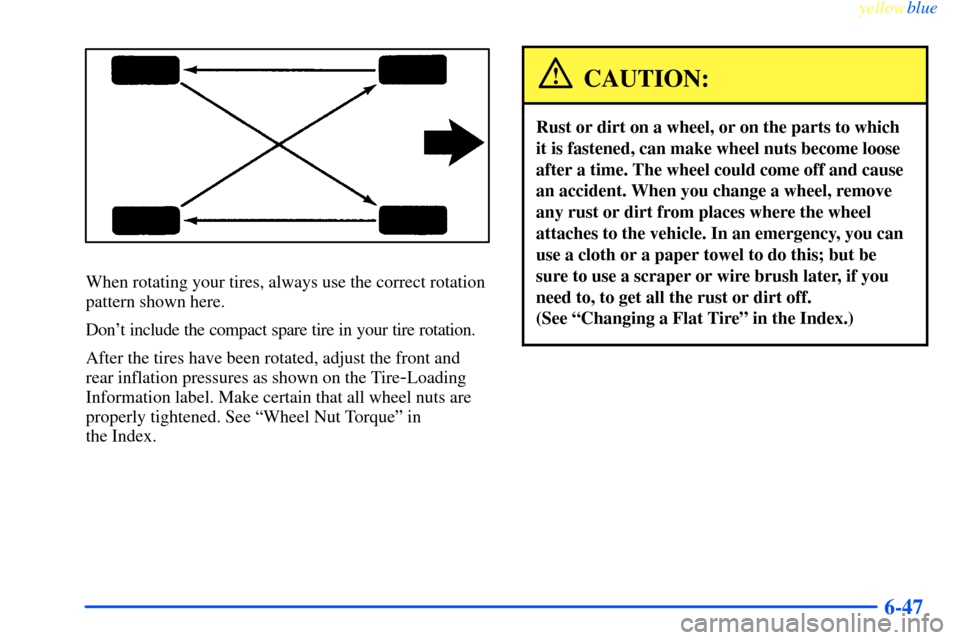
When rotating your tires, always use the correct rotation
pattern shown here.
Don't include the compact spare tire in your tire rotation.
After the tires have been rotated, adjust the front and
rear inflation pressures as shown on the Tire
-Loading
Information label. Make certain that all wheel nuts are
properly tightened. See ªWheel Nut Torqueº in
the Index.
CAUTION:
Rust or dirt on a wheel, or on the parts to which
it is fastened, can make wheel nuts become loose
after a time. The wheel could come off and cause
an accident. When you change a wheel, remove
any rust or dirt from places where the wheel
attaches to the vehicle. In an emergency, you can
use a cloth or a paper towel to do this; but be
sure to use a scraper or wire brush later, if you
need to, to get all the rust or dirt off.
(See ªChanging a Flat Tireº in the Index.)
Page 306 of 365
yellowblue
6-49
CAUTION:
Mixing tires could cause you to lose control while
driving. If you mix tires of different sizes or types
(radial and bias
-belted tires), the vehicle may not
handle properly, and you could have a crash.
Using tires of different sizes may also cause
damage to your vehicle. Be sure to use the same
size and type tires on all wheels.
It's all right to drive with your compact spare,
though. It was developed for use on your vehicle.
CAUTION:
If you use bias-ply tires on your vehicle, the
wheel rim flanges could develop cracks after
many miles of driving. A tire and/or wheel could
fail suddenly, causing a crash. Use only radial
-ply
tires with the wheels on your vehicle.
Uniform Tire Quality Grading
The following information relates to the system developed
by the United States National Highway Traffic Safety
Administration, which grades tires by treadwear, traction
and temperature performance. (This applies only to
vehicles sold in the United States.) The grades are molded
on the sidewalls of most passenger car tires. The Uniform
Tire Quality Grading system does not apply to deep tread,
winter
-type snow tires, space-saver or temporary use spare
tires, tires with nominal rim diameters of 10 to 12 inches
(25 to 30 cm), or to some limited
-production tires.
While the tires available on General Motors passenger
cars and light trucks may vary with respect to these
grades, they must also conform to Federal safety
requirements and additional General Motors Tire
Performance Criteria (TPC) standards.
Treadwear
The treadwear grade is a comparative rating based on
the wear rate of the tire when tested under controlled
conditions on a specified government test course. For
example, a tire graded 150 would wear one and a half
(1 1/2) times as well on the government course as a tire
graded 100. The relative performance of tires depends
upon the actual conditions of their use, however, and
may depart significantly from the norm due to variations
in driving habits, service practices and differences in
road characteristics and climate.
Page 357 of 365
yellowblue
8-6
Chevrolet Roadside Assistance Program
To enhance Chevrolet's strong commitment to customer
satisfaction, Chevrolet is excited to announce the
establishment of the Chevrolet Roadside Assistance
Center. As the owner of a 2000 Chevrolet, membership
in Roadside Assistance is free.
Roadside Assistance is available 24 hours a day,
365 days a year, by calling 1
-800-CHEV-USA (243-8872).
This toll-free number will provide you over
-the-phone
roadside assistance with minor mechanical problems. If your problem cannot be resolved over the
phone, our advisors have access to a nationwide network
of dealer recommended service providers. Roadside
membership is free; however some services may incur costs.
Roadside offers two levels of service to the customer,
Basic Care and Courtesy Care:
�Toll
-free number, 1-800-CHEV-USA (243-8872)
�Free towing for warranty repairs
�Basic over
-the-phone technical advice
�Available dealer services at reasonable costs (i.e.,
wrecker services, locksmith/key service, glass
repair, etc.)
ROADSIDE Courtesy Care PROVIDES:
�Roadside Basic Care services (as outlined previously)
Plus:
�FREE Non
-Warranty Towing (to the closest dealer
from a legal roadway)
�FREE Locksmith/Key Service (when keys are lost
on the road or locked inside)
�FREE Flat Tire Service (spare installed on the road)
�FREE Jump Start (at home or on the road)
�FREE Fuel Delivery ($5 of fuel delivered on
the road)