Page 83 of 364
2-19
3. If your engine still won't start (or starts but then
stops), it could be flooded with too much gasoline.
Try pushing your accelerator pedal all the way to the
floor and holding it there as you hold the key in
START for a maximum of 15 seconds. This clears
the extra gasoline from the engine. If the engine still
won't start or starts briefly but then stops again,
repeat step 1 or 2, depending on temperature.
When the engine starts, release the key and the
accelerator pedal.
NOTICE:
Your engine is designed to work with the
electronics in your vehicle. If you add electrical
parts or accessories, you could change the way
the engine operates. Before adding electrical
equipment, check with your dealer. If you don't,
your engine might not perform properly.
If you ever have to have your vehicle towed,
see the part of this manual that tells how to do
it without damaging your vehicle. See ªTowing
Your Vehicleº in the Index.
Engine Coolant Heater (If Equipped)
2.2L L4 Engine
Page 85 of 364

2-21
4. Before starting the engine, be sure to unplug and
store the cord as it was before to keep it away
from moving engine parts. If you don't, it could
be damaged.
How long should you keep the coolant heater plugged
in? The answer depends on the outside temperature, the
kind of oil you have, and some other things. Instead of
trying to list everything here, we ask that you contact
your dealer in the area where you'll be parking your
vehicle. The dealer can give you the best advice for that
particular area.
Automatic Transaxle Operation
Your vehicle may be equipped with a three-speed
automatic transaxle or a four
-speed automatic
transaxle. The shift lever is located on the console
between the seats.
There are six different positions for the shift lever on
the three
-speed automatic and seven positions for the
four
-speed automatic transaxles. While PARK (P),
REVERSE (R) and NEUTRAL (N) operate identically
for both transaxles, the forward gear positions represent
different gearing and operation. See ªForward Gears
(3
-Speed)º or ªForward-Gears (4-Speed)º later in
this section.PARK (P): This position locks your front wheels.
It's the best position to use when you start your
engine because your vehicle can't move easily.
CAUTION:
It is dangerous to get out of your vehicle if the
shift lever is not fully in PARK (P) with the
parking brake firmly set. Your vehicle can roll.
Don't leave your vehicle when the engine is
running unless you have to. If you have left the
engine running, the vehicle can move suddenly.
You or others could be injured. To be sure your
vehicle won't move, even when you're on fairly
level ground, always set your parking brake and
move the shift lever to PARK (P).
See ªShifting Into PARK (P)º in the Index.
If you're pulling a trailer, see ªTowing a Trailerº
in the Index.
Page 86 of 364

2-22
Ensure the shift lever is fully in PARK (P) before
starting the engine. Your vehicle has a automatic
transaxle shift lock control system. You have to fully
apply your regular brakes before you can shift from
PARK (P) when the ignition key is in RUN. If you
cannot shift out of PARK (P), ease pressure on the shift
lever
-- push the shift lever all the way into PARK (P)
and also release the shift lever button on floor shift
console models as you maintain brake application.
Then move the shift lever into the gear you wish.
(Press the shift lever button before moving the shift
lever.) See ªShifting Out of PARK (P)º in the Index.
REVERSE (R): Use this gear to back up.
NOTICE:
Shifting to REVERSE (R) while your vehicle is
moving forward could damage your transaxle.
Shift to REVERSE (R) only after your vehicle
is stopped.
To rock your vehicle back and forth to get out of snow,
ice or sand without damaging your transaxle, see
ªStuck: In Sand, Mud, Ice or Snowº in the Index.NEUTRAL (N): In this position, your engine
doesn't connect with the wheels. To restart when
you're already moving, use NEUTRAL (N) only. Also,
use NEUTRAL (N) when your vehicle is being towed.
Note that a 3
-speed transaxle cannot be towed with all
four wheels on the ground.
CAUTION:
Shifting out of PARK (P) or NEUTRAL (N) while
your engine is ªracingº (running at high speed)
is dangerous. Unless your foot is firmly on the
brake pedal, your vehicle could move very
rapidly. You could lose control and hit people
or objects. Don't shift out of PARK (P) or
NEUTRAL (N) while your engine is racing.
NOTICE:
Damage to your transaxle caused by shifting out
of PARK (P) or NEUTRAL (N) with the engine
racing isn't covered by your warranty.
Page 92 of 364
2-28
Shifting Into PARK (P)
(Automatic Transaxle Only)
CAUTION:
It can be dangerous to get out of your vehicle if
the shift lever is not fully in PARK (P) with the
parking brake firmly set. Your vehicle can roll.
If you have left the engine running, the vehicle
can move suddenly. You or others could be
injured. To be sure your vehicle won't move,
even when you're on fairly level ground, use
the steps that follow. If you're pulling a trailer,
see ªTowing a Trailerº in the Index.
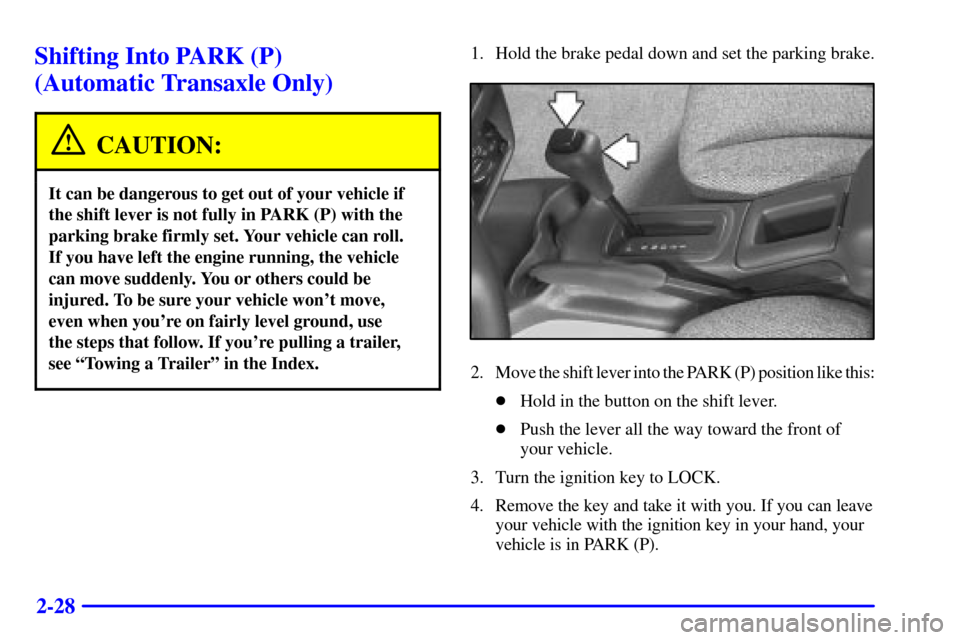
1. Hold the brake pedal down and set the parking brake.
2. Move the shift lever into the PARK (P) position like this:
�Hold in the button on the shift lever.
�Push the lever all the way toward the front of
your vehicle.
3. Turn the ignition key to LOCK.
4. Remove the key and take it with you. If you can leave
your vehicle with the ignition key in your hand, your
vehicle is in PARK (P).
Page 96 of 364

2-32
CAUTION:
It can be dangerous to get out of your vehicle if
the shift lever is not fully in PARK (P) with the
parking brake firmly set. Your vehicle can roll.
Don't leave your vehicle when the engine is
running unless you have to. If you've left the
engine running, the vehicle can move suddenly.
You or others could be injured. To be sure your
vehicle won't move, even when you're on fairly
level ground, always set your parking brake and
move the shift lever to PARK (P).
Follow the proper steps to be sure your vehicle won't
move. See ªShifting Into PARK (P)º in the Index.
If you are parking on a hill and if you're pulling a
trailer, also see ªTowing a Trailerº in the Index.
Windows
Manual Windows
On a vehicle with manual windows, use the window
crank to open and close each window.
Power Windows (If Equipped)
With power windows, switches on the center console
control each of the windows when the ignition is on.
In addition, on four
-door models, each rear passenger
door has a control switch for its own window.
Page 99 of 364

2-35
If a bulb is burned out, replace it to help avoid an
accident. If the arrows don't go on at all when you
signal a turn, check the fuse (see ªFuses and Circuit
Breakersº in the Index) and for burned
-out bulbs.
Headlamp High/Low Beam Changer
To change the headlamps from low beam to high or
high beam to low, pull the turn signal lever all the way
toward you. Then release it.
When the high beams
are on, this light on the
instrument panel cluster
will also be on.
Flash-to-Pass
This feature lets you use your high-beam headlamps to
signal a driver in front of you that you want to pass.
To use it, pull the turn signal/multifunction lever toward
you until the high
-beam headlamps come on, then
release the lever to turn them off.
Windshield Wipers
You control the windshield wipers by moving the stalk
with the windshield wiper symbol on it up or down.
For a single wiper cycle, push the stalk down to MIST,
then release it. The wipers will stop after one cycle.
For more cycles, hold the wiper stalk down longer.
For steady wiping at low speed, move the wiper stalk up
to the (1). For high
-speed wiping, move the stalk up to
(2). To stop the wipers, move the stalk to OFF.
Page 100 of 364

2-36
If your vehicle is equipped with variable delay, you can
set the wiper speed for a long or short interval between
wipes. This can be very useful.
Move the stalk to DELAY, then turn the inner band and
choose the delay you want. Turn the inner band up for
a shorter interval between wiper cycles. Turn the band
down for a longer interval between wiper cycles.
If your vehicle is equipped with fixed delay, you can
use this function by moving the stalk to DELAY.
Remember that damaged wiper blades may prevent
you from seeing well enough to drive safely. To avoid
damage, be sure to clear ice and snow from the wiper
blades before using them. If they're frozen to the
windshield, carefully loosen or thaw them. If your blades
do become damaged, get new blades or blade inserts.
Heavy snow or ice can overload your wipers. A circuit
breaker will stop them until the motor cools. Clear away
snow or ice to prevent an overload.Windshield Washer
To wash your windshield, pull the stalk with the wiper
symbol on it toward you one time. When you release the
stalk, the washers will stop. The wipers continue wiping
for approximately three cycles and will either stop or
will resume the speed you were using before.
CAUTION:
In freezing weather, don't use your washer until
the windshield is warmed. Otherwise the washer
fluid can form ice on the windshield, blocking
your vision.
Page 108 of 364
2-44
Mirrors
Inside Day/Night Rearview Mirror
To reduce glare from lamps behind you, move the lever
toward you to the night position.
Manual Remote Control Mirror
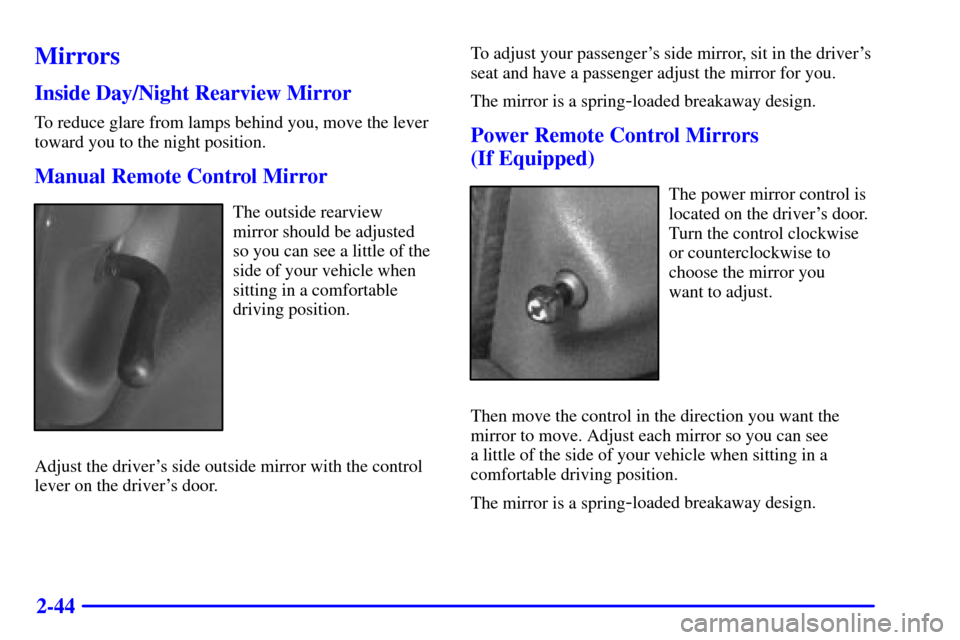
The outside rearview
mirror should be adjusted
so you can see a little of the
side of your vehicle when
sitting in a comfortable
driving position.
Adjust the driver's side outside mirror with the control
lever on the driver's door.To adjust your passenger's side mirror, sit in the driver's
seat and have a passenger adjust the mirror for you.
The mirror is a spring
-loaded breakaway design.
Power Remote Control Mirrors
(If Equipped)
The power mirror control is
located on the driver's door.
Turn the control clockwise
or counterclockwise to
choose the mirror you
want to adjust.
Then move the control in the direction you want the
mirror to move. Adjust each mirror so you can see
a little of the side of your vehicle when sitting in a
comfortable driving position.
The mirror is a spring
-loaded breakaway design.