Page 233 of 364
5-18
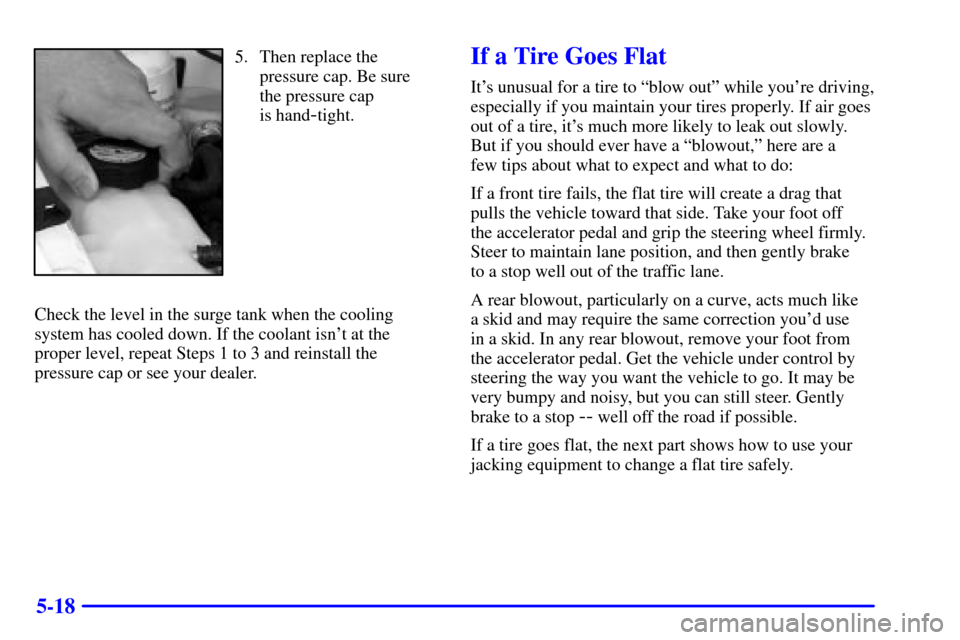
5. Then replace the
pressure cap. Be sure
the pressure cap
is hand
-tight.
Check the level in the surge tank when the cooling
system has cooled down. If the coolant isn't at the
proper level, repeat Steps 1 to 3 and reinstall the
pressure cap or see your dealer.
If a Tire Goes Flat
It's unusual for a tire to ªblow outº while you're driving,
especially if you maintain your tires properly. If air goes
out of a tire, it's much more likely to leak out slowly.
But if you should ever have a ªblowout,º here are a
few tips about what to expect and what to do:
If a front tire fails, the flat tire will create a drag that
pulls the vehicle toward that side. Take your foot off
the accelerator pedal and grip the steering wheel firmly.
Steer to maintain lane position, and then gently brake
to a stop well out of the traffic lane.
A rear blowout, particularly on a curve, acts much like
a skid and may require the same correction you'd use
in a skid. In any rear blowout, remove your foot from
the accelerator pedal. Get the vehicle under control by
steering the way you want the vehicle to go. It may be
very bumpy and noisy, but you can still steer. Gently
brake to a stop
-- well off the road if possible.
If a tire goes flat, the next part shows how to use your
jacking equipment to change a flat tire safely.
Page 239 of 364
5-24
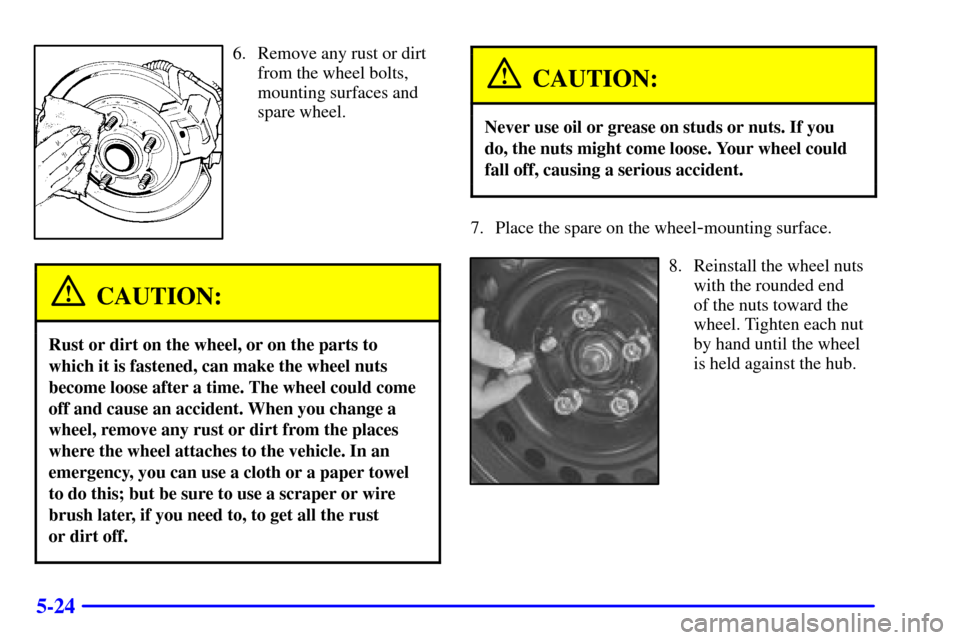
6. Remove any rust or dirt
from the wheel bolts,
mounting surfaces and
spare wheel.
CAUTION:
Rust or dirt on the wheel, or on the parts to
which it is fastened, can make the wheel nuts
become loose after a time. The wheel could come
off and cause an accident. When you change a
wheel, remove any rust or dirt from the places
where the wheel attaches to the vehicle. In an
emergency, you can use a cloth or a paper towel
to do this; but be sure to use a scraper or wire
brush later, if you need to, to get all the rust
or dirt off.
CAUTION:
Never use oil or grease on studs or nuts. If you
do, the nuts might come loose. Your wheel could
fall off, causing a serious accident.
7. Place the spare on the wheel-mounting surface.
8. Reinstall the wheel nuts
with the rounded end
of the nuts toward the
wheel. Tighten each nut
by hand until the wheel
is held against the hub.
Page 245 of 364
5-30
If You're Stuck: In Sand, Mud,
Ice or Snow
In order to free your vehicle when it is stuck, you will
need to spin the wheels, but you don't want to spin your
wheels too fast. The method known as ªrockingº can
help you get out when you're stuck, but you must
use caution.
CAUTION:
If you let your tires spin at high speed, they can
explode, and you or others could be injured.
And, the transaxle or other parts of the vehicle
can overheat. That could cause an engine
compartment fire or other damage. When you're
stuck, spin the wheels as little as possible. Don't
spin the wheels above 35 mph (55 km/h) as shown
on the speedometer.
NOTICE:
Spinning your wheels can destroy parts of your
vehicle as well as the tires. If you spin the wheels
too fast while shifting your transaxle back and
forth, you can destroy your transaxle.
For information about using tire chains on your vehicle,
see ªTire Chainsº in the Index.
Rocking Your Vehicle To Get It Out
First, turn your steering wheel left and right. That will
clear the area around your front wheels. Then shift back
and forth between REVERSE (R) and a forward gear
(or with a manual transaxle, between FIRST (1) or
SECOND (2) and REVERSE (R)), spinning the wheels
as little as possible. Release the accelerator pedal while
you shift, and press lightly on the accelerator pedal
when the transaxle is in gear. By slowly spinning your
wheels in the forward and reverse directions, you will
cause a rocking motion that may free your vehicle. If
that doesn't get you out after a few tries, you may need
to be towed out. If you do need to be towed out, see
ªTowing Your Vehicleº in the Index.
Page 255 of 364
6-9
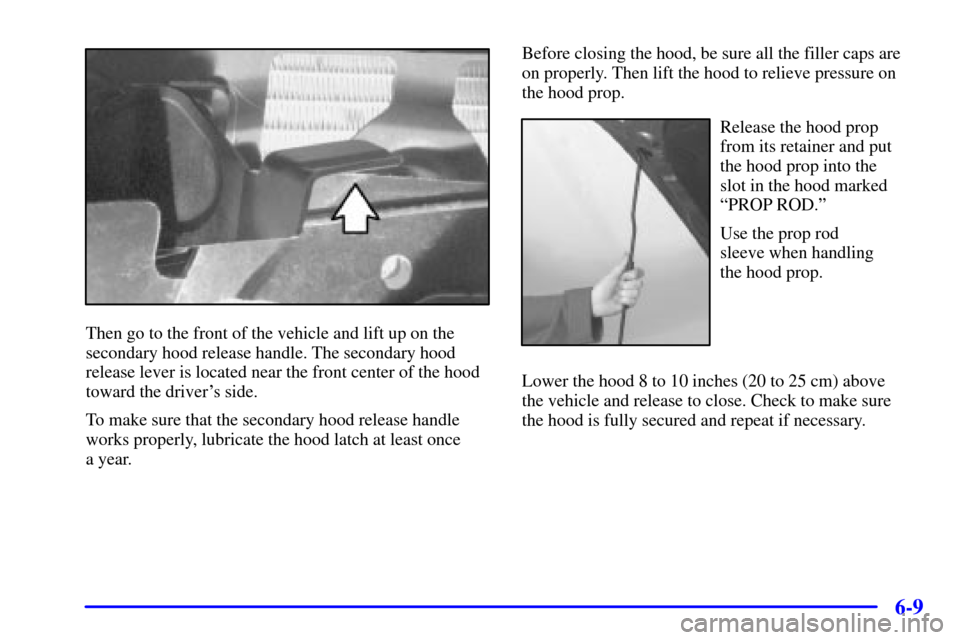
Then go to the front of the vehicle and lift up on the
secondary hood release handle. The secondary hood
release lever is located near the front center of the hood
toward the driver's side.
To make sure that the secondary hood release handle
works properly, lubricate the hood latch at least once
a year.Before closing the hood, be sure all the filler caps are
on properly. Then lift the hood to relieve pressure on
the hood prop.
Release the hood prop
from its retainer and put
the hood prop into the
slot in the hood marked
ªPROP ROD.º
Use the prop rod
sleeve when handling
the hood prop.
Lower the hood 8 to 10 inches (20 to 25 cm) above
the vehicle and release to close. Check to make sure
the hood is fully secured and repeat if necessary.
Page 258 of 364
6-12
Engine Oil
If the oil pressure light appears on the instrument panel,
it means you need to check your engine oil level right
away. For more information, see ªOil Pressure Lightº
in the Index.
You should check your engine oil level regularly; this is
an added reminder.
Checking Engine Oil
It's a good idea to check your engine oil every time you
get fuel. In order to get an accurate reading, the oil must
be warm and the vehicle must be on level ground.
Check the oil here if you
have a 2.2L engine.
2.2L L4 Engine2.4L L4 Engine
Check the oil here if you have a 2.4L engine. The dipstick's
handle will be a yellow ring.
Turn off the engine and give the oil several minutes to
drain back into the oil pan. If you don't, the oil dipstick
might not show the actual level.
Pull out the dipstick and clean it with a paper towel or
cloth, then push it back in all the way. Remove it again,
keeping the tip down, and check the level.
Page 266 of 364
6-20
Then, without shutting off the engine, follow these steps:
1. If you have a
three
-speed
automatic
transaxle, the
handle on the
transaxle dipstick
is a red ring. Pull
out the dipstick and
wipe it with a clean
rag or paper towel.
2. Push it back in all the way, wait three seconds and
then pull it back out again.
3. Check both sides of
the dipstick, and
read the lowerlevel.
The fluid level
must be in the
cross
-hatched area.
4. If the fluid level is in the acceptable range, push the
dipstick back in all the way.
How to Add Fluid
Refer to the Maintenance Schedule to determine what
kind of transaxle fluid to use. See ªRecommended
Fluids and Lubricantsº in the Index.
If the fluid level is low, add only enough of the proper
fluid to bring the level into the cross
-hatched area
on the dipstick.
Page 267 of 364
6-21
1. Pull out the dipstick.
2. Using a long
-neck funnel, add enough fluid at the
dipstick hole to bring it to the proper level.
It doesn't take much fluid, generally less than one
pint (0.5 L). Don't overfill.
NOTICE:
We recommend you use only fluid labeled
DEXRON�-III, because fluid with that label is
made especially for your automatic transaxle.
Damage caused by fluid other than DEXRON
�-III
is not covered by your new vehicle warranty.
3. After adding fluid, recheck the fluid level as
described under ªHow to Check.º
4. When the correct fluid level is obtained, push the
dipstick back in all the way.
Automatic Transaxle Fluid
(Four
-Speed Only)
It is not necessary to check the transaxle fluid level.
A transaxle fluid leak is the only reason for fluid loss.
If a leak occurs, take the vehicle to the dealership
service department and have it repaired as soon as
possible. You may also have your fluid level checked
by your dealer or service center when you have your
oil changed.
Change both the fluid and filter every 50,000 miles
(83 000 km) if the vehicle is mainly driven under one
or more of these conditions:
�In heavy city traffic where the outside temperature
regularly reaches 90�F (32�C) or higher.
�In hilly or mountainous terrain.
�When doing frequent trailer towing.
�Uses such as found in taxi, police or delivery service.
If you do not use your vehicle under any of these
conditions, the fluid and filter do not require changing.
Page 280 of 364
6-34 Headlamps
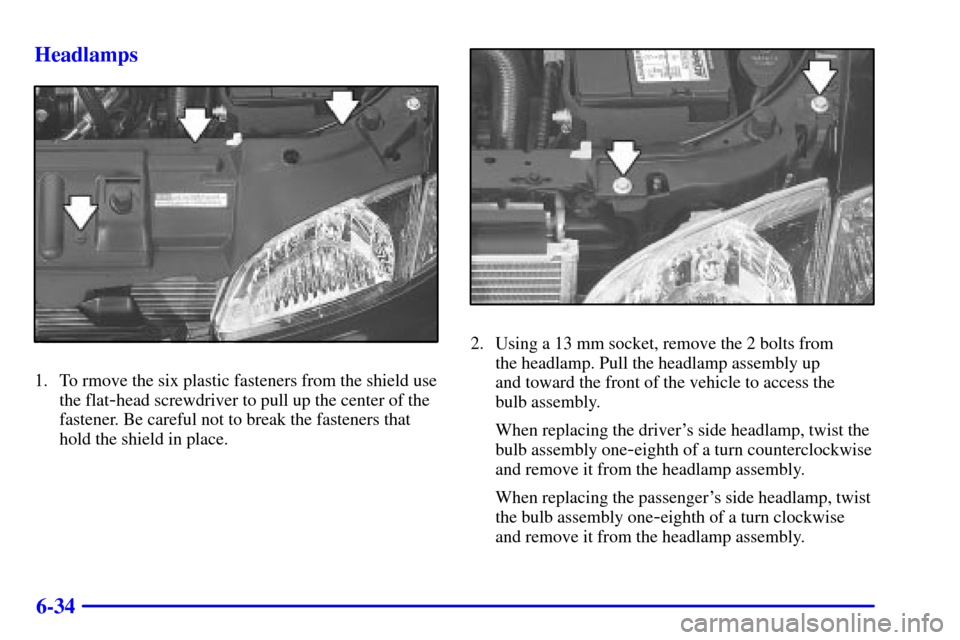
1. To rmove the six plastic fasteners from the shield use
the flat
-head screwdriver to pull up the center of the
fastener. Be careful not to break the fasteners that
hold the shield in place.
2. Using a 13 mm socket, remove the 2 bolts from
the headlamp. Pull the headlamp assembly up
and toward the front of the vehicle to access the
bulb assembly.
When replacing the driver's side headlamp, twist the
bulb assembly one
-eighth of a turn counterclockwise
and remove it from the headlamp assembly.
When replacing the passenger's side headlamp, twist
the bulb assembly one
-eighth of a turn clockwise
and remove it from the headlamp assembly.