Page 210 of 321

4-35 Hitches
It's important to have the correct hitch equipment.
Crosswinds, large trucks going by and rough roads are a
few reasons why you'll need the right hitch. Here are
some rules to follow:
�The rear bumper on your vehicle is not intended for
hitches. Do not attach rental hitches or other
bumper
-type hitches to it. Use only a frame-mounted
hitch that does not attach to the bumper.
�Will you have to make any holes in the body of your
vehicle when you install a trailer hitch? If you do,
then be sure to seal the holes later when you remove
the hitch. If you don't seal them, deadly carbon
monoxide (CO) from your exhaust can get into your
vehicle (see ªCarbon Monoxideº in the Index).
Dirt and water can, too.
Safety Chains
You should always attach chains between your vehicle
and your trailer. Cross the safety chains under the tongue
of the trailer so that the tongue will not drop to the road
if it becomes separated from the hitch. Instructions
about safety chains may be provided by the hitch
manufacturer or by the trailer manufacturer. Follow the
manufacturer's recommendation for attaching safety
chains and do not attach them to the bumper. Always
leave just enough slack so you can turn with your rig.
And, never allow safety chains to drag on the ground.
Trailer Brakes
Because your vehicle has anti-lock brakes, don't try to
tap into the hydraulic brake system. If you do, both
brake systems won't work well, or at all.
Be sure to read and follow the instructions for the trailer
brakes so you'll be able to install, adjust and maintain
them properly.
Page 217 of 321

5-4
1. Check the other vehicle. It must have a 12-volt
battery with a negative ground system.
NOTICE:
If the other system isn't a 12-volt system with a
negative ground, both vehicles can be damaged.
2. Get the vehicles close enough so the jumper cables
can reach, but be sure the vehicles aren't touching
each other. If they are, it could cause a ground
connection you don't want. You wouldn't be able to
start your vehicle and the bad grounding could
damage the electrical systems.
3. Turn off the ignition on both vehicles. Unplug
unnecessary accessories plugged into the cigarette
lighter. Turn off all lamps that aren't needed as well
as the radios. This will avoid sparks and help save
both batteries. In addition, it could save the radio!
4. Open the hoods and locate the batteries. You'll also
need to open the power distribution fuse block cover
to access the positive (+) terminal on the battery
(see arrow).
CAUTION:
An electric fan can start up even when the engine
is not running and can injure you. Keep hands,
clothing and tools away from any underhood
electric fan.
Page 220 of 321
5-7
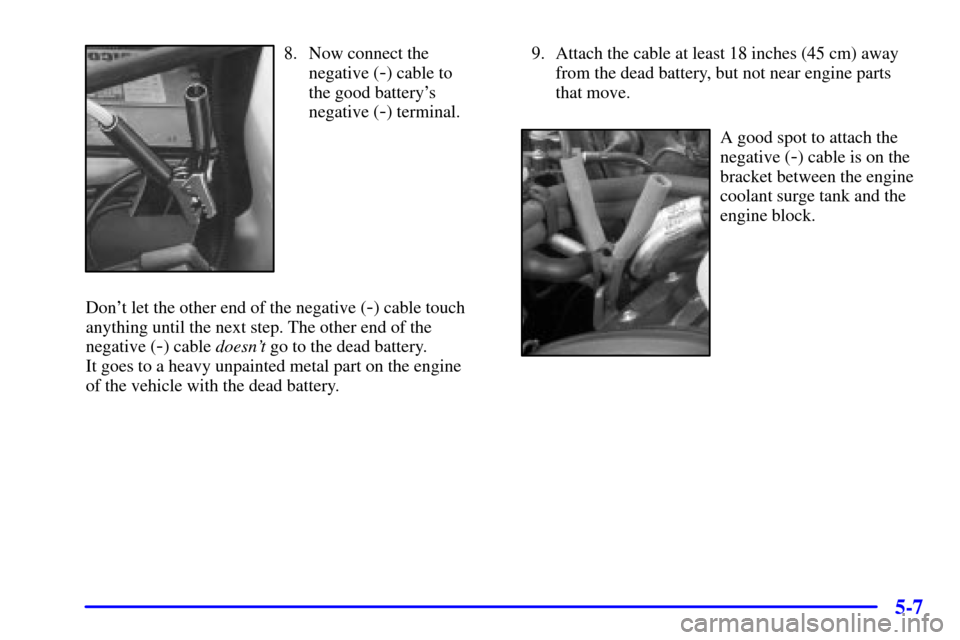
8. Now connect the
negative (
-) cable to
the good battery's
negative (
-) terminal.
Don't let the other end of the negative (
-) cable touch
anything until the next step. The other end of the
negative (
-) cable doesn't go to the dead battery.
It goes to a heavy unpainted metal part on the engine
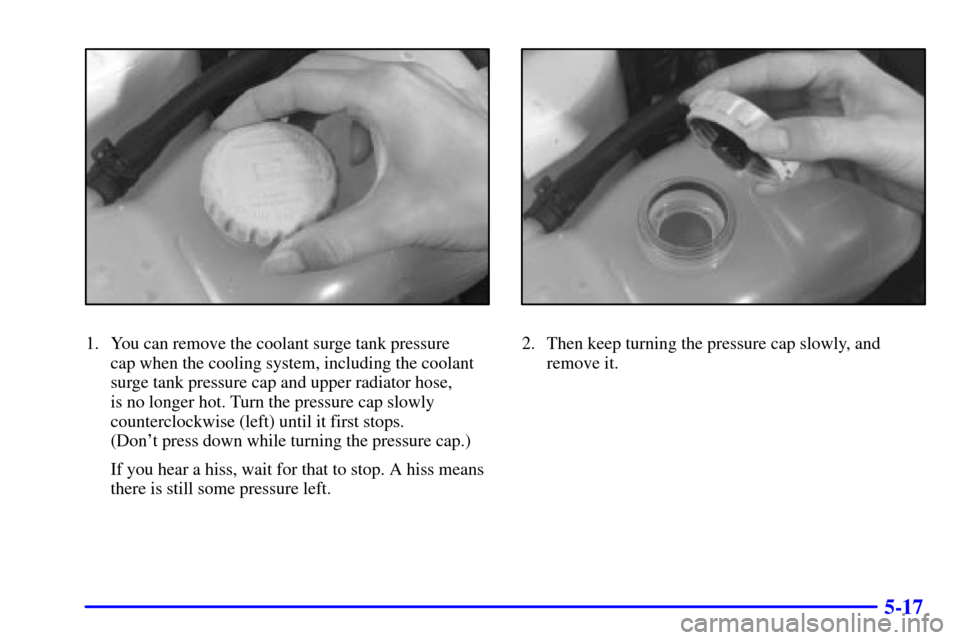
of the vehicle with the dead battery.9. Attach the cable at least 18 inches (45 cm) away
from the dead battery, but not near engine parts
that move.
A good spot to attach the
negative (
-) cable is on the
bracket between the engine
coolant surge tank and the
engine block.
Page 230 of 321
5-17
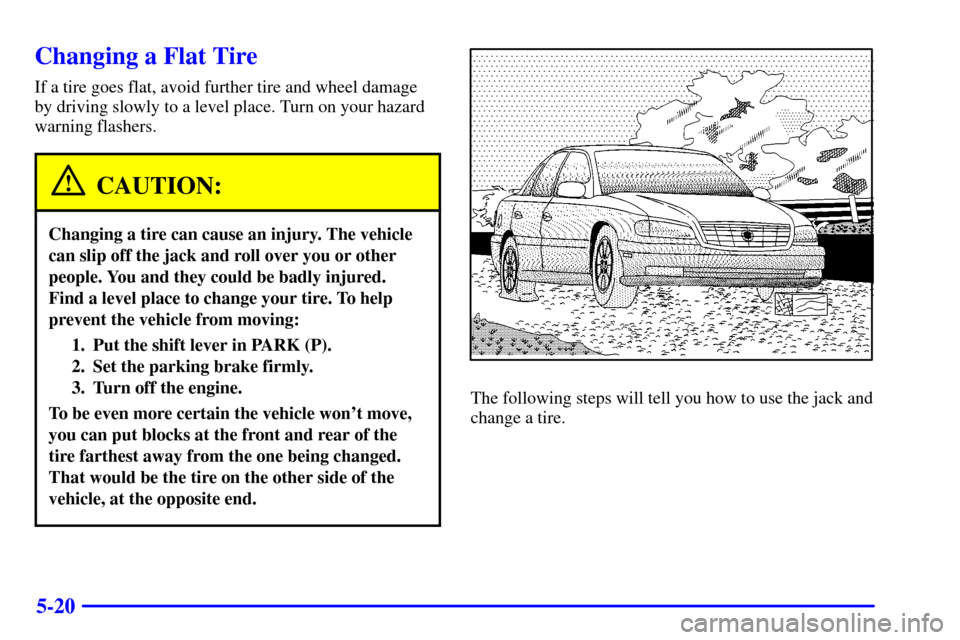
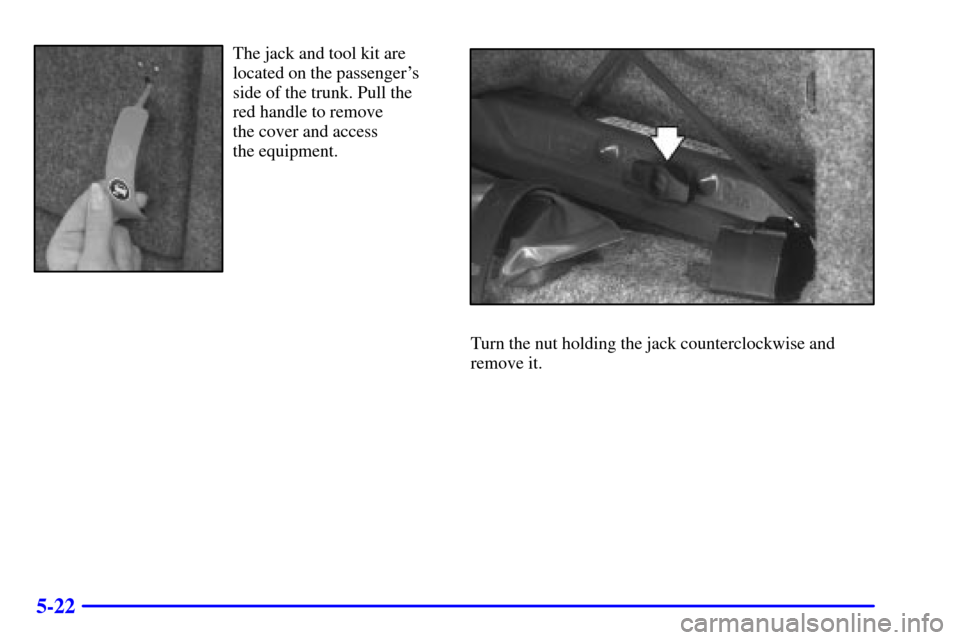
1. You can remove the coolant surge tank pressure
cap when the cooling system, including the coolant
surge tank pressure cap and upper radiator hose,
is no longer hot. Turn the pressure cap slowly
counterclockwise (left) until it first stops.
(Don't press down while turning the pressure cap.)
If you hear a hiss, wait for that to stop. A hiss means
there is still some pressure left.2. Then keep turning the pressure cap slowly, and
remove it.
Page 233 of 321
5-20
Changing a Flat Tire
If a tire goes flat, avoid further tire and wheel damage
by driving slowly to a level place. Turn on your hazard
warning flashers.
CAUTION:
Changing a tire can cause an injury. The vehicle
can slip off the jack and roll over you or other
people. You and they could be badly injured.
Find a level place to change your tire. To help
prevent the vehicle from moving:
1. Put the shift lever in PARK (P).
2. Set the parking brake firmly.
3. Turn off the engine.
To be even more certain the vehicle won't move,
you can put blocks at the front and rear of the
tire farthest away from the one being changed.
That would be the tire on the other side of the
vehicle, at the opposite end.The following steps will tell you how to use the jack and
change a tire.
Page 235 of 321
5-22
The jack and tool kit are
located on the passenger's
side of the trunk. Pull the
red handle to remove
the cover and access
the equipment.
Turn the nut holding the jack counterclockwise and
remove it.
Page 237 of 321
5-24
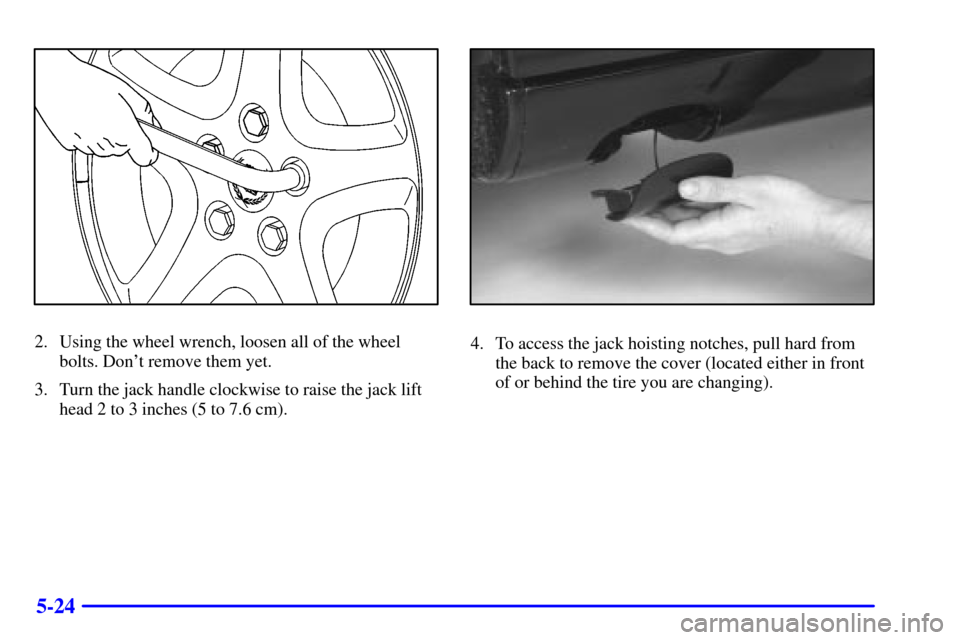
2. Using the wheel wrench, loosen all of the wheel
bolts. Don't remove them yet.
3. Turn the jack handle clockwise to raise the jack lift
head 2 to 3 inches (5 to 7.6 cm).4. To access the jack hoisting notches, pull hard from
the back to remove the cover (located either in front
of or behind the tire you are changing).
Page 239 of 321
5-26
CAUTION:
Getting under a vehicle when it is jacked up is
dangerous. If the vehicle slips off the jack, you
could be badly injured or killed. Never get under
a vehicle when it is supported only by a jack.
CAUTION:
Raising your vehicle with the jack improperly
positioned can damage the vehicle and even make
the vehicle fall. To help avoid personal injury and
vehicle damage, be sure to fit the jack lift head
into the proper location before raising
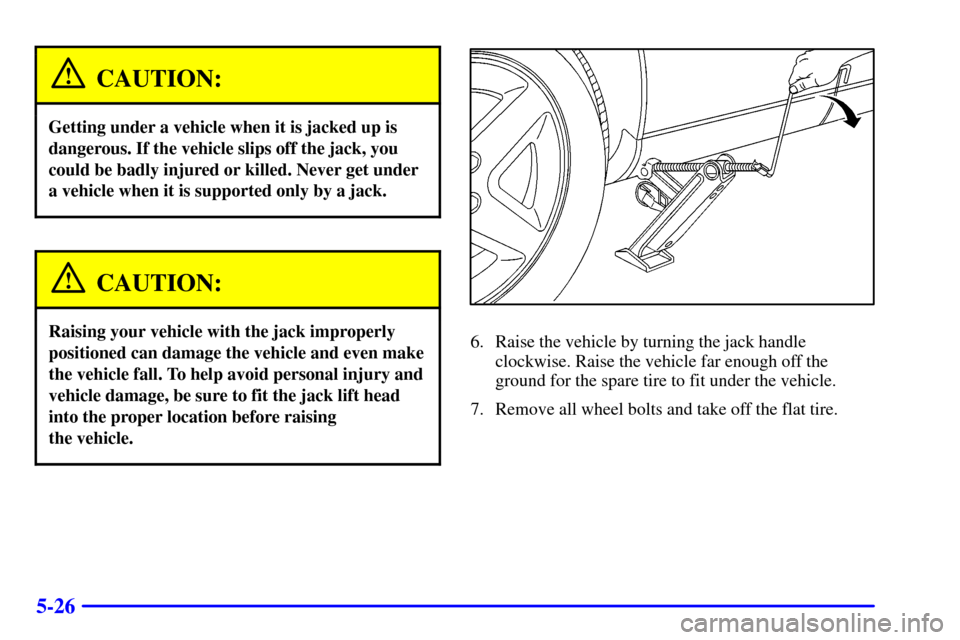
the vehicle.6. Raise the vehicle by turning the jack handle
clockwise. Raise the vehicle far enough off the
ground for the spare tire to fit under the vehicle.
7. Remove all wheel bolts and take off the flat tire.