2000 BMW Z8 brake
[x] Cancel search: brakePage 119 of 172

118n
Caring for your vehicleCaring for the vehicle finish Regular washing is a preventive mea-
sure against long-term effects from
substances that are harmful to the vehi-
cle's finish, especially if you drive your
vehicle in areas with high levels of air
pollution or natural contaminants (tree
resins, pollen).
Nevertheless, you should immediately
remove especially aggressive sub-
stances. Failure to do so can lead to
changes in the paint's chemical struc-
ture or to discoloration. Gasoline spilled
during refueling, oil, grease, brake fluid
and bird droppings should always be
cleaned up immediately.
Any contamination remaining on the
surface of the vehicle will be especially
conspicuous after washing. Use clean-
ing fluid or alcohol and a clean cloth
or cotton pad to remove. Remove tar
spots with tar remover. After cleaning,
the affected areas should be waxed to
ensure continued protection.
Use the cleaning and car-care
products available at your BMW
center.<
Waxing your vehicle Protect the finish using carnauba or
synthetic-based waxes only.
The best way to determine when the
finish needs to be waxed is by noting
when water stops beading on the
surface.
You can use a glass cleaner to remove
any wax or silicone that may have been
left on the windows during waxing.
Use the cleaning and car-care
products available at your BMW
center.<
Repairing the paint You can touch up small areas of paint
damage with a BMW spray paint or a
BMW touchup stick.
The color code of your vehicle is pro-
vided on a tag located near the vehicle
data plate and on the first page of the
Service and Warranty Information
Booklet (US models) or the Warranty
and Service Guide Booklet (Canadian
models).
More extensive paint damage should
be repaired professionally in accor-
dance with the manufacturer's instruc-
tions. Your BMW center uses original
BMW finish materials in accordance
with approved repair procedures.
Page 123 of 172

122n
Storing your vehicle
If you plan on parking the vehicle
for more than three months,
please adhere the maintenance opera-
tions described below.<
Preparations for storageHave your BMW center perform the
following procedures:
1 Clean and apply a rustproofing agent
or other treatment to the engine,
engine compartment, undercarriage,
axles and major components in accor-
dance with approved repair proce-
dures. Wash the vehicle, clean the
interior and treat painted and
chromed parts. Clean the weather-
stripping around the hood, luggage
compartment and doors
2 Change engine oil and oil filter at op-
erating temperature. As an additional
corrosion protection measure, an an-
ticorrosive agent can be added to the
engine in accordance with the manu-
facturer's instructions
3 Check the coolant level and concen-
tration and top off if necessary
4 Check the fluid level of the wind-
shield washer fluid reservoir; top off
if necessary
5 Fill the fuel tank completely to pre-
vent the formation of condensation
6 Increase the tire inflation pressure to
51 psi (350 kPa).Before parking the vehicle1 Dry the parking brake and footbrake
by brake applications to prevent the
brake discs and drums from
corroding
2 Park the vehicle in a covered, dry,
and well-ventilated area. Place the
transmission in first gear or, if neces-
sary, chock the wheels to prevent the
vehicle from rolling. Do not engage
the parking brake
3 Remove the battery, charge it com-
pletely and store it in a cool (but
frost-free) room
4 Remove the hardtop and store it
separately, refer to page 95
5 Close the convertible top.During storageRecharge a battery that has been taken
out of the car every six months. If it is
not recharged, it will not be serviceable.
Every time the battery is discharged,
especially over extended periods, its
service life is reduced.
Removing the vehicle from
storageRecharge the battery if the "Magic Eye"
turns black, refer to page 136.
Then have Inspection I performed by
your BMW center, including a brake
fluid replacement, if necessary. Refer to
the Service and Warranty Information
Booklet (US models) or the Warranty
and Service Guide Booklet (Canadian
models).
Page 130 of 172

129n
IndexDataTechnologyRepairsCar careControlsOverview
Lamps and bulbs The lamps and bulbs make essential
contributions to the safety of your vehi-
cle. Therefore, comply fully with the fol-
lowing instructions during bulb replace-
ment. If you are not familiar with any of
the procedures, consult your BMW
center.
Do not touch the glass portion of
a new bulb with your bare hands
since even small amounts of impurities
burn into the surface and reduce the
service life of the bulb. Use a clean
cloth, paper napkin, or a similar material,
or hold the bulb by its metallic base.<
A replacement bulb set is available from
your BMW center.
Whenever working on the electri-
cal system, switch off the electri-
cal accessory you are working on or
disconnect the cable from the negative
terminal of the battery. Failure to do this
could result in short circuits.
To prevent injuries and damage, com-
ply with any instructions provided by
the bulb manufacturer.<
When cleaning the headlamps,
please observe the following:
>Do not clean by wiping with a dry
cloth. Never use abrasives or strong
solvents to clean the covers
>Remove dirt and contamination (such
as insects) by soaking with BMW Car
Shampoo and then rinsing with plenty
of water
>Always use a deicer spray to remove
accumulated ice and snow Ð never
use a scraper.<
Xenon lamps
The main headlamps for your BMW
Z8 roadster have been designed using
xenon-light technology. The service life
of these bulbs is very long and the
probability of a failure is very low, pro-
vided that they are not switched on and
off an unusual number of times.
Should a lamp ever fail, however,
please contact your BMW center for
assistance.
Because of the extremely high
voltages involved, any work on the
lighting system should be performed
only by authorized technicians. Failure
to comply with this creates a risk of
fatal injury.<
Neon lampsThe front turn signal indicators (side
marker lamps), the rear turn signal indi-
cators, the rear and brake lamps, as
well as the high-mount brake lamp, are
of neon-light technology. The service
life for these lamps is very high and the
likelihood of failure very minimal.
Should a lamp ever fail, however,
please contact your BMW center for
assistance.
Page 131 of 172

130n
Lamps and bulbsSide turn signal indicators5 watt bulb
Please contact a BMW center in the
event of a malfunction.Side lamps5 watt bulb
Please contact a BMW center in the
event of a malfunction.
Taillamps 1 Turn signal indicators red
2 Taillamp/Brake lamp red
3 High-mounted brake lamp red
4 Backup lamp red/white
5 Rear foglamp red
6 Reflector red520us010
Side marker lamps rearPlease contact a BMW center in the
event of a malfunction.520us011
Page 146 of 172
145n
IndexDataTechnologyRepairsCar careControlsOverview
Towing
Avoid "off-center" towing. Be sure
that the tow rope is pulled tightly
when the towing vehicle begins to
move.<
The towed vehicle should always
be the lighter of the two vehicles.
If this is not the case, it is no longer
possible to control vehicle response.<
Tow-startingFor instructions on jump starting, refer
to page 143.
Never attempt to use your vehicle to
push another vehicle, since damage to
the energy-absorbing bumpers could
result.
Towing a vehicle1 Put the manual-shift gear lever in
neutral
2 Towing speed:
Max. 45 mph (70 km/h)
3 Towing distance:
Max. 95 miles (150 km)
4 Leave the ignition key at position 1 to
ensure that the brake lamps, turn sig-
nals, horn and windshield wipers
remain operative, and to prevent the
steering lock detent from engaging
5 Switch on the hazard-warning system
(comply with country-specific regula-
tions).
Find some means of identifying the
vehicle in tow, e. g. place a sign or
warning triangle in the rear window.
Make sure that the ignition key re-
mains in position 1 even when the
electrical system has failed to prevent
the steering lock from engaging. The
steering and brakes are without power
assist when the engine is not running.
This means that increased effort is
required for steering and braking.<
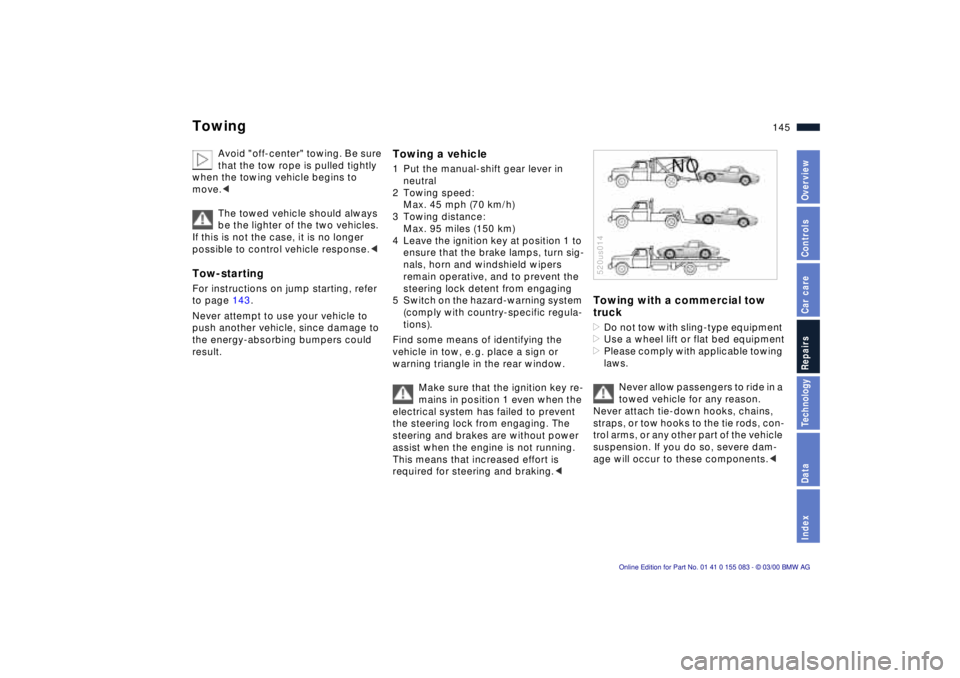
Towing with a commercial tow
truck>Do not tow with sling-type equipment
>Use a wheel lift or flat bed equipment
>Please comply with applicable towing
laws.
Never allow passengers to ride in a
towed vehicle for any reason.
Never attach tie-down hooks, chains,
straps, or tow hooks to the tie rods, con-
trol arms, or any other part of the vehicle
suspension. If you do so, severe dam-
age will occur to these components.<520us014
Page 150 of 172

149n
IndexDataTechnologyRepairsCar careControlsOverview
Highly sensitive sensors monitor the
number of revolutions of the wheels,
steering angle, lateral acceleration,
brake pressure and the movement
of the vehicle around its vertical axis.
If differences in wheel speed should
occur, the system will recognize the
danger this loss of traction causes and
reduce the drive torque going to the
wheels. The system will also apply the
brakes specifically to the rear wheels,
if necessary.
In addition, DSC permanently monitors
the vehicle's current operating condi-
tion and compares it with an ideal con-
dition that is calculated from the sen-
sor's signals. If differences such as
under- or oversteering should occur,
DSC will stabilize the vehicle in frac-
tions of a second by reducing engine
power output, applying the brakes to
individual rear wheels Ð and to specific
front wheels, too, if necessary. As a
result, dangerous skids can be pre-
vented even as they are beginning.You may need some time to become
accustomed to this system's interven-
tion. However, it provides optimum
drive force and vehicle stability.
The braking intervention may be
accompanied by sounds specific to
the system.
The safety belt tensioner responds to
severe frontal collisions by tightening
the belt to ensure that occupants
remain firmly positioned in their seats.
A gas-pressure system retracts the
buckle assembly to tension the shoul-
der and lap belts within fractions of a
second. This reduces the tendency to
slide under the lap belt.
520de148
DSC Safety belt tensioner
Page 163 of 172

Everything from A to ZA
ABS (Antilock Brake
System)19,86
Accessories4
Activated charcoal filter73
Adding engine oil109
Adding washer
fluid108,157
Adjusting the
temperature72
Adusting seats43
Air conditioner70
Air distribution72
Air nozzles70
Air outlets70
Air pressure96
Air supply72
Airbags19,49,121,148
Alarm system36
Antenna92
Antifreeze111
Antilock Brake System
(ABS)19,86
Anti-theft alarm system36
Anti-theft protection30
Aquaplaning85,97
Ashtray79
Attach vehicle vacuum
cleaner80
Automatic car washes115
Automatic speed control59 Automatic windshield
washer58
Avoiding unwanted
alarm37
Axle loads156
B
Backrest, unlock44
Backup lamps56
bulb replacement130
Battery136,158
charge137
discharged143
Battery capacity158
Battery charge current18
Belts48
Beverage can holder78
Blower72
BMW High Performance
Synthetic Oil110
Bore154
Brake fluid112
Brake hydraulic system18
Brake pads20
Brakes88
brake faults89
Breaking in the vehicle84
Bulb replacement129 C
California Proposition 65
Warning123 Can holder78
Car Memory46
Car radio62,92
refer also to the car radio
Owner's Manual
Car radio
reception92,148
Car telephone79
Car wash115
Care
exterior117
interior119
Caring for the vehicle
finish118
Catalytic converter85
CBC (Cornering Brake
Control)19
CD mode, refer to the radio
Owner's Manual
Cellular phone92
refer also to "Radio and
Information Systems
Owner's Manual"
Central locking system30
key34
Changing the oil filter157
Check air pressure24
Child restraint systems51
Child seat safety52
Child seats51
Cigarette lighter80
Clock62
Cockpit14 Code, refer to the radio
Owner's Manual
Combination switch56
Compartments76,77
Compartments for stowing
items76
Compression154
Configuring the settings46
Connector for On-Board-
Diagnostics124
Consumption display60
Controls14
Convertible top39
closing after an electrical
malfunction141
Coolant111,157
Coolant temperature
gauge61
Cornering Brake Control
(CBC)19
Cruise control59
Curb weight156
Current check indicator18
D
Dashboard14
Data
dimensions155
engine154
technical154
weights156
A-Z
Page 164 of 172

Everything from A to Z
163n
IndexDataTechnologyRepairsCar careControlsOverview
Daytime running lamps
switch67
Daytime-driving lamp
switch67
DBC (Dynamic Brake
Control)88
Defrost position73
Defroster, rear
window58,73
Defrosting the windows73
Dimensions155
Dipstick109
Disc brakes88
Displacement154
Display lighting67
Displays16
Door keys28
Door warning lamp
bulb replacement132
Doors
emergency actuation30
remote control31
unlocking and locking30
DOT Quality Grades98
Draft-free ventilation73
Drive belts158
Driving hints85
Driving lamps67
DSC (Dynamic Stability
Control)20,63,149
Dynamic Brake Control
(DBC)88 Dynamic Stability Control
(DSC)20,63,149
E
Electric power seat
adjustment43
Electric power windows38
Electrical defect
passenger-side door141
Electrical equipment
failure138
Electrical system158
Electronic vehicle
immobilizer29
Emergency actuation
doors30
Emergency operation
fuel filler door140
passenger-side door141
Engine compartment106
Engine coolant111
Engine cooling157
Engine data154
Engine oil109
consumption109
fill capacity157
quality110
specifications110
viscosity110
Engine oil level19
check109
Engine oil pressure18 Engine output154
Engine speed154
Engine, starting54
Exit lamps
bulb replacement132
Exterior mirrors45
F
Fault, ABS87
Fill capacities157
Filler cap cover23
Filling capacities157
Filling the washer
reservoir157
Filling the windshield washer
reservoir157
First aid22
First-aid kit22
Fittings, tow starting and
towing144
Flashlight77
Flat tire135
Foglamps
bulb replacement131
Follow-Me-Home lamps67
Footbrake88
Footwell lamps68
bulb replacement132
For car phones and
telephones, please refer to
the manufacturer's
Owner's Manual Front seat adjustment43
Frost protection,
radiator111
Fuel24
preparation154
Fuel filler door
release after an electrical
defect140
Fuel gauge60
Fuel indicator60
Fuel quality24
Fuel tank capacity157
Fuses138
G
Gasoline24
Glove compartment76
Glove compartment lamp
bulb replacement133
Gross vehicle weight156 H
Handbrake55
Handsfree system79
Hardtop94
Hazard warning flashers22
Hazard warning triangle22
Head restraint44
Headlamp covers,
care115,129
Headlamp flasher68