2000 BMW 540I SEDAN ABS
[x] Cancel search: ABSPage 11 of 217

11n
Controls and features
Operation, care and maintenance
Lamps:
Parking lamps/Low beams94
Instrument lighting94
High beams/Parking lamps95
Fog lamps95
Interior lamps96
Reading lamps96
Controlling the climate
for pleasant driving:
Automatic climate control98
Seat heating 103
Steering wheel heating 103
Roller sun blind 104
Independent ventilation
system 104
Cabin convenience:
BMW Universal Transmitter 105
Glove compartment108
Storage facilities108
Cellular phone 109
Beverage holder 109
Ashtray, front110
Cigarette lighter 110
Ashtray, rear111
Loading and transporting cargo:
Through-loading system 112
Ski bag 113
sport wagon:
Luggage compartment 116
Roll-up cover 116
Separation net 116
Storage areas in the luggage
compartment 118
Cargo loading120
Roof-mounted luggage rack121
Special operating instructions:
Break-in procedure124
Driving notes125
Catalytic converter126
Antilock Brake System
(ABS)127
Disc brakes128
Brake system130
Winter operation130
Power steering132
Level control system 132
Cellular phone 133
Radio reception133
Wheels and tires:
Tire inflation pressure134
Tire condition134
Tire replacement135
Tire rotation136
Wheel and tire
combinations137
Winter tires138
Snow chains 139
Approved wheel and tire
specifications 140
Page 19 of 217

19n
RepairsIndexOverview Controls Car care Technology Data
Instrument cluster
There are two versions, depending on
the equipment on your vehicle
1 Fuel gauge with indicator lamp for
fuel reserve 83
2 Indicator lamp for turn signals 24
3 Speedometer
4 Indicator lamp for high beams 24
5 Tachometer and
Energy Control 83
6 Engine coolant thermometer with
"Coolant temperature too high"
indicator 84
7 Indicator and warning lamps for:
>
Parking brake/Brake hydraulic
system, Dynamic Brake Control
(DBC)
*
22, 23
>
Antilock Brake System (ABS) 23
>
Brake pads 23
>
Tire Pressure Control (RDC)
*
23
>
Airbags 23
>
Automatic transmission
*
23
>
Please fasten safety belts 23
>
Cruise control 24
8 Selector lever and program display
for automatic transmission
*
71, 74
9 Service Interval Display 8410 Display for onboard computer
(operation via the turn signal lever,
refer to page 88):
>
Outside temperature
>
Average fuel consumption
>
Cruising range
>
Average speed
11 Indicator lamp for Automatic
Stability Control plus Traction
(ASC+T)/Dynamic Stability
Control (DSC)
*
24
12 Indicator lamp for level control
system
*
23
13 Odometer and trip odometer 82
14 Indicator for Check Control 85
15 Reset button for trip odometer 82
16 Indicator and warning lamps for:
>
Fog lamps 24
>
Battery charge current 22
>
Engine oil level/Engine oil
pressure 22, 23
>
Electronic Engine Power
Control (EML) 24
>
CHECK ENGINE lamp 24
Page 21 of 217

21n
RepairsIndexOverview Controls Car care Technology Data
Instrument cluster
*
There are two versions, depending on
the equipment on your vehicle
1 Fuel gauge with indicator lamp for
fuel reserve 83
2 Indicator lamp for turn signals 24
3 Speedometer
4 Indicator lamp for high beams 24
5 Tachometer and
Energy control 83
6 Engine coolant temperature
gauge 84
7 Indicator and warning lamps for:
>
Parking brake 23
>
Brake hydraulic system, Dynamic
Brake Control (DBC)
*
22, 23
>
Antilock Brake System (ABS) 23
>
Airbags 23
>
Please fasten safety belts 23
>
Cruise control 24
8 CHECK button 85
9 Selector lever and program display
for automatic transmission
*
71, 7410 Outside temperature display 82
11 Indicator lamp for Automatic
Stability Control plus Traction
(ASC+T)/Dynamic Stability
Control (DSC)
*
24
12 Trip odometer 82
13 Indicator for Check Control 85
14 Odometer 82
15 Service Interval Display 84
16 Reset button for trip odometer 82
17 Indicator and warning lamps for:
>
Fog lamps 24
>
Battery charge current 22
>
Engine oil pressure 22
>
CHECK ENGINE lamp 24
Page 23 of 217
23n
RepairsIndexOverview Controls Car care Technology Data
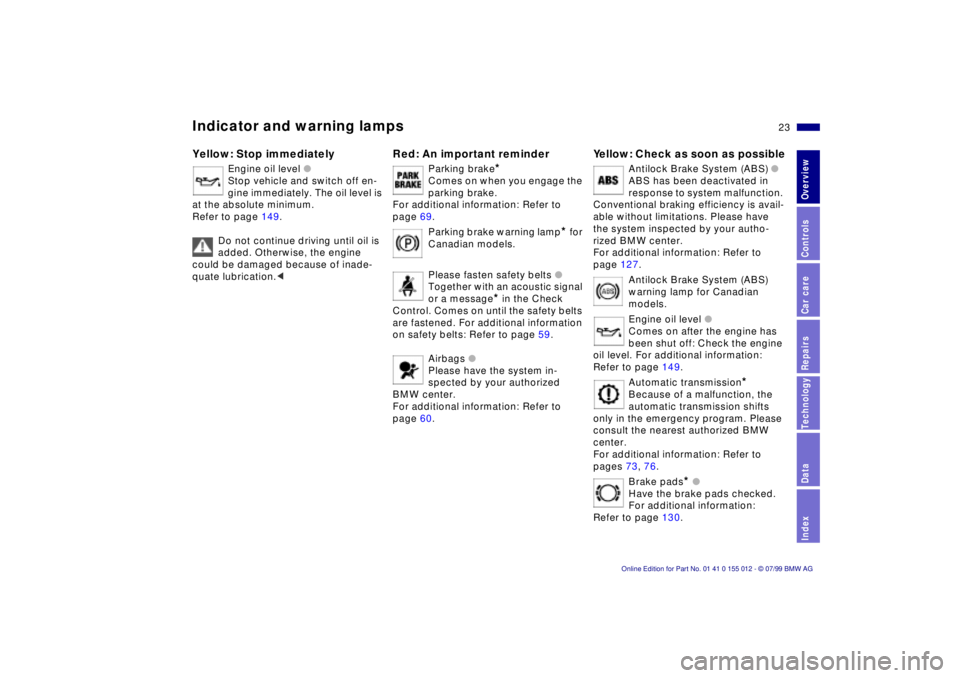
Indicator and warning lampsYellow: Stop immediately
Engine oil level l
Stop vehicle and switch off en-
gine immediately. The oil level is
at the absolute minimum.
Refer to page 149.
Do not continue driving until oil is
added. Otherwise, the engine
could be damaged because of inade-
quate lubrication.<
Red: An important reminder
Parking brake
*
Comes on when you engage the
parking brake.
For additional information: Refer to
page 69.
Parking brake warning lamp
* for
Canadian models.
Please fasten safety belts l
Together with an acoustic signal
or a message
* in the Check
Control. Comes on until the safety belts
are fastened. For additional information
on safety belts: Refer to page 59.
Airbags l
Please have the system in-
spected by your authorized
BMW center.
For additional information: Refer to
page 60.
Yellow: Check as soon as possible
Antilock Brake System (ABS) l
ABS has been deactivated in
response to system malfunction.
Conventional braking efficiency is avail-
able without limitations. Please have
the system inspected by your autho-
rized BMW center.
For additional information: Refer to
page 127.
Antilock Brake System (ABS)
warning lamp for Canadian
models.
Engine oil level l
Comes on after the engine has
been shut off: Check the engine
oil level. For additional information:
Refer to page 149.
Automatic transmission
*
Because of a malfunction, the
automatic transmission shifts
only in the emergency program. Please
consult the nearest authorized BMW
center.
For additional information: Refer to
pages 73, 76.
Brake pads
* l
Have the brake pads checked.
For additional information:
Refer to page 130.
Page 43 of 217
43n
RepairsIndexOverview Controls Car care Technology Data
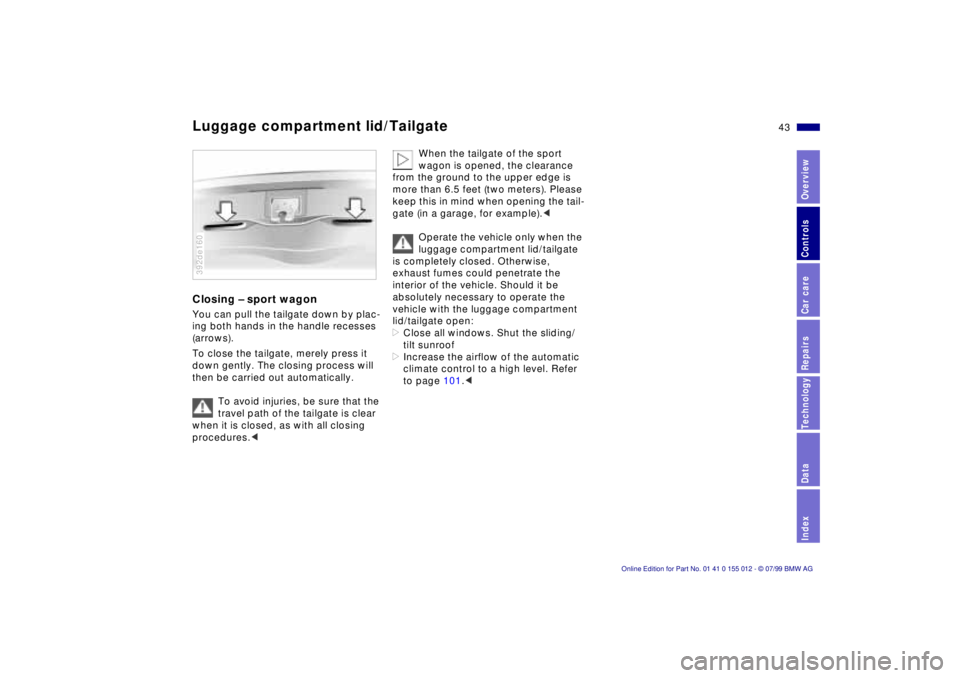
Luggage compartment lid/TailgateClosing Ð sport wagonYou can pull the tailgate down by plac-
ing both hands in the handle recesses
(arrows).
To close the tailgate, merely press it
down gently. The closing process will
then be carried out automatically.
To avoid injuries, be sure that the
travel path of the tailgate is clear
when it is closed, as with all closing
procedures.< 392de160
When the tailgate of the sport
wagon is opened, the clearance
from the ground to the upper edge is
more than 6.5 feet (two meters). Please
keep this in mind when opening the tail-
gate (in a garage, for example).<
Operate the vehicle only when the
luggage compartment lid/tailgate
is completely closed. Otherwise,
exhaust fumes could penetrate the
interior of the vehicle. Should it be
absolutely necessary to operate the
vehicle with the luggage compartment
lid/tailgate open:
>Close all windows. Shut the sliding/
tilt sunroof
>Increase the airflow of the automatic
climate control to a high level. Refer
to page 101.<
Page 123 of 217
Overview
Controls and features
Operation, care
and maintenance
Owner service procedures
Technical data
Index Advanced technology
123n
RepairsIndexOverview Controls Car care Technology Data
Under the hood:
Hood143
Engine compartment144
Washer fluids148
Washer nozzles148
Engine oil149
Coolant151
Brake fluid152
Vehicle Identification
Number153
Care and maintenance:
The BMW Maintenance
System154
Caring for your car155
Airbags160
Vehicle storage160
Laws and regulations:
Technical modifications161
OBD connector162 Special operating instructions:
Break-in procedure124
Driving notes125
Catalytic converter126
Antilock Brake System
(ABS)127
Disc brakes128
Brake system130
Winter operation130
Power steering132
Level control system132
Cellular phone133
Radio reception133
Wheels and tires:
Tire inflation pressure134
Tire condition134
Tire replacement135
Tire rotation136
Wheel and tire
combinations137
Winter tires138
Snow chains139
Approved wheel and tire
specifications140
Page 127 of 217

127n
RepairsIndexOverview Controls Car care Technology Data
Antilock Brake System (ABS)The conceptABS enhances active safety by helping
to prevent the wheels from locking un-
der braking. The reason: Locked wheels
are dangerous. When the front wheels
slide, the driver loses steering control
over the vehicle. Traction loss at the
rear wheels can cause the rear end to
break into an uncontrolled skid.
ABS is designed to meet two essential
requirements during every brake appli-
cation:
>To help provide vehicle stability
>To help retain steering and maneu-
vering capability on all types of road
surface (asphalt, cement, dirt, mois-
ture, snow and ice).
The system can achieve the shortest
braking distances possible under most
conditions (on straight-away and in
curves, on asphalt, ice, wet road sur-
faces, etc.).
Braking with ABSThe system becomes operative once
the vehicle exceeds a speed of approx.
6 mph (10 km/h). The ABS is deacti-
vated whenever the vehicle's speed
drops back below approx. 4 mph
(6 km/h). This means that the wheels
can lock in the final phase of a brake
application Ð a factor of no significance
in actual use.
If you are in a situation which requires
full braking, you will exploit the full ben-
efits of the ABS system if you apply
maximum brake pressure ("panic stop").
Since the vehicle maintains steering re-
sponsiveness, you can avoid possible
obstacles with a minimum of steering
effort, despite the full brake application.
The ABS system closed-loop control
circuit cycles in fractions of a second.
A pulsation at the brake pedal indicates
to the driver that ABS is active, that is,
that the vehicle is within its maximum
braking range. In addition, the audible
pulsation that accompanies the control
operation calls the attention of the
driver to the reduced traction between
the tires and the road surface (slippery
road surface), and serves as a reminder
that the speed of the car should be re-
duced to adapt to road conditions.On road surfaces which have a loose
layer on a firm base (on gravel or snow,
for instance), the braking distances with
ABS may be longer than with the
wheels locked. The same applies when
snow chains have been mounted. How-
ever, ABS continues to provide en-
hanced vehicle stability and steering re-
sponse under these conditions.
Page 128 of 217

128n
Antilock Brake System (ABS) Disc brakesInformation for your safetyNot even ABS can suspend the laws of
physics. ABS alone cannot prevent
accidents when the brakes are applied
without an adequate safety interval
between vehicles, if the car is driven at
an excessive rate of speed in curves, or
if aquaplaning occurs. Responsibility for
these types of situations remains in the
hands (and at the feet) of the driver.
You should never allow the added
safety of ABS to lull you into a false
sense of security, or mislead you into
taking increased risks that could affect
your own safety and that of others.
Do not make any modifications to
the ABS system.
Service procedures on ABS are to be
performed by authorized technicians
only.<
In the event of a fault
If the ABS warning lamp in the
instrument cluster comes on,
refer to page 23. The brake
system then reverts to conven-
tional operation as on vehicles
without ABS. However, have the
brake system checked by your BMW
center as soon as possible. To prevent
undetected defects and cumulative
faults from adversely affecting the brake
system, refer any problems to your
authorized BMW center at the earliest
opportunity.
Disc brakes furnish optimum decelera-
tion and braking control and greater
fade resistance under heavy use.
When the vehicle is driven only occa-
sionally, during extended periods when
the vehicle is not used at all, and in
operating conditions where brake appli-
cations are less frequent, there is an
increased tendency for corrosion of the
rotors and accumulation of contamina-
tion on the brake pads. This occurs
because the minimal pressure which
must be exerted by the pads during
brake applications to clean the rotors is
not reached.
If the brake rotors are corroded, they
will tend to respond to braking with a
pulsating effect which even extended
application will fail to cure.
For your own safety: Use only
brake pads that BMW has
approved for your specific vehicle
model. BMW cannot evaluate non-
approved brake pads to determine if
they are suited for use, and therefore
cannot ensure the operating safety of
the vehicle if they are installed.<