Page 64 of 189
62n
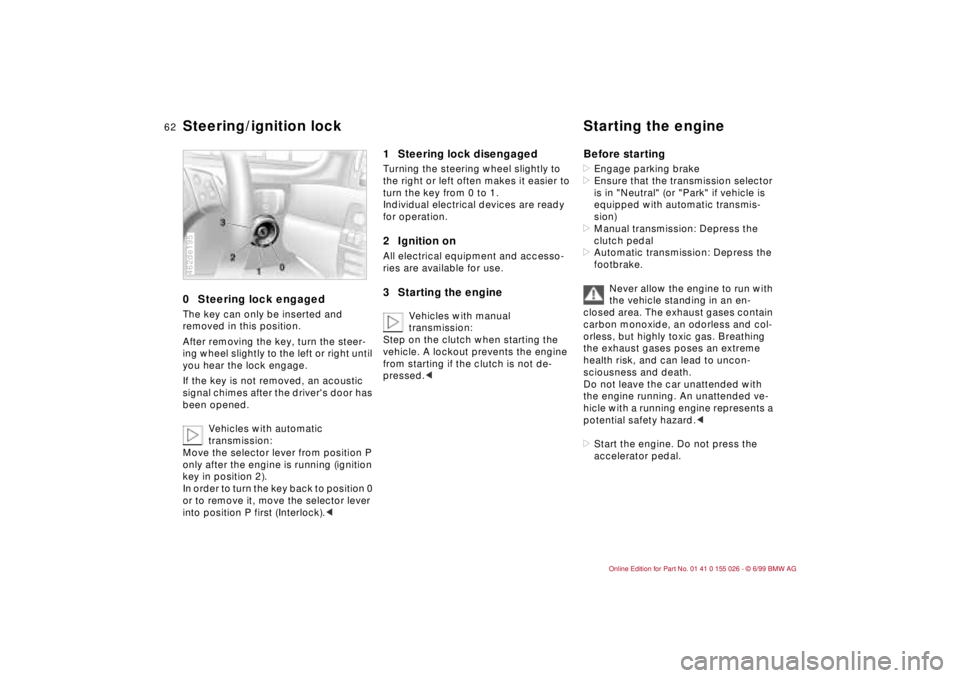
0 Steering lock engaged The key can only be inserted and
removed in this position.
After removing the key, turn the steer-
ing wheel slightly to the left or right until
you hear the lock engage.
If the key is not removed, an acoustic
signal chimes after the driver's door has
been opened.
Vehicles with automatic
transmission:
Move the selector lever from position P
only after the engine is running (ignition
key in position 2).
In order to turn the key back to position 0
or to remove it, move the selector lever
into position P first (Interlock).<462de195
1 Steering lock disengaged Turning the steering wheel slightly to
the right or left often makes it easier to
turn the key from 0 to 1.
Individual electrical devices are ready
for operation.2 Ignition onAll electrical equipment and accesso-
ries are available for use.3 Starting the engine
Vehicles with manual
transmission:
Step on the clutch when starting the
vehicle. A lockout prevents the engine
from starting if the clutch is not de-
pressed.c
Before starting>Engage parking brake
>Ensure that the transmission selector
is in "Neutral" (or "Park" if vehicle is
equipped with automatic transmis-
sion)
>Manual transmission: Depress the
clutch pedal
>Automatic transmission: Depress the
footbrake.
Never allow the engine to run with
the vehicle standing in an en-
closed area. The exhaust gases contain
carbon monoxide, an odorless and col-
orless, but highly toxic gas. Breathing
the exhaust gases poses an extreme
health risk, and can lead to uncon-
sciousness and death.
Do not leave the car unattended with
the engine running. An unattended ve-
hicle with a running engine represents a
potential safety hazard.<
>Start the engine. Do not press the
accelerator pedal.
Steering/ignition lock Starting the engine
Page 66 of 189
64n
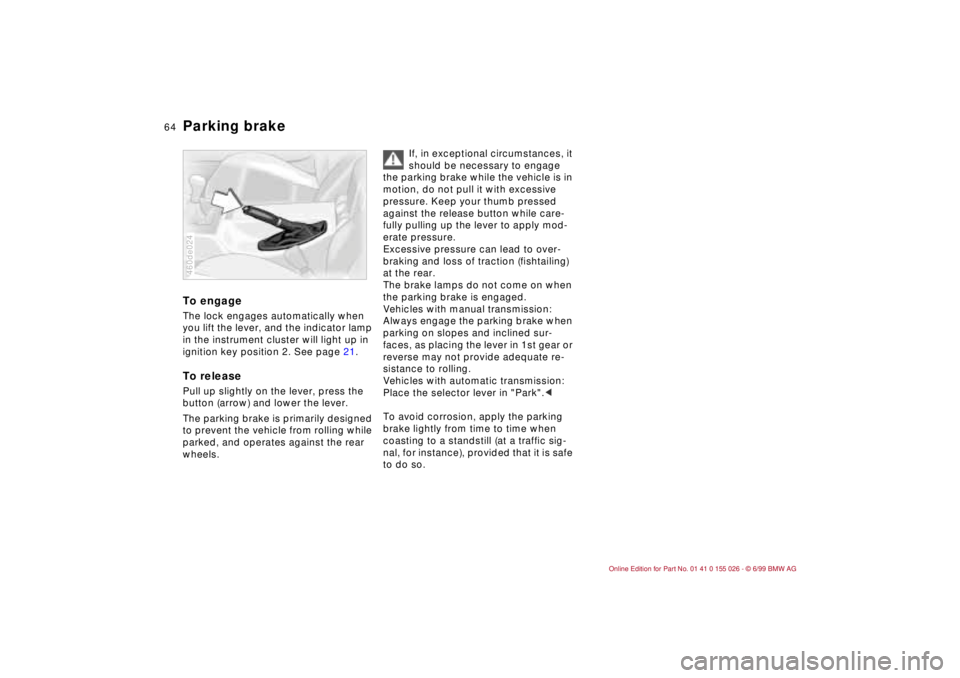
Parking brake To engageThe lock engages automatically when
you lift the lever, and the indicator lamp
in the instrument cluster will light up in
ignition key position 2. See page 21.To releasePull up slightly on the lever, press the
button (arrow) and lower the lever.
The parking brake is primarily designed
to prevent the vehicle from rolling while
parked, and operates against the rear
wheels.460de024
If, in exceptional circumstances, it
should be necessary to engage
the parking brake while the vehicle is in
motion, do not pull it with excessive
pressure. Keep your thumb pressed
against the release button while care-
fully pulling up the lever to apply mod-
erate pressure.
Excessive pressure can lead to over-
braking and loss of traction (fishtailing)
at the rear.
The brake lamps do not come on when
the parking brake is engaged.
Vehicles with manual transmission:
Always engage the parking brake when
parking on slopes and inclined sur-
faces, as placing the lever in 1st gear or
reverse may not provide adequate re-
sistance to rolling.
Vehicles with automatic transmission:
Place the selector lever in "Park".<
To avoid corrosion, apply the parking
brake lightly from time to time when
coasting to a standstill (at a traffic sig-
nal, for instance), provided that it is safe
to do so.
Page 67 of 189
65n
RepairsIndexOverview Controls Car care Technology Data
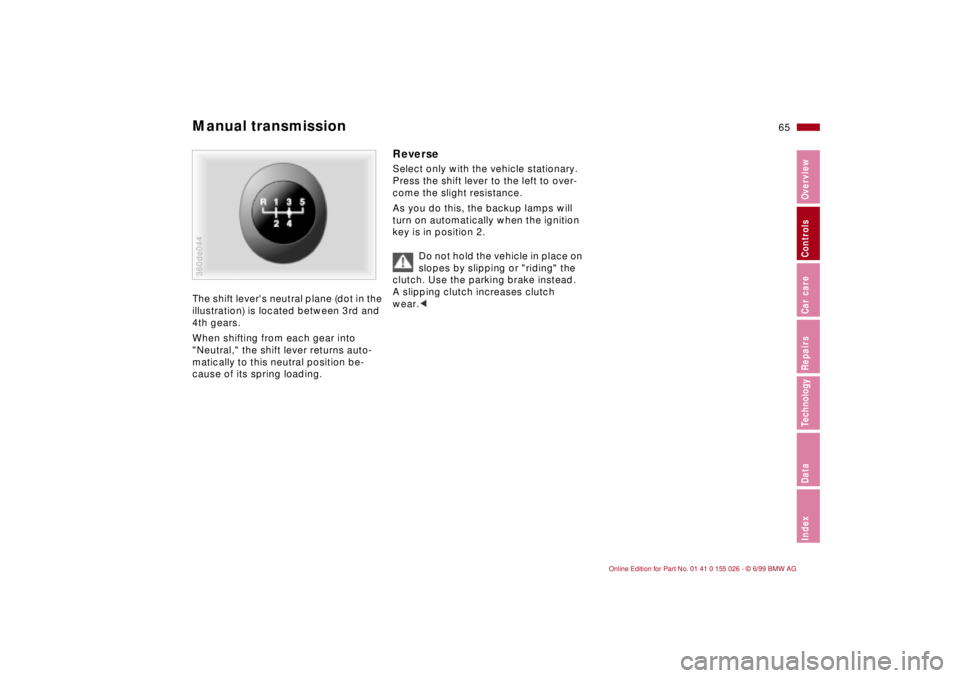
Manual transmission The shift lever's neutral plane (dot in the
illustration) is located between 3rd and
4th gears.
When shifting from each gear into
"Neutral," the shift lever returns auto-
matically to this neutral position be-
cause of its spring loading.360de044
Reverse Select only with the vehicle stationary.
Press the shift lever to the left to over-
come the slight resistance.
As you do this, the backup lamps will
turn on automatically when the ignition
key is in position 2.
Do not hold the vehicle in place on
slopes by slipping or "riding" the
clutch. Use the parking brake instead.
A slipping clutch increases clutch
wear.<
Page 69 of 189
67n
RepairsIndexOverview Controls Car care Technology Data
Automatic transmission with Steptronic
*
D Drive (automatic shift program)This position is designed for driving un-
der all normal operating conditions. All
forward gears are available, the Adap-
tive Transmission Control (ATC) is fully
operational."Kickdown" (automatic downshift)In the "Kickdown" mode, you achieve
maximum performance.
To activate this mode, depress the ac-
celerator pedal beyond the full-throttle
position, at which a resistance point
must be overcome.
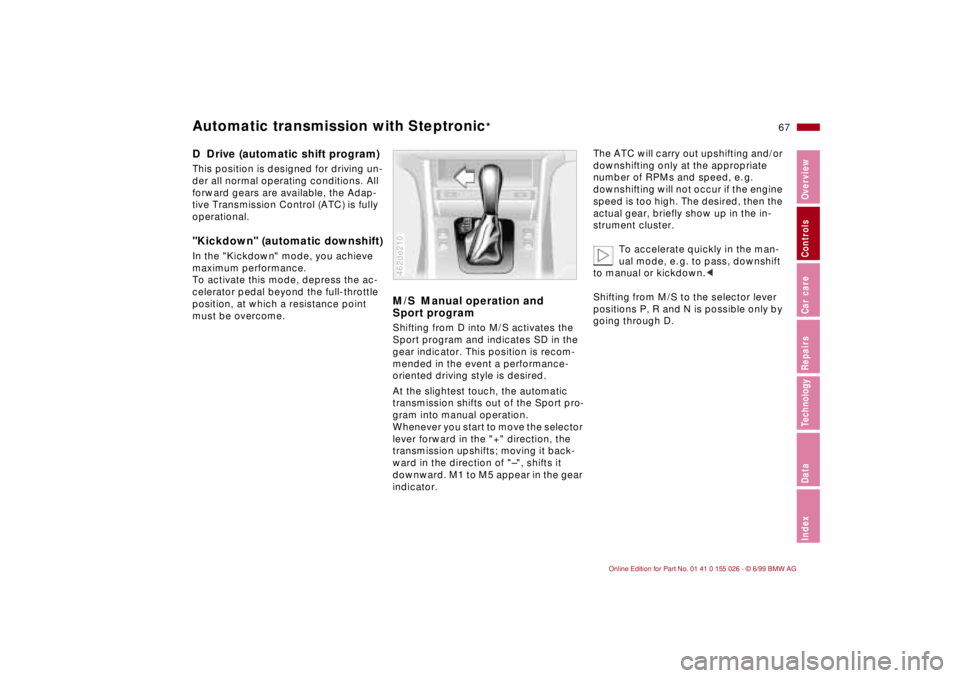
M/S Manual operation and
Sport programShifting from D into M/S activates the
Sport program and indicates SD in the
gear indicator. This position is recom-
mended in the event a performance-
oriented driving style is desired.
At the slightest touch, the automatic
transmission shifts out of the Sport pro-
gram into manual operation.
Whenever you start to move the selector
lever forward in the "+" direction, the
transmission upshifts; moving it back-
ward in the direction of "–", shifts it
downward. M1 to M5 appear in the gear
indicator.462de210
The ATC will carry out upshifting and/or
downshifting only at the appropriate
number of RPMs and speed, e. g.
downshifting will not occur if the engine
speed is too high. The desired, then the
actual gear, briefly show up in the in-
strument cluster.
To accelerate quickly in the man-
ual mode, e. g. to pass, downshift
to manual or kickdown.<
Shifting from M/S to the selector lever
positions P, R and N is possible only by
going through D.
Page 73 of 189
71n
RepairsIndexOverview Controls Car care Technology Data
Wiper/washer system Rear window defroster Headlamp washers
*
When the vehicle's lighting system is
switched on, the headlamps will also be
cleaned every fifth time the automatic
windshield washer is activated.
Do not use the washers if there is
any danger that the fluid will freeze
on the windshield, otherwise vision
could be obscured. Use an antifreeze
agent. Refer to page 122.
Do not use the washers when the reser-
voir is empty, otherwise damage to the
washer pump could result.
automatically when the ignition key is in
position 2
*.
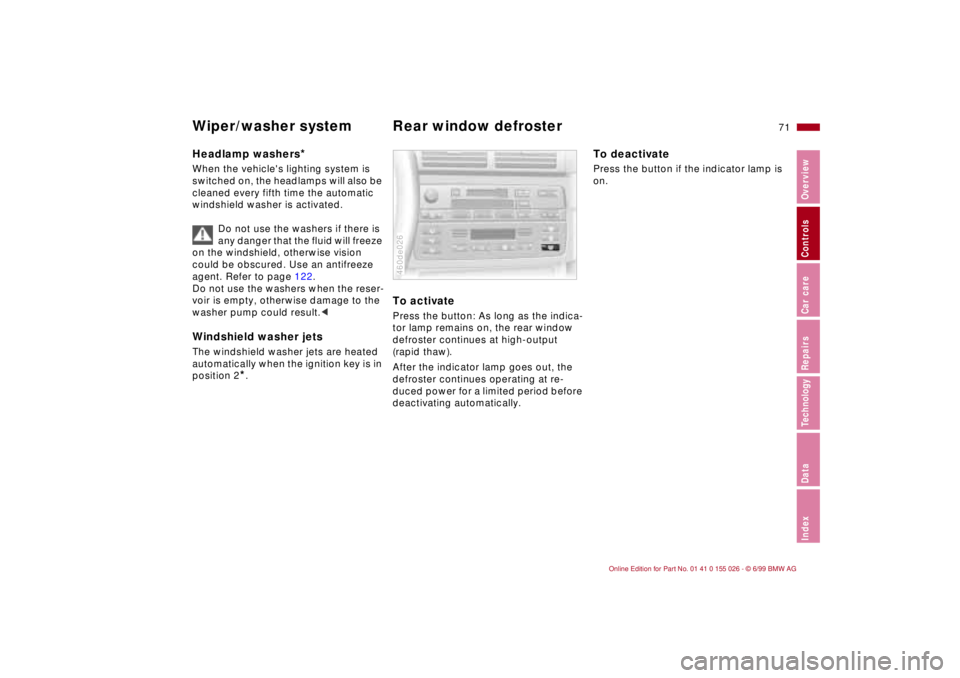
To activatePress the button: As long as the indica-
tor lamp remains on, the rear window
defroster continues at high-output
(rapid thaw).
After the indicator lamp goes out, the
defroster continues operating at re-
duced power for a limited period before
deactivating automatically. 460de026
To deactivatePress the button if the indicator lamp is
on.
Page 77 of 189
75n
RepairsIndexOverview Controls Car care Technology Data
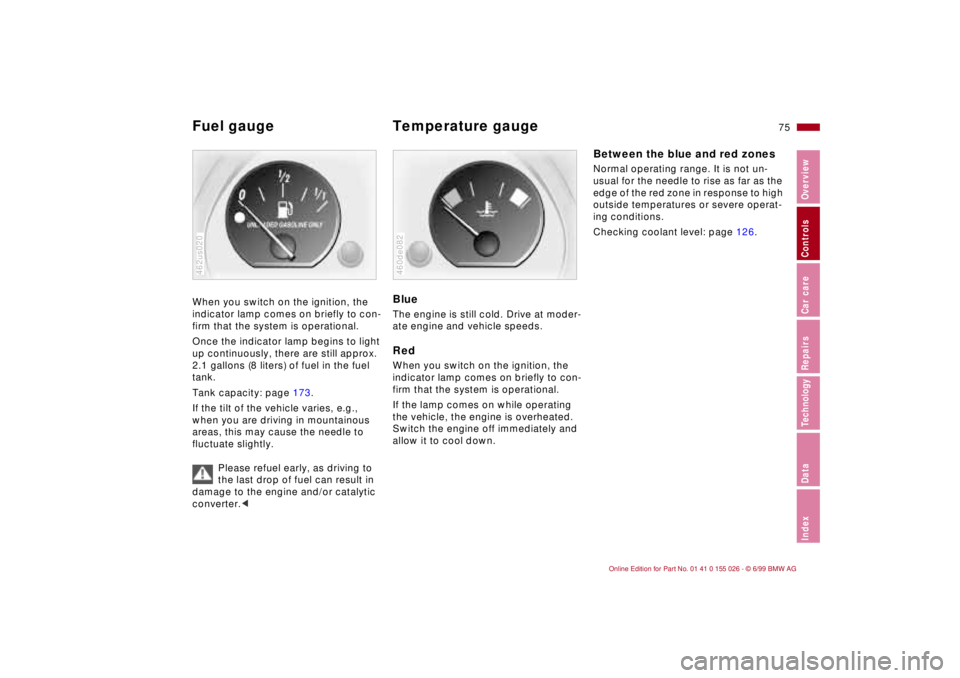
Fuel gauge Temperature gauge When you switch on the ignition, the
indicator lamp comes on briefly to con-
firm that the system is operational.
Once the indicator lamp begins to light
up continuously, there are still approx.
2.1 gallons (8 liters) of fuel in the fuel
tank.
Tank capacity: page 173.
If the tilt of the vehicle varies, e.g.,
when you are driving in mountainous
areas, this may cause the needle to
fluctuate slightly.
Please refuel early, as driving to
the last drop of fuel can result in
damage to the engine and/or catalytic
converter.<462us020
BlueThe engine is still cold. Drive at moder-
ate engine and vehicle speeds.RedWhen you switch on the ignition, the
indicator lamp comes on briefly to con-
firm that the system is operational.
If the lamp comes on while operating
the vehicle, the engine is overheated.
Switch the engine off immediately and
allow it to cool down.460de082
Between the blue and red zonesNormal operating range. It is not un-
usual for the needle to rise as far as the
edge of the red zone in response to high
outside temperatures or severe operat-
ing conditions.
Checking coolant level: page 126.
Page 84 of 189
82n
Tire Pressure Control (RDC)
*
The conceptThe RDC monitors the tire pressures at
all four wheels, even when the vehicle is
moving. The system provides an alert
whenever the inflation pressure drops
significantly below the specified pres-
sure in one or more tires.
In order for the RDC to "learn" the cor-
rect tire inflation pressure, first check
the tire inflation pressure in all tires.
Then compare these pressures with the
tire inflation pressure chart (page 28)
and adjust if necessary. Then activate
the system.
This indicator lamp in the instru-
ment cluster informs you when-
ever the tire pressure is not nor-
mal.
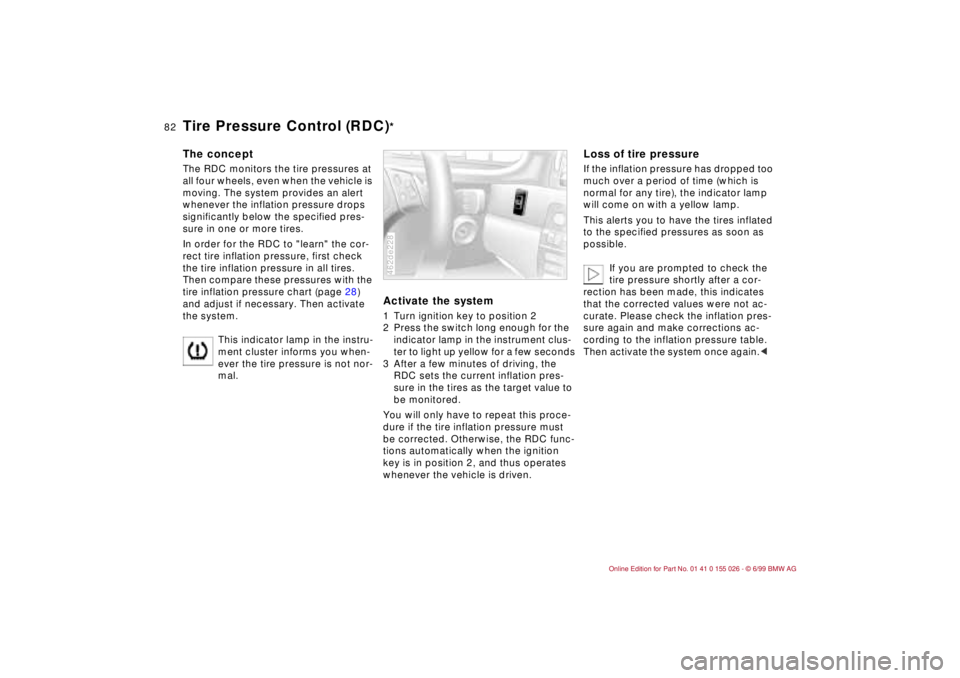
Activate the system1 Turn ignition key to position 2
2 Press the switch long enough for the
indicator lamp in the instrument clus-
ter to light up yellow for a few seconds
3 After a few minutes of driving, the
RDC sets the current inflation pres-
sure in the tires as the target value to
be monitored.
You will only have to repeat this proce-
dure if the tire inflation pressure must
be corrected. Otherwise, the RDC func-
tions automatically when the ignition
key is in position 2, and thus operates
whenever the vehicle is driven.462de228
Loss of tire pressureIf the inflation pressure has dropped too
much over a period of time (which is
normal for any tire), the indicator lamp
will come on with a yellow lamp.
This alerts you to have the tires inflated
to the specified pressures as soon as
possible.
If you are prompted to check the
tire pressure shortly after a cor-
rection has been made, this indicates
that the corrected values were not ac-
curate. Please check the inflation pres-
sure again and make corrections ac-
cording to the inflation pressure table.
Then activate the system once again.<
Page 86 of 189
84n
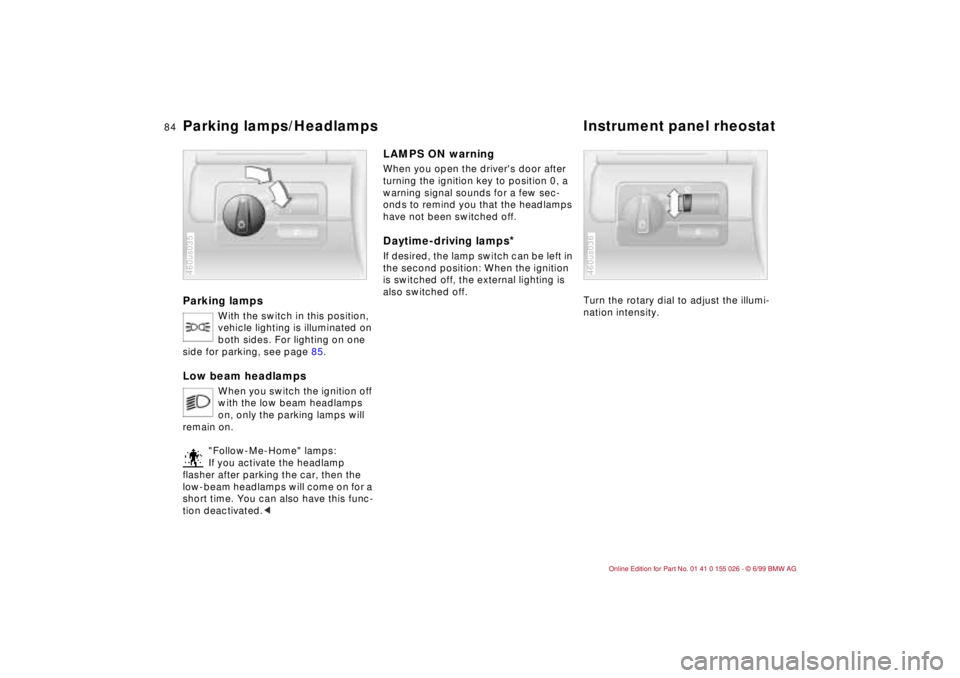
Parking lamps
With the switch in this position,
vehicle lighting is illuminated on
both sides. For lighting on one
side for parking, see page 85.
Low beam headlamps
When you switch the ignition off
with the low beam headlamps
on, only the parking lamps will
remain on.
"Follow-Me-Home" lamps:
If you activate the headlamp
flasher after parking the car, then the
low-beam headlamps will come on for a
short time. You can also have this func-
tion deactivated.<
460us035
LAMPS ON warningWhen you open the driver's door after
turning the ignition key to position 0, a
warning signal sounds for a few sec-
onds to remind you that the headlamps
have not been switched off
.
Daytime-driving lamps
*
If desired, the lamp switch can be left in
the second position: When the ignition
is switched off, the external lighting is
also switched off.
Turn the rotary dial to adjust the illumi-
nation intensity.
460us036
Parking lamps/Headlamps Instrument panel rheostat