2000 BMW 323Ci light
[x] Cancel search: lightPage 113 of 189

111n
RepairsIndexOverview Controls Car care Technology Data
Winter operation
Do not shift down on slick road
surfaces. Doing so could cause
the rear wheels to lose traction and
skid, that could result in the loss of
vehicle control.<
Depress the clutch during hard
braking on road surfaces that pro-
vide only poor or uneven traction.<
Skid control Depress the clutch and release the
accelerator pedal, or place the selector
lever of the automatic transmission into
the "Neutral" position. Countersteer
carefully and attempt to regain control
of the vehicle.
ParkingEngage 1st or reverse gear. If your car
is equipped with an automatic transmis-
sion, place the selector lever in "Park".
On vehicles with manual transmission,
also apply the parking brake when
parking on inclined surfaces. In order to
prevent the parking brake linings from
locking due to frost or corrosion, dry
them by gently applying the parking
brake as the vehicle is coming to a
stop. Make sure that following traffic is
not endangered.
The brake lamps do not light up
when the parking brake is ap-
plied.<
Page 117 of 189

115n
RepairsIndexOverview Controls Car care Technology Data
Wheel and tire combinations The right choice Use only BMW-approved tires, refer to
page 117.
Due to the high speeds this vehicle can
achieve, the use of specific tire brands,
specifications and dimensions is man-
datory.
Consult any BMW center for details.
Comply with local/national regulations.
The correct wheel/tire combinaton
affects different sytems, such as
ABS, ATC, DSC. The function of these
systems can be impaired if the correct
combinaton is not used.
Therefore, only use tires of the same
brand and tread pattern. Replace a flat
tire with an approved wheel/tire combi-
nation as soon as possible.<
Codes on the tires and wheels The tire codes will aid you in selecting
the correct tire.
Codes on radial tires:
The speed rating indicates the ap-
proved maximum speed for the tire.
Summer tires:
S = up to 112 mph (180 km/h)
T = up to 118 mph (190 km/h)
H = up to 130 mph (210 km/h)
V = up to 150 mph (240 km/h)
W = up to 167 mph (270 km/h)
Y = above 167 mph (270 km/h)
ZR = above 150 mph (240 km/h) Example:
Nominal width
in mm
Aspect ratio in %
Radial tire code
Rim diameter in inches
Load rating
(not on ZR tires)
Speed rating
(before R on ZR tires)
225/50 R
1692W
Winter tires:
Q M+S = up to 100 mph (160 km/h)
T M+S = up to 118 mph (190 km/h)
H M+S = up to 130 mph (210 km/h)
Codes stamped on light-alloy wheels:
Protect valve inserts against dirt using
screw-on valve stem caps. Dirt in the
valves frequently leads to slow leaks. Example:
Rim width
in inches
Code letter for
flange type
Symbol for full-drop
center rim
Rim diameter in inches
Hump on the 2 rim shoulders
7 x 16 H 2
J
Page 118 of 189

116n
Winter tiresChoosing the right tireBMW recommends winter tires (M+S
radial tires) for driving in adverse winter
road conditions. Although all-season
M+S tires provide better winter traction
than standard summer tires with H, V,
W, Y and ZR speed ratings, they gener-
ally fail to provide the same levels of
performance as standard snow tires in
winter driving.
For of safe tracking and steering re-
sponse, install winter tires made by the
same manufacturer having the same
tread configuration on all four wheels.
Mount only winter tires approved by
BMW. Any BMW center will be glad to
provide you with information on the
best winter tires for your particular driv-
ing conditions.Never exceed the maximum speed
for that the tires are rated.
Unprofessional attempts by laymen to
service tires can lead to damage and
accidents.
Have this work performed by skilled
professionals only. Your BMW center
will be glad to assist you with both their
expertise and the proper equipment for
your vehicle.<
Tire condition, tire pressureWinter tires display a perceptible loss in
their ability to cope with winter driving
conditions once the tread wears to be-
low 0.16 in (4 mm), and should thus be
replaced.
Comply with the specified tire inflation
pressures – and be sure to have the
wheel and tire assemblies balanced
every time you change the tires.
StorageStore tires in a cool, dry place, away
from light whenever possible. Protect
the tires against contact with oil, grease
and fuel.Snow chains
*
Use narrow-link BMW snow chains on
summer or winter tires only in pairs and
only on the rear wheels. Comply with all
manufacturer's safety precautions when
mounting the chains.
Page 119 of 189

117n
RepairsIndexOverview Controls Car care Technology Data
Approved wheel and tire specifications Tire specifications Steel rim (wheel rim) Light-alloy wheel
BMW 323Ci
All-Season
195/65 R 15 91 H – 6.5Jx15
Summer tires
195/65 R 15 91 H – 6.5Jx15
205/60 R 15 91 H – 6.5Jx15
7Jx15
205/55 R 16 91 H
225/50 R 16 92 W
225/50 ZR 16– 7Jx16
225/45 R 17 91 W – 8Jx17
Front: 225/45 ZR 17 – 7.5Jx17
Rear: 245/40 ZR 17 – 8.5Jx17
Winter tires
195/65 R 15 91 Q M+S 6.5Jx15 6.5Jx15
205/60 R 15 91 Q M+S 6.5Jx15 6.5Jx15
7Jx15
205/55 R 16 91 Q M + S
225/50 R 16 92 Q M + S7Jx16 7Jx16
225/45 R 17 91 Q M + S – 8Jx17
Space-saver spare tire
T 125/90 R 15 96 M 3.5Bx15 –
T 125/90 R 16 98 M 3.5Bx16 –
Pay attention to the specifications for tires and wheels in the vehicle's
manuals. If you install tire sizes not approved by the manufacturer,
you are required to enter this in the vehicle documents.
Snow chains
*
Snow chains cannot be mounted on the
following tires:
225/50 R 16 92 W
225/50 ZR 16
225/45 R 17 91 W
225/50 R 16 92 Q/T/H
225/45 R 17 91 Q/T/HMixed tiresFor details concerning tire manufactur-
ers for mixed tires, refer to the original-
equipment specifications.
Page 120 of 189

118n
Approved wheel and tire specifications Tire specifications Steel rim (wheel rim) Light-alloy wheel
BMW 328Ci
All-Season
205/55 R 16 91 H – 7Jx16
Summer tires
205/55 R 16 91 H
225/50 R 16 92 H
225/50 ZR 16– 7Jx16
225/45 R 17 91 H – 8Jx17
Front: 225/45 ZR 17 – 7.5Jx17
Rear: 245/40 ZR 17 – 8.5Jx17
Winter tires
205/55 R 16 91 Q M + S
225/50 R 16 92 Q M + S7Jx16 7Jx16
225/45 R 17 91 Q M + S – 8Jx17
Space-saver spare tire
T 125/90 R 16 98 M 3.5Bx16 –
Pay attention to the specifications for tires and wheels in the vehicle's
manuals. If you install tire sizes not approved by the manufacturer, you
are required to enter this in the vehicle documents.
Snow chains
*
Snow chains cannot be mounted on the
following tires:
225/50 R 16 92 W
225/50 ZR 16
225/45 R 17 91 W
225/50 R 16 92 Q/T/H
225/45 R 17 91 Q/T/HMixed tiresFor details concerning tire manufactur-
ers for mixed tires, refer to the original-
equipment specifications.
Page 128 of 189
126n
Coolant
Do not add coolant to the cooling
system when the engine is hot,
since escaping coolant can cause
burns.
To avoid the possibility of damage later
on, never use anything other than fac-
tory-approved, nitrite- and amino-free
extended-duty antifreeze with corrosion
inhibitor. Your authorized BMW center
is familiar with the official specifica-
tions.
Antifreeze and anticorrosion agents are
hazardous to health. Store antifreeze
and anticorrosion agents in their origi-
nal containers and inaccessible to chil-
dren. Extended-duty antifreeze with
corrosion inhibitor contains the flamma-
ble substance ethyleneglycol. Do not
spill antifreeze containing corrosion
inhibitor on hot engine components,
since it could catch fire and cause seri-
ous burns.<
Comply with the applicable envi-
ronmental laws regulating the dis-
posal of extended-duty antifreeze with
corrosion inhibitor.<
Checking coolant levelCorrect coolant level when the engine
is cold (approx. 687 or 206):
Unscrew the cap from the expansion
tank.
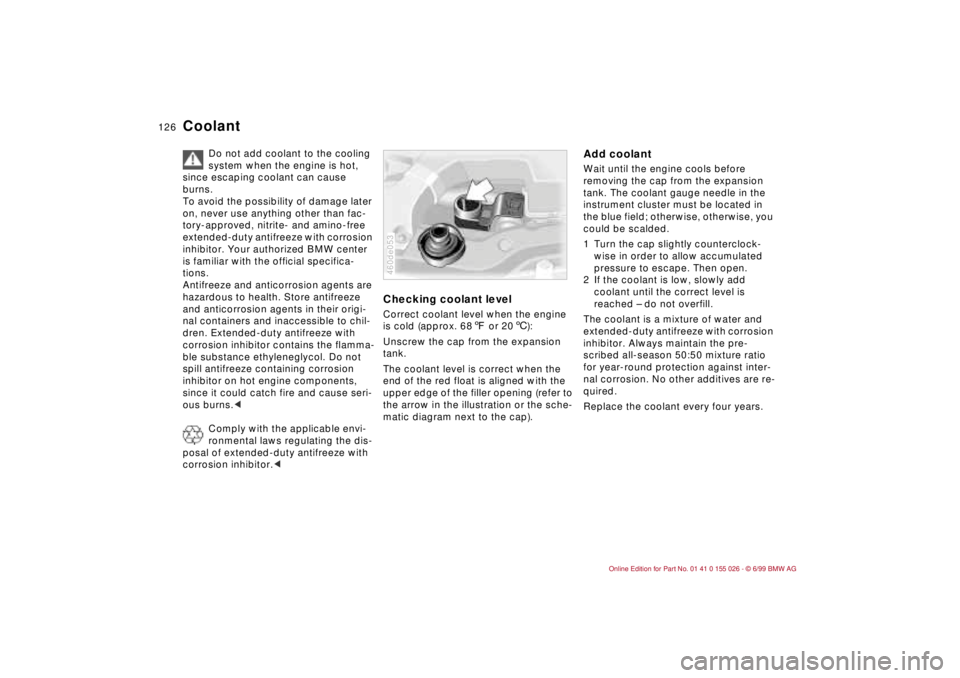
The coolant level is correct when the
end of the red float is aligned with the
upper edge of the filler opening (refer to
the arrow in the illustration or the sche-
matic diagram next to the cap).460de053
Add coolant Wait until the engine cools before
removing the cap from the expansion
tank. The coolant gauge needle in the
instrument cluster must be located in
the blue field; otherwise, otherwise, you
could be scalded.
1 Turn the cap slightly counterclock-
wise in order to allow accumulated
pressure to escape. Then open.
2 If the coolant is low, slowly add
coolant until the correct level is
reached – do not overfill.
The coolant is a mixture of water and
extended-duty antifreeze with corrosion
inhibitor. Always maintain the pre-
scribed all-season 50:50 mixture ratio
for year-round protection against inter-
nal corrosion. No other additives are re-
quired.
Replace the coolant every four years.
Page 129 of 189
127n
RepairsIndexOverview Controls Car care Technology Data
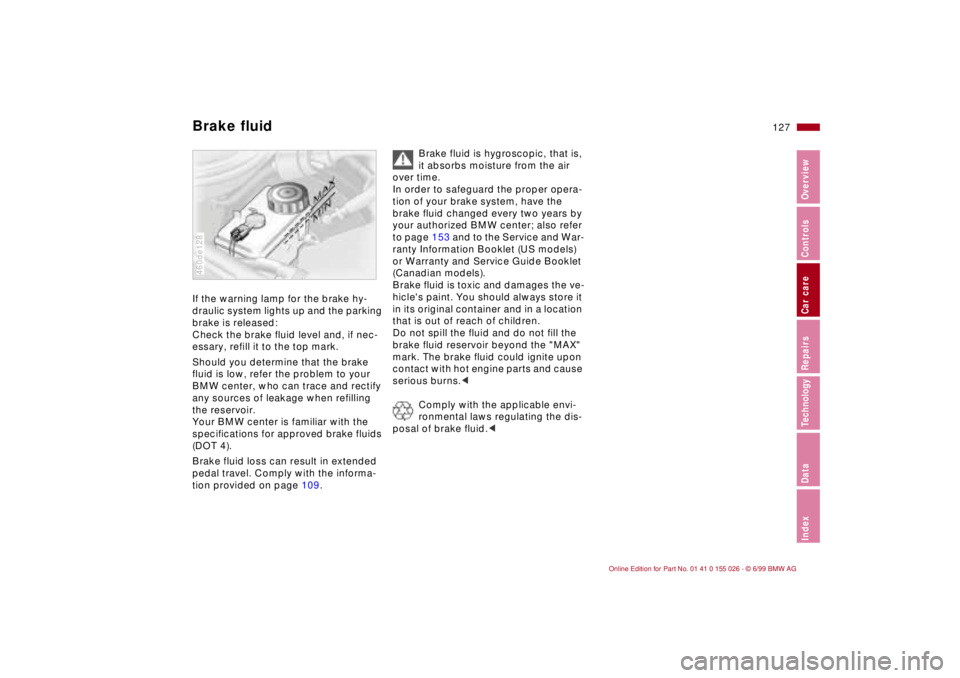
Brake fluidIf the warning lamp for the brake hy-
draulic system lights up and the parking
brake is released:
Check the brake fluid level and, if nec-
essary, refill it to the top mark.
Should you determine that the brake
fluid is low, refer the problem to your
BMW center, who can trace and rectify
any sources of leakage when refilling
the reservoir.
Your BMW center is familiar with the
specifications for approved brake fluids
(DOT 4).
Brake fluid loss can result in extended
pedal travel. Comply with the informa-
tion provided on page 109.460de128
Brake fluid is hygroscopic, that is,
it absorbs moisture from the air
over time.
In order to safeguard the proper opera-
tion of your brake system, have the
brake fluid changed every two years by
your authorized BMW center; also refer
to page 153 and to the Service and War-
ranty Information Booklet (US models)
or Warranty and Service Guide Booklet
(Canadian models).
Brake fluid is toxic and damages the ve-
hicle's paint. You should always store it
in its original container and in a location
that is out of reach of children.
Do not spill the fluid and do not fill the
brake fluid reservoir beyond the "MAX"
mark. The brake fluid could ignite upon
contact with hot engine parts and cause
serious burns.<
Comply with the applicable envi-
ronmental laws regulating the dis-
posal of brake fluid.<
Page 132 of 189

130n
Washing your car Right from the start, you can wash your
new BMW in an automatic car wash.
Car wash systems that do not employ
brushes are preferable.
Wipe away tough dirt and loosen and
remove dead insects before washing
the car.
To prevent spots, avoid washing when
the hood is still warm, or immediately
after and during exposure to strong
sunlight.
When using an automatic car wash, be
sure that:
>The car wash system is suited for the
dimensions of your vehicle
>No damage will occur on vehicles
with attached body accessories (such
as spoilers or antennas). Consult the
car wash operator if necessary
>The wheels and tires of your vehicle
cannot be damaged by the convey-
ance devices of the car wash system
>The vehicle is cleaned with minimum
brush pressure, and that ample water
is available for washing and rinsing.Vehicles with rain sensor:
Clean the windshield regularly. Wax
from car washes or the presence of
dead insects can cause rain sensor
malfunctions.
Switch the rain sensor off when
the vehicle passes through the car
wash (refer to page 70). Damage could
occur by an undesired actuation of the
wipers if the system is not deacti-
vated.<
Parts of the car that are inaccessible
to the automatic washer – such as door
sills, door and hood edges, etc. –
should be cleaned by hand.
In the winter months, it is especially im-
portant to ensure that the car is washed
on a regular basis. Large quantities of
dirt and road salt are difficult to remove,
and they also cause damage to the ve-
hicle.
If spray wands or high-pressure
washers are used, be sure to
maintain an adequate distance between
the spray source and the vehicle's sur-
face. Inadequate distance and exces-
sive pressure can damage or weaken
the finish, making it more susceptible to
subsequent attack. In addition, mois-
ture could penetrate to vehicle compo-
nents, leading to long-term damage.<
When cleaning the headlamps,
please observe the following:
>Do not rub dry. Never use abrasives
or strong cleaning agents to clean the
covers
>Remove dirt and contamination
(such as insects) by soaking with
BMW Car Shampoo and then rinsing
with plenty of water
>Always use a deicer spray to remove
accumulated ice and snow – never
use a scraper.<
After washing the car, apply the
brakes briefly to dry them. Braking
efficiency might otherwise be reduced
by the moisture and the brake rotors
could also be corroded.<
Caring for your car