Page 163 of 273
Follow the Severe Conditions
Maintenance Schedule if you
drive your vehicle MAINLY
under one or more of the
following conditions: Driving less than 5 miles (8
km) per trip or, in freezing
temperatures, driving less than 10 miles (16 km) per trip. Driving in extremely hot
[over 90°F (32°C)] conditions.
Extensive idling or long
periods of stop-and-go driving.
Trailer towing, driving with a roof top carrier, or driving in
mountainous conditions. Driving on muddy, dusty, or
de-iced roads.
# : See information on maintenance and emissions warranty, last column, page 157.* 1 : Refer to page 191 for replacement information under special driving conditions.
Maintenanc e
Page 164 of 273
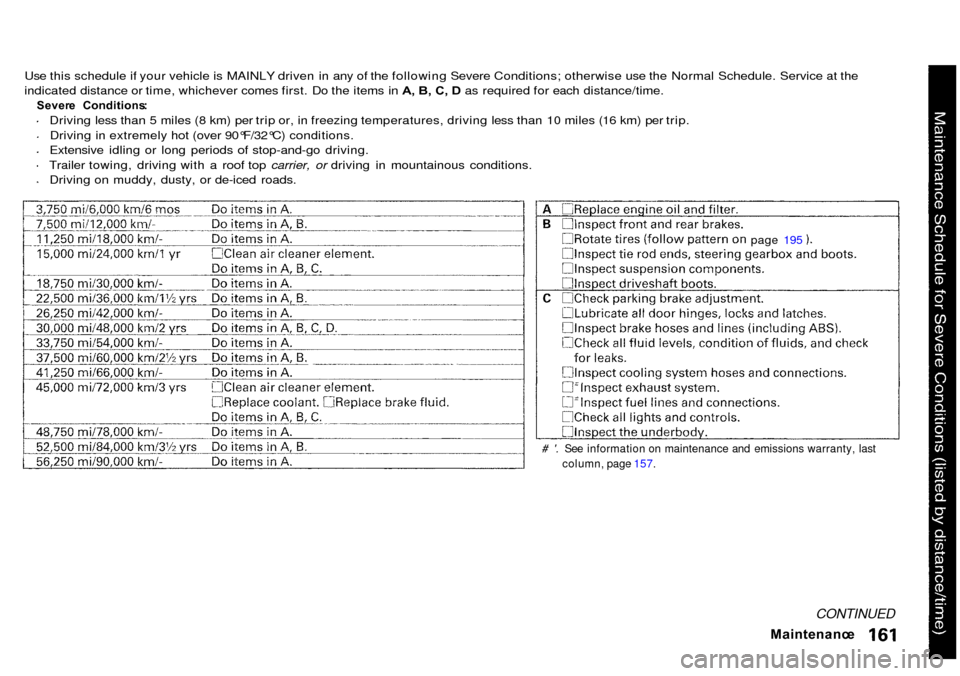
Use this schedule if your vehicle is MAINLY driven in any of the following Severe Conditions; otherwise use the Normal Schedule. Service at the
indicated distance or time, whichever comes first. Do the items in A, B, C, D as required for each distance/time.
Sever e Conditions :
Driving less than 5 miles (8 km) per trip or, in freezing temperatures, driving less than 10 miles (16 km) per trip.
Driving in extremely hot (over 90°F/32°C) conditions.
Extensive idling or long periods of stop-and-go driving.
Trailer towing, driving with a roof top carrier, or driving in mountainous conditions.
Driving on muddy, dusty, or de-iced roads.
# '. See information on maintenance and emissions warranty, lastcolumn, page 157.
Maintenance
CONTINUED
page 195
Page 189 of 273
Batter
y
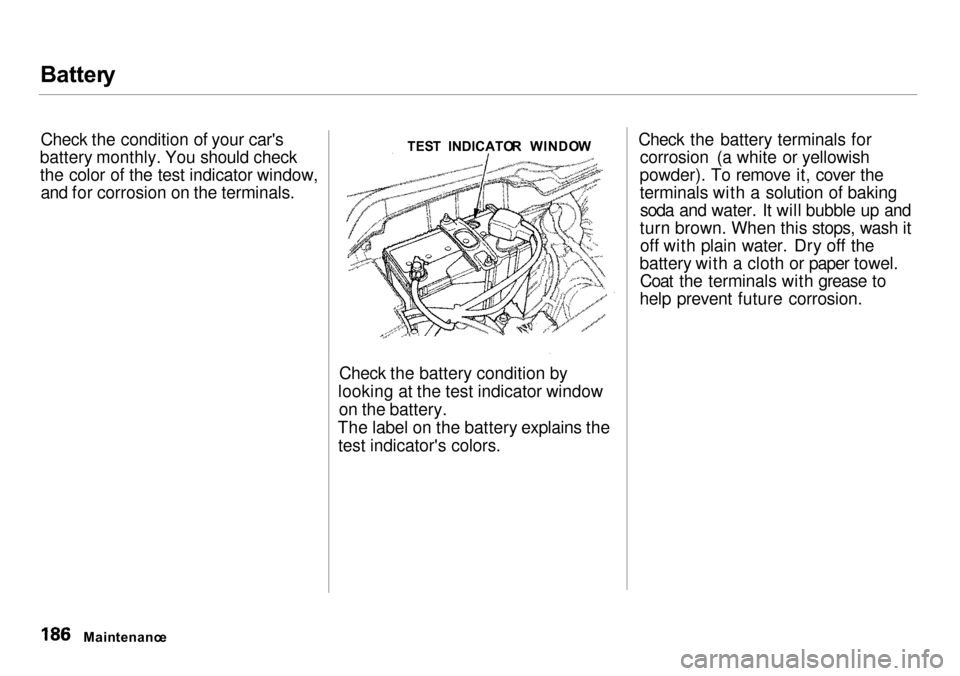
Check the condition of your car's
battery monthly. You should check
the color of the test indicator window, and for corrosion on the terminals.
Check the battery condition by
looking at the test indicator window on the battery.
The label on the battery explains the test indicator's colors. Check the battery terminals for
corrosion (a white or yellowish
powder). To remove it, cover the
terminals with a solution of baking soda and water. It will bubble up and
turn brown. When this stops, wash it off with plain water. Dry off the
battery with a cloth or paper towel. Coat the terminals with grease to
help prevent future corrosion.
Maintenanc e TES
T INDICATO R WINDO W
Page 191 of 273
Wipe
r Blade s
Check the condition of the wiper
blades at least every six months.
Look for signs of cracking in the
rubber, or areas that are getting
hard. Replace the blades if you find
these signs, or they leave streaks and unwiped areas when used.
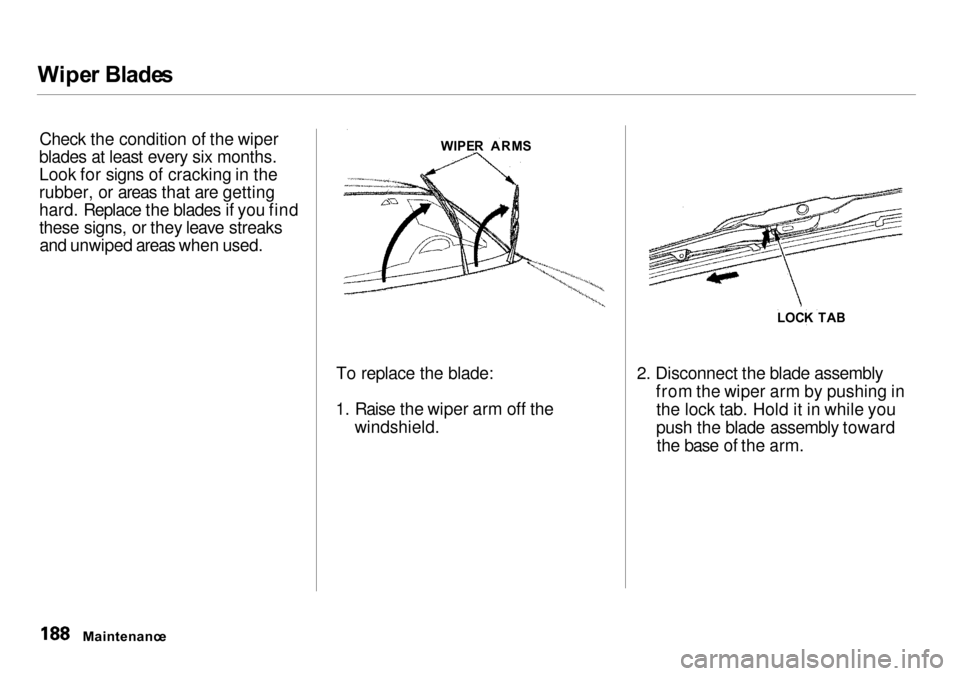
To replace the blade:
1. Raise the wiper arm off the windshield. 2. Disconnect the blade assembly
from the wiper arm by pushing inthe lock tab. Hold it in while you
push the blade assembly towardthe base of the arm.
Maintenanc e
WIPE
R ARM S
LOCK TA B
Page 213 of 273

Storin
g You r Ca r
If you need to park your car for an extended period (more than one
month), there are several things you should do to prepare it for storage.
Proper preparation helps prevent deterioration and makes it easier to
get your car back on the road. If
possible, store your car indoors. Fill the fuel tank.
Change the engine oil and filter
(see page 170).
Wash and dry the exterior
completely.
Clean the interior. Make sure the
carpeting, floor mats, etc. are
completely dry.
Leave the parking brake off. Put
the transmission in Reverse (5- speed manual) or Park
(automatic).
Block the rear wheels. If the car is to be stored for a
longer period, it should be
supported on jackstands so the
tires are off the ground.
Leave one window open slightly (if
the car is being stored indoors).
Disconnect the battery.
Support the front wiper blade
arms with a folded towel or rag so
they do not touch the windshield. To minimize sticking, apply a
silicone spray lubricant to all door
and trunk seals. Also, apply a
vehicle body wax to the painted surfaces that mate with the door
and trunk seals. Cover the car with a "breathable"
cover, one made from a porous
material such as cotton.
Nonporous materials, such as
plastic sheeting, trap moisture,
which can damage the paint. If possible, run the engine for a
while periodically (preferably once a month).
If you store your car for 12 months
or longer, have your Acura dealer perform the inspections called for in
the 24 months/30,000 miles (48,000 km) maintenance schedule (NormalConditions) as soon as you take it
out of storage (see page 158). The
replacements called for in the
maintenance schedule are not
needed unless the car has actually
reached that time or mileage.
Maintenanc e
Page 215 of 273

Exterio
r Car e
Washin g
Frequent washing helps preserve
your car's beauty. Dirt and grit can scratch the paint, while tree sap and
bird droppings can permanently ruin
the finish.
Wash your car in a shady area, not in direct sunlight. If the car is parked in
the sun, move it into the shade and
let the exterior cool down before you start.
Only use the solvents and cleaners
recommended in this Owner's
Manual.
Chemical solvents and strong cleaners
can damage the paint, metal, and
plastic on your car.
Rinse the car thoroughly with cool
water to remove loose dirt. Fill a bucket with cool water. Mix
in a mild detergent, such as
dishwashing liquid or a product
made especially for car washing. Wash the car using the water and
detergent solution and a soft-
bristle brush, sponge, or soft cloth. Start at the top and work your waydown. Rinse frequently. Check the body for road tar, tree
sap, etc. Remove these stains with
tar remover or turpentine. Rinse it off immediately so it does not
harm the finish. Remember to re-
wax these areas, even if the rest of the car does not need waxing. When you have washed and rinsed
the whole exterior, dry it with a chamois or soft towel. Letting it
air-dry will cause dulling and water
spots.
As you dry the car, inspect it for
chips and scratches that could allow
corrosion to start. Repair them with
touch-up paint (see page 213 ).
Appearanc e Car e
NOTIC
E
Page 218 of 273

Interio
r Car e
Dirt build-up in the loops of the seat
belt anchors can cause the belts to
retract slowly. Wipe the insides of
the loops with a clean cloth
dampened in mild soap and warm water or isopropyl alcohol. Window
s
Clean the windows, inside and out,
with a commercially-available glass cleaner. You can also use a mixtureof one part white vinegar to ten parts
water. This will remove the haze that
builds up on the inside of the
windows. Use a soft cloth or paper
towels to clean all glass and clear plastic surfaces.
The rear window defogger and
antenna wires are bonded to the inside of the glass. Wiping vigorously up-and-
down can dislodge and break thesewires. When cleaning the rear window, use gentle pressure and wipe side-to-
side. Ai
r Freshener s
If you want to use an air freshener/
deodorizer in the interior of your car,
it is best to use a solid type. Some liquid air fresheners contain chemi-
cals that may cause parts of the
interior trim and fabric to crack or discolor.
If you use a liquid air freshener,
make sure you fasten it securely so it
does not spill as you drive.
Appearance Car e
NOTIC
E
Page 222 of 273

Takin
g Car e o f th e Unexpecte d
This section covers the more- common problems that motoristsexperience with their vehicles. It
gives you information about how to safely evaluate the problem and what
to do to correct it. If the problem has stranded you on the side of the road,
you may be able to get going again. If not, you will also find instructionson getting your car towed. Compact Spare Tire....................... 220
Changing a Flat Tire..................... 221
If Your Engine Won't Start........... 226
Nothing Happens or theStarter Motor OperatesVery Slowly......................... 226
The Starter Operates Normally................................. 227
Jump Starting................................. 227
If Your Engine Overheats............. 229Low Oil Pressure Indicator.......... 231
Charging System Indicator........... 232
Malfunction Indicator Lamp........ 233
Brake System Indicator................ 234
Closing the Moonroof................... 235
Fuses............................................... 236 Checking and Replacing........... 237
Emergency Towing...................... 241
Takin g Car e o f th e Unexpecte d