Page 307 of 656
6A2-20 ENGINE MECHANICAL (H27 ENGINE)
12) Install oil pan and oil pump strainer.
Refer to “OIL PAN AND OIL PUMP STRAINER” in this sec-
tion.
13) Install cylinder head cover.
Refer to “CYLINDER HEAD COVER” in this section.
14) Install exhaust manifold.
Refer to “EXHAUST MANIFOLD” in this section.
15) Install radiator outlet pipe, radiator, cooling fan and water
hose.
Refer to “COOLING WATER PIPES OR HOSES”, “RADIA-
TOR” and “COOLING FAN AND FAN CLUTCH” in Section
6B.
16) Install throttle body and intake manifold.
Refer to “THROTTLE BODY AND INTAKE MANIFOLD” in
this section.
17) Adjust water pump drive belt tension.
Refer to “COOLING FAN BELT TENSION CHECK AND
ADJUSTMENT” in Section 6B.
18) Adjust power steering pump drive belt tension.
Refer to “POWER STEERING PUMP DRIVE BELT” in Sec-
tion 3B1.
19) Adjust accelerator cable play and A/T throttle cable play.
Refer to “ACCELERATOR CABLE ADJUSTMENT” and “A/T
THROTTLE CABLE ADJUSTMENT (A/T VEHICLE)” in Sec-
tion 6E2.
20) Check to ensure that all removed parts are back in place.
Reinstall any necessary parts which have not been rein-
stalled.
21) Refill engine with engine oil, referring to “ENGINE OIL
CHANGE” in Section 0B.
22) Refill cooling system referring to “COOLING SYSTEM
FLUSH AND REFILL” in Section 6B.
23) Refill front differential housing with gear oil if drained, refer-
ring to “MAINTENANCE SERVICE” in Section 7E.
24) Connect negative cable at battery.
25) Check ignition timing and adjust as necessary, referring to
“IGNITION TIMING CHECK AND ADJUSTMENT” in Section
6F2.
26) Verify that there is no fuel leakage, water leakage, oil leak-
age and exhaust gas leakage at each connection.
27) Check wheel alignment, referring to “STEERING ANGLE” in
Section 3A.
Page 308 of 656
ENGINE MECHANICAL (H27 ENGINE) 6A2-21
Piston, Piston Rings, Connecting Rods and Cylinders
1. Top ring 5. Connecting rod :
Clean bearing installing surface when install.9. Piston pin circlip Tightening Torque
2. 2nd ring 6. Connecting rod bearing cap :
Clean bearing installing surface when install.10. Cylinder block Do not reuse
3. Oil ring 7. Connecting rod bearing :
Clean outer surface when install.11. Bearing cap nut Apply engine oil to sliding
surface of each parts.
4. Piston 8. Piston pin
Page 309 of 656
6A2-22 ENGINE MECHANICAL (H27 ENGINE)
INSPECTION
Cylinders
•Inspect cylinder walls for scratches, roughness, or ridges
which indicate excessive wear. If cylinder bore is very rough
or deeply scratched, or ridged, rebore cylinder and use over
size piston.
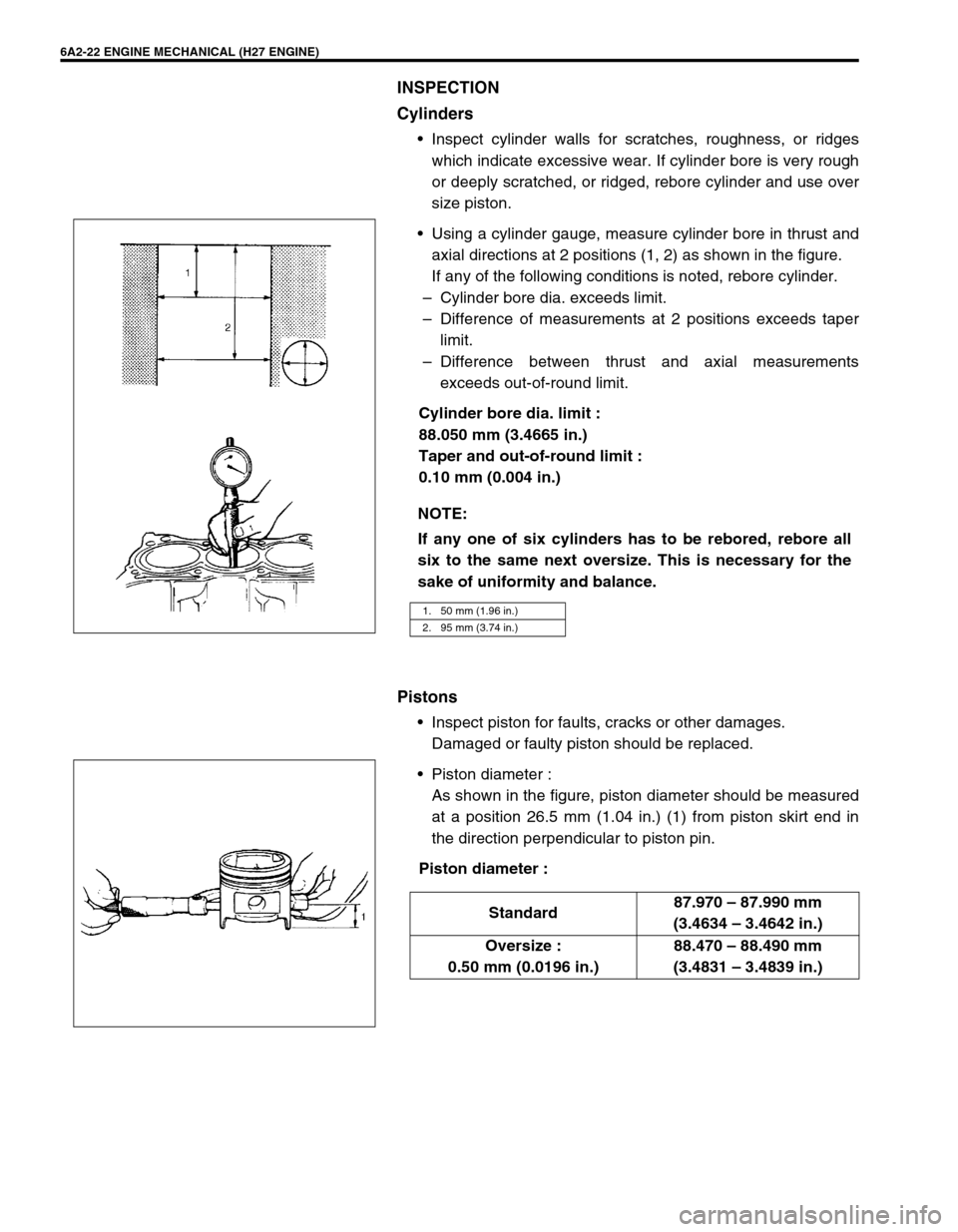
•Using a cylinder gauge, measure cylinder bore in thrust and
axial directions at 2 positions (1, 2) as shown in the figure.
If any of the following conditions is noted, rebore cylinder.
–Cylinder bore dia. exceeds limit.
–Difference of measurements at 2 positions exceeds taper
limit.
–Difference between thrust and axial measurements
exceeds out-of-round limit.
Cylinder bore dia. limit :
88.050 mm (3.4665 in.)
Taper and out-of-round limit :
0.10 mm (0.004 in.)
Pistons
•Inspect piston for faults, cracks or other damages.
Damaged or faulty piston should be replaced.
•Piston diameter :
As shown in the figure, piston diameter should be measured
at a position 26.5 mm (1.04 in.) (1) from piston skirt end in
the direction perpendicular to piston pin.
Piston diameter : NOTE:
If any one of six cylinders has to be rebored, rebore all
six to the same next oversize. This is necessary for the
sake of uniformity and balance.
1. 50 mm (1.96 in.)
2. 95 mm (3.74 in.)
Standard87.970 – 87.990 mm
(3.4634 – 3.4642 in.)
Oversize :
0.50 mm (0.0196 in.)88.470 – 88.490 mm
(3.4831 – 3.4839 in.)
Page 310 of 656
ENGINE MECHANICAL (H27 ENGINE) 6A2-23
•Piston clearance :
Measure cylinder bore diameter and piston diameter to find
their difference which is piston clearance. Piston clearance
should be within specification as given below. If it is out of
specification, rebore cylinder and use oversize piston.
Piston clearance :
0.02 – 0.04 mm (0.0008 – 0.0015 in.)
•Ring groove clearance :
Before checking, piston grooves must be clean, dry and free
of carbon.
Fit new piston ring (1) into piston groove, and measure clear-
ance between ring and ring land by using thickness gauge
(2). If clearance is out of specification, replace piston.
Ring groove clearance :
Top : 0.03 – 0.07 mm (0.0012 – 0.0027 in.)
2nd : 0.02 – 0.06 mm (0.0008 – 0.0023 in.) NOTE:
Cylinder bore diameters used here are measured in
thrust direction at 2 positions.
1. 26.5 mm (1.04 in.)
Page 311 of 656
6A2-24 ENGINE MECHANICAL (H27 ENGINE)
ASSEMBLY
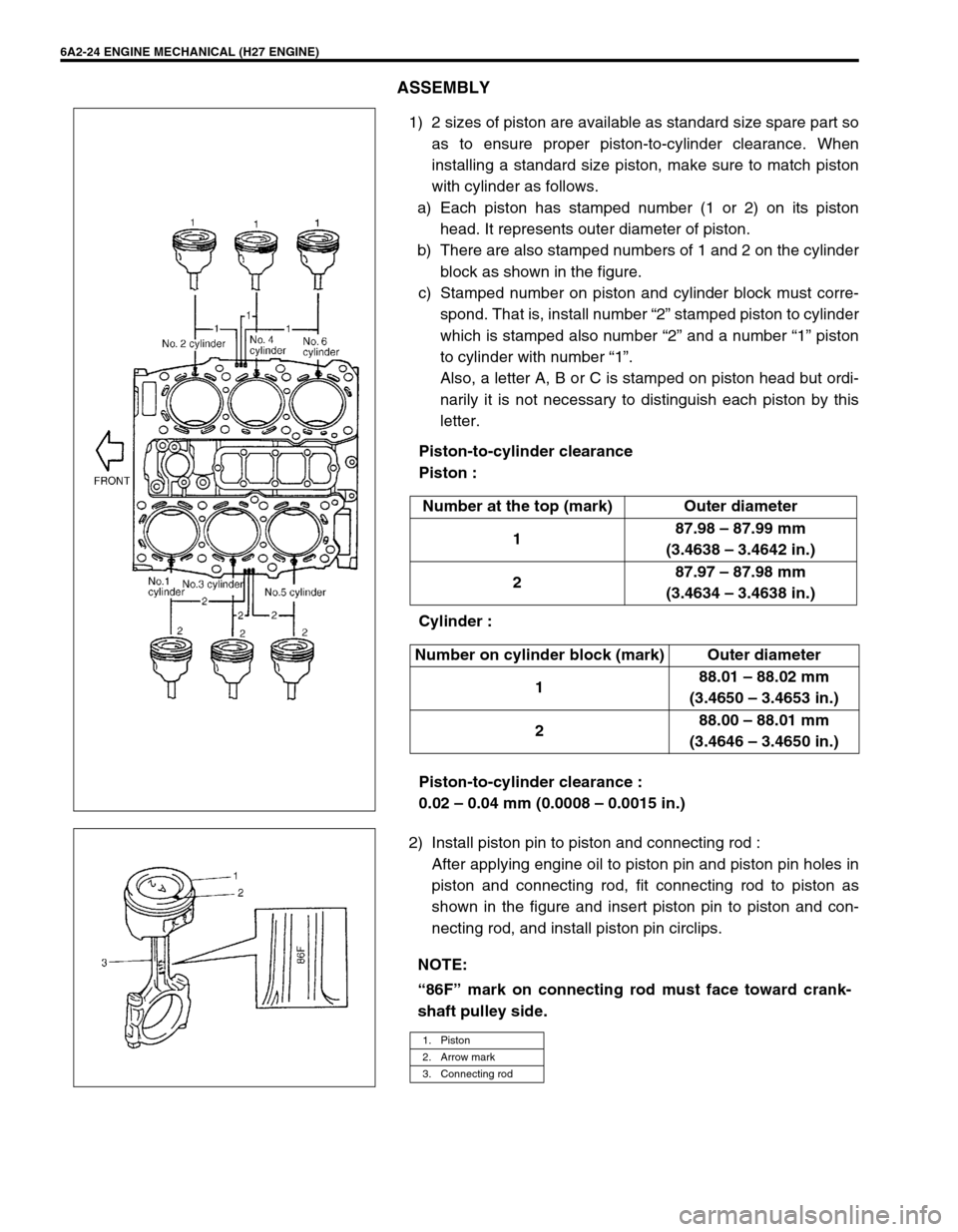
1) 2 sizes of piston are available as standard size spare part so
as to ensure proper piston-to-cylinder clearance. When
installing a standard size piston, make sure to match piston
with cylinder as follows.
a) Each piston has stamped number (1 or 2) on its piston
head. It represents outer diameter of piston.
b) There are also stamped numbers of 1 and 2 on the cylinder
block as shown in the figure.
c) Stamped number on piston and cylinder block must corre-
spond. That is, install number “2” stamped piston to cylinder
which is stamped also number “2” and a number “1” piston
to cylinder with number “1”.
Also, a letter A, B or C is stamped on piston head but ordi-
narily it is not necessary to distinguish each piston by this
letter.
Piston-to-cylinder clearance
Piston :
Cylinder :
Piston-to-cylinder clearance :
0.02 – 0.04 mm (0.0008 – 0.0015 in.)
2) Install piston pin to piston and connecting rod :
After applying engine oil to piston pin and piston pin holes in
piston and connecting rod, fit connecting rod to piston as
shown in the figure and insert piston pin to piston and con-
necting rod, and install piston pin circlips. Number at the top (mark) Outer diameter
187.98 – 87.99 mm
(3.4638 – 3.4642 in.)
287.97 – 87.98 mm
(3.4634 – 3.4638 in.)
Number on cylinder block (mark) Outer diameter
188.01 – 88.02 mm
(3.4650 – 3.4653 in.)
288.00 – 88.01 mm
(3.4646 – 3.4650 in.)
NOTE:
“86F” mark on connecting rod must face toward crank-
shaft pulley side.
1. Piston
2. Arrow mark
3. Connecting rod
Page 312 of 656
ENGINE MECHANICAL (H27 ENGINE) 6A2-25
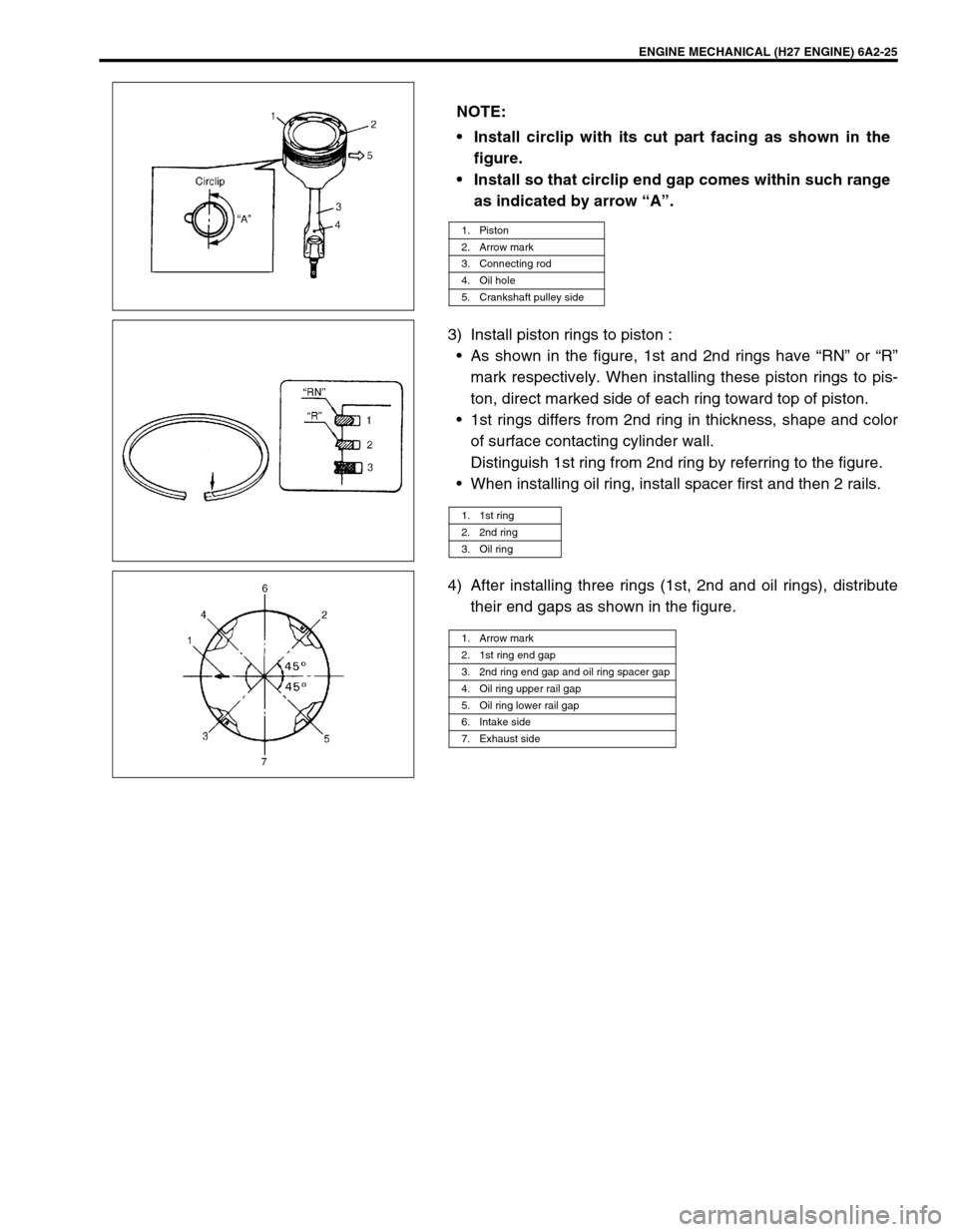
3) Install piston rings to piston :
•As shown in the figure, 1st and 2nd rings have “RN” or “R”
mark respectively. When installing these piston rings to pis-
ton, direct marked side of each ring toward top of piston.
•1st rings differs from 2nd ring in thickness, shape and color
of surface contacting cylinder wall.
Distinguish 1st ring from 2nd ring by referring to the figure.
•When installing oil ring, install spacer first and then 2 rails.
4) After installing three rings (1st, 2nd and oil rings), distribute
their end gaps as shown in the figure. NOTE:
Install circlip with its cut part facing as shown in the
figure.
Install so that circlip end gap comes within such range
as indicated by arrow “A”.
1. Piston
2. Arrow mark
3. Connecting rod
4. Oil hole
5. Crankshaft pulley side
1. 1st ring
2. 2nd ring
3. Oil ring
1. Arrow mark
2. 1st ring end gap
3. 2nd ring end gap and oil ring spacer gap
4. Oil ring upper rail gap
5. Oil ring lower rail gap
6. Intake side
7. Exhaust side
Page 313 of 656
6A2-26 ENGINE MECHANICAL (H27 ENGINE)
Unit Repair Overhaul
Engine Assembly
REMOVAL
1) Release fuel pressure in fuel feed line. Refer to “FUEL
PRESSURE RELIEF PROCEDURE” in Section 6.
2) Disconnect negative (–) cable at battery.
3) Remove engine hood.
4) Drain engine oil.
5) Drain coolant.
6) Remove radiator, radiator fan shroud, cooling fan and radia-
tor reservoir. Refer to “COOLING FAN AND FAN CLUTCH”
and “RADIATOR” in Section 6B.
7) Disconnect accelerator cable (1) and A/T throttle cable (for
A/T vehicle) (2) from throttle body.
8) Remove strut tower bar and surge tank cover.
9) Disconnect IAT sensor coupler and MAF sensor coupler then
remove air cleaner upper case, intake air hose, intake air
pipe and surge tank pipe as a component.
10) Remove engine oil level gauge guide and A/T fluid level
gauge guide (for A/T vehicle).
11) Remove ignition coil covers.
12
Page 314 of 656

ENGINE MECHANICAL (H27 ENGINE) 6A2-27
12) Disconnect the following electric lead wires :
•Injector wire coupler
•CMP sensor coupler
•Ignition coil couplers
•CKP sensor coupler
•MAP sensor coupler
•TP sensor (1) coupler
•IAC valve (2) coupler
•Earth wire (3) from surge tank
•EVAP canister purge valve coupler
•EGR valve coupler
•Oxygen sensor -1 and -2 couplers referring to “Exhaust Man-
ifold” in this section
•Coolant temperature sensor coupler
•Knock sensor coupler
•Generator wires
•Starter wires
•Oil pressure wire
•P/S pump wire
•Earth wire from generator bracket
•Engine block heater (if equipped)
13) Remove clamps and brackets.
14) Disconnect the following hoses :
•Heater hose from heater water pipe
•Heater hose from water outlet cap
•EVAP canister hose from canister pipe
•Brake booster vacuum hose
15) Remove EVAP canister purge valve (5).
16) Disconnect the following hoses at the location shown in the
figure :
•Fuel feed hose (1) from fuel feed pipe
•Fuel return hose from (2) fuel return pipe
17) Remove P/S pump assembly. Refer to “POWER STEERING
PUMP” in Section 3B1.
18) Remove A/C compressor assembly. Refer to “COMPRES-
SOR ASSEMBLY” in Section 1B.
19) Remove steering shaft lower assembly. Refer to “STEERING
LOWER SHAFT ASSEMBLY” in Section 3C1.
20) Raise vehicle.
21) Remove front differential housing with differential from chas-
sis if equipped. Refer to “DISMOUNTING” in Section 7E.
22) Remove exhaust No.1 pipe. Refer to “EXHAUST MANI-
FOLD” in this section.
23) Remove exhaust manifold stiffener from transmission.
4. Clamp bracket
6. EGR valve
7. Heater hose
2
14
3
75
6